Instagram this (Past Few) Weeks








Announcing MacblazeV
So with all my work on the Hugo websites it occurred to me that this site could use some love. It went through a major redesign last year, but the back end was still in the last century.

Redesigned Theme
So while the look hasn’t changed much (except for some fixes/refinements I have been meaning to do for ages) the theme itself (now called MacblazeV) has been redone almost from scratch. My intent was to build it completely from scratch without borrowing any code MacblazeIV was built on a blank framework from Underscores but this time I was trying to avoid that. In the end I did use some of their functions for customization, but it was pretty minimal. 95% of this theme was done from a blank file—I am actually pretty chuffed with myself about that.
WordPress has gotten more and more complicated over the years and all the bells and whistles are pretty complex to implement. Because this theme is for personal use I was able to ignore a large part of that and just add the features I knew I would use.
Design stuff
I am not 100% about all the design elements at this point. As I said this was more about rebuilding the back end and getting rid of floats etc. So I will likely still be tweaking it for a while. But I am super happy with its responsiveness and and the overall structure. It will be much easier to modify now.
I still have to work on some technical issues regarding Instagram and some excessive resource use on the server, but that’s a separate subject.
ebook Update 2020
We’ve added a few more books this year to the list.
L and I worked on some childhood favourites of hers and I added a few plays, some Wodehouse and a Barsoom book. As usual they can all be found at Standard Ebooks‘ website and the whole list is current on my portfolio site: astart.ca.


And so…
The Wodehouse shorts took a lot of work and research—a massive canon and many only available in modern collection or the original serial publications. And there are still a lot more stories to add. It was fun to delve back into Restoration drama (The Way of the World) and I added a few Shakespeare—I had actually never read The Merry Wives of Windsor. As always, I hope you give some of them a try. I also try to keep a current list of books over at astart.ca/ebooks.
Thought of the day
Amid the Covid-19 explosion of online experts and the concurrent shift to populist governments it occurred to me that:
The internet has fostered the age of ideologues.
—August 1, 2020
Hugo Notes
I’ve added my markdown notes for hugo to a page for easy future reference:
Hugo again
A quick update
Having (mostly) successfully updated my professional site using Hugo I decided to take a swing at L’s. It was more of a blog format so it gave me some insight into how that kind of functionality could be used.


I also learned I was a dinosaur who still used floats and ended up updating both it and my own site to use flexbox. Learn something new every day! That in itself is worth a post or two.
Netlify
Under the category of learning and things I need to go into greater detail about later, I also switched the hosting of readingwithapencil.com from wordpress.com to Netlify. As a result I have a more flexible site without actually having to pay for anything (WordPress charged for the use of a custom domain).
The workflow works off of Github which I have been using more and more with the Standard Ebooks project so it is pretty smooth. All in all it is really worth of a post of its own but there are so many videos out there it might just serve you (the reader) better to go watch a couple of them.
But I will eventually jot down my thoughts here…at least so I can figure out what I did when I inevitably break it—that being, originally, the whole purpose of this site.
Hugo!
While I was looking into linux, I came across a vlog that recommended using Hugo and Netlify as a way to maintain a free web presence. I’ve found a lot of these sorts of things (“free”) and even went so far as to set up a small site using the free parts of Google Cloud to get my Python project up and running.
But what struck me about Hugo was that it was a static website and therefore faster and more secure than the typical WordPress install. And it was an intriguing concept that you could mimic the flexibility of a dynamic site using static pages. So I decided to give it a go.
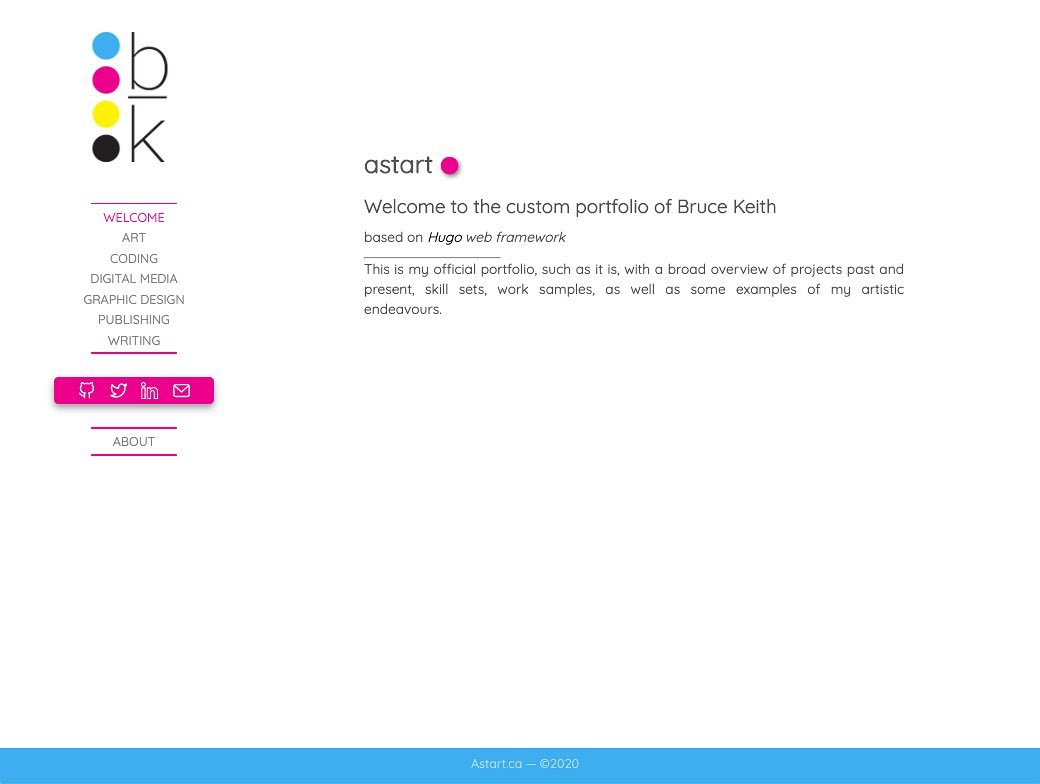
I deiced to leave Netlify as an experiment for a future project and set about rebuilding the site using Hugo. As a result my old, much ignored portfolio site astart.ca is now refreshed and way more speedy even though I didn’t change the content or the host.

So what is it?
I will get into more it in a later post. But basically it’s a framework that allows you to build the website using templates and pseudo-dynamic techniques and when you are ready to go, you just “publish” the project and it exports the whole website as static pages. It supports a ton of themes like WordPress, although again I decided to build my own from scratch.
Pages are built using markdown. It’s a versatile markup language and one I keep trying to use so one of the side benefits of this is I have become much more facile using it. The gist is that now the site is built all you have to do is open a text file, add content using markdown formatting, link to accompanying pictures and then just run a short “deploy” script to automatically rebuild the site and upload to your host. Simple.
It’s perfect for a site like the portfolio that doesn’t change much, but now I am going to try it on a more blog-oriented site to see it it will stand up to more frequent posting. I will let you know.
As for astart.ca, well it’s up and running and has a fresh new design. Check it out. Now all I have to do is dig up more current material to post. And that’s the hard part 😉
Instagram This Week


#is2020overyet
Books Read & Calibre Web Update
Previously (Making A “Books Read” Page) I had posted how I added info to the default Calibre Web templates to add the Series and Pub date information so I could scrape it. Well, it’s gotten a bit more complex since then. Someone added a similar mod to the Github repository which has not yet been incorporated. They didn’t add the pub dates, but did add the series to a few more pages so I thought I would restate my changes here for future reference.
/templates/shelf.html
Add both series info and pub date for the python web scraping program to access:
{% if entry.series|length > 0 %}
    <p class="series">
        {{_('Book')}} {{entry.series_index}} {{_('of')}} <a href="{{url_for('web.books_list', data='series',sort='abc', book_id=entry.series[0].id)}}">{{entry.series[0].name}}</a>
    </p>
{% endif %}


{% if entry.pubdate[:10] != '0101-01-01' %}
    <p class="publishing-date">{{entry.pubdate|formatdate}} </p>
{% endif %}
Added around line 45 (just after the {% endif %} for the author section).
/templates/index.html
Add only series info just for aesthetics (note the code is from the proposed mod and is slightly different):
        {% if entry.series.__len__() > 0 %}
        <p class="series">
          <a href="{{url_for('web.books_list', data='series', sort='new', book_id=entry.series[0].id )}}">
            {{entry.series[0].name}}
          </a>
          ({{entry.series_index}})
        </p>
        {% endif %}
Added around line 193 111 (just after the {% endif %} for the author section). (This might be 36… there seems to have been a change…)
/templates/discover.html
        {% if entry.series.__len__() > 0 %}
        <p class="series">
          <a href="{{url_for('web.books_list', data='series', sort='new', book_id=entry.series[0].id )}}">
            {{entry.series[0].name}}
          </a>
          ({{entry.series_index}})
        </p>
        {% endif %}
Added around line 36 (just after the {% endif %} for the author section).
I am trying to figure out a way to automate the mods if the main repository doesn’t decide to incorporate the changes but so far an elegant solution eludes me.
Instagram This Week