Category: Le Book
It’s Saturday
The State of Ebooks Update
Standard Ebooks
I continue to make ebooks for Standard although my rate has slowed down. This is mostly due to choosing longer projects instead of sticking to plays. I think I am on number 38 now (a collection of Wodehouse’s golf stories). I also do reviews of others’ submissions, which is this weird mishmash of proofreading, code checking and editorial oversight—a combination of skills I didn’t think would be all that easy to acquire.
All in all I enjoy it immensely and intend to keep participating for the foreseeable future.
Bright Wing Media
Back just before the new year I interviewed with Bright Wing for a job I hadn’t applied for. That didn’t turn out (afaik they just didn’t fill the position) but I kept gently reminding them of my existence and finally picked up some work. So far I have created/remediated four public domain ebooks for them: Theodore Dreiser – An American Tragedy, Charles Dickens – Bleak House, Elizabeth Gaskell – North and South and T.E. Lawrence – Seven Pillars of Wisdom. And it looks like I have another project in the pipeline for next week and it might even be something original this time. Hopefully this will turn into an ongoing gig.
It’s been interesting work, mostly for the understanding of different publisher’s systems and requirements and I was finally forced to learn to use Sigil (which I had played around with previously but ultimately ignored in favour of using a straight-up text editor).
The General State of Ebooks
This (different publishers’ systems and requirements) brings me to an important topic that I am trying to learn/participate in/promote. Just a disclaimer first, this is a huge topic and well worth a much, much longer post, but I am just going to give you a bit of a rant and leave the meat of the issue for later.
Ebook Accessibility
A traditional bound book sucks for accessibility. You need two good hands and two good eyes to read it. You could probably get away with one of each but the experience starts to deteriorate rapidly. But what could you do? But ebooks, ah, ebooks offer a world of possibilities, don’t they?
Way back when, when ebooks were in a fledgling state and sales were minimal, publishers embraced ebooks reluctantly and, quite frankly, poorly. But these days — sadly (to me) much under the influence of that monolith of capitalism Amazon — ebook sales have increased to over 20% of a publisher’s total book sales revenue. The books themselves are getting more and more sophisticated in design and format and the readers much more ubiquitous.
Industry standard programs lie Adobe Indesign has made great strides in their approach to converting a print book to digital format and many other tools have continued to progress to the point where creating an ebook is relatively simple for any publisher.
In conjunction with all that the issue of accessibility has also continued to be addressed and many working groups like NNELS here in Canada, Accessible Books Consortium, The DAISY Consortium
Creating the best way to read and publish, Benetech, and the World Wide Web Consortium have all been working together to develop and modify standards that will hopefully help the broadest swath of disadvantaged readers.
As a result there exists now a robust standard now that allows an ebook to be created in a way that helps various technologies to present the material to make the experience enjoyable and fluid for a broad range of disabilities.
Great stuff.
So what’s the problem?
The problem is change is hard and publishers are stubborn.
I know, I know, that’s not totally fair but it is a realistic overview of the situation. In order to create a born-accessible ebook certain jobs have to shift around, new skill sets have to be learned and priorities have to change. To remediate old ebooks to the current standard takes more money, more time and an even more specialized skillset. All this costs money and time and most small publishers don’t have either. The big ones — the ones who should be showing leadership and have a bit more money — are a bit more on the stubborn side if you ask me; although I admit shifting a production process is infinitely harder when you produce 1000 books a year than when you produce 10.
Still, you get the point.
What’s the solution?
Hah, if I knew that I would be a lot richer than I am now. But…
- First they need to look at the problem from a different angle. It’s all just code and if there is anything this world has a lot of, its coders. It’s not that hard to automate a lot of this — working Standard has taught me that.
- Second we need to stop focussing on profit. There is no profit incentive for wheelchair ramps, braille letters on elevators or TTY machines. Just invest in making the process easy and publishers will fall in line and someone will figure out how to make money from it later.
- Publishing needs to grasp that change is good and rearranging and retraining some key personnel will make this go a lot smoother — and they will eventually reap the benefits of that change. Personally I don’t believe it means hiring more people or spending more money. It’s no worse that the transition to desktop publishing from paste up — eventually the benefits spoke for themselves.
- And finally, and most importantly someone needs to conk the standard setters on the head and remind them that just because standards organization have been speaking in something even worse than legalese for decades, that it really, really isn’t helping anyone. In fact, even for me, it is a huge disincentive.
You’d think if the technology types could sit with the communication types to make the process clear and then the government types provided a bit of money then this would straighten itself out pretty quick. Right, I know. Lol.
But I watched a panel a while back talking about the issues surrounding ebook remediation and two things struck me.
- Someone said that publishers can’t expect to retain people with all the right skillsets. Granted he was talking about the broader idea of accessibility and that included braille, audio books, etc. as well as accessible ebooks but still… It’s not that hard to train/find people to understand standards, code and software as well as design and traditional production — we already did that once back in the 90s. It’s not hard or unreasonable, it’s just different and, again, I acknowledge change is hard. I don’t know what the design schools are teaching these days but this really should be a priority.
- The person who represented small publishers said she had gone through a back-and-forth process with NNELS to produce a fully compliant accessible ebook and she now has a template. As a result their ebook production time and difficulty has decreased significantly. Exactly. Set a standard and follow it. Any press could do that and if the template was freely available and easily customizable, well…
Of course it’s not always that simple. Especially if you are dealing with textbooks, or specialized publications that require a lot extra coding. But there is absolutely no excuse for producing a traditional fiction-style ebook that is not fully compliant with the accessibility standards. None. It’s just ignorance and/or laziness.
And we can fix both of those. So let’s…
P.S. My biggest issue remains the kind of communication and misinformation that surrounds the whole ebook production process. It’s just not that hard, and making an ebook accessible in the first place (or remediating old ones if you have to) is currently wrapped in some sort of mystique and arcane-ness — and a whole lot of mumbo-jumbo. Again, to me, it comes down to piss poor communication and misguided advocacy in an age where driving public perception, propaganda, and manipulating the message have reached a high art. I can’t help thinking it’s a matter of mistaken priorities.
P.P.S. If you want to learn more about ebook production, coding and even what’s necessary to meet the standards, I encourage you to take a swing at volunteering for Standard Ebooks. There is a great step-by-step and I have even written a guide on how to go about getting started for those of us more editor and less coder.
The Kaiju Preservation Society: A review

John Scalzi had a problem and that problem was myriad: Covid, politics and a whole lot of writer’s block. So he decided to pull the plug on his current project despite contractual obligations. Then he had his own The Big Idea (The Big Idea is Scalzi’s vehicle on his blog that gives a platform to other writers to talk about what inspired their latest work.) And the The Kaiju Preservation Society was born (hatched? produced?). Don’t skip the Afterword on this one, it contains a lot of interesting tidbits and insight into the process.
The The Kaiju Preservation Society is set in a near-present-day period and features an aspiring academic who ends up in a go-nowhere gig-economy job during Covid. Until one day a “client” offers him an interesting proposition. What follows is fun, fast-paced and above all the signature Scalzi brand of clever. Throughout the book Scalzi plays with words, tropes and cultural references while weaving a delightful tale that is easy on the brain, yet satisfying and ultimately a darn good read.
In this book, Scalzi depends less on fancy technology or science-fictiony elements and leans heavily on his (admittedly slightly absurd) premise to force his characters to move the story along. It becomes one long string of what-ifs that, in aggregate reads more like a 70s adventure/spy novel than anything else. Given Scalzi was going for a “fun” read, I think that was an excellent choice. I certainly enjoyed the ride.
If this is your first venture into Scalzi’s oeuvre then you won’t be disappointed (unless perhaps you don’t like light-hearted romps) and if you are a long-time reader then, well, it’s 100% pure Scalzi.
Also posted on Goodreads
The Saturday Morning Post
Instead of some senseless blithering this snowy Saturday morn, I wrote another review: macblaze.ca/books/reviews/2022/network-effect/

Going Pro
Well, well, well…
 After 3+ years of volunteer work for Standard ebooks, I will very soon be able to call myself a professional ebook developer. (I know, I know, I have actually been paid before but this is somehow different.) I got my first project today and should be able to bill for it early next week. With any luck it will turn into a regular thing.
Details to follow.
So chuffed.
NetGalley Follies
So I signed up for NetGalley after doing two reviews using L’s account. I didn’t have to much in the way of hope at first since I didn’t really have a record of reviewing but I thought…what the hell.
I got my first acceptance from MacMillan/Tor: The Origin of Storms by Elizabeth Bear— which was unfortunately a book I already had done a review for. Not wanting to shoot myself in the foot by submitting the same review twice I did another one. Read it here.
Then I got another book, and another (look for new reviews soon). Which brings me to this post.

PDF Galleys
One of the books I was given was Guy Gavriel Kay’s upcoming new book All the Seas of the World published by Penguin Random House Canada. Unfortunately it was a drm’ed pdf. “Unfortunately” because not only did I not want to read a pdf, and not only did I not want to authorize my ereader for drm, it turned out it was the pdf of the hardcover pages which meant it was meant to be read at 6 x 9 and the type was super tiny on all of my devices — and I actually couldn’t read it without glasses which was a non-starter for me.
But I didn’t want to fail on one of my first acceptances—I am not sure how harshly the publishers judge these things. I tried a bunch of different things including trying to convert it to an epub but the drm stymied me. For some reason the de-drm scripts I was using just wouldn’t work on this pdf file even though the documentation implied that it would.
Getting creative
I put it aside. Then I came back to it, tried a bunch of different software to try and embiggen the type and again failed miserably. At this point I was starting to feel threatened by the “machine” and my stubborn kicked in.
A google search found reference to Adobe changing their DRM in relation to pdfs between ADE 2 and 3 (Adobe Digital Editions) with no recourse except to downgrade. I was running ADE 4.1 by this time so I decided to install an old version of ADE (care of the handy Internet Archive link) on my old Mac Mini 2011. This along with an old Version of Calibre and older De-drm script resulted in a functioning, albeit slow, install that finally was able to strip the drm from the pdf.
A bad, bad epub
Next step: Calibre’s handy convert to epub feature gave me a functioning, yet butt-ugly epub.
So I used eCanCrusher to unpack the epub and started to make a new one. Using Standard ebooks tool suite I made a new container and started to copy the text into the new publication, cleaning it up as I went.

The text was pretty messy since the epub convertor can’t differentiate styles, chapter breaks etc. But I’ve been doing this sort of clean up a lot so it took less than an hour to go from pdf to 90% clean ebook. The last 10% will take a close proofread which is what I wanted it for in the first place. Ta-da…take that technology!
Who owns what?
Now I had been making the assumption that as Galleys these books were essentially electronic ARCs (Advanced Reader Copies) which are what publisher’s produce in advance of the publication date to give out to reviewers. It is understood that you aren’t to sell or give away these copies but they make a neat addition to you library…I have a bunch of paper ones from past projects.
But I noticed in ADE that, like a traditional library loan, these books had status dates on them. Does that mean my review copy expires? Boo…Hiss!

I guess I will have to wait the 53 days in order to find out, but if so this is just another way that I think the whole ebook publishing market is one big scam. What’s even more ironic is that the Gladstone book (up next after Kay) is published by Tor who eschews DRM altogether. So if I buy a book from them it won’t have drm—but seemingly these galleys do and it will expire like any other library book. I am not sure the value exchange is fair here…I get to read a book a month or two earlier in exchange for my review and personal promotion, but I don’t actually get to reread the book in the future unless I buy it (or take it out from a library). Sheesh…talk about chintzy…
I mean I get that digital materials are way too easy to pass around but how about a little faith? Of course I guess after all that work I can hang on to my newly converted epub, but that just seems like cheating.
Addendum
I checked the NetGalley site and apparently the books do indeed expire after 55 days with the option for another 55 day renewal, up until the archive date—which is when the publishers pull them from the site. Except for Kindles:
*If you have used the Kindle option to send a copy of the file to your Kindle, that file will not expire, and will continue to be available to you.
Which is a total crock given how proprietary Amazon is. Maybe I will trying the Kindle app instead so I get to keep ’em. Of course that is like jumping from the frying pan to the fire…
Addendum Part 2
A bit more investigating yielded this:
How It Works
To put a book on NetGalley, authors will first need to complete a contract and submit a payment form. Most authors will likely select from one of the following pricing options: the basic six-month listing option, which is priced at $399, and the Marketing-Plus-Title listing, priced at $599, which includes placement in the NetGalley Newsletter. Indie authors who are members of the Independent Book Publishers Association can take advantage of the organization’s relationship with NetGalley. Through the IBPA partnership, indie authors can list their books at discounted prices ($349 for a standard six-month listing; $499 for a package enhanced by marketing features). In addition, IBPA will do most of the work involved in adding books to NetGalley and processing requests.
—publishersweekly.com/pw/by-topic/authors/pw-select/article/68517-the-savvy-self-publisher-s-guide-to-netgalley.html
Ahh, the world we live in, where everything is for sale. Another “review” site apparently charges $2/review but that’s ok because the money doesn’t go to the reader…it goes to the company. Right. That makes it ok. Not. So the self-publisher is getting screwed, the reviewer is getting screwed, and the big 5 (or is it 4 now?) reap the benefits of increased sales and exposure at a pretty minimal per/unit cost.
TANSTAAFL.
Books and Reviews
For a lark I have decided to move/copy my book reviews to their own sub-site: https://macblaze.ca/books/
Hopefully I will start to do more reviews regularly and see if I can build up a solid block of reviews (maybe even enough to call myself a book reviewer 🙂 ). I might consider posting my book-related stuff like my book counts there as well.

Saturday Review Two. On Monday…
Where to start? This is the second of my reviews for NetGalley. Unfortunately it’s book three of a series that is a continuation of another three-book series. Quite the place to start…talk about in media res. Still we soldier on, noblesse oblige and all that…or is it just contractual obligation? Whatever…
 The Origin of Storms

Elizabeth Bear
Book 3 of The Lotus Kingdoms
Elizabeth Bear is probably one of the most versatile authors I know. I first met her way back in 2005 with her Jenny Casey books and have been following along ever since. Sometimes she thrills me and sometimes I find her prose/subject mater just a tad intimidating, but I have never failed to finish a book of hers other than satisfied. Which is quite the accomplishment given the massively disparate subject matter (from Norse mythology to AI-driven space opera and pretty much working away on everything between) she tackles.
The Origin of Storms is book 3 of The Lotus Kingdoms series, which itself is the second trilogy that takes place in the worlds of the Eternal Sky. As in a lot of the fantasy of this genre, Bear uses the first two books to set up the final conflict between “good” and “evil” (although it’s, thank goodness, much much more nuanced than that), and starts this third and final volume with the minor villains disposed of, the armies arrayed, heroes/heroines girded and final conflict looming. And then off the story goes, upsetting the form, exploring motherhood, “stewardship” and the real meanings of power and responsibility. At least that’s what I took from it. The great thing about Bear is when she’s in top form, the story’s pretty darn dense and there’s always lots and lots you can take away. I think The Origin of Storms is pretty high up in the Bear canon.

While the first series had an Asian steppes flavour, this one moves the action to a south-Asian milieu with more rajahs and fewer horses. The conflicts are rooted in a fallen empire and the struggles of the multiple heirs to secure their own borders and destinies. As we start The Origin of Storms we realize perhaps the conflict is bigger than simple, mortal jealousies and ambitions — that perhaps these children of empire have inherited something much larger and more dangerous than they expected.
One think I liked, and this is a tad provocative, is Bear’s handling of oft-touchy issues like race, gender, sexuality and equality, etc. that are slowly (or quickly, depending on your viewpoint) coming to the forefront in SciFi/Fantasy publishing. To me, Bear delivers a smooth story chock full of diversity without really making a big deal of it—it just is, as it should be. Integral to the story, unremarkable except when it’s not and delivered with a smooth touch that leaves very little for anyone to get their shorts in a knot about.
Anyway, it’s a great book, a great conclusion to a great series and leaves me both wondering and keen to find out where Bear will take us next.
Saturday Review
I noticed the other day that a lot of people on various review sites were getting advanced copies of books from NetGalley and when I mentioned it to L she replied she had an account, but hadn’t used it much.
A quick perusal of the site turned up Scalzi’s new book The Kaiju Preservation Society which is due out in late March. The tile had intrigued me since I first heard it—I am not much of a Godzilla nerd. So I asked her to acquire that (and another) on the promise I would write the requisite review. So here is the review. Maybe I will make this a thing.
 The Kaiju Preservation Society
John Scalzi
pub date: March 15, 2022
reviewed from eGalley
This review has been (moved to macblaze.ca/books/reviews/2022/the-kaiju-preservation-society)
Books 2021—The Last Year of the Covid
Year 10
 What’s that about? 10 years? For all my mumbling I should stop, it seems I am addicted to counting. Could it be I am The Count’s illegitimate love child? His twin brother who for years was trapped in a foam mask? His doppelgänger recently unfrozen from the Antarctic ice?
Well…maybe not. With no further silliness, I present Year of the Covid: Part II — The Readening…
January (11)
- The Sundering Walter Jon Williams (2003)
Book 2 of Dread Empire’s Fall – ebook; - Praxis Walter Jon Williams (2002)
Book 1 of Dread Empire’s Fall – ebook; - Conventions of War Walter Jon Williams (2005)
Book 3 of Dread Empire’s Fall – ebook; - The Burning God R. F. Kuang (2020)
Book 3 of The Poppy War – ebook; - Plague Ship Andre Norton (1956)
Book 2 of Solar Queen – ebook; - A Sky Beyond the Storm Sabaa Tahir (2020)
Book 4 of An Ember in the Ashes – ebook; - Investments Walter Jon Williams (2012)
Book 3.5 of Dread Empire’s Fall – ebook; - Impersonations Walter Jon Williams (2016)
Book 3.5 of Dread Empire’s Fall – ebook; - Silver in the Wood Emily Tesh (2019)
– ebook; - Blood and Circuses Kerry Greenwood (1994)
Book 6 of Phryne Fisher Mysteries – ebook; - Hive Monkey Gareth L. Powell (2014)
Book 2 of Ack-Ack Macaque – ebook;
February (11)
- Machine Elizabeth Bear (2020)
Book 2 of White Space – ebook; - Three Cheers for Me Donald Jack (1973)
Book 1 of The Bandy Papers – ebook; reread - That’s Me in the Middle Donald Jack (1973)
Book 2 of The Bandy Papers – ebook; reread - Uneasy Money P.G. Wodehouse (1916)
– ebook; - A School For Scandal Richard Brinsley Sheridan (1777)
– ebook; reread - It’s Me Again Donald Jack (1975)
Book 3 of The Bandy Papers – ebook; reread - Me Bandy, You Cissie Donald Jack (1979)
Book 4 of The Bandy Papers – ebook; reread - The Accidental War Walter Jon Williams (2018)
Book 4 of Dread Empire’s Fall – ebook; - Fleet Elements Walter Jon Williams (2020)
Book 5 of Dread Empire’s Fall – ebook; - Range of Ghosts Elizabeth Bear (2012)
Book 1 of The Eternal Sky – ebook; - Shattered Pillars Elizabeth Bear (2013)
Book 2 of The Eternal Sky – ebook;
March (9)
- Steles of the Sky Elizabeth Bear (2014)
Book 3 of The Eternal Sky – ebook; - Ruddy Gore Kerry Greenwood (1995)
Book 7 of Phryne Fisher Mysteries – ebook; - An Apprentice to Elves Sarah Monette and Elizabeth Bear (2015)
Book 3 of Iskryne – ebook; - Women and Economics Charlotte Perkins Gilman (1898)
– ebook; - Unwind Neal Shusterman (2007)
Book 1 of The Unwind dystology – ebook; - Black Tide Rising John Ringo & Gary Poole (2016)
Book 4.5 of Black Tide Rising – ebook; - Tigana Guy Gavriel Kay (1990)
– ebook; - Four-Day Planet H. Beam Piper (1961)
– ebook; - The House in the Cerulean Sea TJ Klune (2020)
– ebook;
April (11)
- Foundation Isaac Asimov (1951)
Book 1 of Foundation – ebook; reread - Foundation and Empire Isaac Asimov (1952)
Book 2 of Foundation – ebook; reread - Second Foundation Isaac Asimov (1953)
Book 3 of Foundation – ebook; reread - The Life of Buffalo Bill William F Cody (1879)
– ebook; - Forever Peace Joe Haldeman (1998)
– ebook; - The Lions of Al-Rassan Guy Gavriel Kay (1995)
– ebook; - Witchmark C. L. Polk (2018)
Book 1 of Kingston Cycle – ebook; - Stormsong C. L. Polk (2020)
Book 2 of Kingston Cycle – ebook; - The Life of Olaudah Equiano Olaudah Equiano (1789)
– ebook; - City of Lies Sam Hawke (2018)
Book 1 of Poison Wars – ebook; - The Curse of Chalion Lois McMaster Bujold (2001)
Book 1 of Chalion – ebook; reread
May (11)
- Paladin of Souls Lois McMaster Bujold (2003)
Book 2 of Chalion – ebook; reread - Urn Burial Kerry Greenwood (1996)
Book 8 of Phryne Fisher Mysteries – ebook; - Soulstar C. L. Polk (2021)
Book 3 of Kingston Cycle – ebook;
On the Trail of the Space Pirates Carey Rockwell (1953)
Book 3 of Tom Corbett – ebook; - A Brightness Long Ago Guy Gavriel Kay (2019)
– ebook; - Hollow Empire Sam Hawke (2020)
Book 2 of Poison Wars – ebook;
The Dispatcher John Scalzi (2017)
Book 1 of The Dispatcher – ebook;
The Dispatcher: Murder by Other Means John Scalzi (2021)
Book 2 of The Dispatcher – ebook; - In Fury Born David Weber (2005)
– ebook; reread - Shadows in Flight Orson Scott Card (2012)
Book 5 of Ender’s Shadow – ebook; - The Stars Are Legion Kameron Hurley (2017)
– ebook;
June (8)
- The Chrysalids John Wyndham (1955)
– ebook; reread - A Desolation Called Peace Arkady Martine (2021)
Book 2 of Teixcalaan – ebook; - The Assassins of Thasalon Lois McMaster Bujold (2021)
Book 10 of Penric & Desdemona – ebook; - Fugitive Telemetry Martha Wells (2021)
Book 6 of The Murderbot Diaries – ebook; - The Baron of Magister Valley Steven Brust (2020)
– ebook; - Star Rebel F.M.Busby (1984)
Book 1 of Hulzein – ebook; reread - Rebel’s Quest F.M.Busby (1985)
Book 2 of Hulzein – ebook; reread - Zelde M’Tana F.M.Busby (1980)
Book 4 of Rissa Kerguelen – ebook;
July (14)
- Me Too Donald Jack (1983)
Book 5 of The Bandy Papers – ebook; reread - This One’s On Me Donald Jack (1987)
Book 6 of The Bandy Papers – ebook; - Short Stories P. G. Wodehouse (1901 ff)
– ebook; - Rissa and Tregare F.M.Busby (1979)
Book 2 of Rissa Kerguelen – ebook; reread - The Long View F.M.Busby (1976)
Book 3 of Rissa Kerguelen – ebook; - The Goblin Emperor Katherine Addison (2014)
– ebook; - Tartuffe Molière (1664)
– ebook; - Me So Far Donald Jack (1989)
Book 7 of The Bandy Papers – ebook; - The Jew of Malta Christopher Marlowe (1589)
– ebook; - Alien Debt F.M.Busby (1984)
Book 3 of Hulzein – ebook; - Systemic Shock Dean Ing (1981)
Book 1 of Quantrill – ebook; - Single Combat Dean Ing (1983)
Book 2 of Quantrill – ebook; reread - The Country Wife William Wycherley (1675)
– ebook; - Wild Country Dean Ing (1985)
Book 3 of Quantrill – ebook;
August (8)
- Hitler vs Me Donald Jack (1997)
Book 8 of The Bandy Papers – ebook; - Stalin vs Me Donald Jack (2005)
Book 9 of The Bandy Papers – ebook; - Velocity Weapon Megan E. O’Keefe (2019)
Book 1 of Protectorate – ebook; reread - Chaos Vector Megan E. O’Keefe (2020)
Book 2 of Protectorate – ebook; - Catalyst Gate Megan E. O’Keefe (2021)
Book 3 of Protectorate – ebook; - The Witness for the Dead Katherine Addison (2021)
Book 2.0 of Goblin Emperor – ebook; - Raisins and Almonds Kerry Greenwood (1997)
Book 9 of Phryne Fisher Mysteries – ebook; - Rebels’ Seed F.M.Busby (1986)
Book 4 of Hulzein – ebook;
September (8)
- Architects of Memory Karen Osborne (2020)
Book 1 of The Memory War – ebook; - Engines of Oblivion Karen Osborne (2021)
Book 2 of The Memory War – ebook; - Oath of Swords David Weber (1995)
Book 1 of Bahnakson – ebook; reread - The War God’s Own David Weber (1998)
Book 2 of Bahnakson – ebook; reread - Wind Rider’s Oath David Weber (2004)
Book 3 of Bahnakson – ebook; reread - A Summoning of Demons Cate Glass (2021)
Book 3 of Chimera – ebook; - War Maid’s Choice David Weber (2012)
Book 4 of Bahnakson – ebook; reread - The Paladin C.J. Cherryh (1998)
– ebook; reread
October (11)
- Guardians of Porthaven Shane Arbuthnott (2021)
– ebook; - Her Majesty’s Wizard Christopher Stasheff (1986)
Book 1 of A Wizard in Rhyme – ebook; reread - The Element of Fire Martha Wells (1993)
Book 1 of Ile-Rien – ebook; - Sheepfarmer’s Daughter Elizabeth Moon (1988)
Book 1 of The Deed of Paksenarrion – ebook; reread - Divided Allegiance Elizabeth Moon (1988)
Book 2 of The Deed of Paksenarrion – ebook; reread - Oath of Gold Elizabeth Moon (1989)
Book 3 of The Deed of Paksenarrion – ebook; reread - Victories Greater Than Death Charlie Jane Anders (2021)
– ebook; - Cultivar Sharon Lee & Steve Miller (2017)
Book 25 of Liaden Adventures – ebook; - The Death of the Necromancer Martha Wells (1998)
Book 2 of Ile-Rien – ebook; - The Witches of Karres James H. Schmitz (1966)
– ebook; reread - A Deadly Education Naomi Novik (2020)
Book 1 of Scholomance – ebook; reread
November (8)
- The Last Graduate Naomi Novik (2021)
Book 2 of Scholomance – ebook; - Finder Suzanne Palmer (2019)
Book 1 of The Finder Chronicles – ebook - Driving the Deep Suzanne Palmer (2020)
Book 2 of The Finder Chronicles – ebook - The Scavenger Door Suzanne Palmer (2021)
Book 3 of The Finder Chronicles – ebook - The Oathbound Wizard Christopher Stasheff (1993)
Book 2 of A Wizard in Rhyme – ebook; reread - The Last Watch J. S. Dewes (2021)
Book 1 of The Divide – ebook; - Penric’s Demon Lois McMaster Bujold (2015)
Book 1 of Penric & Desdemona – ebook; reread - Penric and the Shaman Lois McMaster Bujold (2017)
Book 2 of Penric & Desdemona – ebook; reread
December (14)
- Penric’s Fox Lois McMaster Bujold (2018)
Book 5 of Penric & Desdemona – ebook; reread - Masquerade in Lodi Lois McMaster Bujold (2020)
Book 8 of Penric & Desdemona – ebook; reread - Penric’s Mission Lois McMaster Bujold (2017)
Book 3 of Penric & Desdemona – ebook; reread - Mira’s Last Dance Lois McMaster Bujold (2018)
Book 4 of Penric & Desdemona – ebook; reread - Prisoner of Limnos Lois McMaster Bujold (2019)
Book 6 of Penric & Desdemona – ebook; reread - The Orphans of Raspay Lois McMaster Bujold (2019)
Book 7 of Penric & Desdemona – ebook; reread - The Physicians of Vilnoc Lois McMaster Bujold (2020)
Book 9 of Penric & Desdemona – ebook; reread - The Assassins of Thasalon Lois McMaster Bujold (2021)
Book 10 of Penric & Desdemona – ebook; reread - Knot of Shadows Lois McMaster Bujold (2021)
Book 11 of Penric & Desdemona – ebook; - The Exiled Fleet J. S. Dewes (2021)
Book 2 of The Divide – ebook; - The Witch Doctor Christopher Stasheff (1994)
Book 3 of A Wizard in Rhyme – ebook; - The Devil You Know Kit Rocha (2021)
Book 2 of Mercenary Librarians – ebook; - Live Free or Die John Ringo (2010)
Book 1 of Troy Rising – ebook; reread - Citadel John Ringo (2011)
Book 2 of Troy Rising – ebook; reread
((\
(-.-)
o_(“)(“)
Numéro dix
Quel est le nombre?
read 124
rereads 42
10.3 books/month
2.38 books/week
.34 books/day:
Books by women: 57
Oldest 1589 (- The Jew of Malta)
2021 18
2020 14
Unread? Not so much!
The ebook library sits at 966 these days. I imagine I will break 1000 sometime this year. Of those the dreaded unread count is now a much more reasonable number than a mere two years ago. Ah, but just what is that number? To answer that oh-so-pertinent question, let’s indulge in some logic, math and philosophy:
Unread according to the library software: 37 books
Classics and other books in the “backup, but not likely to ever read stack”: 13 books
Phryne Fisher: 12 books (see below)
Christopher Stasheff: 2 (see below)
37-13-12-2=10
Total Unread according to me: 10 books!
The logic
Well, I really have only had those “classics” in my library as emergency backups and I legit don’t foresee a future where I say to myself “Hey self, don’t you think we should ditch all those books you really want to read and just tackle Middlemarch?” So I think I can discount them.
The Phryne books? Well those are L’s. I just “borrowed” them in case I wanted to read them. Not my pile. 🙂 From last year:
I’ve only read 5 so far but that forced me to file the other 15 in my to-be-read ‘pile’ rather than dump them as I had originally intended.
I’ve read up to book 9 now.
As to the two Stasheff titles, well, it’s a conundrum and I think they will be going to the big digital trashcan in the sky if I can bring myself to do it.
Not aging well?
I read Her Majesty’s Wizard by Christopher Stasheff many years ago and loved it—the oldest version of it is a tattered paperback in my hardcopy collection, one that has been read many times since. I also read the sequel The Oathbound Wizard at some point but I never actually bought it and didn’t really remember much about it (which should have been a clue). This year I realized Stasheff had written another 3 follow-ups and decided to acquire them. A decision I think I regret.
Book 3 of a “Wizard in Rhyme” was The Witch Doctor and it was really, really disappointing. I don’t know if Stasheff was getting old and tired and just didn’t care or if he had fallen into some self-indulgent trap of believing that the philosophical questions raised in book one could be rehashed a bunch more times in what is essentially an light-hearted fantasy series without boring the crap out of his readers—but whatever the reason it really, really dragged. AND he actually repeated a complete scene from a previous book, just not-so-subtlety replacing a few words and plunking in the current protagonists. I mean WTF Christopher? I so have no incentive to read the next two.
But this brings up an interesting digital-age question. Deleting and ownership… since the bizarre, ridiculous and completely bogus rules surrounding ebooks means I don’t “technically” own any of my ebooks, throwing one away (aka deleting) is potentially a much more casual act than physically chucking a 300-page paper book in the garbage—something, fwiw, I have never done.
I’m just not sure I can do it though. And I am legally (and I admit morally) constrained from giving the book away which is what I would “normally” do (not that I have done that either…I think I am a bit of a hoarder…but I am guess a lot of you understand where I am coming from…at least when it comes to books…but at least I am not as bad as L…now there is someone with a problem…)…
Where was I? Oh, right. Well I guess only time will tell. Keep, chuck or give away? I guess I will let you know next year.
Novellas, profit and loss, and making money in publishing
Some interesting trends out there. If one pays any attention at all to John Scalzi, one can’t help but admire his very workmanlike approach to being a professional writer. He unabashedly admits he is in it to make a living — and as a result explores a lot of avenues writers have traditionally ignored. Among other things he has dabbled in serial publishing and audiobook-first publications. As a result he’s managed to net himself an unprecedented 3.4 million dollar, 10-year book contract and sell a lot of tv/movie rights. Nothing has been produced yet but time will tell. Good on him.
And novellas are a thing now. Lois McMaster Bujold, one of my favs, has been publishing the “Penric” novellas for a bunch of years now and as far as I can tell after the first one her agents took over the role of publisher. The first one’s metadata listed : Publisher: CreateSpace Independent Publishing Platform but lately it seems to be: Publisher: Spectrum Literary Agency, Inc.
She has written and released 10 novellas and one full-length novel since 2016 (all ebooks) which is pretty good output. Unlike some other “self-published” short works by mainstream writers I have encountered these seemed to be well-edited (or maybe she is just that good?) and professionally produced. And, like Scalzi, Subterranean Press have picked up the hardcopy/special edition rights.
This has resulted in Baen picking up the first ones and publishing them again in a couple of omnibus editions. This is a great business model and I hope she makes scads of money from this approach. My only real beef is that Amazon seems to be the distributor of choice and it forces me to buy and crack the azw files — which I would rather not be forced do, especially as Amazon might some day change their formats (again) and I won’t be able to do it anymore. I would truly hate to miss a Penric book…
Series Completion
It was good years for finishing serieses (sic). I bring this up because I won’t be finishing “The Divide” series by J. S. Dewes. That’s because since the first two books were released in 2021, I foolishly let myself get sucked into reading them, and they were good, maybe even great. But now I suspect she turned in an overly-large book one and the publisher decided to break it up into 2 books because Book 3 apparently isn’t due until 2023… oooh I hate waiting!
Finished!
Some of these I started decades ago and either didn’t realize there were sequels/prequels or couldn’t find them in a proper format. I also can’t guarantee that a few of them are “really” finished, but time, as they say, will tell…
Book 4 of An Ember in the Ashes – Sabaa Tahir
Book 5 of Dread Empire’s Fall – Walter Jon Williams
Book 3 of The Eternal Sky – Elizabeth Bear
Book 3 of Iskryne – Sarah Monette and Elizabeth Bear
Book 3 of Kingston Cycle C. L. Polk
Book 3 of Quantrill – Dean Ing
Book 9 of The Bandy Papers – Donald Jack
Book 3 of Protectorate – Megan E. O’Keefe
Book 4 of Hulzein – F. M.Busby
Book 3 of Chimera – Cate Glass
Book 3 of The Finder Chronicles – Suzanne Palmer
In the new year:
These two are on my list for January and should be done within spitting distance of this post:
Fonda Lee’s The Green Bone Saga: Jade Legacy
James Corey’s Expanse: Leviathan Falls
In conclusion
It was a great year for reading. I hope some of the books I listed appeal to you. There are very, very few I would hesitate to recommend. But if you want some…
- Silver in the Wood Emily Tesh (2019) drove me to the edge before redeeming itself. A great read.
- The Life of Buffalo Bill William F. Cody (1879) is worth it for the historical perspective, especially in these days where we wonder where we came up with some of our more idiotic beliefs. I also read The Life of Olaudah Equiano Olaudah Equiano (1789) at the same time and feel the same way.
- The Goblin Emperor Katherine Addison (2014) was one of those rare internet recommendations that turns out to be spot on.
- A Deadly Education Naomi Novik (2020) and the sequel The Last Graduate. Loved the first one and the second is a worthy successor. Beware the cliffhanger endings.
- The Last Watch J. S. Dewes (2021) As noted watch out for the missing book 3. It doesn’t really leave you hanging though.
Have a great 2022!
My fellow book counters: (Coming soon!) Dr. Leslie’s 2021 book and music list and the one, the only, the original, Earl J Woods’ Books I Read.
Links to previous years’ book count posts:
Open Source
L needs a textbook for a course. Her go-to is now out-of-print. Last year she used an open-source textbook from UBC in a different course and was keen on the idea.
So she wrote one.
And I get to make it a book.
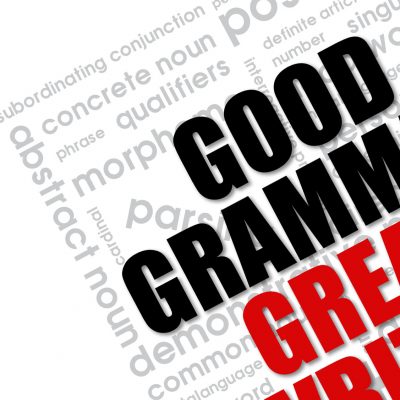 Making an epub/pdf text

So it’s been a scramble because she was still writing while I was trying to adapt the tools (standard ebooks toolset) I usually use to fit the new model. Eventually she wants to host it with the MacEwan OER repository and that might mean moving it over to Pressbooks which they use for publication and version management, but for now I was just going to stick with what I knew best. And frankly Pressbooks has turned into one of those things like Microsoft Word that tries to do too much in a way that appeals to the lowest common denominator and ends up being more confusing than helpful.
So I stuck with my own tools for now. My intent is to produce a epub/azw files and then covert back into pdf. It sacrifices a bit on the design side but it ensures clean epub files and, after all, its only a text book—and a free one for that.
Process
Step one was revising the Standard file templates so I could continue to use the tools without anything hiccuping (thanks Alex for all the latest revision that have facilitated that!) and building out the extra components.
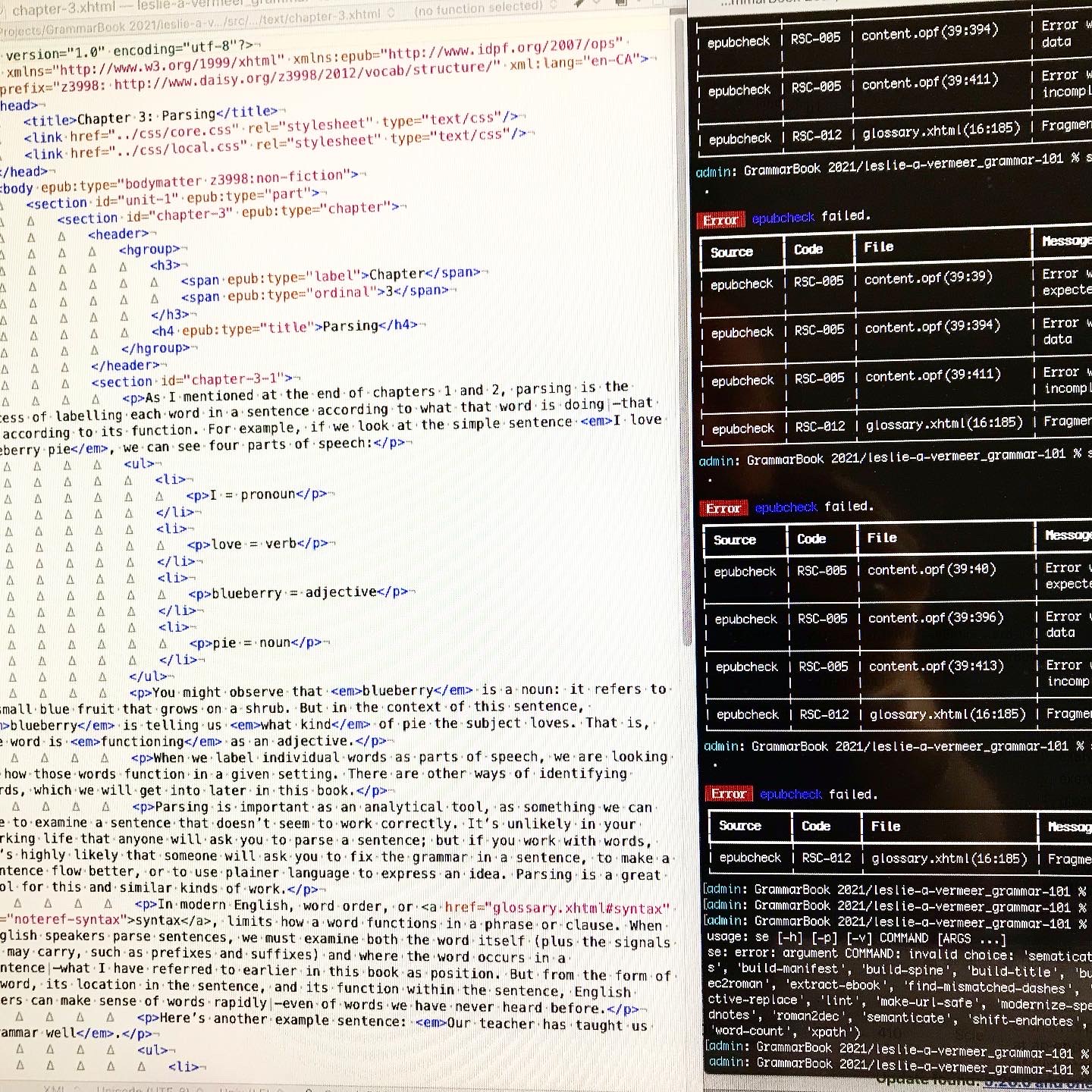
This meant adding a glossary (and associated linking system), a table of contents (because Standard eschews them for the built-in version), answer keys (again with associated links back to the exercises), a bibliography and an About the Author page. Pretty much everything else came straight from the basic templates I usually use.
I also had to go through and change and adapt things like logos, metadata that referred to Standard Ebooks and their imprint and colophon. I also had to remove all the references to the custom Standard Ebooks semantics, redesign the cover build tool and research and ask some question in regards to the more complex hierarchy (again, thanks Alex!).
Challenges
To get this:
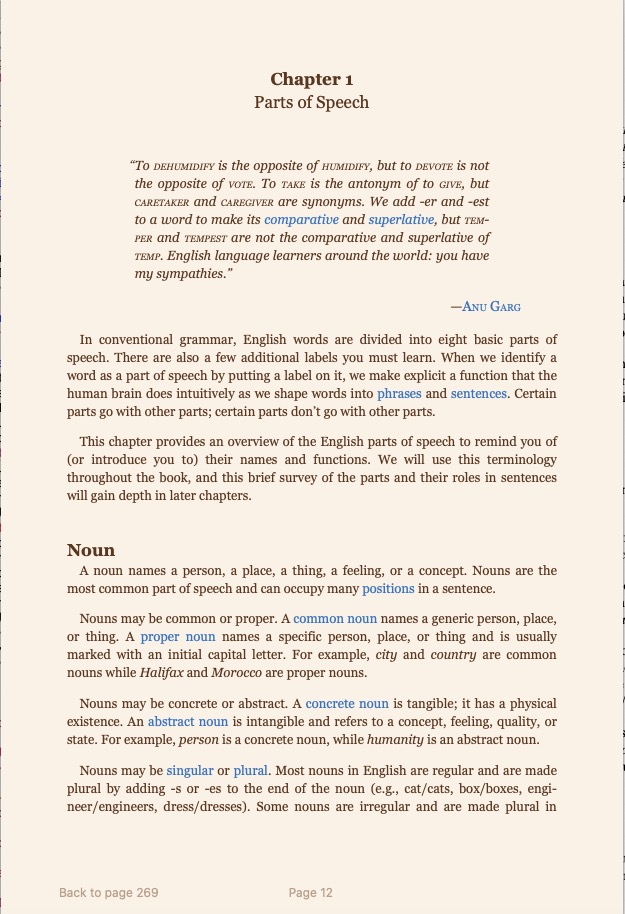
You need to produce this:
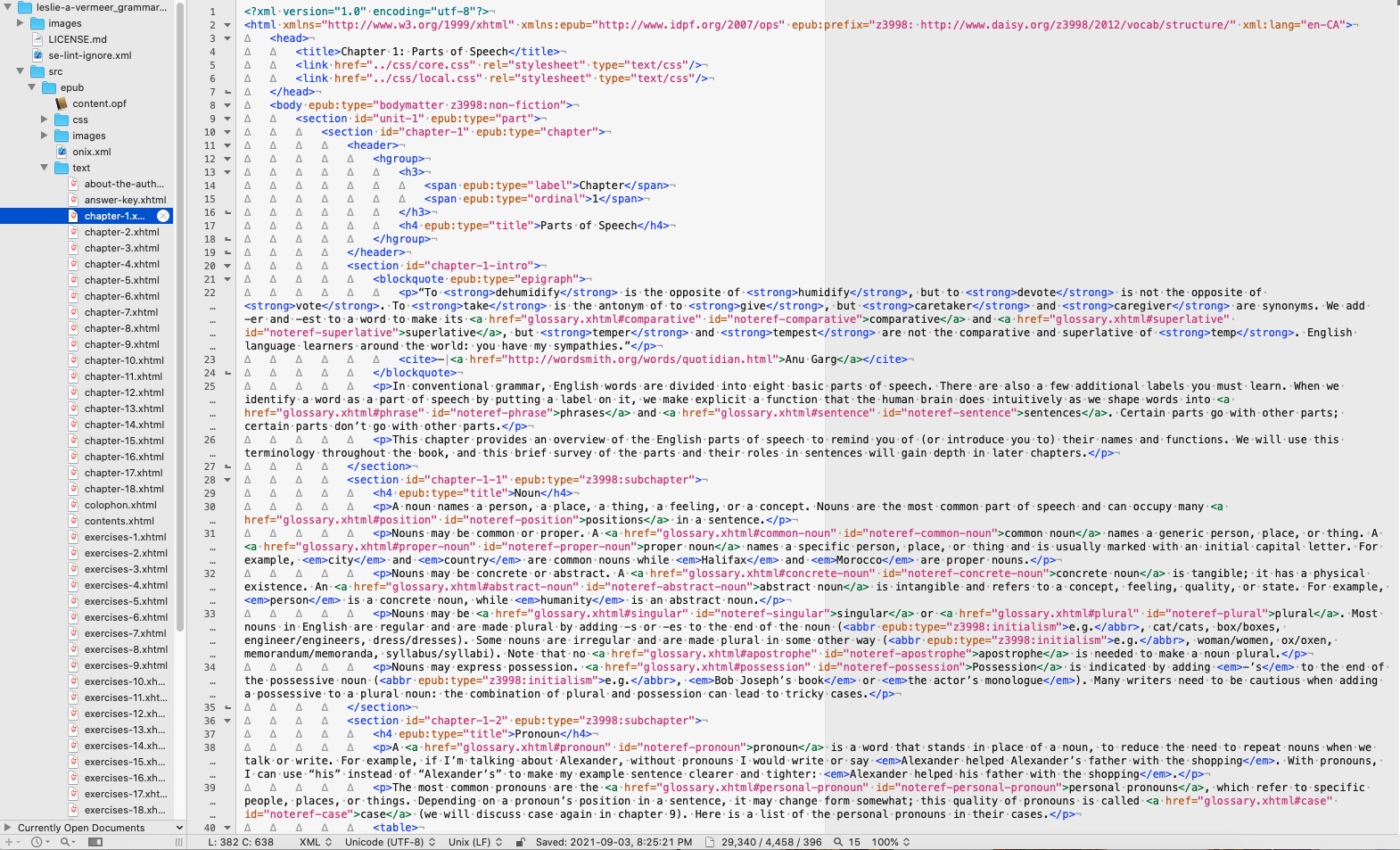
The single biggest issue I encountered (and this will be a surprise to absolutely no one who has had to do any kind of design) was…wait for it…Microsoft Word. Gawd, what a monstrosity. All I wanted to do was export files that had the appropriate heads, bulleted and numbered lists and text that was highlighted or underlined while retaining italics and bolds.. This is among the simplest and most basic html markup you can do. So you’d think that one of the many export to html functions. built into Word would be able to accomplish that, wouldn’t you?
Nope.
At worst I got massive amounts of unnecessary gobbledy-gook that still didn’t retain the list format and at best I got a cleaner file that apparently at random either retained the list format or translated the it into some complex css while turning the highlighted text into increasing more bizarre span links. But it wasn’t much of a surprise as there are tons and tons of Word -> html utilities out there and why would they exist unless to try and solve a problem that was pretty universal.
I looked at bunch of them but soon found that even that wasn’t going to work. Most of the rely n a copy form Word and past into an instance of tiny mce editor (a web utility to allow you to write and format text). After converting most of the files I discovered it had a weird glitch that dropped words in the last line of a list if it had any formatting applied. I didn’t look into exactly what the issue was but it occurred in all of the converters I could find.
Back to the drawing board.
In the end I exported all the Word files to .rtf files and then copied and pasted them into this converter. I was careful not to clean the html as that lost me some of my formatting. This left me with somethin like this:
<p class="p1">Chapter 1: Parts of Speech</p>
<p class="p2"> </p>
<p class="p1">In conventional grammar, English words are divided into eight basic parts of speech. There are also a few additional labels you must learn. When we identify a word as a part of speech by putting a label on it, we make explicit a function that the human brain does intuitively as we shape words into phrases and sentences. Certain parts go with other parts; certain parts don’t go with other parts.</p>
<p class="p1">This chapter provides an overview of the English parts of speech to remind you of (or introduce you to) their names and functions. We will use this terminology throughout the book, and this brief survey of the parts and their roles in sentences will gain depth in later chapters.</p>
<p class="p2"> </p>
<p class="p1"><h2> Noun</p>
<p class="p1">A noun names a person, a place, a thing, a feeling, or a concept. Nouns are the most common part of speech and can occupy many <span class="s2">positions </span>in a sentence.</p>

<p class="p1">Nouns may be common or proper. A <span class="s2">common noun</span> names a generic person, place, or thing. A <span class="s2">proper noun</span> names a specific person, place, or thing and is usually marked with an initial capital letter. For example, <em>city</em> and <em>country</em> are common nouns while <em>Halifax</em> and <em>Morocco</em> are proper nouns.</p>
Which was pretty easy to clean up.
Everything from then on went pretty smoothly. From raw text to a complete (albeit badly formatted) textbook was less than half and hour after I got the chapter templates set up.
The Fiddley Bits
- It needed a cover. I had a quick concept so that didn’t take long and the “client” was not fussy.
- It needed some internal links from word -> glossary and then glossary -> originating word and frankly this second bit took the most time of the whole project, as I didn’t know which chapter the word came from so I had to search each term and then edit the backlink. But it was only a couple of hours work.
- I had to do some research on Pressbooks to make sure I could convert the book later if I had to. I can.
- I also had to look at/for Library and Archives Canada’s list of Canadian Subject Headings (CSH) as I was used to the Library of Congress. Now there was a rabbit hole… or more accurately a morass. What a mess! I ended up just using BISAC codes.
- Figuring out how to convert to pdf. In the end I went with this online tool and then edited the resulting pdf in Acrobat to add page numbers and footers. It still had some bad page breaks but overall it made a pretty nice text.
- Custom css. I am still working on tweaking this. I want to keep it simple but still add a bit of functional design to make it easier on the eyes.
What’s Next
Well, L is going to pilot the 1.0 version this fall with her current class and in the mean time it will go out for peer review to various people. After any revisions and updates she hopes to add it to the OER network for others to also use as a teaching tool.
I will post up the links to the files when I get everything done and reviews are in.