My cellphone sees…
The latest in hotel room blocks! #sandmaninn
Almost ready to go
You may recall that L and I are off to circumnavigate Vancouver Island a Tim Melville’s Baltic 42. It will be around a two week trip and the itinerary for the first 6-8 days has been tentatively laid out. Here is Tim’s schedule:
On Monday we meet everyone on Gabriola Island. The plan is to have everyone connect at Tim and Donna’s house for dinner on Monday. We’ll do a BBQ on the deck overlooking the marina at around 6:00pm.
Day 1:
We will try to get away from the dock Tuesday before the high slack at Gabriola Passage at 11:30 at which time the current unfortunately turns against us through the Pass and for the rest of the afternoon out in Georgia Strait. We’ll head across the Strait and up to the Sunshine Coast for an overnight around Pender Harbour…..if we are making good time and are feeling ambitious we could try to make Hardy Island or even Westview (Powell River).
Day 2:
As I look at the currents at Seymour Narrows or all the other narrows we will need to transit…(Yuculta/ Dent/Greene Pt) it looks like the high slack at these narrows occurs mid-afternoons and we will more likely be looking at a transit on May 14th in which case we could overnight at Campbell River or if we stay inside we could look at Cortes/ Redonda/ Stuart Islands.
Day 3:
Pick a narrow pass or three to get us into Johnstone Strait for some exciting sailing…
Day 4:
More Johnstone Strait and a night at dock at Port McNeill or Alert Bay or even Port Hardy…showers/ shopping/water/fuel…dining out/ice cream…
Day 5:
Hope Island…Bull Harbour. The last good anchorage before the Nahwitti Bar crossing and Cape Scott and big ocean.
This is as far as I want to predict….we may need 6 days to get to Bull Harbour and after that I envision a night passage ‘offshore’ to get us to Winter Harbour and following that we will consider the conditions for rounding Brooks Peninsula….
My wish is for us to try to make good time to reach the top of Vancouver Island quickly….this way we will allow more time on the West Coast and have some leeway if we have to wait for any bad weather.
Exciting stuff. I don’t anticipate being able to post much past Port McNeill so all y’all will have to be patient and I will post it all after we reach civilization again.
Posting Issues
The latest auto post using SNAP didn’t work. I think it’s a combo of the XMLRPC issue and a new update to WordPress. I filed a ticket with the creators and heard back from them but they are still working on it.
For those who are interested you can read it here: Anchors Away

But as for the SNAP issue, it worked for the first 3 times and then the latest attempt threw up this error:
[Error] [WP - WordPress(Macblaze)] - -=ERROR=- Array ( [pgID] => [isPosted] => 0 [pDate] => 2015-05-05 18:43:20 [Error] => -=ERROR=- transport error - HTTP status code was not 200 - 0 - | HTTP/1.1 404 Not Found Date: Tue, 05 May 2015 18:43:20 GMT Accept-Ranges: bytes Content-Type: text/html X-Varnish: 20178337 Age: 0 X-Cache: MISS Content-Length: 2019 Connection: keep-alive <!DOCTYPE html PUBLIC "-//W3C//DTD XHTML 1.0 Transitional//EN" "http://www.w3.org/TR/xhtml1/DTD/xhtml1-transitional.dtd"> <html> <head> <title>404 Not Found</title> <meta http-equiv="Content-Type" content="text/html; charset=utf-8" /> <style type="text/css"> body { font-family: Verdana, Arial, Helvetica, sans-serif; font-size: 12px; background-color:#367E8E; scrollbar-base-color: #005B70; scrollbar-arrow-color: #F3960B; scrollbar-DarkShadow-Color: #000000; color: #FFFFFF; margin:0; } a { color:#021f25; text-decoration:none} h1 { font-size: 18px; color: #FB9802; padding-bottom: 10px; background-image: url(sys_cpanel/images/bottombody.jpg); background-repeat: repeat-x; padding:5px 0 10px 15px; margin:0; } #body-content p { padding-left: 25px; padding-right: 25px; line-height: 18px; padding-top: 5px; padding-bottom: 5px; } h2 { font-size: 14px; font-weight: bold; color: #FF9900; padding-left: 15px; } </style> </head> <body> <div id="body-content"> <!-- start content--> <!-- instead of REQUEST_URI, we could show absolute URL via: http://HTTP_HOST/REQUEST_URI but what if its https:// or other protocol? SERVER_PORT_SECURE doesn't seem to be used SERVER_PORT logic would break if they use alternate ports --> <h1>404 Not Found</h1> <p>The server can not find the requested page:</p> <blockquote> macblaze.ca/xmlrpc_wp.php/xmlrpc.php (port 80) </blockquote> <p> Please forward this error screen to macblaze.ca's <a href="mailto:cpanel@stablehost.com?subject=Error message [404] 404 Not Found for macblaze.ca/xmlrpc_wp.php/xmlrpc.php port 80 on Tuesday, 05-May-2015 14:43:20 EDT"> WebMaster</a>. </p> <hr /> <!-- end content --> </div> </body> </html> ) | PostID: 0 -
I have no idea what it means so I will have to wait and see…
My cellphone sees…
Just when when you think you have them figured out they find a new weird behavior.
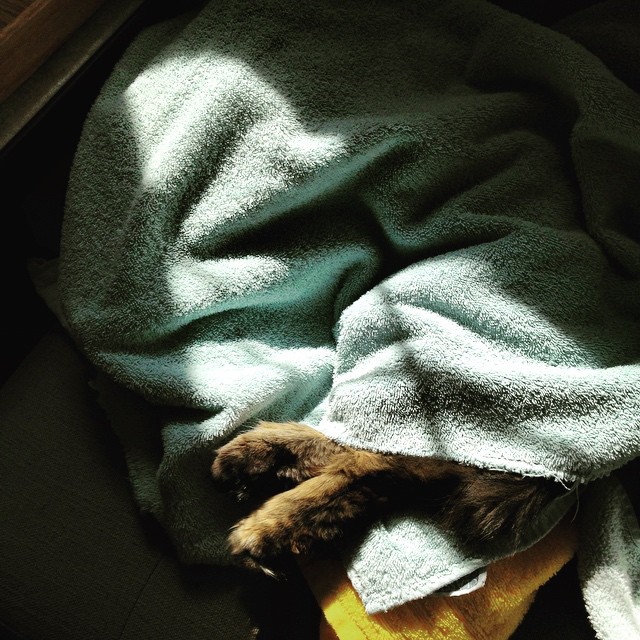
My cellphone sees…
Ummmm…duh?

Radio Ga Ga
Never for Ever (I suppose I should start calling her that) came with a VHF radio. In fact, it came with a Standard Horizon Matrix AIS GX2150 VHF with a remote mic. The radio is both DSC capable and has an AIS receiver. Simply put, DSC stands for digital selective calling and provides a way to communicate digitally between two or more stations without tying up any VHF channels, which—if you have ever listened to the inane chatter on some of the public channels like 66— is a good thing. AIS stands for automatic identification system and is something that most (all?) bigger ships use to track each other. We won’t have a transmitter so we can’t be tracked, but the AIS receiver provided an easy way to keep a look out for big, fast moving ships, especially in fog or at night.

Our radio is black, not white.
Our RAM (remote access microphone) is white, not black.
The RAM mic allows you to use the VHF from the cockpit and has most of the functions of the main station. This is handy so you don’t have to keep ducking down into the cabin to chat with a fellow boater or the marina you are entering. The last boat we chartered didn’t have a RAM and it was often a bit of a pain to carry on conversations while steering the baot and you had to keep the radio turned all the way up to hear it.
The Radio Law
In order to use the DSC, your radio has to have an MMSI (Marine Mobile Service Identify) which acts as your ID and your ‘phone number.’ These are supplied free by the federal government and are good worldwide.
The Restricted Radio Operator Certificate is required to operate a marine VHF. See Radio Communication Regulations para 30-33 at http://laws-lois.justice.gc.ca/eng/regulations/SOR-96-484/ in regards to certification requirements.
Legally a ROC(M) with an DSC endorsement is required to operate a marine VHF in Canada. That means technically any individual cannot use the radio in your boat until that person has taken the proper course and passed the test; a regulation I think is often ignored based on the typical radio traffic you hear.
As per the Radiocommunication Regulations section 15.2 (1), radio operators are required to licence their radio If the radio will be installed and used outside Canadian water. For more details on that regulation, please refer to the Radiocommunication Regulations SOR/96-484 located at http://laws-lois.justice.gc.ca/eng/regulations/SOR-96-484/page-6.html#h-16 and Radiocommunication Act at http://laws.justice.gc.ca/eng/acts/R-2/FullText.html.
A station license for the radio itself is no longer required for use within Canada, supposedly to save on paperwork, but if you are leaving the country you must obtain a station license.
We got our ROC(M)’s a few years back when we did our PCOC (Pleasure Craft Operator Card) which is also a requirement in Canada. There are a lot of dubious purveyors of this certification as the Federal Government decided it was best handled by private companies (wtf?) but we did ours online through the Canadian Power and Sails Squadron who are a national organization dedicated to boating and safety. They also administer the ROC(M) program so getting a membership there is a great idea. And you get a subscription to Canadian Yachting West!
The ROC(M) class was two days and you also learn about most of the radio-based equipment potentially found in a boat like epirbs and SSB radios that are usually only found in offshore boats. You also have to learn the phonetic alphabet: alpha bravo charlie delta…
The radio in our boat already had an MMSI number so I submitted a CPC-2-3-07 Annex B to change the registration over to us (you can view it here w00t!). The old registration for our radio also listed a call sign so I figured it had already been licensed — so I contacted the Calgary office who processed my MMSI application to enquire. We want to go down to the U.S. and explore Puget Sound so according to the law, a license is a must. Turns out the Edmonton office does the licensing and they were already processing it. I have to pay a $36 annual fee to keep the license up-to-date but other than that we are good to go.
More on AIS
AIS is cool. I am tempted to get a transmitter (upwards of another $1000) just so we can be in the system. As it stands now the AIS receiver in the radio is (at least I am pretty sure it is — now that I think about it, I forgot to check) tied into our chart plotter. That means I should be able to bring up a display that looks a bit like the one below that will show all the ships in the area and also display their MMSI and basic facts about them.

If we got a transmitter then all the other ships would see us as well. The other great thing about AIS is that you can use one of many tracking services like VesselFinder.com to track traffic or even individual boats. One of the bloggers I follow (Life Aboard Gudgeon — a young fellow living in Victoria Inner Harbour) just recently installed his AIS system so if you go to VesselFinder and type in the name of his boat or his MMSI you get his most recent location—zoom out to see nearby boats as well. Or you can just snoop around and see what all the ferries or warships are doing. So cool!

The vhf at our nav station with a small handheld vhf in a charger to the right as a back up.

The RAM mic on the binnacle with the rest of the cockpit instruments
—Captain? #Posts
Rock Lake
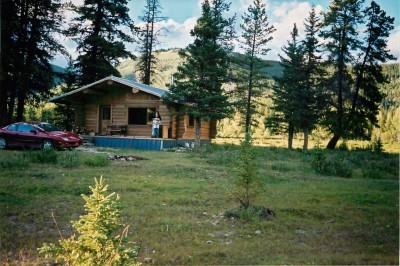
Many years ago (the early 2000s?), we headed off for a vacation. I had done a bunch of research and found a place called Rock Lake that was just outside of the Willmore Wilderness Area, north and a bit east of Jasper.
There was a backcountry lodge there with 4 small wooden cabins for rent. The cabins had no power but hot water and refrigeration were provided by natural gas tanks and they had indoor plumbing. It’s a beautiful place to visit with lots of hiking and meadows full of elk in the evenings as you sat on the veranda.
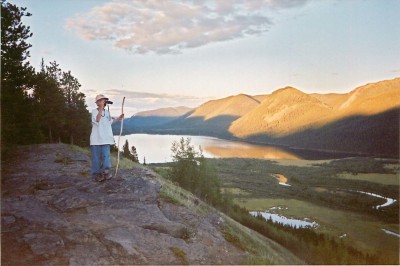
But the best part of the trip was actually the outfitters just down the road. They mainly did guided hunting trips on horseback during the seasons, but lucky for us, did day rides in the off season as well. These were great, back-country horses with none of the passivity commonly associated with trail ride horses and the trails themselves were exhilarating and magnificent. We scrambled up 60° inclines and crossed ridgelines and explored valleys. I think we went back three days in a row, just meandering around the mountains and ridges and up to the top of a few of them.
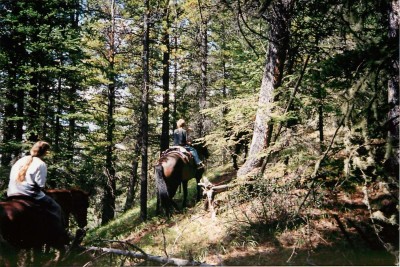
But many of you will have heard my story of the one trip we did where the leader asked us repeatedly if we were scared of heights before he would take us up. From the picture below it doesn’t look all that terrifying, but if you are 8 feet up on the back of a horse and you can touch the side of the hill with one hand, looking down the side of the mountain was enough to make anyone close their eyes and pray to whatever horse gods there are.
But the view was oh, so worth it.

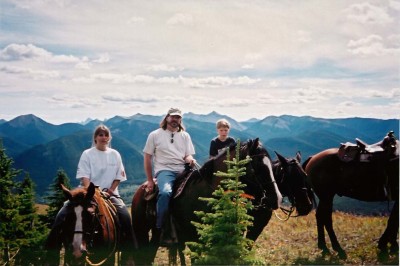
Unfortunately I have never been able to find out if these cabins are still there. The original listing is long gone and the long meandering drive in a bit too lengthy to make just to find out.
The art of waiting
Boat ownership has, so far, been an exercise in patience. Actually from what ‘little’ I know of it, boating should always be such an exercise. There is apparently a cruiser’s saying that goes “The most dangerous thing in cruising is a schedule.” This refers to the fact that heading out on a day with iffy conditions or leaving dock with a boat that is ill-prepared just because you have to “be somewhere” is likely the worst decision you will ever make on a boat. So I guess the last couple of weeks have been good practice.
The issue is basically the time of year. I have a fairly hefty bit of work to do on the boat—most of it to be paid for by the PO (previous owner) and a bunch of it necessitating hauling the boat. Now since the PO is paying for the lift and storage (upwards of $700) it makes sense to schedule the work I am paying for at the same time in order to save a few dollars. And therein lies the rub. It’s springtime on the west coast and every dog and his brother wants his work done and his boat in the water. Now, if not sooner.
And since we have our Vancouver Island circumnavigation booked for mid-May, it makes sense to wait to have the work done since we can’t use the boat anyway. It all makes sense. The only downside is we might be paying two moorage fees since moving the boat away from Granville not only costs money, but may delay the work if they have to move it back, and we have already reserved a spot in Mosquito Creek to keep the boat until we are ready to go.
But all that means I have to wait.
In case you are wondering what kind of things need to be done to boat that I just bought, here is a list of what was decided should be done and approximate costs. As far as I can tell they are in no way unusual or extraordinary:
- lift & store 5 days—$700
- repitch prop—$450
- rebed (replace) strut bolts—$200
- repair chainplate crack—$475
- keel hull joint crack—$475
- hull damage—$1300 (up to $9000 if there is core damage)
- replace/repair galvanic isolator—$650
- Webasto heater repair—$1100
- rigging repair (misc)—$1500
- engine repairs (misc)—$2000
- *engine service & upgrades (misc)—$2000
- winch service—$500
- hot water tank repair/replace—$1300
- *repaint hull—$700
- *polish hull—$800
- items marked with an asterisk are not paid for by the PO

The galvanic isolator is the panel on the bottom. Actually that’s just its (non-functioning) panel but I have no idea what the isolator itself looks like.

The hull damage on the port side that needs to be repaired (hopefully not to the tune of $9000)
I also want to investigate the cost of tying in the water heater to the Webasto and upgrading the alternator to 100 amps. The first will give us hot water without having to fire up the main engine while away from dock since the Webasto hydronic heating system is basically a mini boiler. The second just reduces the amount of time it will take to recharge the batteries using the engine; important if we intend to stay in one place for more than a day and cheaper than installing solar panels or buying a generator.
Hopefully I will have a schedule in the next day or two for all this work. Right about now, all I really know is Lawrence wants us to go to Specialty Yacht’s Hunter Rendezvous on Thetis Island in late June so the boat has to be ready for then. We aren’t scheduled to take off on our grand adventure until July so I guess that’s ok. Even if it means waiting…
—Captain? #Posts
Cats in our lives
Ghlaghghee, 2003 – 2015
Ghlaghghee died in January of this year. I had stopped following John Scalzi’s blog Whatever closely some time ago so I missed the entry. For some reason or another it was mentioned on twitter the other day and I finally read it. It’s a wonderful thing to have a person whose profession is words to describe something. I wished I could have conjured half the emotion revealed half the truths Mr. Scalzi does when Samantha died last fall. The bond with a cat is often so subtle that it is impossible to describe and though it leaves a disproportionate scar when it’s finally sundered, you rarely give much thought what that bond actually is.
John’s entry does this well and it speaks, for the most part, for me as well. Thank-you John.
Remembering is a source of joy
One of the things we too often discount in this ‘modern’ age is that by remembering and retelling stories we keep things alive in our hearts and heal our spirits. The disconnected glee that John had at my, among others, expense as I would try to pronounce Ghlaghghee’s name now, in turn, makes me smile. For those who are disinclined to read the blog post, apparently John’s 4-year-old daughter wanted to name the new kitten Fluffy despite an official ban on such ‘cutesey’ names. The daughter won; but John, taking a page from Bernard-Shaw’s book, decided to spell Fluffy with assorted g’s and h’s to the eternal consternation of all readers and speakers. (Gh=f) (l=l) (agh=u) (gh=f) (ee=y)
Apparently Ghlaghghee was also the first internet ‘bacon-cat’ and his fame even exceeded the best-selling author’s for a period.

Samantha was never so famous. Named simply Samantha by our then 5-year-old after a classmate, she eventually became formally know as Samantha T(he) Cat. But she did perfect the ‘clamber-up-the-bathrobe-in-the-morning’ and modeled for several books and magazines—although rarely when she was actually supposed to be modeling.

Anyway, it’s good to remember and it’s good to smile and I hope when my time comes everyone pauses to laugh at me, laugh with me or simply just laugh.
Secret doors!
I want! I want!

I have always wanted a secret passageway. And every time we have done any renovations at all I have contemplated putting in a revolving book case. I still have it in mind for our current basement. Some of these ideas are just sweet!


Find even more images here: http://bookriot.com/2012/11/02/10-kick-ass-secret-passage-bookshelves/