Gal-LLery
I have been playing with Gallery (Gallery 3 to be exact) software since I moved to the new host. I am not sure I will leave it installed but it’s interesting to play with. For now you can visit it here macblaze.ca/gallery.
At this point, I have a public album and a private one. If you want to see the private one you have to sign in:
User: test
Password: album
This mean I could set up private albums and control the permissions via viewing. There are also supposed to be shopping basket modules and ecommerce integrations which I will be playing with next. It will also automatically watermark the images for me.
One of the things I am supposed to be able to do is integrate images from the gallery into my WP posts. See the example below:
Smooth Gallery
Doesn’t work at all
[hgallery3 id=”4,6″ render=”smoothgallery”]
Jcarousel
[hgallery3 id=”3″ render=”jcarousel”]
Seems to skip all over the place
Dir Table
I can make this work.
[hgallery3 id=”14,16″ render=”dir_table”]
Single Image
Why?
[hgallery3 id=”14″ render=”single_img”]
Dir
Again, why?
[hgallery3 id=”4,14,16″ render=”dir”]
Best Fantasy? Ever?
Round about the end of last year I came across this article on someone’s Top 20 Fantasy novels over the last 20 years. I looked through it and was immediately struck by how much I disagreed. He was just plain wrong. So I thought I would make my own to correct the record.
Huh. Well that was easier said than done. What constituted best? Was something written first (Lord of the Rings) always better because it was ground breaking? Was a most excellent series best because, while no one book stood out, the whole was a magnificent feat? What actually constituted a fantasy book anyway? I’ve read through all the pseudo-scholarly crap of high fantasy and low fantasy and ridiculous sub genres of sub genres etc. ad nauseum, but frankly I don’t think that way and don’t agree with most of it anyway and besides, I had my own system.
It turns out I don’t — not really.
So given that I was finding it so hard to decide based on genre, literary value, etc., I therefore focussed on the most read, most remembered and most influential fantasy books that I have read. I am generally a read and move-on kinda guy, so I figure that if I either a) remember it in detail, b) have read it many, many times, or c) remember the title and author as making me want to read more, then they must have been among the best. Sound right?
I was loathe to unpack my books from their boxes for this little exercise (yes, they are still packed. No, I haven’t finished the shelving yet. I know… I know…), so I did this from memory and using my Google-fu. So I might have missed a few. If (or when) I get around to trying this with SF, I will have to unpack them. My memory just ain’t that good.
One last note. I am not a real avid reader of fantasy. While I have read a lot of it over the years, I think it gets a bit too precious sometimes and I generally want something original or uniquely interesting before I will pick up a new title or author. Or, as you will see, assassins. I like assassins.
My ‘Best’ 25
Jhereg Steven Brust (1983) Vlad Taltos Series
This was the first Brust I read. I have read all in the series multiple times and I love the character, love the world and love the writing. And I love all of his other stuff. And he’s a socialist so Leslie likes him too — hard core marxist… really. And really, what could be cooler than an assassin with his own ‘mini-dragon’ (sorry Loish).
Assassin’s Apprentice Robin Hobb (1995) The Farseer Trilogy
Again, the first Robin Hobb book I read and I have followed along as she has built out her world in many different series. A rich place with lots of room to explore and one of the better orphan-makes-good tales. And I have to say, I have a real soft spot for Assassins with a conscience.
The Shadow of the Torturer Gene Wolfe (1980) Book of the New Sun (4 books)
Weird, wonderful and awesome in the real sense of making me full of awe. I read these many years ago as a young man and while I have not reread them all that many times —in fact don’t even own them — they stand as an example of all fantasy can aspire too. And no, a torturer isn’t the same thing as an assassin, but still…
The Warlock in Spite of Himself Christopher Stasheff (1969)
I wasn’t prepared to accept this as fantasy, but a lot of online lists did so I thought I would put it in as one of my first split genre experiences. Magic and science: they are a lot alike aren’t they?
Her Majesty’s Wizard Christopher Stasheff (1986)
Mr. Stasheff is the only author on my list twice. Not because he is a particular favourite, although I read quite a lot of his stuff, but because he checks off two of my favourite themes. The Warlock in Spite of Himself covers the intersection of magic and technology and Her Majesty’s Wizard covers the blend christianity and fantasy. A good tale, and my first real introduction to the explicit mixing up of a dose of Catholic guilt, devils and classic fantasy.
The Lord Of The Rings J.R.R. Tolkien (1954)
Really? You want to know more? How about this: the movies suck. Just read the damn books already and discover the joy of Tom Bombadil. And don’t think of the movies while you do.
Thomas Covenant the Unbeliever Series Stephen R. Donaldson (1977)
Apparently this series is on quite a few people’s most hated list. My first real anti-hero, Thomas Covenant was someone you spent the entire series wanting to dive into the book after, grab by the ears and boot him in the ass until he smartened up. Every time you thought he might, he managed to sink back into his stupid depression again. Would probably have been a different read if Wikipedia had been around to do some research on leprosy, but the picture of society’s rejection that Donaldson paints is pretty horrific.
Apprentice Adept Series Piers Anthony (1980)
There were 7 books in this series but frankly only first 3 were that good. This definitely falls into the ‘not such good individual books’ category, but I enjoyed the introduction to the world crossover genre and they inspired me into a real Anthony kick for quite a few years before I tired of him.
The Dragon and the George Gordon R. Dickson (1976) Dragon Knight series
I didn’t know this was a series; just found out today. Gordon R. Dickson was a hard military Sci-Fi writer to me (the Dorsai books) and he was probably the first writer I ever read to hop genres like that. I still love this book for its characters and playful interactions, but I am unsure if I will go back and ruin that pleasant memory by reading the rest of the series; it might just not be as good as I remember.
The Belgariad David Eddings (1982) Series of 5
Another series on some people ‘worst ever’ list. I read it in late high school around the time we were discovering D & D and the like. Likely my first epic fantasy series and I fuzzily remember Mitch and I naming our PCs after the books’ characters. I think. Or something. But it made a long-lasting impression anyway.
Another Fine Myth Robert Asprin (1978) Myth Adventures series
Comedy and fantasy, who’d a thunk? I think Asprin invented the genre; he certainly did for me. There was another series I read about the same time by Craig Shaw Gardener, but that is dated 1987. Fun stuff and I was really sad when Robert Asprin died. And even sadder when I learned all about his tax troubles. The bloody state should just keep its nose out of my favourite author’s businesses: it screws with the output.
Sheepfarmer’s Daughter Elizabeth Moon (1988) Deeds of Paksenarrion
The blurb on this compares it to Lord of the Rings. Pah. A bit of fluff says I in my most offended tone. Yet as I read through the first book I was hooked and have gobbled up the whole multi-series collection of Paks books. It just grows on you. seriously. I just think the blurb writer was on bad drugs is all.
Liavek edited by Emma Bull and Will Shetterly (1985)
Not my first Shared World anthology (I had dabbled in Asprin’s Thieves’ World earlier) but it showed me what the new genre(?) was capable of. Actually this is probably a tie with Cherryh’s Merovingen Nights in the Shared World category, but I really preferred Cherryh’s stand alone introductory novel Angel With the Sword (1985) over the later anthologies, so Liavek wins.
Lord Valentine’s Castle Robert Silverberg (1980) ‘The Majipoor Cycle’ (3 books)
What a world. SF? Fantasy? Who the hell cares! An epic journey, a loveable character, a seemingly simple device like juggling and a broad sweeping new world combine to make these some of my favourite books. And another great SF writer struts his stuff in the fantasy genre.
The Once and Future King T.H. White (1958)
Actually a series of 4 books, I encountered the omnibus long before I saw Disney’s Sword in the Stone. This was my first initiation into Arthurian fantasy and still one of the best of the genre in my opinion. It was also a catalyst to learning and reading much, much more about the mysterious King Arthur. At the end of the day though, I still tend to think of T.H. White as the original Arthurian source and all others as deviations.
The Book of Swords’ Trilogy Fred Saberhagen (1983)
I have a love/hate relationship with this trilogy. Saberhagen obviously knew more than me about the trap of trying to sustain a 12 book story and so didn’t bother. The gods forged 12 powerful swords and the series starts out like it will trace the interwoven history of each sword, one per book. Then he wraps the story up in three books. Sure, sure he adds another series (Books of Lost Swords) to highlight 8 other swords’ tales, but still. Not what I wanted. But he didn’t ask me and I still love the original three.
Kushiel’s Dart Jacqueline Carey (2001) Kushiel’s Legacy Trilogy
I read this book based on a recommendation by Steven Brust on his blog. The post isn’t there any more, but it went something like this: “I don’t often recommend books but this one’s premise is super cool.” I’m pretty sure it sounded much more Steven Brust-y though. Since I don’t often take recommendations but like a super cool premise, I thought it was a good fit. It was. A book that builds on generations of fantasy tropes and worlds, it builds something new, exciting and oh so interesting to read.
A Companion to Wolves Elizabeth Bear with Sarah Monette (2007) The Iskryne series (3 books)
I just discovered the existence of the 3rd book, although the pub date of 2013 seems to be in error, because I can’t find the book for sale anywhere. A lot of the reviews of the second book were along the lines of ‘disappointing’ and ‘placeholder’ and I can’t disagree. But this was less because the sequel was bad than because the first was tremendous. Mind-blowingly original, full of adventure and excitement but at the core, a look at relationships, fear and acceptance. Read A Companion to Wolves. All of you.
Imager Portfolio L E Modesitt Jr (2009) 3 book series with 5 more featuring new characters
Another really cool, cool premise that makes a great read. This one reminds me very much of David Brin’s Practice Effect, which, come to think of it, should be on this list. One of my favourite things about SF and Fantasy is the practice of taking a unique or fantastical idea and then running with it wherever it may take you. Oh and wrapping it in a good tale at the same time. Both Brin and Modesitt do that extremely well.
The Hundred Thousand Kingdoms N. K. Jemisin (2010) First in a series of 3
Jemesin is one of my latest pleasant discoveries. Again I read this based on a recommendation and since I really like the super-cool cover and the word shape of the author’s name I read it. What? You have a better system for choosing titles to read? I am a visual guy, so give me break. Great first novel. Great novel period, and it is going to hold high place in my reread pile as the years pass (the count’s at 2 so far).
Assassin of Gor John Norman (1970) #5 of the Gor series
Don’t read this one. Seriously. I can’t think of a single (current) friend or potential reader of this blog that could find any redeeming value in this trite, misogynistic and philosophically brutal series of books. But it was formative and I read the first 10 or so novels in the series before I finally gave up. I owned #5 in my poor days so it was on my reread pile for a long, long time.
Watership Down Richard Adams (1972)
These next three are additions that I hadn’t originally contemplated. It was what got me starting to question my definitions of fantasy, because none of the three are/were really on my list of what I would shelve as fantasy novels. I was given the tale of Fiver and Hazel in one of those books sets along with Shardik and Plague Dogs. I never read those other two (the danger of giving Bruce books he didn’t ask for), but for some reason Watership Down made it to my read pile—I actually think it was because I was expecting some sort of 20,000 Leagues thing, you know, a water ship. One of my first non-North American English books, I admit to being very confused with the language at times. I never really did get what a down was until years afterwards. Still, to this day I hold the tale very dear to my heart and would recommend it to anyone, anytime.
Tarzan of the Apes Edgar Rice Burroughs (1914)
Any questions? 1914 people… 1914… and Tarzan. Ahhh-eyahhhhh!
The Screwtape Letters C S Lewis (1942)
I read this because it was lent to me by a dear friend and teacher who happened to be a fairly devout Christian. I don’t remember if it was a result of a discussion we had been having or if he was trying to get me to see the error of my agnostic ways or if he just thought it was well worth the read. Well it was. A brilliant idea and a clever and absorbing look at Christianity’s tenants and the nature of humankind.
The Curse of Chalion Lois McMaster Bujold (2001)
And lastly my favourite. Best Ever. It doesn’t make many other people’s top list, it was nominated for, but never won, a Hugo and a Locus and the general online buzz is that Paladin of Souls, the semi-sequel follow up, was the better book (It got the awards which I think was nothing more than guilt on the judges part at having missed Curse). But I think that’s all idiotic, asinine, misguided and fallacious bullshit. The Curse of Chalion is only slightly older than a decade and it tops my all-time reread stats. I have both a much-bedraggled paperback copy and an epub version and both have been read and reread and reread again.
I love the beginning. I adore the end, and I am astonished every time by the development in between. I have to say, that of all the heroes and protagonists I have encountered over the years of reading all the schlock I can get my hands on, Caz is hands down my favourite. And I hope Lois never writes a sequel for Caz, because frankly he’s tired. And he’s earned a quiet peaceful life. So leave him alone… do you hear me!
***
And so now, after this exercise in opinion, I find I can forgive my mysterious friend Dominick his choices and wish him well for another 20 happy years of fantasy reading. Best, it turns out, is such a slippery thing to define — even for one as opinionated as me. I found a few new books I think I will look into and learned a few things about some much-loved titles. And for the next 20 years, I will be here, plowing through my Space Operas and laser pistol schlock, waiting for the next great fantasy title to wink in my direction. And I will relish it when it comes.
Action: Screen Test
Some ideas we were playing with to sharpen up/learn some skills. It’s pretty rough stuff, mostly just proof of concept, but it got the idea across. We didn’t get much done in time for this past Xmas, but watch out for next year!
The video was shot with an iPhone 5 and composed in Adobe Premiere. The stills were shot with a Nikon D200, roughly edited in Adobe Bridge and put together in Premiere.
Click to play…
or
All New & Super Speedy
Ok. As of noon, I seem to be on the new host (Stablehost.com) and everything seems to running as well as can be expected.
I don’t have my actual files uploaded yet as the ftp and webdisk seem to be super slow at uploads. I will work on it. All this means is for now there are no images that I haven’t uploaded by hand.
Let me know if things seem speedier to you’all… Or not.
Process
- I downloaded (via ftp) the entire contents of my wp-content folder to my desktop from GoDaddy’s server.
- I exported the mysql database via phpMyadmin, also to my desktop.
- I did a clean install of WordPress on Stablehost.
- I attempted to import the mysql backup on Stablehost via phpmyadmin but it kept kicking up xxx table already exists errors. eventually I deleted all the tables from the new database and tried again. THis time it imported the tables and data with no problem.
- I headed over to GoDaddy and pointed the macblaze.ca domain to Stablehost’s nameservers and about 20 –30 minutes later the redirect took affect and I was now going tot eh new server.
The issue at this point was that while I was being directed to the new server (tested by uploading a new index.html page), it wasn’t picking up the default wordpress pages and nothing was being displayed. I screwed around for about 2 hours and then suddenly it started working. I am not sure if I fixed it or there was just some cache that needed to be flushed or what.
- To get it up and running I uploaded my theme to the host and then we were cooking with bacon.
- Next up, I need to figure out how to get nearly 1 gig of old files uploaded because the 40 meg I have tried so far has taken almost 2 hours. (Turns out you need to use the file manager in cpanel. Bulk upload zipped files and extract them once they are uploaded. Speedy-speedy.)
- I also need to redirect my macblaze.ca email and we should be good to go. (Done like dinner)
Blogs & Such, Act I
If you’ve searched through the back entries in this blog, you will know it started out as an attempt to learn a bit more about blogging software and hosting a blog. I had originally set up a Blogger site called moreblaze.blogspot.ca— which Leslie still uses. Blaze was an initialism of Bruce, Leslie And Zak’s Electronic blog and became a staple in my online nomenclature. My first entry was at 4:21 on November 29th, 2002. I (we) continued dabbling on Blogspot until September 2005, when I decided I had enough.
The idea of some external agency hosting — and controlling — my personal files and intellectual property bugged me (and still does); there is too much about online copyright that is fuzzy to make that situation overly comfortable. I would much rather be in control of the servers and the actual files than to trust some unknown agency to back them up and keep them private. There was also the issue of compatibility; I had already lost years of diary entries when I lost my old Apple IIc. I still have the floppies, but no way to access them. Was I going to trust some IT company to still be there year after year?
And this was before Google bought Blogger and there was a lot of less investment in the finer details. When it comes to software, I am a bit of a control freak and I didn’t exactly like the way Blogspot managed the interface or my ability to modify the blog itself: I’m just not much of a standard template guy.
Anyway in August 2005, I started toying with the idea of hosting my own blog. I had an old Ruby iMac with a copy of OS X Server 10.3 that I used as a testing server and it seemed natural to start using it to host my own stuff. After some research I settled on Blojsom, a java based blog platform that used flat text files as a storage method: that seemed safe enough. It also seemed pretty easy and foolproof. On September 1, 2005 I posted my first entry; ironically about the difficulties I was having getting Blojsom to work properly.
Note: the more curious of you will remark that there are in fact entries older than Sept 1, 2005. When I got around to adding a bunch of old poetry, I decided to back date the entries to the date that I originally wrote them.
Around about the same time I had been playing around with MySQL, an open source relational database. It’s not something I have ever gotten extremely comfortable with, but at least I know the basics, or at least, enough to f*ck it up when I get too cocky. (An occurrence that Anthony, my old Hole’s IT contractor, would say was all too often.) Along about the end of September I had been getting frustrated with Blojsom and tried out WordPress for the first time. My main issue with it was that it seemed to limit me to one blog per installation and that wasn’t going to work for what I had in mind. Still WordPress was based on a MySQL back end and I was getting to be an expert at that wasn’t I? But then I would lose my safe flat files wouldnt’t I?
Almost exactly a month later I finally gave up on Blojsom, installed WordPress on the Ruby iMac, retrieved the blog entries from the old Blojsom blog and moved on. I had solved the multiple blog issue (thanks, Google) and managed to set up a nice blog for Zak to play with. Which he did for about as long as a teenager does anything, then promptly ignored it. WordPress at this point was in version 1.5 or 1.6. Version 2.0 with an awesome backend UI came out in December of that year, and I have never regretted moving.
And so November 12, 2005 found my first entry under the category of Random Picture of the Day and the start of more and more non-computer related blog posts.
But I digress… The next big event was the big Ruby crash of ’05. The Ruby bit the big one, and I was faced with trying to retrieve all my files and data. I got a new iMac (flatscreen) and retrieved the (thankfully) healthy harddrive from Ruby, installed a fresh installation of WordPress and was up and running again pretty damn quickly. But was at a bit of a loss on how to retrieve the blog entries, as they all resided in a MySQL database on an external drive. MySQL, as you may or may not know, has (or had at that point) no UI and it was all controlled by terminal commands that were at least 50% gobbledy-gook to me. Suffice it to say that in the end, with my old pal Google, I figured it out and we were cooking with gas once more.
Somewhere around this point I looked into domain names. After all, no one was going to visit my blog if they had to type in http://24.68.54.xxx to go to my blog. I settled on a free service called NoIP. I had to renew my membership by following a link every couple of months, but other than that it was free. Basically I entered the (semi) static IP (the weird number above) of my cable modem at home on their website and reserved macblaze.hopto.org as my personal domain. I then set up a route on my firewall at home directing traffic to port 80 (the www port) to be directed to my iMac. So now all calls for that domain name were then forwarded to my home computer’s WordPress installation and they got my blog. Cool!
Somewhere in there I also designed/modified my own theme (I did mention the control issues, didn’t I?). After I got it the way I liked it it remained relatively stable until a couple of months ago when I finally designed a theme from the ground up and made it more flexible. Look for more changes in the future.
I continued on merrily for a bunch of years after that. The only significant changes were a new mac mini for my personal use in March of 2009 (the old iMac became solely a blog server), the introduction of mobile blogging and the rise of blogging apps. When the iMac blew up in November of 2009 I had to do the whole song and dance of moving the MYSQL databases again, this time to the Mini, but it all worked out fine.
In January 2010, two things happened. I finally got my own domain (the current macblaze.ca) and I finally moved my WordPress installation to external hosting at GoDaddy. The domain was about $12/year and the hosting worked out to $60 a year or so. The main impetus for this was I was going to set up a site for my brother (beakerwood.ca), and if I was going to do for him, why not move mine as well. It all could be loaded on the same installation so I wasn’t paying any extra and hopefully would see some speed gains from their professional servers.
A word on privacy and control. While I am now using an external host and theoretically this does give GoDaddy access to my files, it is not the same thing as using a blog service and trusting them with your backend. The TOS (Terms of Service) are entirely different and my database is controlled by my passwords, not theirs. A quibble that is meaningless in this age of hackers and computer nerds but still, I don’t like the idea of anyone else controlling my intellectual property. I make regular back ups of the DB and the content on my own machines and am pretty disaster-proof.
At this time I also got access to GoDaddy’s email service so I could set up my own info (@) macblaze.ca email address for fun. (Incidentally this brought me up to 10 email addresses, only 4 of which I actively use). It lacked IMAP, which was annoying as I was pretty connected by this time (iPhone, iPad, 3 computers) and having to check the same mail on all my devices was annoying, so I didn’t use it for much; still don’t.
That’s pretty much it. I am learning more CSS and a bit of php to try and modify the blog as it suits me, but WordPress’s healthy development community generally supplies me with all the plugins I could want. Last year I started to make more of an an effort to post everyday and as of today the blog has been running for 8 years and 4 months with 1,192 posts.
So why all this long-winded and overly verbose history of my blog? Well I am getting pissed with GoDaddy. It’s slow, it keeps timing out, and frankly it’s time to break something again. So this month I am going to move to a new host. I have my eye on an account at StableHost. It’s only 4 bucks (maybe 6 if I upgrade) a month and gives me my IMAP email and is pretty highly regarded on the forums and such.
So…. there might be a wee interruption at some point. I have no idea how long the process of moving everything will take. Redirecting the domain can cause an up to 24-hour gap (although I’ve seen it happen in less than an hour) and moving the data and files might take a bit longer.
At some point I might continue my thoughts about blogs and intellectual property. I have a lot of them and they are mostly confused and illogical so you might enjoy the experience. 😉
A Good Crop

Taken out on the farm in Redwater a couple of summers ago, this is one of my favourite images. Every time I come across it I smile because of its overall attitude and mood, and then I always start noticing the great light, composition and balance (purely serendipitous, let me assure you). L, the smallest of the three focal points, gets the strong highlight. C’s elevated position, although in shadow, moves her forward in the viewer’s perception, and in the foreground, F’s larger size and strong isolated profile serve to underscore his presence. All three are then framed by the shape of the trees and contrast of shadow and light.
I thought I might try a few crops and see what shifting our triad around the frame and changing the crop ratio might accomplish. I tried to stick to the traditional 2/3 rule and ignored my ‘favourites’ in deference to variety. As you can see, some crops just didn’t work, while others served to change the overall impression the image gives.
A traditional, more or less 4:3, crop


A widescreen 16:9 crop

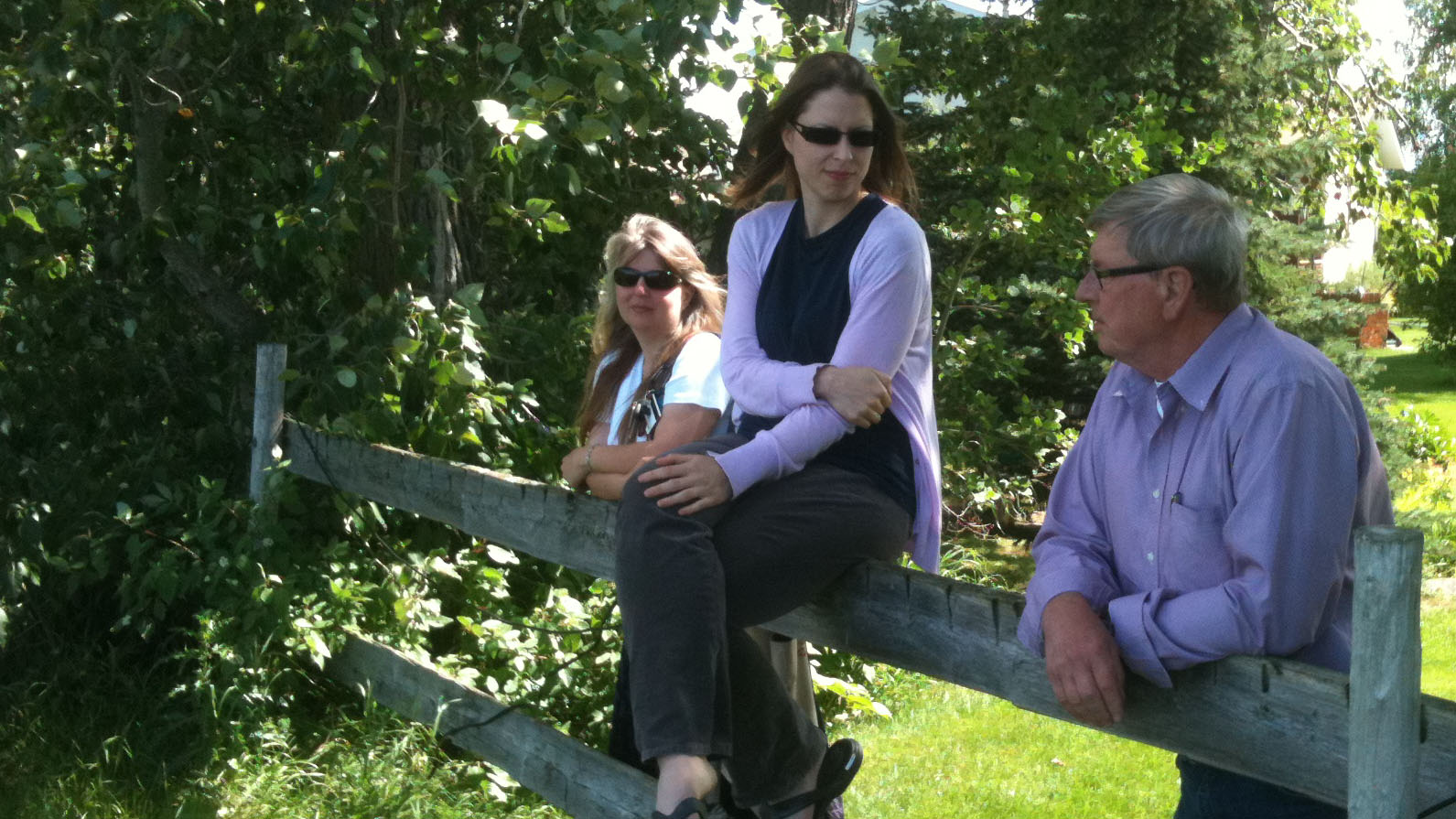

The newly fashionable ‘Instagram’ square crop


Tom Corbett: Space Cadet
Many years ago, sometime in the early 70s growing up in the English suburbs of Montreal, I started to read voraciously. I remember it being so bad that my mother would confiscate all the books we were taking on a holiday and then dole them out so I wouldn’t read them all in the first few days. The books themselves came from frequent visits to the used bookstore and the local libraries (one of which, in Pointe Claire I believe, was housed in an old mansion with broad wooden staircases and cool turrets to read in) and, of course, the dependable school-based Scholastic Book Club.
At the point I discovered science fiction we were still on Roosevelt in our Dollard des Ormeaux house. I discovered it in my brothers’ room, sitting on the shelf under the window.
Although I was the youngest, my brothers shared a room and I had one to myself. The logic had been that since Dale (the eldest) had his own room in the old Roxboro house, that it was now my turn. In retrospect that doesn’t really explain why Doug didn’t get a room. Wouldn’t it have been his turn? I now suspect that in my somewhat notable precociousness (my mother had resorted to a leash for most of my terrible twos and threes), no one wanted to bunk with me and that having Dale and Doug together was the best solution for my parents’ sanity.
Be that as it may, I found the book in their room. It was one of those old green-turquoise, cloth-bound 6 x 9s with a foil line drawing on the cover and the embossed title Tom Corbett: Space Cadet. At least I remember it saying that; turns out I was wrong. But more on that later. I don’t believe I had ever read a hardcover book of this nature & vintage before. Certainly the type is now ubiquitous in every garage sale or (more horrifically) displayed in show homes or trendy restaurants with ripped pages and torn covers. But at this point I do believe it was the first book of that vintage I had come across aside from my mother’s old nursing texts. I have no idea whose book it was or who had obtained it from the used bookstore, but from that moment on it was my book.
I remember being reluctant to read it. There was no fancy cover with interesting images, no book blurb to tease, and frankly I had never read a science fiction book before and the idea didn’t seem as enticing as a talking mouse detective with a cool-sounding name like Basil. I think it was nothing more than desperation that prompted me to finally read the thing.
These were the days that I surreptitiously read beneath the cover with a flashlight perched on my shoulder so my parents wouldn’t know that I was staying up late. I am now amazed at the logic trail that led me to believe my efforts remained secret. While ostriches may not actually stick their heads in the sand to hide, I believe we humans continually do so from an early age: Look! I can’t see you so you can’t see me! While I can’t honestly state that was how I read the book that first time, I am quite certain it was a method employed in the second, third and many subsequent readings. I fell in love with that book immediately.
Not long after, we packed up and moved thousands of miles west to Brooks, Alberta, and I entered junior high school. There the library supplied many, many new adventures and there I discovered Burroughs’ John Carter of Mars, Jack Vance’s Dying Earth and, to my still undying pleasure, most of Robert A. Heinlein’s juvenile novels. I read my way through all those ratty sci-fi paperbacks often multiple times, while simultaneously working my way through every horse book from Black Beauty to the Black Stallion in the public library. But mostly, it was in the wire racks of well-thumbed paperbacks in Brooks Junior High School that I found the best and the brightest. It is a still guilty/pleasure that I retain one or two yellowed pocket books with BJHS stamped on the pages.
At some point or another in the three years of junior high, definitely not on my first read, I noticed some startling similarities between my first love, Mr. Corbett, Space Cadet of the Solar Guard, and Cadet Matt Dodson of the Space Patrol from Mr. Heinlein’s Space Cadet. I never really thought too much about it and by that time the original Tom Corbett hardcover had disappeared, perhaps in the move West, perhaps in an unthinking purge of possessions.
I had not yet acquired the pack-rattish fetish for owning books that I (and without exception, all of my closest friends) now have, although I can state from the books in my collection it happened sometime in junior high. That first glimpse at SF had been at least three long young-man years in the past. In fact, I don’t think I gave the Tom Corbett book more than a passing thought for years, so absorbed was I in reading the entire back catalogue from the Golden Age of Science Fiction. And then, when I got a job and a car, the trips to the city usually consisted of collecting new books to read and new authors to collect.
Sometime later, when I was in University studying fine and proper English literature and the internet was just beginning to become a useful tool, I thought to look up the Tom the space cadet book of my childhood. By that time my recollection of it was very vague, and initially I thought I was looking for the popular Tom Swift books. Imagine my surprise when I found there was a whole series of them and none that I could find were about space cadets or rocketships or anything remotely sci-fi. In fact my boyhood inspiration seemed to be chiefly known for his inspiration of Tom Swifties, an adverbial play on words, e.g., “‘I lost my crutches,’ said Tom lamely.” With the still rudimentary nature of such online powerhouses such as Compuserve and usenet at the time, I pretty much gave up looking any further.
Another decade or so passed and, upon the umpteenth reading of the venerable Space Cadets, I again was struck with a desire to investigate the apparent plagiarism between what I remembered of Tom and his adventures on Mars and the plot of Heinlein’s novel. This time the internet brought to light the error of my previous research and revealed was indeed a series of books written about a young space cadet named Tom Corbett by a fellow named Carey Rockwell. Wikipedia to the rescue and I soon discovered the series of books was apparently based on a radio, then TV, show in the 50s and there was in fact no such person as Carey Rockwell. The more curious of you can read more about it all here.
The book I had read as a young’un was book one of a series of eight and had in fact been titled Stand By For Mars! The similarities to Heinlein’s Space Cadet were acknowledged, but the story for Stand by for Mars! had apparently been based on a script written in 1946, two years before Heinlein’s book was published. There is still a mystery there, but something obviously more complicated than mere plagiarism. Still the original mystery was solved and, except for the hollow place in my book-collecting soul the size of a small green hardcover, I was satisfied. I think it occurred to me at some point to search for a copy online when eBay was first on the scene, but it came to naught and I resigned myself to my memories.
Skipping ahead another decade more or less and we find ourselves in the freshly minted era of ebooks and Project Gutenberg’s great dream. Not that long ago in the scope of things, I started to read ebooks and often found myself buying texts in epub format that I already had in paperback. It once again occurred to me that the long elusive Tom Corbett might be accessible online in some format or another. Much to my delight I found it on epubbooks.com and immediately downloaded it and dived right in. Not quite the sweeping in-depth vision of space cadetedness I had constructed in my mind’s eye over the years, it nevertheless sufficed to scratch that decades-old itch. I was pretty damned pleased with myself for recapturing a moment of my childhood.
A few months later I found the other seven books in Project Gutenberg editions and acquired them as well. I will admit that it wasn’t until this winter that I finally started in on the other seven books; they held no sentimental value and frankly were the kind of juvenile schlock that any semi-educated reader in this modern and sophisticated age will generally turn his nose up at.
But whenever I reread early SF or juvenile books (or see an old movie for that matter) I am always struck by the learning process we all go through and how one’s vision is always based on what came before. I am always grateful I read Lord of the Rings back in those Brooks Junior High School editions; what more recent writers have built on that foundation is often astounding, but without Tolkien’s first masterpiece none of that would have come to pass. I’m so grateful I read those first and he remains the master in my personal chronology.
So now I am trying to read the remaining Corbett books with that in mind. We all, readers and writers alike, have to start somewhere, and if our palate eventually becomes too refined to tolerate the plonk we were weaned on, we can’t ever forget that without those first precious tastes, we will lose the opportunity to grow into the connoisseurs we believe ourselves to be.
And now you know why I am such a SF-schlock nerd…
Re building epubs
A while back, in one of Apple’s many bizarre OS shifts, they screwed with the compress file function in finder. What this means is that epubs (which are essentially zip files) no longer package or unpackage correctly. Attempt it and you end up with a rather bizarre cpgz file.
I came across this lovely post on how to use terminal to attain correct results and thought I would repost it for posterity:
Open Terminal Services: Applications/Utilities/Terminal Services and go to your file – I usually put a folder on the desktop with the ePub file in it, so to get to it, I use the following:
cd desktop/epub_folder
If you are unzipping the folder, use this command:
unzip epubfilename.epub
(At this point, if you’re doing a fixed format file, you will put Apple’s display options file inside the META-INF folder. This is also the only way I know of to add audio and video files to an ePUB, and to make all the updates required to make these files work.)
When you zip the ePub file back up, it’s important to zip an ePub up in the correct order. mimetype goes in first, with no compression. We’re also going to rename the file so we know we’re creating a new version. Here’s how:
zip -X newepubname.epub mimetype
Next up is the META-INF folder. You also want to suppress adding any MAC O/S .DS_Store files.
zip -rg newepubname.epub META-INF -x \*.DS_Store
Next is the OEBPS folder:
zip -rg newepubname.epub OEBPS -x \*.DS_Store
That’s it!
It’s a wrap!
“So You Think You Can Write” 2013
So do I? I have no flipping idea. From what I can tell, I am creative enough to get a few points on choreography and interpretation. Maybe a few more points from the judges on character. I certainly going to gather a few criticisms on style and technical proficiency, and frankly I ignored conventions almost entirely. (That was mostly due to the fact I have no idea what the conventions are and was too [lazy?] to figure them out.)
All in all I think I would be one of those guys they sent back to practice for the second audition, then dropped like a rusty anchor with no rode off the side of a fast-moving ocean liner in the mid Atlantic, with plenty of well wishes but (hopefully) never to be seen again.
I’m good with that.
The Method
I managed to write pretty much everyday. For the first part of the year I was generally a week ahead and L had time to edit the entry before they posted. By late August I was unemployed and the writing slowed instead of increased (mostly a matter of lack of routine and discipline) and she got busy. I imagine the typos and technical inconsistencies increased at that point — I have no idea because I’m not going back to read that long-winded crap 🙂 — but hopefully not so much to make it unreadable, or any more than it innately was.
I generally wrote entries during my morning 15 minute coffee break. This fact tended to dictate length and content as I often was too busy to go back and look what I had previously said. Weekends were feast or famine: if I was relaxed I would pound out words and multiple entries that at least related to each other. If I was busy you got drivel. After I stopped working, this system sort of fell apart and it was catch as catch can with often disastrous results.
The finale was written all in one marathon session (about 6 or 7 hours with breaks) for a total of 5,531 words. Given my laxity in the preceding days (weeks?) I had to forgo finishing up a lot of threads, but at least I think I brought some conclusion to the table and definitely left myself open to a sequel in case anyone wants the Hollywood rights.
The Audience
Of the 5 or 6 people I know look at my blog, I know for a fact I lost my mother early on. Really I can’t blame her: who wants to see her baby make a mockery of literature? Day after day. Incessantly. Actually I think it was mostly the chronological nature of blog posting. Miss a day or three and suddenly you have to scroll down to figure out where you were and what the hell was happening. Add to that the insane flipping around of character and plot that I admittedly used mostly to amuse myself on days when I had nothing to say and voila!
I am pretty sure I lost L somewhere in September although she is being pretty cagey about admitting it. C stuck it through mostly although I again suspect she shifted to a weekly schedule rather than daily.
As for the other few, who knows. I know they were out there but you would have to be pretty insane to make the effort to keep up given the, shall we say, odiferous, nature of the output. Bravo (or more likely Brava) to those who managed to finish the slog. Your medals are in the mail; wear them with pride!
Oh, at one point Laura seemed to be reading along and passed on my sentimental thoughts about change to other co-workers. I really can’t imagine she kept up after that but it was nice to see. Still of two minds about that entry as it had more than bit of truth in it but was way more wishful thinking than any reality I think I am capable of managing.
By the Numbers
- 377 entries in total (including the forewords in December 2012)
7 entries were completely D’autres
31 entries were trip reports that I (hokeley tied in)
8 or so missed days (most egregiously in late December 2013)
12 and bit months
361 days
| January | 13601 words |
| February | 8092 words |
| NYC Trip | 6166 words |
| March | 9092 words |
| April | 6215 words |
| At Last Trip | 7045 words |
| May | 6261 words |
| June | 8201 words |
| July | 3744 words |
| Sailing 2013 | 11890 words |
| August | 8892 words |
| September | 8051 words |
| October | 7120 words |
| November | 6446 words |
| December | 9142 words |
And the sums are…
94,857 words in It’s Novel
25,101 words in Trip Reports &
119,958 words in total
Note:
Short stories are 1,000 to 9,000 words
Novellas are 20,000 to 40,000 words
Novels are 40,000 words and up. Some like War & Peace or Les Miserables exceed 500,000 words.
Tools & Tech
I wrote almost entirely in IA Writer mostly on my iPad but later on the desktop version. Files were stored on my Dropbox account and synched to all my various devices. Upon completion of an entry I would post it to WordPress (generally from the iOS app) and schedule the entry for that appropriate time and date. L would come by later and edit the entry directly in WordPress. Each month I would start a new Writer file and begin again.
All in all it was pretty successful and the only qualm I have with Writer is its habit of making a .md file for use in iCloud as a default. I tended to just make a copy of a preceding file and rename it instead of screwing with their idea of a proper workflow.
Issues and Thoughts
One of the major drawbacks of the digital age, at least for those of us with spatial memories, is the difficulty of looking back to refresh our memories or browse old ideas. I am a skim reader and a pile of paper is way easier to flip through than a digital document, especially one broken up into 12 sections.
For those who have better memories, then the search function is a great tool, but i ma more likely to remember where on a page a character resides than what the hell I decided to name him.
I think word count/writing session would be a better measure than writing /per day. A longer entry has more cohesiveness and less pressure to just get it done.
I can’t type worth sh*t anymore. My arthritis has locked at least two fingers on my right hand and even C mocks my typing style now 🙂 Add into that my brain that works twice as fast as I can type and you get typos, missed words and a whole lot of nonsense sometimes. Actually the most bizarre twitch is the one that introduces way too many double spaces: hate that.
Rewriting is necessary and endless. The few times I went back to seriously reread and entry I almost inevitably started rewriting it and adding plot details which I knew I was going to regret later (see bad memory above). The problem is that you are never satisfied and stopping is more a frustration issue than a happy choice.
The Future
Well, I think I am not going to do that again. I will, however, try to keep up the daily posting, and, hopefully to my Mother’s delight, try and make it more personal—or at least less about bizarre rabbits and egotistical beavers.
I find I have enjoyed Edward and the Beaver and hopefully will try a short story or the like featuring their furry little asses.
I also want to try a few more spoken-word poems, just for the rhythm of it and have been toying with scripts again. Seems I consider myself more of a dialogue guy and less of a descriptive writer.
And visuals. I miss visuals. I think a few more videos and some photography would be nice. I cam considering cross-posting my entries in Facebook and Twitter to drum up some readers as does the inestimable Mr. Woods, but not sure that I am ready for such fame; we’ll see.
Anyway, as the pig always says, “Th-th-th that’s all folks!”
Books 2013
What I read in 2013
I recorded my reading in 2012 and decided to do it again in 2013.
The count is slightly higher this year, although given my lack of gainful employment for a portion of the year it really should be more.
The Books
(appearing in the order they were read)
Ghost Ship Sharon Lee & Steve Miller (2011)
Liaden Universe – ebook; reread
Dragon Ship Sharon Lee & Steve Miller (2012)
Liaden Universe – ebook; reread
The Shadowed Sun N.K. Jemesin (2013)
Dreamblood Book 2 – ebook;
Furious Mike Shepherd (2012)
Kris Longknife Book 10 – ebook;
Harlequins Moon Brenda Cooper & Larry Niven (2012)
– ebook;
Spartan Planet A. Bertram Chandler (1969)
John Grimes – ebook;
The Inheritors A. Bertram Chandler (1972)
John Grimes – ebook;
The Big Black Mark A. Bertram Chandler (1975)
John Grimes – ebook; reread
The Far Traveler A. Bertram Chandler (1979)
John Grimes – ebook; reread
The Clan Corporate Charles Stross (2006)
Merchant Princes Book 3 – ebook;
Green Jay Lake (2009)
Green Series Book 1 – ebook;
The Merchant’s War Charles Stross (2007)
Merchant Princes Book 4 – ebook;
Endurance Jay Lake (2011)
Green Series Book 2 – ebook;
The Revolution Business Charles Stross (2009)
Merchant Princes Book 5 – ebook;
Kalimpura Jay Lake (2013)
Green Series Book 3 – ebook;
The Trade of Queens Charles Stross (2010)
Merchant Princes Book 6 – ebook;
Honor Among Enemies David Weber (1996)
Honor Harrington Series Book 6 – ebook; reread
In Enemy Hands David Weber (1997)
Honor Harrington Series Book 7 – ebook; reread
Echoes of Honor David Weber (1998)
Honor Harrington Series Book 8 – ebook; reread
Ashes of Victory David Weber (2000)
Honor Harrington Series Book 9 – ebook; reread
the Jazz Melissa Scott (2000)
– ebook;
Captain Vorpatril’s Alliance Lois McMaster Bujold (2012)
Miles Vorkosigan Series Book 13 – ebook; reread
The Curse of Chalion Lois McMaster Bujold (2001)
Chalion Book 1 – ebook; reread
Paladin of Souls Lois McMaster Bujold (2003)
Chalion Book 2 – ebook; reread
Tuf Voyaging George R.R. Martin (1986)
– ebook; reread
Star Courier A. Bertram Chandler (1988)
John Grimes – ebook;
To Keep the Ship A. Bertram Chandler (1978)
John Grimes – ebook;
Matilda’s Stepchildren A. Bertram Chandler (1979)
John Grimes – ebook;
Star Loot A. Bertram Chandler (1980)
John Grimes – ebook; reread
The Anarch Lords A. Bertram Chandler (1981)
John Grimes – ebook;
The Last Amazon A. Bertram Chandler (1984)
John Grimes – ebook;
The Wild Ones A. Bertram Chandler (1985)
John Grimes – ebook;
Catch the Star Winds A. Bertram Chandler (1969)
John Grimes – ebook;
Poor Man’s Fight Elliot Kay (2013)
– ebook (self-published);
Terms of Enlistment Marko Kloos (2013)
– ebook (self-published);
For the Win Cory Doctorow (2010)
– ebook;
The Human Division John Scalzi (2013)
Old Man’s War – ebook;
Heroes Die Matthew Stover (1998)
The Acts of Caine Book 1 – ebook;
Cobra Slave Timothy Zahn (2013)
Cobra Rebellion Book 1 – ebook;
Agent of Vega and Other Stories James H. Schmitz (2001)
– ebook;
Dragon And Thief Timothy Zahn (2003)
Dragonback Book 1 – ebook;
Dragon and Soldier Timothy Zahn (2004)
Dragonback Book 2 – ebook;
Dragon and Slave Timothy Zahn (2005)
Dragonback Book 3 – ebook;
Limits of Power Elizabeth Moon (2013)
Legacy of Paladins Book4 – ebook;
The Blade of Tyshalle Matthew Stover (2001)
The Acts of Caine Book 2 – ebook;
Caine Black Knife Matthew Stover (2008)
The Acts of Caine Book 3 – ebook;
Caine’s Law Matthew Stover (2012)
The Acts of Caine Book 4 – ebook;
Trade Secret e-ARC Sharon Lee & Steve Miller (2013)
Liaden Book – ebook;
Freedom’s Landing Anne McCaffrey (1995)
The Freedom Series Book 1 – ebook;
Deadman Switch Timothy Zahn (1988)
– ebook;
Monster Hunter Vendetta Larry Correia (2010)
Monster Hunters International Book 2 – ebook;
The Atrocity Archives Charles Stross (2004)
The Laundry Files Book 1 – ebook;
Manta’s Gift Timothy Zahn (2002)
– ebook;
The Paladin C.J. Cherry (1998)
– ebook; reread
The WarSlayer Rosemary Edghill (2002)
– ebook;
Tiassa Stephen Brust (2011)
Vlad Taltos Book 13 – ebook; reread
The Course of Empire Eric Flint and K.D. Wentworth (2003)
Jao Empire Series Book 1 – ebook;
The Crucible of Empire Eric Flint and K.D. Wentworth (2010)
Jao Empire Series Book 2 – ebook;
Dragon and Herdsman Timothy Zahn (2006)
Dragonback Series Book 4 – ebook;
Dragon and Judge Timothy Zahn (2007)
Dragonback Series Book 5 – ebook;
The Jennifer Morgue Charles Stross (2011)
The Laundry Files Book 2 – ebook;
Red Seas Under Red Skies Scott Lynch (2007)
Locke Lamora Book 2 – ebook;
Only Superhuman Christopher L. Bennett (2012)
– ebook;
Old Nathan David Drake (1991)
– ebook;
The Incrementalists Steven Brust & Skyler White (2013)
– ebook;
Seven for a Secret Elizabeth Bear (2009)
New Amsterdam – ebook;
The White City Elizabeth Bear (2011)
New Amsterdam – ebook;
A Passage of Stars Kate Elliot (1990)
Highroad Trilogy Book 1 – ebook;
The Warriors Apprentice Lois McMaster Bujold (1986)
Miles Vorkosigan Book 1 – ebook; reread
The Vor Game Lois McMaster Bujold (1990)
Miles Vorkosigan Book 2 – ebook; reread
The Hallowed Hunt Lois McMaster Bujold (2005)
Chalion Book 3 – ebook; reread
The Tyrant David Drake & Eric Flint (2002)
Raj WhiteHall – ebook; reread
March Upcountry David Weber & John Ringo (2001)
Empire of Man Book 1 – ebook; reread
March to the Sea David Weber & John Ringo (2002)
Empire of Man Book 2 – ebook; reread
March to the Stars David Weber & John Ringo (2003)
Empire of Man Book 3 – ebook; reread
We Few David Weber & John Ringo (2005)
Empire of Man Book 4 – ebook; reread
Draw One In the Dark Sarah A. Hoyt (2006)
Shifter Series Book 1 – ebook;
Stormdancer Jay Kristoff (2012)
The Lotus Wars Book 1 – ebook;
Come and Take Them Tom Kratman (2013)
A Desert Called Peace Book 5 – ebook;
Kinslayer Jay Kristoff (2013)
The Lotus Wars Book 2 – ebook;
Under a Graveyard Sky John Ringo (2013)
Black Tide Rising Book 1 – ebook;
To Sail a Darkling Sea eARC John Ringo (2014)
Black Tide Rising Book 2 – ebook;
Live Free or Die John Ringo (2010)
Troy Rising Book 1 – ebook; reread
Citadel John Ringo (2011)
Troy Rising Book 2 – ebook; reread
The Hot Gate John Ringo (2011)
Troy Rising Book 3 – ebook; reread
An Oblique Approach David Drake & Eric Flint (1998)
Belisarius Book 1 – ebook; reread
In the Heart of Darkness David Drake & Eric Flint (1998)
Belisarius Book 2 – ebook; reread
Destiny’s Shield David Drake & Eric Flint (1999)
Belisarius Book 3 – ebook; reread
Fortune’s Stroke David Drake & Eric Flint (2000)
Belisarius Book 4 – ebook; reread
The Tide of Victory David Drake & Eric Flint (2001)
Belisarius Book 5 – ebook; reread
The Dance of Time David Drake & Eric Flint (2006)
Belisarius Book 6 – ebook; reread
Stand By For Mars! Carey Rockwell (1952)
Tom Corbett Space Cadet Book 1 – ebook; reread
Galactic Bounty William C. Dietz (1984)
Sam McCade Book 1 – ebook;
Danger in Deep Space! Carey Rockwell (1953)
Tom Corbett Space Cadet Book 2 – ebook;
A Call to Duty eArc David Weber & Timothy Zahn (2014)
Manticore Ascendant Book 1 – ebook;
95 books; .26 books a day; 1.8 books a week
62 new titles
33 rereads
Once again my move to ebooks has been made manifest: I read zero bound books this year. It wasn’t my intention but I always reached for the convenience of an ebook when it was time to choose a new book. My eyes are getting bad and changing type size for light conditions is a bonus. I did take a few bound books along on trips as a backup but never needed them.
I added a Nexus 7 (Android) to my collection of readers and synch that from Calibre (still awesome!) using their wireless content server function. I also picked up a new Sony PRS T1 as the battery on my old Sony was starting to go. I have started to use its wireless function with the content server as well since it doesn’t need to be plugged in all that often. I do 99% of my evening reading on the Sony and most of the daytime on either the iPad or the Nexus. It took me quite a bit of experimenting with Android’s store to choose a reader but I settled on the Calibre Companion app to manage the books and FB Reader to read them. You can say a lot about the ‘open’ nature of Android but it is actually more of a pain to choose a good ereader from the dozens available than it is to be stuck with Apple’s default choice. I mean the reviews are worthless and you actually have to use it to read something to test out the functionality properly; that makes a quick and obvious choice almost impossible.
THe iPad’s Books app continues to drain the battery like hell but I didn’t upgrade to the iPad Air like I intended so I have no idea if that has been fixed in iOS 7. I also did more reading on my iPhone this year: generally when I was waiting in line or had a few moments to myself.
I also have been experimenting with audio books, listening to Isaac Asimov’s Foundations series in the truck. It has a bluetooth connection to my iPhone so I can just have it start up the book whenever I am driving alone. I suppose I might add another book to the total based on that experiment but we will leave that question to next year.
This year most of my purchases were either Baen or Kobo. I did pick up a few from a new venture Open Road Media but their list is still pretty limited. I am much happier with Kobo’s new store but seriously, what kind of book store won’t let you sort by Author? Ridiculous! I admit to spending time in Chapters for research and then coming home and downloading the books. Really… have the engineers and programmers at Kobo never been to a books store? Gah!
And I am still madly in love with Baen’s eArcs. It is totally worth the extra money to read a book early. To be true the best and worst thing about genre fiction (SF/Fantasy most especially) is the serial nature of the narratives. But damn, sometimes it hard to wait for a book to come out.
I also picked up two self published books based on online recommendations (Poor Man’s Fight by Elliott Kay and Terms of Enlistment by Marko Kloos) and was pretty satisfied. You can see that the lack of a good editor does affect the overall quality but all in all the books were definitely readable and nowhere near as bad as the worst of the traditionally published books I have encountered. I have picked up the Wool Omnibus by Hugh Howey for the new year and have great hopes; it has had rave reviews.
According to Calibre I made 77 acquisitions since January 1st 2012. There were a couple of freebies, some open source stuff from the University of Adelaide‘s excellent ebook library and the majority bought and paid for. I think my spending has actually gone up since I forsook paperbacks.
After a few Xmas purchases (thanks Zak!) my total ebook count is now up to 318:
- 1 self published
1 poetry (The Rubáiyát of Omar Khayyám)
3 Drama
7 non-fiction
19 mainstream fiction
59 Fantasy (3 Short Stories, 2 Novellas)
229 Science Fiction (6 Short Stories, 1 Novella)
So there you have it, another successful reading year just shy of the elusive 100.
Ta-Da!
****
For information’s sake, find L’s end-of-year summary here…