Instagram This Week

Instagram This Week

Book 2016…
Happy 2017! This is my fifth year of recording (and counting) my books read. Previous lists (and associated totals) can be found here: 2012 (85), 2013 (95), 2014 (106), 2015 (92). In 2016, I also tracked them by month although occasionally books would bleed from one month to another. The results were distinctly lopsided. So how many did I manage to read this year? Let’s find out…
January
The Happy Return C.S. Forester (1937)
Horatio Hornblower Book 5 – ebook;
A Ship of the Line C.S. Forester (1938)
Horatio Hornblower Book 6 – ebook;
Hornblower’s Charitable Offering C.S. Forester (1941)
Horatio Hornblower Book 6.5 – ebook;
Flying Colours C.S. Forester (1938)
Horatio Hornblower Book 7 – ebook;
The Commodore C.S. Forester (1938)
Horatio Hornblower Book 8 – ebook;
Today I Will Fly Mo Willems (2007)
An Elephant & Piggie Book – HC;
Lord Hornblower C.S. Forester (1946)
Horatio Hornblower Book 9 – ebook;
Bears Don’t Read Emma Chichester Clark (2014)
– HC;
Hornblower in the West Indies C.S. Forester (1958)
Horatio Hornblower Book 9 – ebook;
The Last Encounter C.S. Forester (1967)
Horatio Hornblower Book 10 – ebook;
Virtues of War Bennett R. Coles (2015)
Astral Force Book 1 – ebook;
February
Captain Vorpatril’s Alliance Lois McMaster Bujold (2012)
Vokosigan Saga Book 13 – ebook; reread
A Book Editor’s Primer (What a Book Editor Does) Dr. Leslie Vermeer (2016)
-manuscript
Oath of Swords David Weber (1995)
War God Book 1 – ebook; reread
The War God’s Own David Weber (1998)
War God Book 2 – ebook; reread
Wind Rider’s Oath David Weber (2004)
War God Book 3 – ebook; reread
March
War Maid’s Choice David Weber (2012)
War God Book 4 – ebook; reread
Sword of the South David Weber (2016)
Nofressa Book 1 – ebook;
War Maid’s Choice David Weber (2012)
War God Book 4 – ebook; reread
Balance Point Robert Buettner (2015)
Janzen Parker Book 3 – ebook;
Fool’s Assassin Robin Hobb (2014)
Fitz and the Fool Trilogy Book 1 – ebook; reread
April
Fool’s Quest Robin Hobb (2015)
Fitz and the Fool Trilogy Book 2 – ebook;
Hell’s Foundations Quiver David Weber (2016)
Safehold Book 8 – ebook;
May
Unbreakable W.C. Bauer (2014)
Chronicles of Promise Paen Book 1 – ebook;
The Long Way to a Small, Angry Planet Becky Chambers (2014)
Wayfarers Book 1 – ebook;
A Talent for War Jack McDevitt (1989)
Alex Benedict Book 1 – ebook; reread
Polaris Jack McDevitt (2004)
Alex Benedict Book 2 – ebook;
Seeker Jack McDevitt (2005)
Alex Benedict Book 3 – ebook;
Dauntless Jack Campbell (2006)
The Lost Fleet Book 1 – ebook; reread
Fearless Jack Campbell (2007)
The Lost Fleet Book 2 – ebook; reread
Courageous Jack Campbell (2007)
The Lost Fleet Book 3 – ebook; reread
Valiant Jack Campbell (2008)
The Lost Fleet Book 4 – ebook; reread
Relentless Jack Campbell (2009)
The Lost Fleet Book 5 – ebook; reread
Victorious Jack Campbell (2010)
The Lost Fleet Book 6 – ebook; reread
The Lion of Farside John Dalmas (1995)
The Lion of Farside Book 1 – ebook; reread
June
The Bavarian Gate John Dalmas (1997)
The Lion of Farside Book 2 – ebook; reread
The Lion Returns John Dalmas (1999)
The Lion of Farside Book 3 – ebook; reread
Madness in Solidar L.E. Modesitt Jr (2015)
Imager’s Portfolio Book 9 – ebook;
Alliance of Equals Sharon Lee & Steve Miller (2016)
Liaden Universe Book 19 – ebook; eARC
Cauldron of Ghosts David Weber and Eric Flint (2014)
Crown of Slaves Book 3 – ebook;
A Princess of Mars Edgar Rice Burroughs (1917)
John Carter of Mars Book 1 – ebook; reread
The Gods of Mars Edgar Rice Burroughs (1918)
John Carter of Mars Book 2 – ebook; reread
Warlord of Mars Edgar Rice Burroughs (1919)
John Carter of Mars Book 2 – ebook; reread
Dragon and Thief Timothy Zahn (2003)
Dragonback Book 1 – ebook; reread
Dragon and Soldier Timothy Zahn (2004)
Dragonback Book 2 – ebook; reread
Dragon and Slave Timothy Zahn (2005)
Dragonback Book 3 – ebook; reread
Dragon and Herdsman Timothy Zahn (2006)
Dragonback Book 4 – ebook; reread
Dragon and Judge Timothy Zahn (2007)
Dragonback Book 5 – ebook; reread
Dragon and Liberator Timothy Zahn (2008)
Dragonback Book 6 – ebook; reread
Terms of Enlistment Marko Kloos (2013)
Frontline Book 1 – ebook; reread
Lines of Departure Marko Kloos (2014)
Frontline Book 2 – ebook; reread
Angles of Attack Marko Kloos (2015)
Frontline Book 3 – ebook;
Chains of Command Marko Kloos (2016)
Frontline Book 4 – ebook;
July
Ring of Fire Eric Flint ed. (2004)
Ring of Fire Book 2 – ebook;
1633 Eric Flint (2002)
Ring of Fire Book 3 – ebook; reread
1634: The Baltic War David Weber (2007)
Ring of Fire Book 3 – ebook;
Cobra Slave Timothy Zahn (2013)
Cobra Rebellion Book 1 – ebook; reread
Cobra Outlaw Timothy Zahn (2015)
Cobra Rebellion Book 2 – ebook;
The Lies of Locke Lamorra Scott Lynch (2006)
The Gentleman Bastard Book 1 – ebook; reread
August
Red Seas Under Red Skies Scott Lynch (2007)
The Gentleman Bastard Book 2 – ebook; reread
The Republic of Thieves Scott Lynch (2013)
The Gentleman Bastard Book 3 – ebook; reread
Drifter William C. Deitz (1991)
Pik Lando Book 1 – ebook; reread
Drifter’s Run William C. Deitz (1992)
Pik Lando Book 2 – ebook;
Drifter’s War William C. Deitz (1992)
Pik Lando Book 3 – ebook;
Scholar L.E. Modesitt Jr (2011)
The Imager Portfolio Book 4 – ebook; reread
On the Trail of Space Pilots Carey Rockwell (1953)
Tom Corbett Space Cadet Book 3 – ebook;
Princeps L.E. Modesitt Jr (2012)
The Imager Portfolio Book 5 – ebook; reread
September
Imager’s Battalion L.E. Modesitt Jr (2013)
The Imager Portfolio Book 6 – ebook; reread
Antiagon Fire L.E. Modesitt Jr (2013)
The Imager Portfolio Book 7 – ebook; reread
Rex Regis L.E. Modesitt Jr (2014)
The Imager Portfolio Book 8 – ebook; reread
Revisionary Jim C. Hines (2016)
Ex Libris Book 4 – ebook;
Foreigner CJ Cherryh (1994)
Foreigner 1 Book 1 – ebook; reread
Invader CJ Cherryh (1995)
Foreigner 1 Book 2 – ebook;
October
Inheritor CJ Cherryh (1996)
Foreigner 1 Book 3 – ebook;
League of Dragons Naomi Novik (2016)
Temeraire Book 9 – ebook;
All my Sins Remembered Joe Haldeman (1977)
– ebook;
Old Man’s War John Scalzi (2005)
Old Man’s War Book 1 – ebook; reread
The Ghost Brigades John Scalzi (2006)
Old Man’s War Book 2 – ebook; reread
An Exchange of Hostage Susan R. Matthews (1997)
Jurisdiction Book 1 – ebook;
Prisoner of Conscience Susan R. Matthews (1998)
Jurisdiction Book 2 – ebook;
Angel of Destruction Susan R. Matthews (2001)
Jurisdiction Book 3 – ebook;
Sheepfarmer’s Daughter Elizabeth Moon (1988)
The Deed of Paksenarrion Book 1 – ebook; reread
Divided Allegiance Elizabeth Moon (1988)
The Deed of Paksenarrion Book 2 – ebook; reread
Oath of Gold Elizabeth Moon (1989)
The Deed of Paksenarrion Book 3 – ebook; reread
Citizen of the Galaxy Robert Heinlein (1957)
– ebook; reread
November
Oath of Fealty Elizabeth Moon (2010)
The Deed of Paksenarrion Book 4 – ebook; reread
Kings of the North Elizabeth Moon (2011)
The Deed of Paksenarrion Book 5 – ebook; reread
Echoes of Betrayal Elizabeth Moon (2012)
The Deed of Paksenarrion Book 6 – ebook; reread
Limits of Power Elizabeth Moon (2013)
The Deed of Paksenarrion Book 7 – ebook; reread
Crown of Renewal Elizabeth Moon (2014)
The Deed of Paksenarrion Book 8 – ebook; reread
Madness in Solidar L.E. Modesitt Jr (2015)
Imager’s Portfolio Book 9 – ebook; reread
December
Treachery’s Tools L.E. Modesitt Jr (2016)
Imager’s Portfolio Book 10 – ebook;
Far-Seer Robert J. Sawyer (1992)
The Quintaglio Ascension Trilogy Book 1 – ebook;
Fossil Hunter Robert J. Sawyer (1993)
The Quintaglio Ascension Trilogy Book 2 – ebook;
Foreigner Robert J. Sawyer (1994)
The Quintaglio Ascension Trilogy Book 3 – ebook;
The Magic of Recluce L.E. Modesitt Jr (1991)
The Saga of Recluce Book 1 – ebook;
The Towers of Sunset L.E. Modesitt Jr (1992)
The Saga of Recluce Book 2 – ebook;
Spellwright Blake Charlton (2010)
Spellwright Book 1 – ebook; reread
Spellbound Blake Charlton (2011)
Spellwright Book 2 – ebook; reread
Spellbreaker Blake Charlton (2016)
Spellwright Book 3 – ebook;
Legion of the Damned William C. Dietz (1993)
Legion of the Damned Book 1 – ebook; reread
The Totals
101 books read —8.4 books a month, 1.94 books a week, .28 books a day
46 new
55 rereads
January — 11
February — 5
March — 5
April — 2
May — 12
June — 18
July — 6
August — 8
September — 6
October — 12
November — 6
December — 10
Some Conclusions
Surprisingly my new books/reread ratio favours rereads for the first time —not the first time ever, but the first time since 2013 (2013 62/33, 2014 67/39, 2015 58/34). I attribute that partially to being on the boat half a year and also to the release of a lot of books at the end of a series—I often go back and reread the entire series if it’s been a while in order to get the full effect. Nonetheless it seems I did put off reading new titles since I have at least five or six in my library that have been there most of the year. I wonder what that means?
As you can see I have stuck mostly to fantasy and SF as usual. I did finish off the Hornblower books (very enjoyable) and read L’s manuscript for the Complete Canadian Book Editor (Woo-hoo! There is an author in the family!). Despite my reluctance to read any new fantasy (I am not a fan of the mega-series which seems to dominate the marketplace these days) I seem to be reading a lot more than I would have suspected. But new books are almost always from authors I already respect or as a result of recommendations by those selfsame authors. So I guess they have been more prolific than usual.
April was brutal. The month itself was fine but I chose to read two 1000 page+ books and Fool’s Assassin (another monster title) bled from March into April by a lot. As a result I technically only read 2 books. We did spend that month prepping the boat for departure from Victoria so that accounts for some of it, but I admit to a bit of shame when I look at the sparsity of titles. Ah well, c’est la vie… Other months made up for it though. We were in full cruising mode in June and the count soared, although I will admit that the Dragonback series is Juvenile SF and thus a bit shorter and of course Burroughs’ John Carter books are smaller than a modern book.
Speaking of Burroughs, I was astonished at how much my perspective has changed since Grade 8 when I first discovered and consumed these classics. It is so obvious to me now that they are such a product of their period, but none of that registered on me then. Like many others, Heinlein and Burroughs were my entry into the SF/Fantasy world and it’s a bit weird reading them now and reacting in such a luke-warm manner.
I had sampled a bunch of William C. Deitz a few years ago and am now making my way through a bunch more of his canon. Nothing spectacular but good solid stuff. And I’ve always liked L.E. Modesitt Jr, but for some reason had avoided the Recluse series (although I suspect I may have read the first book when it came out but it just didn’t ring any bells). So I made some headway there and will continue to work my way through the 19 titles that make up the (thankfully) non- linear series. It’s funny that he doesn’t really register as one of my “favourite” authors yet I consistently enjoy anything he’s written.
I also picked up a bunch of Robert J. Sawyer titles for free using my Kobo points, so I started my Sawyer introduction with this Canadian SF author’s Quintaglio Ascension trilogy. These were some of his first major works and the while enjoyable, the inexperience shows. I’m a bit ashamed that I have never before read any Sawyer, he being Canadian, a multi-award winning author and in fact the only SF author I have ever met in person. Funny story, I actually said something like “Wow, I am so excited to meet you—I’ve never read one of your books — but I am so excited to meet you!” Ask my brother, I have always suffered a bit from foot-in-mouth disease. I blame my not reading his stuff on his seeming focus on hard SF (not my favourite), a series of spectacularly bad (in my opinion) covers and that uniquely Canadian prejudice/insecurity that “Canadian”=The Beachcombers. Sad, I know. I will move on to some more of his recent stuff in 2017. I promise.
The Library
As for the state of the library, I am now up to 464 ebooks. Acquisitions have been slow but again, I have been sailing and not working, so expenses were definitely a consideration.
I did give Shelfie a try. This is an app that allows you to scan your paper books and potentially download electronic or audio version for a much reduced price (or even, so they say, but I have not encountered, free). The software is pretty cool. You snap a picture of the spines of your books and it processes them — almost always accurately deriving the title and author — and then adds them to you library. You can also just go ahead and scan the individual barcodes, but that’s not as cool. Then it goes through the lists of publishers/titles it has deals with and tells you which books you can gain access to digital versions of. In order to use it you have to sign up for Goodreads (which was annoying since I was [sort of] already using Librarything as L is a big fan).
I have entered 70 books so far and it has let me know that 22 are available as ebooks and one as an audio book. The ebooks are almost all $1.99 (USD) and the audiobook is $8.99 (regularly $24.95). There are some old titles (the Rissa and Tregare books by F.M. Busby written in the late 70s) and some new ones (David Weber’s Safehold series) but it seems to be rather random. As an experiment I picked up Scalzi’s Old Man’s War and The Ghost Brigades since I had some later books in that series as ebooks already. You have to sign the copyright page and submit a picture of it and a picture of the cover, then it charges your Apple account and sends you a link. The interface is a bit clunky and it can be hard to find the available purchases but all-in-all it works pretty smooth. I will start unpacking some books and seeing what’s available in the new year.
So there you have it. 2016. I guess it’s time to start reading….
Earl ( the cause of all this statistical nonsense) has his list up already here. Leslie’s can be found here.
Instagram This Week


My First Wikipedia Article
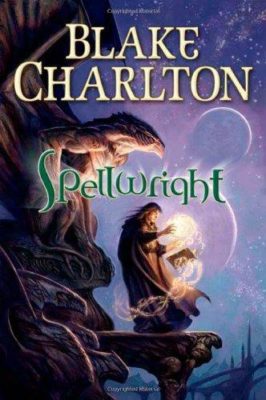 I generally use Wikipedia to look up pub dates for books I am reading and to keep track of series orders etc. Imagine my surprise when I looked up Blake Charlton — who has three books published by Tor — and there was no entry. While I have occasionally edited a Wikipedia article, I have never attempted to write one from scratch so this looked like a good opportunity.
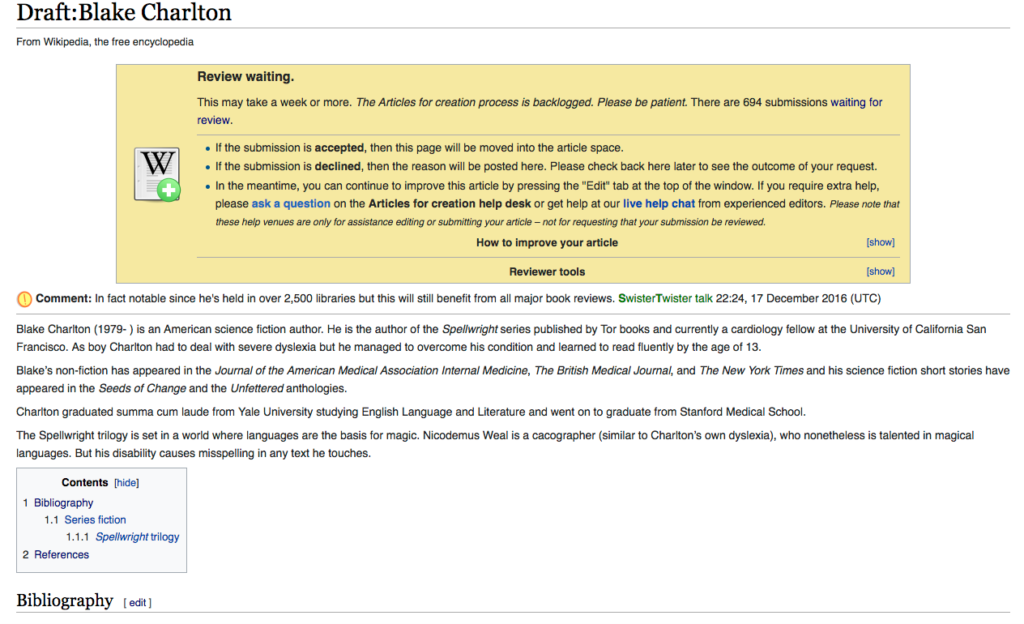
I did a brief bit of research and outlined a brief entry (see below). Then I submitted it without creating an ID. This puts it into a hold queue waiting for review from more senior Wikipedians (Wikipediaites?) to review, approve or reject.
The interface is surprisingly easy to maneuver at first but it becomes increasingly more complex and arcane as you get down to details. Which is as it should be I suppose.
The queued entry can be seen here: https://en.wikipedia.org/wiki/Draft:Blake_Charlton
Blake Charlton
Blake Charlton (1979-) is an American science fiction author. He is the author of the Spellbreaker series published by Tor books and currently a cardiology fellow at the University of California San Francisco. As boy Charlton had to deal with severe dyslexia but has he managed to overcome his condition and learned to read fluently by the age of 13.
Blake’s non-fiction has appeared in the Journal of the American Medical Association Internal Medicine, The British Medical Journal, and The New York Times. and his science fiction short stories have appeared in the Seeds of Change and the Unfettered anthologies.
Charlton graduated summa cum laude from Yale University studying English Language and Literature and went on to graduate from Stanford Medical School.
The Spellwright trilogy is set in a world where languages for the basis for magic. Nicodemus Weal is a cacographer (similar to Charlton’s own dyslexia), who nonetheless is talented in magical languages. But his disability that causes misspelling in any text he touches.
Bibliography
Series fiction
Spellwright
- Spellwright (2010, Tor Books, ISBN 0-7653-8856-8)
- Spellbound (2011, Tor Books, ISBN 0-7653-5659-8)
- Spellbreaker (2016, Tor Books, ISBN 0-7653-1729-2)
References
- http://dyslexia.yale.edu/charlton.html
- https://nl.wikipedia.org/wiki/Blake_Charlton
- http://www.blakecharlton.com
- http://www.nytimes.com/2013/05/23/opinion/defining-my-own-dyslexia.html
This entry created and uploaded as a part of the Ulysses testing process.
Instagram This Week


A Test-drive of Ulysses
A writing program
Ulysses is a writing program that I putzed with for about 5 minutes during NaNoWriMo but didn’t look at again. Then it turned out they were offering a few free copies of the software to lucky contestants in a draw. I entered. I won. So now I have my own fully functional copy of Ulysses to play with.
It features iCloud syncing, sheets that can be merged etc, export styles, and attachments. Ulysses is designed to make writing easier. I have generally used IA Writer Classic in the past because I have old version that work on my old first gen iPad. I am not sure yet if I will switch but that’s what this exercise is for.
Markdown
Ulysses uses Markdown XL for formatting functions. I have previously dabbled in Markdown on the blog but this has a few more bells and whistles. The full list of available definitions is accessible via ?9 or the toolbar’s A| button.
I am writing these all down again as a reminder to myself and to practice getting used to the language.
Heads (preceded by pound symbols — one for each level)
quote: preceded by greater than (>) symbol
emphasis is ?I or a bracketed by single asterisks (*)
Bold is ?B or a bracketed by double asterisks (**)
A divider is 4 dashes
——
Lists
- unordered lists
- are preceded
- by a dash
- and a space
- ordered lists
- are preceded by
- the numeral,
- a period
- and the space
Add highlighted text (bracketed by double colons ::) or deletions (bracketed by double vertical bars ||)
Comments are bracketed by double plus symbols ++you can see this comment only because I overrode the code++
…or are paragraphs preceded by double percent signs
%% This is a comment paragraph, again visible
because I used code to override
Text Objects
A Footnote1 Type (fn), enter your footnote text and hit Cmd-return
To add a link, type square brackets [ ] around a word or phrase (or use the ?K shortcut).
To add an annotation type curly brackets { } around a phrase, It is basically a note added to that phrase. I don’t think it exports.
<a href="sample code> is done by bracketing with the tick mark (found under the tilde). Entire paragraphs can be done by preceding with double single quote marks
code code code code etc
Executable code that won’t show in a pdf but will in a html doc can be made by using Raw Source: bracketing with double tildes or paragraphs preceded by double tildes.
So this ~~<a href="http://www.neverforever.ca">A link to neverforever.ca done manually in html</a>~~ appears as this:
A link to neverforever.ca done manually in html
And finally, here’s a link to a pdf 
And that’s it for the Markdown portion of Ulysses. More to come…
- This is a footnote (it appears at the bottom with an automatic link) ?
Reposts etc.
When I started up neverforever.ca I had intended it for a broader audience than my personal blog so that meant making some attempt at promotion was called for. Besides sharing links for each post on Facebook and Twitter, I also answered a call from threesheetsnw.com to provide content for their site aggregator. They would repost the first couple of paragraphs and or images from a post that they thought was appropriate for their readership and then link to my site for the balance. They didn’t pick up every post I made but did contribute significantly to the traffic overall.
But not so long ago I was looking at the site stats and noticed that a whole bunch of viewers —hundreds! — of my post about my trip down to LA had come from the same site — which was actually someone’s e-newsletter. Seems Cruising Compass had picked up the story and republished an excerpt and link in their weekly newsletter and of course also on their home site, BWSailing.com, under the heading Website of the Week (A West Coast Journey: Not So Offshore).
Now I in no way mind that they did this, but I do wonder at the lack of permission seeking or even notification. I would never had known about it if I hadn’t investigated the spike in traffic. I originally had thought it was due to my latest post , but quickly realized that it was for a post that was over a month old. That led to discovering the above. But, as they say, any publicity is good publicity…
Movie Time?
Guess who got a new action camera? I picked up a SJ4000 from 6mega for only $120. I decided to go for it after watching a review of different underwater cameras by Gone with the Wynns. It comes with an underwater housing and a bunch of mounts. And hey, for 120 bucks how can you go wrong?
Seriously though, I am hoping it will make getting some good sailing footage much easier. Now I just have to wait for sailing season…
My ride home from buying microSD cards. It’s always something…
I’m a novelist…Not!
As of right now I am 49,359 words into NaNoWriMo (National Novel Writing Month), a self-regulated challenge to write a “novel” in less than thirty days. For the purposes of the challenge a novel is loosely defined as 50,000 words. This mean that in order to successfully complete the challenge you need to write approximately 1600 words each and every day. Hopefully with this entry I will complete my last 700 words one day early and be able to finish off a few other writing projects that have been back-burnered.
So why do it? Well if you visit nanowrimo.org/faq you will find lots of who’s, what’s, where’s, and why’s, but frankly it is simply a way to get people writing, stretching their brains and exerting their creative muscles.
It actually sounded pretty easy. I set up a chart that marked 1700 words a day with a target of writing 2500 words a day and then taking weekends off. Then I challenged myself to write 3000 words a day as a personal goal. Well, the first four days I easily wrote my 3000 word goal, and then only managed to do it again for four other days. Life can get in the way and creativity is apparently not an infinite resource. Who knew? Sometimes you just can’t go on in the face of your own personal doubts or sheer boredom with continuing down a path that seems to be going nowhere. And I found that I couldn’t afford to go back and edit or even proof what I had written; if I did I would get caught up in rewriting and spend two hours and only add a couple of hundred words to the count. And eh count became all important as the days slipped by.
But back to my strategies. I know from years of personal experience that home is not my productive place. After spending most of the winter in Victoria’s library watching Leslie be productive, I decided to find a home in our local branch for the duration. Daily I showed up just before opening time at 10 am and joined the queue. Most days I got the same carrel although once or twice I missed out and had to substitute another. I wore my noise cancelling headphones and eschewed a power source. That way I was fairly isolated and knew I wouldn’t be able to play any power-hungry games. The library has internet — both EPL and Shaw — but I tried to use it only for research or an online thesaurus. Most days wrote for 3 hours as I soon discovered that I was good for around 1000 words an hour and that, after three hours, I really lost focus.
I chose to write in IA writer Classic because I had it on my phone, ipad and laptop, it was able to sync files across the cloud and offered “distraction-free” writing features. In the end a pretty good choice. They have gone on beyond the classic version so I don’t know if its available any more but I still like it al lot.
And there you are: twenty-nine days of writing… sort of. And how did it go? Well, that depends.
First the numbers. I figure after this I will end up with around 51,000 words all said and done. As I mentioned I set a target of 20 days writing with 2500 words each day. Well I wrote on 25 days with a maximum of word count of 3281 and minimum of 224 words (actually the minimum was 8 but I’m not going to count that one). I might add the day-to-day achievements below as an afterthought.
And did I finish a novel? No. Not even close. In fact I gave up and restarted at least three times. I hadn’t decided that I was going to do this until a few days before the start of November, so my plan was so vague as to be almost nonexistent and my outline was a quick sketch based on a a few writing advice sites. It looked pretty much like this:
**Hook**
How can you escape when you bring it all with you? Just go…
**1st Plot Point**
*Conflict: why there is a story*
Running from death of family
*Journey of discovery*
***Pinch Point***
*apply pressure to character*
Hole in the Wall Rapids
**Mid point**
*move from reaction to action*
Arrive Broughtons. Reading log book
** 2nd Plot Point**
*obtain what is necessary to go forward*
Defining fear
***Pinch Point***
*apply pressure to character*
Windlass shot. Boat almost sinks
**Resolution**
*What does the ending look like?*
Killer whales hunting porpoises
It wasn’t much. I even had to come up with a title to sign up for “contest” so I simply called it Go. After I started, I think I hit about 6,000 words that were written in order before I got bored and skipped ahead to another scene/chapter. And it pretty much went to hell after that. I was aiming for literary fiction since I figured that’s where the bigs bucks were (it’s a joke people) but frankly, despite the amount of literary stuff I have read, I have never really grokked it. I spent time with the a Miriam Toews novel that was on the shelf behind my carrel and started lugging around Tom Wharton’s Icefields to use as inspiration. Next I started adding in different viewpoints and trying my hand at bitter and resentful. I flipped for 1st person to third person and back again. But eventually I just couldn’t go on. A lot of the reason I abandoned it comes from the 1500 words a day pressure. There was no room to go back and rewrite or reshape and so I found I was forced to either continue drifting or just restart.
So I took a break and did some other writing and added the word totals to the challenge. I figured fair was fair and writing was writing. Including this blog entry… so if you don’t like it, then tough.
Okay, so I had determined I wasn’t going to write any of my own particular poison (schlocky Sci-Fi) because A) there was no money in it (not so much a joke this time), and B) it wasn’t going to teach me enough about my potential to be a famous writer, so that left my next favourite genre which was humour. So I started again, recasting the characters and telling the same story from a completely different viewpoint. And it was fun. For a while. And then it got boring — both the exercise and the story. And while I was willing to accept the exercise being a drag, no one wants to read a humour book that isn’t funny. Seriously. Being consistently funny is hard.
My next strategy was to go for a short story. I had a pretty good idea what the conclusion of my story was going to be, so why not try and compress the whole thing into a short story. The problem with that was that I hate short stories. I have read a lot of the classics courtesy of a short story course in university, but frankly they always left me wanting. Still, you never know; nothing ventured etc.
I did it. 6800 or so words later I had a beginning, middle and end that I might, maybe, someday be willing to show someone. Which is more than I can say about the preceding 35,000 or so words. It would need a lot of editing and rewriting but it was a story. Of course it left me 8000 words short and I had just blown my big story idea.
Another idea, one which I know very little about but had been floating around for a month or so, was trying my hand at a piece of creative non-fiction. I had been toying with the idea of writing up some of my thoughts and experiences of our year away but had a lot of concerns about publishing my personal opinions about other people or experiences that could be discerned as hurtful. I also have a notoriously vague memory that likes to compress time and events into wholes that, while generally truthful are not entirely accurate. So I’d been talking to Land C about creative non-fiction and the boundaries and limitations of this “new” genre.
So I decided, well, to hell with research, why not just start swinging. I’ve done a lot of blogging over the years and am pretty comfortable with the travelogue but what was missing was my interpretation of what it was I was seeing and maybe some back story about why I see the world the way I do. So with my personal ignorance safely riding up on my shoulder, I set out to tell the story of why I (we) decided to leave everything behind and live on small boat for a year. The next 8000 words zipped by and I barely got started. I have no idea if the attempt at introspection works and I do know that it will need a lot more humour if I want to avoid insulting everyone I know but who knows if it will ever see the light of day anyway. I also have a lot of thinking to do about the wholeness of the truth and the honesty of including/excluding people in a story that can never be wholly my own. As well I have to think about the value of describing events or incidents from the perspective of emotional lows and highs; the resulting distortion is valid and real in the moment but presents a skewed perspective that can be damaging to the story and even to the ongoing relationships you have to have with reality. In short I have a lot of thinking to do.
Which brings me to the conclusion. Or conclusions I guess. Just what did I come away with? I have never been one for rewriting but I have to say this exercise has taught me that even though I generally don’t want to go back, the simple fact is that writing anything over 3000 words demands, actually demands, that you go back and rework and recast. Resisting that unsought-for imperative was probably the hardest thing to do during the month.
I also now know that 3000 words a day is still a breeze — I knew that from my essay writing days as an English major — but writing 3000 words a day, or 3000 words a week that flows from page to page and idea to idea is so hard as to border on impossible. Especially if you are trying to be creative, maintain a style or voice and still consider the readers’ reactions and engagement. Freakin’ hard. I have much, much more respect for those writers that manage to weave those stories, to balance and manage those images and ideas that make a story more art than craft. The craft is hard, the art is likely beyond me.
I also realized that the genres and the boxes that we as readers and we as publishers like to put books into are the very things that should be the enemies of all writers. Doing the expected is a trap that no one will appreciate one one-hundredth as much as they will when you are breaking the rules. And that’s hard too. Really freakin’ hard.
So there you go. 29 days. 51,036 words. And a lot of spent brain cells.
