Private Moorings? Le Sigh…
We’ve only been cruising the PNW for five years or so and it is already starting to bug me. Every year when we set out, anchorages that we enjoyed the previous year are now limited or inaccessible because of private mooring balls. Entire harbours are now full of permanent moorages and any hope of anchoring has completely disappeared. And try as I may to see both sides of the issue, it really bugs me.

The Rules
The first thing you have to realize is, in Canada at least, that the waters of the Salish Sea fall under the control of the Federal Government. That means while derelict and abandoned boats (another issue entirely) are becoming problems in many harbours, there isn’t a clean and straightforward path for the various jurisdictions to deal with them. Places like Nanaimo and Victoria have been working for years to clean up the mess of boats and are faced with issues like legitimate authority, murky ownership and disposal costs.
One of the things that has seemed to help is that the Canada Shipping Act 2001 (CSA 2001) now includes specific regulations on how to mark private mooring buoys. This included contact information. It further states that when a private buoy does not meet legal standards, the Minister may remove or order the owner to modify it to meet current standards. And The Navigable Waters Protection Act (NWPA), which protects the public right of navigation in all Canadian waters, states, “No work shall be built or placed in, on, over, under, through or across any navigable water unless it is approved by the Minister.” And Transport Canada considers mooring buoys as “works” under the NWPA. Of course enforcement is spotty. Or, more accurately, almost non-existent where it doesn’t interfere with commercial traffic.
I can’t believe every single one of the new “legal” moorage buoys I have seen has been reviewed and approved by the Feds. And given the strange triumvirate we have up here in Canada between the Coast Guard, RCMP, and Fisheries Department, I am not sure who is actually responsible for enforcement (I think the Americans got this one right with their Coast Guard). And I can’t imagine that any of them wander around with a database of GPS coordinates detailing “approved” buoys; as far as I can tell there are no licence or registration numbers attached to private buoyage and no other way to track them. I do know it is often left to local government to deal with any issues arising in their local waters and only in larger urban places like Vancouver, Victoria or Nanaimo have I heard of any successful regulation.
I suppose there is some consolation in the fact that at least the newer buoys popping up everywhere tend to conform to the regulations. But it doesn’t really seem to make the problem any easier to deal with.
Mooring Positive
I am not completely down on mooring balls. A couple of years ago I was looking for a temporary place for our boat and a friend had a new mooring buoy in Degnen Bay that we contemplated using. I also found a few to rent in places like Cadboro Bay and Tsehum. A mooring buoy would have been a great, cost-effective option for us and I really appreciated the opportunity. Finding moorage is often difficult and expensive, and it is one of those factors that tends to make boating a more elite activity, Imagine if you had to pay to park your car in your garage. It would make you think twice about owning one.

Private moorings outside Gibsons mean there is more room for everyone.
And a good mooring field can cram a heck of a lot more boats into a harbour and — if done correctly — can do it much more safely and effectively than just having a bunch of boats anchored out all year. If I lived on the coast full time and could have a permanent moorage for a reasonable one-time cost I would would be pretty gung-ho. Owning a boat has been a long-time dream for me and who am I to deny anyone else something that takes them closer to their dreams.
Private moorings can also make bad or mediocre anchorages safer to use. And rather than building one of those monster docks that seem to choke the the life out of the shorelines of places like Pender Harbour, boats can be kept out on a mooring making the whole shoreline more beautiful. What could possibly be wrong with that?
And while I won’t swear they are better for the environment up here in the PNW, they are used to help save the sea bottom in the tropics. Who knows how much better the crabbing would be if we stopped tearing up the bottom in popular anchorages. (OK, maybe it’s not that likely but still…)
The Parker Ridge Effect
The dilemma for me falls under a phenomenon I refer personally to as the Parker Ridge Effect. Parker Ridge is a short but steep hike in the Canadian Rockies that takes you to the top of a ridge overlooking the Saskatchewan Glacier and the Columbia Icefields. I first hiked it in my early 20s and blithely cut across the switchbacks and trampled the delicate alpine terrain with no thought other than to get to the top the quickest way possible. Years later I went back and the entire trail was marked with “No Cutting Across…” and “Stay ON The Trail” signs and had huge areas blocked off for trail rehabilitation. And I quipped something along the lines of “If only the other people would stop wrecking things for everyone, then I would still be able to cut across the switchbacks…” I received a baleful look in response and I dutifully stayed on the trail.
Because you see, it’s not that shortcuts (or mooring balls) are in any way inherently wrong, and it’s also not (unfortunately) that there are idiots out there wrecking it for the rest of us (although there are). The real issue is there are too many people all wanting to do something the local environment can’t handle. And if we don’t regulate it (a word that occasionally makes me shudder), then the combined selfishness and/or thoughtlessness of us common people in pursuit of our own, largely innocent goals, means that eventually it will be unavailable to everyone. And that, as much as it irks me, includes me.
The Downside of Private Balls
First and foremost they are crowding out anchorages. I mentioned Degnen Bay. The only place left to anchor here is in what is (according to a local) technically a seaplane right-of-way. Silva Bay also has virtually zero anchorage space left. The same for Telegraph Harbour. I laugh every time I see Tsehum written up as having an anchorage. When we visited Ganges in May, I kept an eye out for anchoring room and didn’t spot a single place left where I might want to drop a hook. And places like Garden Bay, Nanaimo, Heriot Bay, and Montague all had less space than last time we’d visited due to private mooring balls. I get that locals want inexpensive and convenient moorage, but not all cruisers are wealthy yacht owners and $50-70/night at a marina is a big hit. Visiting boaters want inexpensive and convenient options too.
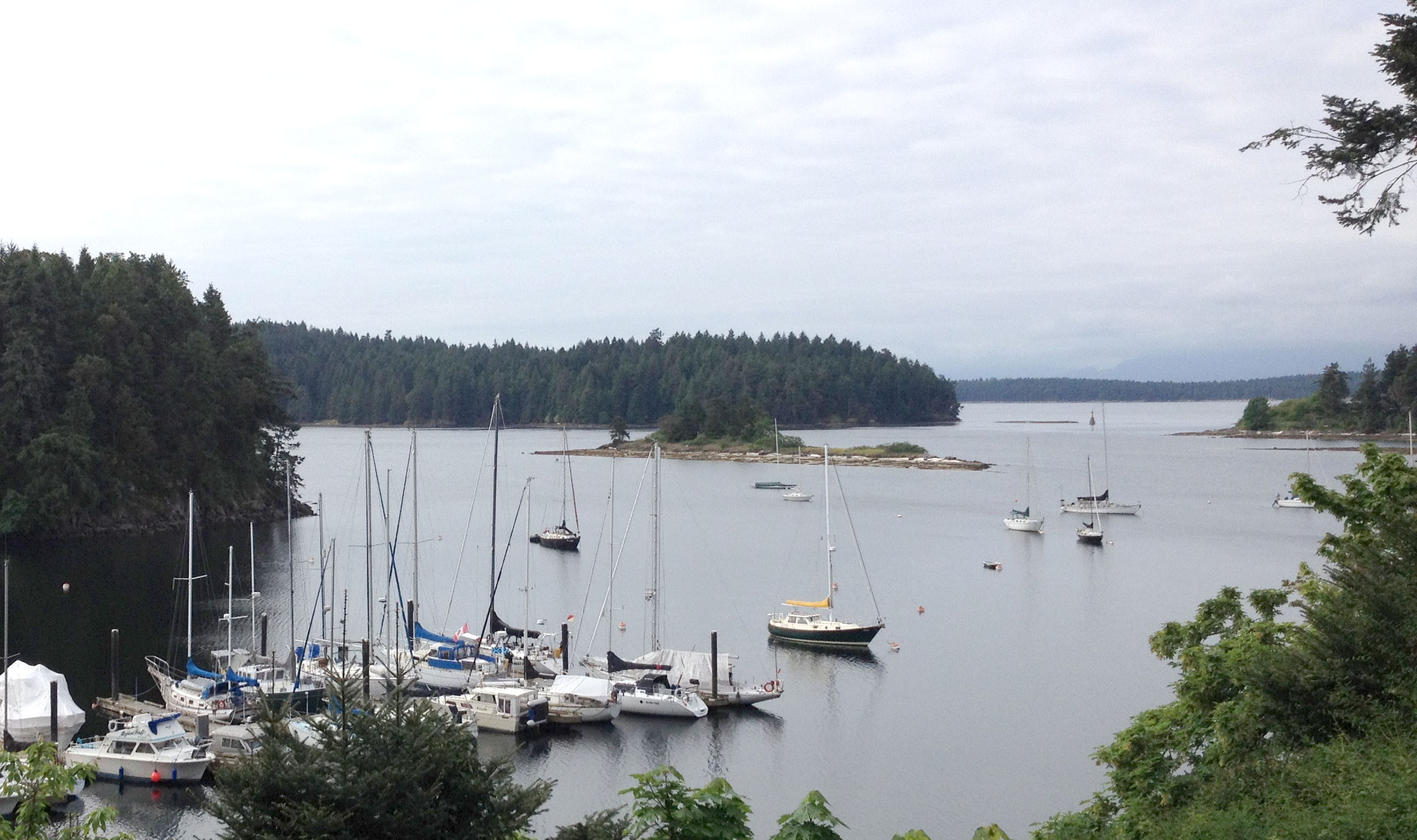
Not much room left in Degnen Bay.

Degnen Bay from the other angle.
For relative beginners like us, another thing that is really irksome is that anchoring in the mix of randomly spaced mooring balls and other anchored boats is hard. A boat on a mooring line doesn’t swing the same way, and with multiple mooring balls in the anchorage, distances that are already tricky (for us) to judge suddenly become a geometrical nightmare. And if the mooring balls are empty or occupied by a dinghy, we have no idea how much swing the owner’s boat will have when (or if—more about that later) it returns.
Funny story. I was caught out in Garden Bay when I went to anchor in our favourite spot off the Royal Van docks. Our spot was occupied by an old aluminum boat tied to what I thought was a mooring buoy. So I grumbled a bit and anchored some distance over with lots of room for the owner of the mooring buoy to tie up a fairly large boat. Half a day later the aluminum boat was ominously closing in on me, and I was starting to doubt my ability to judge distances again. That evening the owner showed up in a slightly larger aluminum and told me that in fact the float marked the end of his (permanent) 150 foot anchor rode and that we were destined to go bump in the night. So we moved.
What this does illustrate —even though it was, in the end, not so much about mooring balls — is that if permanent moorages are made badly or thoughtlessly, they are just plain stupid. We’ve all experienced an anchorage where the first few people in haven’t been overly considerate and a cove that could hold 10 boats now only has room for 4. But that situation resolves itself eventually as people move on. When people are being thoughtless about where they drop their permanent mooring, then an anchorage can be virtually ruined for anyone else on a permanent basis. Not cool.

Mooring ball or anchor? You tell me…
And since the balls are private, they take up the space even when not being used. And I know for a fact that some of these moorings go unused for long periods of time. I even know of a few people who have dropped moorings in places on the off chance they may need them later and have no intention of using them. I suppose some people will go ahead and tie up anyway and move on if the owner comes back, but that’s not really my schtick. Especially if it involves an already-crowded space and the potential of having to relocate in the middle of the night. So all that previously useful communal anchorage space is now taken up by a bunch of seldom-used or unused private balls. Talk about inefficient.
So What’s the Answer?

Sure some of them are park buoys, but those are mostly empty. Except for a few anchored boats, the rest are private ones in one of my favourite anchorages.
Realistically? There isn’t one. Like all Parker Ridge Effect scenarios, growth in popularity and ease of access means the amount of people wanting cheap moorage will continue to grow and transients are, by their very nature, at a disadvantage. The congestion is just going to continue and likely get worse; unless we start spending tons of tax dollars on regulation and enforcement — and frankly, it wouldn’t work any better than posting speed limits prevents speeding. And to be fair, I guess that a lot of cruisers occupy the “tourist” slot and it’s not unreasonable for them to contribute to local economies by paying for their moorage. But we took up cruising to avoid that “tourist” stigma, and I while I enjoy a day at the docks hobnobbing and sampling the local wares, I would much rather swing on my hook in Mark Bay and stare at the lights of Nanaimo, happily self-sufficient. That is, until there’s no more room left for me.
Disclaimer: a lot of the preceding is based on my own personal knowledge and interpretation of the rules governing mooring and I did some background research but make no guarantees about the completeness or accuracy of the facts as I state them.
—Bruce #Cruising
Instagram This Week


Spring 2017 Roundup
April 20–June 16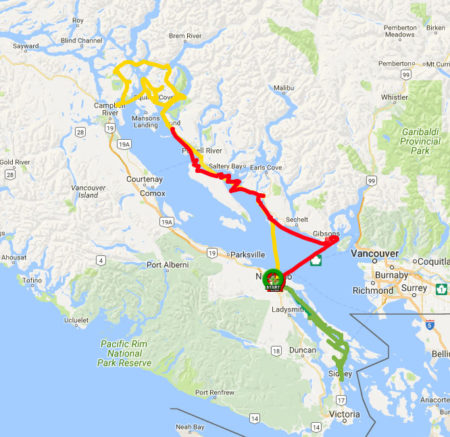

Well, we are back from our first—and likely only—cruise this year. And I think I can safely say it was a success. We saw some new anchorages, hiked some new trails, met some new people, had some great sails (and finally some good downwind ones) and learned quite a few things.
Quick Numbers
- 58 days
- 8 (-ish) weeks
- 434.8 nm (805.3 km) travelled
- 26 days traveling
- 8 marinas visited
- 20 nights in a marina (only 8 were paid for—the other nights were in our home berth)
- 33 nights at anchor
- 5 nights on the hard
- 0 nights on a mooring ball
- 7 new anchorages visited
- 5 popular Desolation Sound anchorages that we had to ourselves
- 1 new marina visited
- 120′ of new G4 chain
- 4 new motor mounts
- 2 pieces of teak refinished
- 0 whales, dolphins or any other large sea mammals 🙁
- 681 images captures
- 333 film clips (62 gigabytes of files)
Our Summary
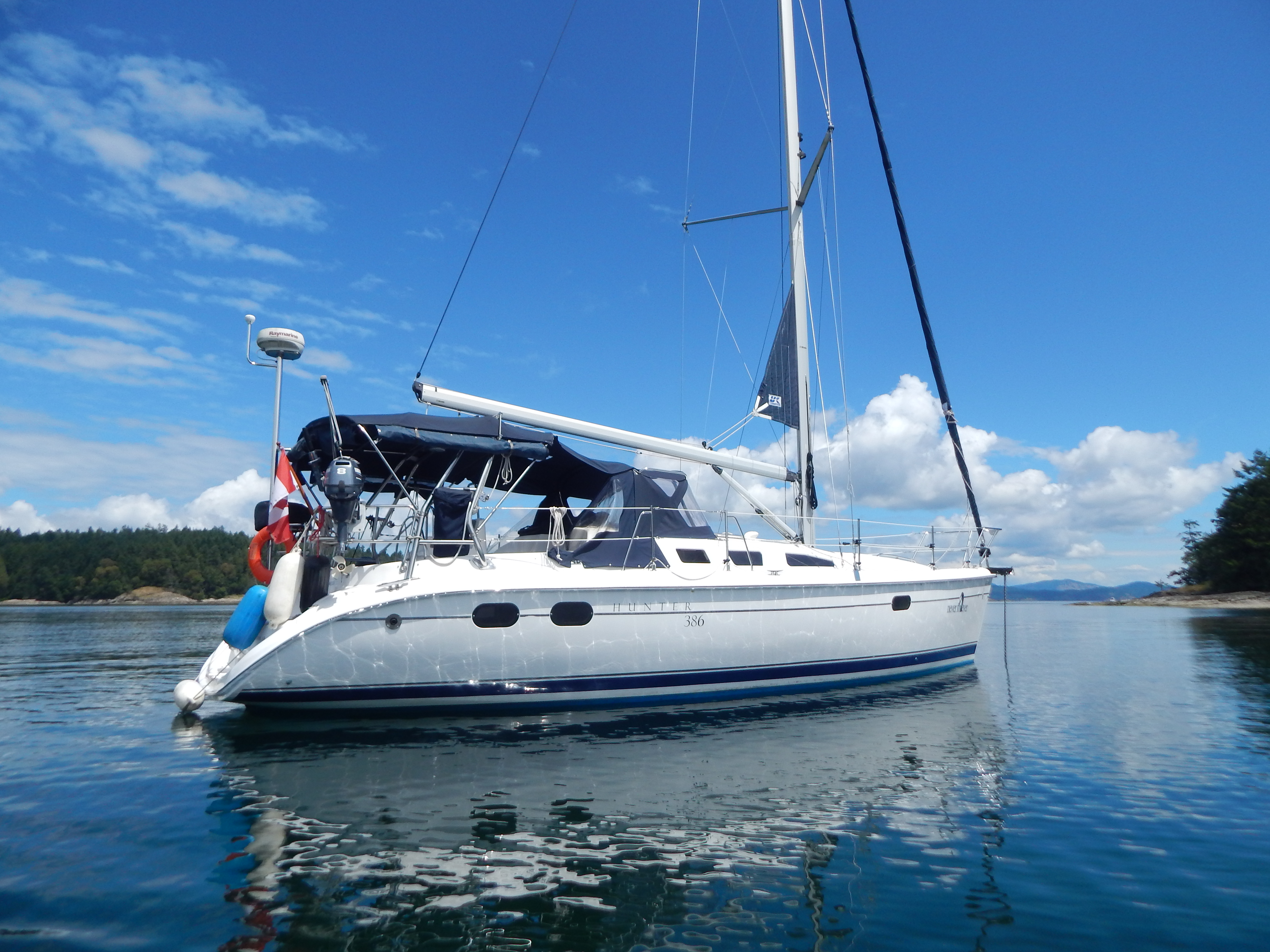
We had so wanted to make it back to the Broughtons, but after talking to a few of the marinas up there about services in April, and the fact that Leslie was going to break up our trip by flying to YYZ at the end of May, we decided to limit our trip to Desolation Sound. And it was magnificent. Over and over again we had popular places like Smuggler Cove, Garden Bay, Laura Cove, Squirrel Cove and Teakerne Arm all to ourselves. For the first 25 days our definition of a busy anchorage was 4 boats. And when we headed south in mid-May you could see the stream of bigger boats heading north and we smirked in self-satisfaction.
Sure there was rain. And cold. But on average we saw some blue sky every second day and there were always times we could go for a hike or walk without being poured on. We quickly settled into a 13° C rule (55° F). If the temperature in the cabin was 13° or lower when we (I) crawled out of the berth, then we fired up the Webasto diesel heater. If it was 14° (60°F) or higher, we just boiled water for tea and toughed it out with blankets.
And the weather meant we moved a bit more than previous trips since there was less lolling around in the sun. In the past we have tended to try to stay 4 nights and max out our battery capacity before heading to a marina to do a bulk recharge. But since we were only staying in anchorages 2-3 nights, generally the couple of hours engine time going from one anchorage to another was enough to recharge the batteries sufficiently to keep ahead of the dreaded 50%-discharged level. And that saved us tons of marina fees.
The only downside of the trip was we when we both caught colds and discovered that rain + colds + wilderness anchorages = misery. So we spent a few unnecessary days tied up at an off-season resort (cheap!) and pampered ourselves with unlimited heat and hot showers.
And we had some great sails. Maybe not as many as we had expected, but it was nice to sail in moderate winds for once. It seems too often on this boat, we have sailed in light winds or reefed down and holding on for dear life. And we got some good downwind sails in 10–20 knots — and I finally experienced the real deficiency of the B & R rig. In Ganges, I ran into a fellow with Hunter 380 who had spent ~$9000 to add a slick roller-furling gennaker to compensate for the poor direct-downwind performance, but at that price, I think I will stick to just gybing my way downwind. At least cranking in the main over and over is good exercise.
Conclusion
Will we do the early-season trip again? I sure hope so. We had a ton of fun and there were very few negatives. If we can continue to cover most of our boat ownership costs with July-August-September charters, then having the boat for up to 2 and half months in the shoulder seems a perfect solution. This year we were off mid-June because we had a charter booked for the last two weeks of the month, but I might consider not doing that next year as it would be nice to finish off the cruise with some really warm days for ourselves. But then again, maybe not. We had some nice days and I remember all those boats heading north—I wonder if we might be turning into sailing misanthropes? Oh well, there is always Alaska.
Now all I have to do is see if there is anything worth posting in all that video I shot.

The Interactive Map
I broke the map up into three legs: Desolation Sound, our return via the Sunshine Coast and the Gulf Islands. You can see some of the stats from the Navionics tracks from the sidebar or if you go to the Google maps site, although they aren’t completely trustworthy as I run Navionics on my old iPad and it has a tendency to crash—so I have to go in later and edit the tracks by hand thus screwing up the stats. There seriously has to be a better way…
Itinerary
| 20-Apr | Stones | 19-May | Smuggler Cove | ||
| 21-Apr | Stones | 20-May | Smuggler Cove | ||
| 22-Apr | Stones | 21-May | Gibsons | ||
| 23-Apr | Stones | 22-May | Gibsons | ||
| 24-Apr | Nanaimo Harbour, Newcastle | 23-May | Plumper Cove | ||
| 25-Apr | Nanaimo Harbour, Newcastle | 24-May | Plumper Cove | ||
| 26-Apr | Smuggler Cove | 25-May | Nanaimo Harbour, Newcastle | ||
| 27-Apr | Smuggler Cove | 26-May | Stones Boatyard | ||
| 28-Apr | Garden Bay | 27-May | Stones Boatyard | ||
| 29-Apr | Garden Bay | 28-May | Stones Boatyard | ||
| 30-Apr | Westview | 29-May | Stones Boatyard | ||
| 01-May | Copeland Islands | 30-May | Stones Boatyard | ||
| 02-May | Melanie Cove | 31-May | Stones | ||
| 03-May | Melanie Cove | 01-Jun | Stones | ||
| 04-May | Squirrel Cove | 02-Jun | Stones | ||
| 05-May | Squirrel Cove | 03-Jun | Clam Bay | ||
| 06-May | Cassel Lake/Von Donop | 04-Jun | Clam Bay | ||
| 07-May | Von Donop | 05-Jun | James Bay, Prevost Island | ||
| 08-May | Taku Resort | 06-Jun | James Bay, Prevost Island | ||
| 09-May | Taku Resort | 07-Jun | James Bay, Prevost Island | ||
| 08-May | Octopus Islands | 08-Jun | Ganges | ||
| 11-May | Octopus Islands | 09-Jun | Russell Island | ||
| 12-May | Octopus Islands | 08-Jun | Russell Island | ||
| 13-May | Laura Cove | 11-Jun | Sidney | ||
| 14-May | Lund | 12-Jun | Montague | ||
| 15-May | Lund | 13-Jun | Montague | ||
| 16-May | Texada Island Boat Club | 14-Jun | Stones | ||
| 17-May | Garden Bay | 15-Jun | Stones | ||
| 18-May | Garden Bay | 16-Jun | Stones | ||
—Bruce #Cruising
Instagram This Week


The Last Week
11 June
- Up around 0700.
- We are an hour away from Sidney and have a noon lunch date so will just hang out for the morning.
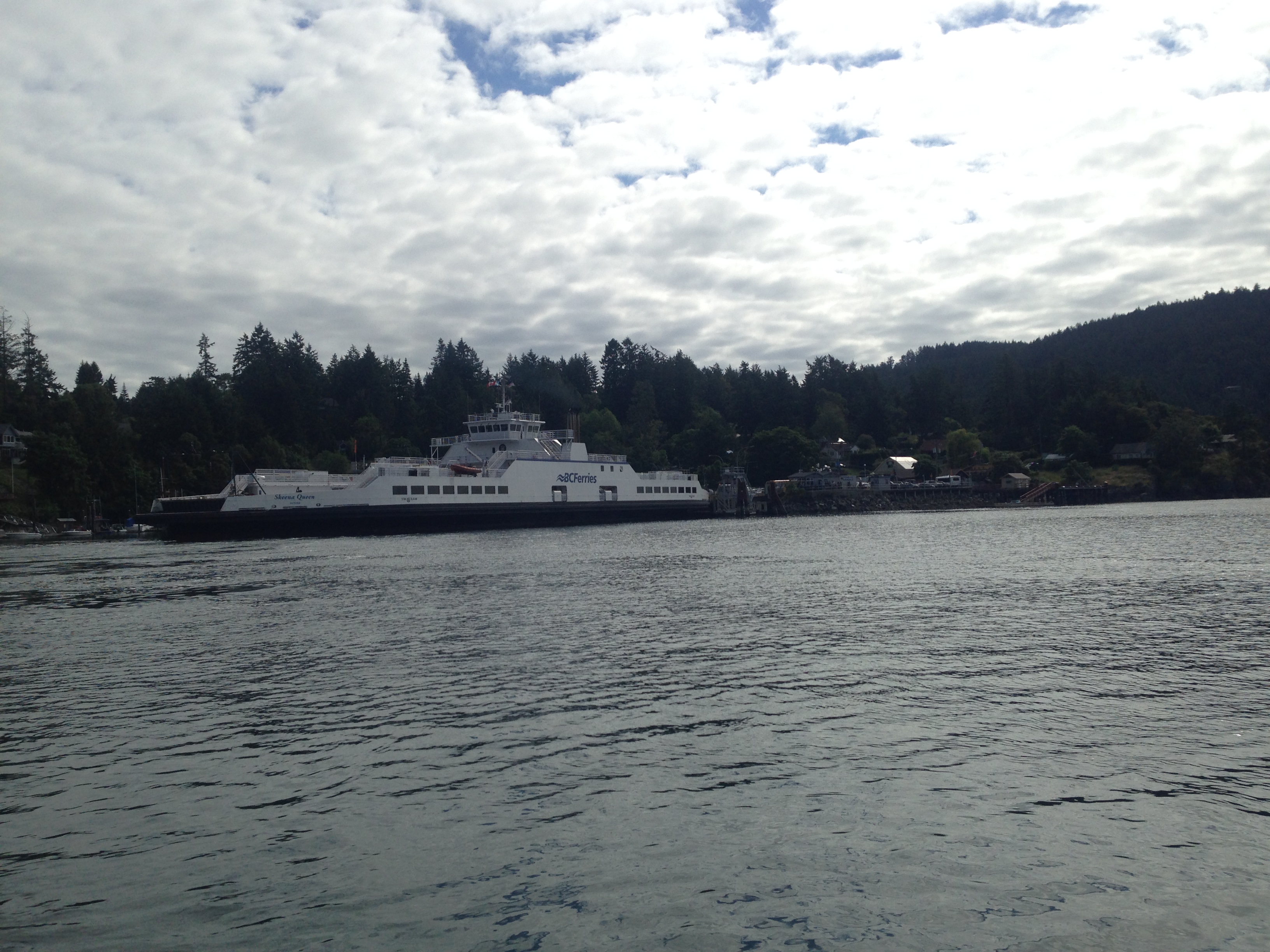
- We motor down and check out Fulford Harbour. Nice looking place except for the big ass ferry that comes and goes multiple times a day.
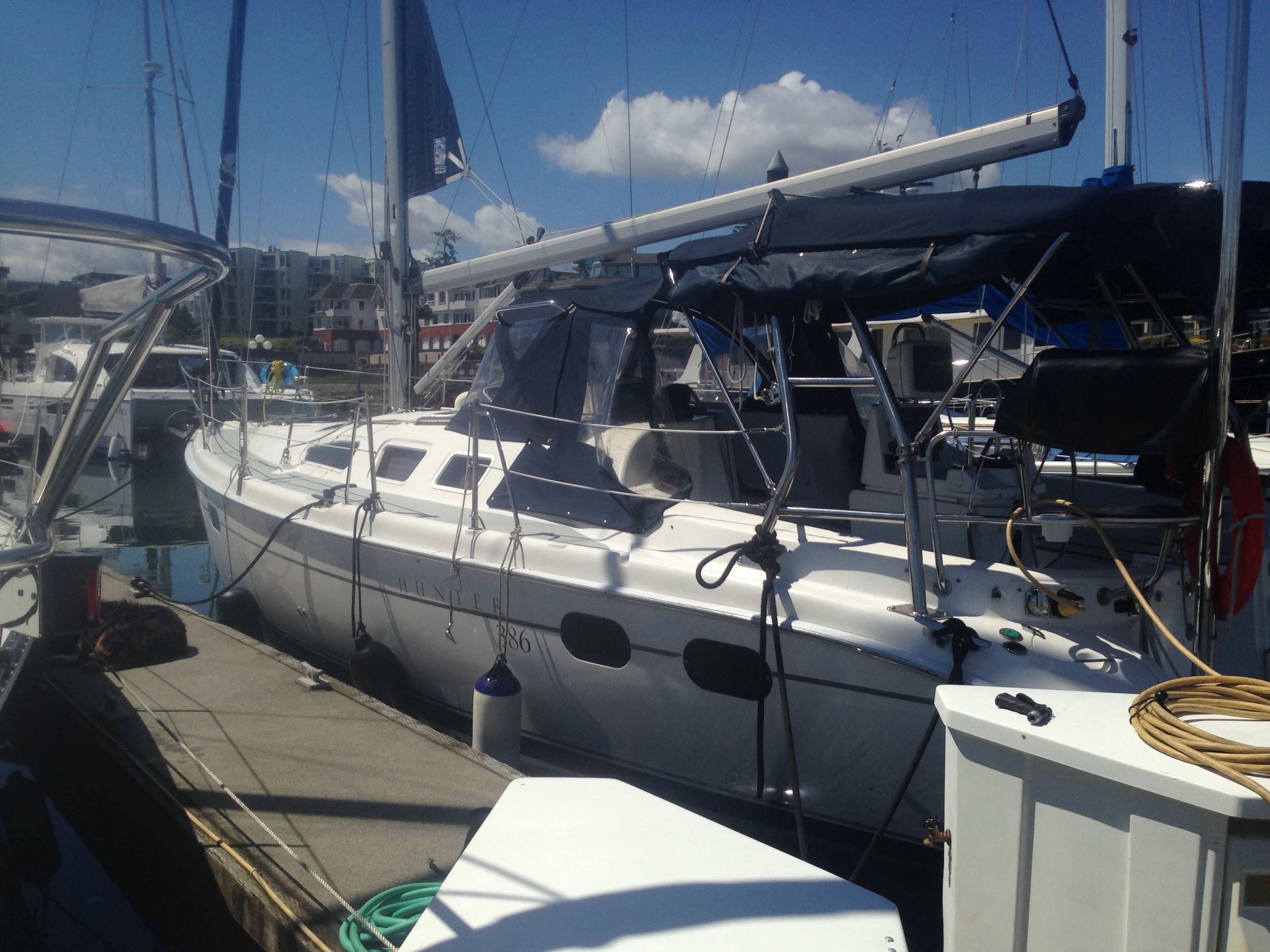
- We motor to Sidney and tie up.
- Lunch with Geo Takach and his daughter Fran.
- Laundry in the P.M.
- Then Mark and Karen pick us up and take us for delicious Chinese.
12 June
- Off the dock around 1000 hrs. I have to stop trying to turn the bow into the wind.
- Motor past Portland Island and then raise the sails.
- We are sailing with a ton of big ferries in some pretty narrow water.
- It gets even more exciting by Enterprise Reef just outside of Active Pass and the Ferries have little room to maneuver and we have a lee shore. But everyone finds sea room and no one dies.
- We sail right into Montague Harbour and drop our sails at hedge of the anchorage.
- We anchor off the marina and settle in for the night.

13 June
- I haul the dinghy up on deck to search again for the slow leak. No luck.
- Load the outboard on the dinghy and set off for the marina to explore.
- Then we head to the Provincial Park to walk the shoreline.

14 June
- We are up bright and early and head for Nanaimo to spend out last few days in the harbour. Need to make Dodd Narrows slack at 1330 hrs.
- We raise the sails in 13 knots and slowly jibe back and forth going down wind. It’s cold again.
- Just before Porlier Pass we haul in the main and motor sail with the jib. We are making 6.3-7 knots the rest of the trip.
- Winds are predicted to be 20-30 tomorrow so we decided to just head on into our slip at Stones.
- Fuel up and back into our slip for the last time around 1430 hrs.


15 June
- Rain. Not much wind though.
- I buy some cleaner for the inside of the bimini (still some algae from last winter). Hosing the underside of the enclosure in the rain…it presents an odd picture.
- We prep for a quick haulout, but then its cancelled.
- So we grab our bins from storage and start sorting and packing.
- And then the winds. And more rain.
- Looks like we are inside for the rest of the day.
- And more rain.
16 June
- Lovely sunny morning.
- Drop off a bag at Seair so they can send it on an earlier flight.
- Do the last loads of laundry for stuff staying in storage.
- Finish packing and inventorying by noon and haul everything into storage unit.
- Clean galley and then the rain starts again.
- Afternoon coffee with L’s parental units.
- More cleaning.
- Last dinner aboard.
- Finish it off with a movie in the cockpit.


17 June
- Off the boat.
- At Seair by 9:15.
- We get to fly in a Beaver (1956); always my favourite.
- Only 3 on the flight so we leave 20 minutes early.
- And a couple of hours in YVR before we are home…

Instagram This Week


The Last Few Weeks (Almost)
As our spring cruise slowly begins to wind up, I bring you even more excerpts from the logs of Never for Ever.
1 June
- I’m up bright and early. Lots of traffic on the docks as boaters (and charterers) come and go.
- Ian makes up some more epoxy and I patch the hole in the dinghy.
- I check the Velcro—the glue has not held; the sealant has not cured right. Need a Plan B. And to stop using that sealant—it has failed me in almost every application since I bought it.
- Around 2, after borrowing the car, I head downtown to pick up Leslie at the Harbour Air terminal.
- We head to Thrifty’s for replenishment. I pick up some contact cement at London Drugs. Then we drive over to Harbour Chandlers and I get a small tube of silicone seal.
- We wander over to chat with Canty. We are not able to make definitive plans but will try and hook up in the next few weeks.
- We order Ali Baba pizza (delivery) for supper. Delicious and a most welcome treat.

2 June
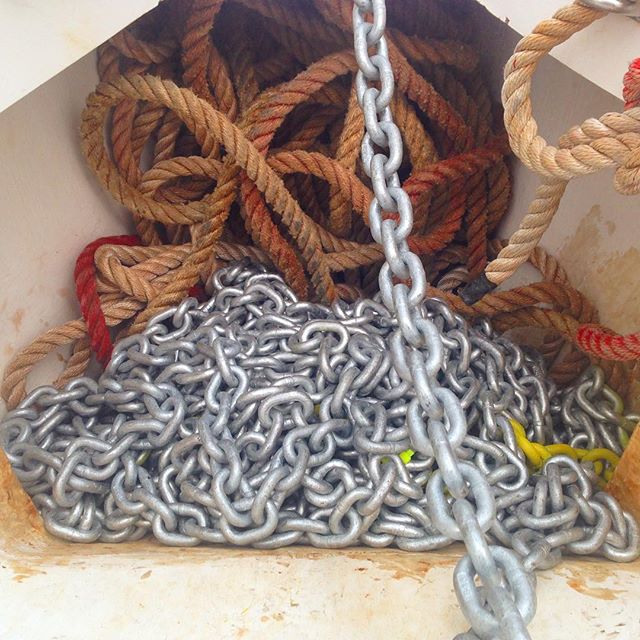
- Chain is in and Ian marks off 120’ up by the office.
- Jared comes down and checks the shaft alignment. Torques the motor mounts one last time and tightens an injector. He also tightens up the stuffing box.
- I reattach the teak and mount the flag on the spiffy refinished flagstaff.
- Leslie and I spray paint yellow in 30’ increments and add yellow zip ties on the 15’ increments. One of the staff comes by and splices the old rope rode onto the new chain. We are good to go.
- We load up the chain, rope and anchor in a heavy-duty wheelbarrow and haul it down to the boat.
- Leslie’s parents show up so we head off to the Pirates Fish and Chip place for lunch.
- Back on board we finish loading rode and anchor back on bow. We are officially good to go.
- We decide to wait another day and clean the canvas before we leave. So we spend the afternoon cleaning canvas and getting wet and grimy.
- Beth (from NYCSS) is taking out Baraka 2 with some friends for the weekend and are loading up tons of supplies.
- We also book our Iceland accommodations and tour as well as the last of the London details.

3 June
- We cast off around 1000 hrs and fuel up.
- Then we roll out the sail while we are still in the harbour and head to Dodd Narrows for the 1300 slack.
- We sail all the way to Dodds and roll in the main for a transit about an hour early. A Hunter in front of us balks twice at the entrance and on their failed second attempt we scoot by and smoothly transit the narrows.
- On the other side we raise sails almost immediately in 10-12 knot winds and start beating south. The next two sailboats, and a few minutes later Baraka 2, all raise their sails as well and we all crisscross back and forth. Eventually we all split off to go our separate ways.
- We arrive at Clam Bay, Thetis Island still under sail around 1600 having put less than an hour on the engine all day. We anchor on the south side in 20’ of water with our shiny new chain.
- Leslie goes for a long evening row.

4 June
- Lazy day.
- Around 1100 we put the motor on Laughing Baby and transit the Cut to the Telegraph Harbour Marina.
- Most of the boats from the Hunter Rendezvous are gone but we chat with Lawrence for a bit and promise we will make next year’s Rendezvous. (It will have an ABBA theme!)
- The rest of the day is relaxing in the very still waters of the bay and watching all the boats leave. There were 15 or 20 when we arrived and we are down to 5 by the time we settle in for the night.
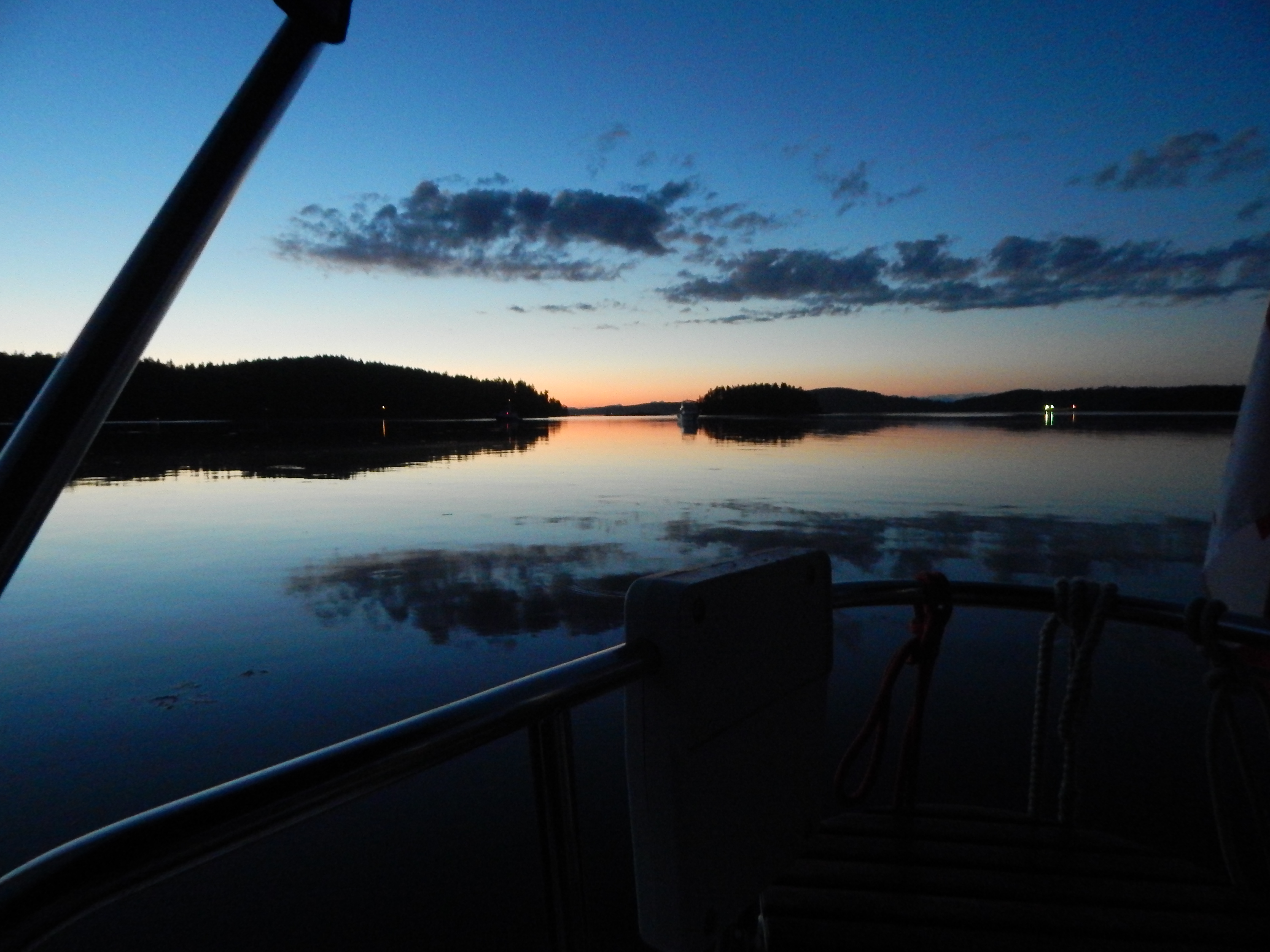
- Beautiful sunset!

5 June
- A slow morning. Only 3 boats left by the time we decided to move on.
- It’s still glassy calm, so we motor south towards Prevost Island or maybe Ganges on Saltspring.
- As soon as the water is hot, I grab a shower.
- James Bay on Prevost is our preferred destination and as we approach, it appears there are only two converted fishing boats rafted together in the deeper part of the Bay. Score.
- We drop anchor in 30’ of water on a falling tide and settle in at the end of our 120’ in about 22’ depth. Perfect.
- We row ashore and explore the mudflats before heading over to the camping area on the west side of the bay. This bay is now part of the Gulf Islands National Marine Park Reserve. We grab a map showing all the reserves and realize we have been to many of them already.
- Another quiet evening. We are joined by two more sailboats but one leaves around 8 o’clock.

6 June
- Up around 0730 to another sunny day.
- I catch up on some blogging.
- We hit the reef at low, low tide (1015 hrs) and do some exploring.
- Ongoing Bald eagle/raven battles keep us amused.
- With the motor on the dinghy we head out into Captains Passage and check out Selby Cove and Annette Cove. Two more anchorages on Prevost Island for next time.
- In the afternoon we hike up rough trails that run north along the peninsula.
- After some bushwhacking we hit the top of the hill and take some images and enjoy the sunshine and view.
- Beautiful sunny day.


7 June
- wakeup.
- loll around.
- Eventually we take off and hike inland. Then we cut across and bushwhack down into a valley before heading back to the cove. No groomed trails here but some really nice hikes nonetheless.
- Cold and rainy evening.

8 June
- Up early in the rain. Slow motor to Ganges Harbour on Saltspring Island dodging crab traps in the limited visibility.
- Tie up at Ganges Marina.
- Wind is up but the sun slowly comes out.
- We check out downtown, Black Sheep Books, acquire some back-up wine, a few souvenirs and buy a few things at Thrifty’s.
- After Eight (a 150’ yacht owned by the Wheaton family of Edmonton) comes in and ties up at the government wharf.
- Back at the boat we unpack and then head out again for a bigger tourist experience.
- We check out all the shops, talk art in the co-op gallery and smell some awesome soaps. L buys a card with a drawing of Mona Lisa— there is a series each with a different version done by a class of school kids. A great idea.
- We now have a new dish drain pan!
- Dinner at Moby’s Pub. Probably the best beef dip I have ever had. Really, really good.
- Quiet night aboard; we have wifi so we catch up on some Netflix.

9 June
- up early and watch the HMCS Raven cast off the outer dock. They leave two crew ashore who then catch up in a RIB.
- We shower, top up the water and cast off.
- 1.75 hrs later we drop anchor alongside two other boats off Russell Island, another Gulf Island National Park.
- It’s low tide so we hit the shore for a couple of hours of beachcombing along the midden beaches. Starfish, sea cucumbers and we actually get some video of barnacles feeding. I love low tide.
- The anchorage starts to fill up with 10 or 11 boats here for the night.
- While we are chatting, it occurs to me that the name of the guy who’s Bayfield bumped into us in the middle of the night had said he was headed to see a friend in Prince Rupert. And his name was Cole. And he had a Bayfield. I ran for my cellphone and loaded the YouTube app. Yup, the Cole who banged into us was Alfie from the Life is Like Sailing YouTube channel that I watch. Cole had helped Alfie take his boat up to Prince Rupert last fall. Small world—I just wish I had figured it out sooner.
- We make a reservation at Port Sidney for Sunday night—gonna go visit some peeps.
- Skipbo for evening entertainment

10 June
- Lots of powerboats=generators disturbing the morning silence.
- We take off for a hike and manage to do the whole island. Probably not more than 3 miles or so total.
- There is an old Hawaiian settlement here: apparently there were lots of Hawaiian workers who decided not to return home and settled the coast.
- Snakes! Clam gardens built along the north shore! Hidden rose gardens and massive clematis!
- We go past the groomed trails and hike to the eastern tip of the island.
- There are 21 + boats in the anchorage by the time we get back.
- A Fine Madness is a big ketch filled with students from Lethbridge. The program is called Literasea. Stuck on a boat with a dozen or so teenager? No wonder the Captain took a short walk on the island by himself 🙂
- Lunch!
- We count them up and realize we have only spent (as in paid cash for) 9 nights in a marina. There was almost a week on the hard in Stones and probably about 6 other nights in our slip. But other than that, in almost two months we have paid to stay only 9 times. Pretty sweet.
- The anchorage must be a common party spot on weekends because a half dozen of the powerboats all seem to know each other.
- Another crib blowout.
- 23 boats in the anchorage when we retire for the evening — 10 of them sailboats.


A Brief Note about Life on the Hard
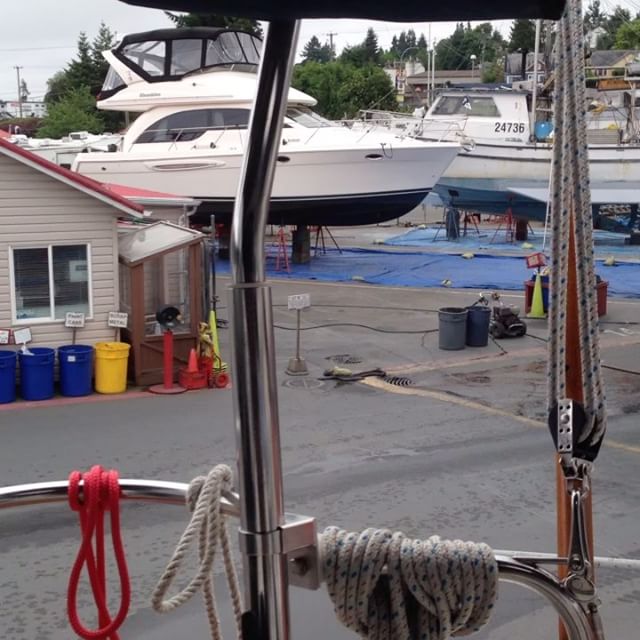
It’s another one of those new experiences that, having read about them or seen them again and again on YouTube, you think you are prepared for. Life on the hard is a … unique … experience and, while not exactly unpleasant, has very little to recommend it. Summed up, it’s sort of like getting all the negatives of living on a boat (with a few extras thrown in) and none of the benefits.

The first thing we really noticed about the hard was that the boat didn’t move. At all. I soon discovered we step differently when we are on a boat in the water; there is bit more roll in my step and my stance is a bit lighter—more on my toes, I guess. And the first time I hit the bottom of the companionway after the boat had been propped up on stands, it felt like my foot was going to go through the cabin sole. It just felt wrong and it took a few days to get used to it.
Water
The problem here is that we have no grey water tank, nor any way to redirect the grey water (grey water being what come out of the various sink drains as well as the shower sump). That means while I did have running water aboard, I couldn’t indiscriminately do dishes and drain all the scummy water onto the tarps under the boat.
I also couldn’t flush the head. That one was a bit unforeseen and we didn’t figure it out until we were getting ready to go to bed the first night. While whatever was in the bowl went directly into the holding tank, the head draws seawater through a thruhull from the stuff we are usually floating in to flush it down. No water…no flushing action.
Luckily Leslie was to be away for five days starting the day after we were hauled, so I could resort to more man-like solutions to the problem. After trying a few different methods, eventually I settled on leaving a big pot in the galley sink and collecting all the wastewater that accumulated throughout the day and then used it to flush the head at the end of the day, which was the only time I used it.
Wind
I’ve read time and time again that boats are hotter and stuffier when on the hard, and lo and behold it seems it’s true. There must be a constant breeze on the water, even on calm days, because the stuffiness has not heretofore been an issue. In the yard, it was hot and still, not to mention dusty and grimy, and the boat became pretty unbearable during the hot days no matter how many hatches I had open.
And then it turned cold. And the cold wind flowed straight into the cabin through the companionway. We’ve gotten used to swinging on the hook and always being bow into the wind. So I had to fire up the heater and leave all the hatches closed.
Noise
The yard started as early as 5 a.m. since that was when the tide was in. And It’s hard to sleep through a 83-ton travel lift rumbling past your stern again and again. And then the boat work would start. Banging, clanging, hammering and hosing, the number of different sounds emanating from the multitude of boats was an experience in itself.
And of course there were people, both staff and boat owners and trades people working from dawn to dusk. Boat yards cost money and people want to get things done. Nothing too obnoxious, but constant. Always someone yelling instructions or walking around discussing the next thing to bang on, hammer into shape or hose down.

Work

But I also had a lot of time to do chores. I stripped and refinished some of the teak, scrubbed the anchor locker (and then decided to buy new chain because I wasn’t putting the old rusty one back in my pristine locker—that, and it was almost time to replace it anyway).
I pulled my knot meter (which is so much less intimidating when you are not in the water), intent on replacing the paddlewheel that was missing one paddle. And then put it back unchanged when I discovered it was almost $150 to replace that one tiny little part. I also fixed the now shredded dinghy painter and patched some fibreglass in the dinghy’s hull.
I also tried to clean the boat, which turned out to be a fruitless endeavour. Right now, a week later, I still despair of getting some of the grime out of my non-skid. Next time I think there will be a rule that shoes need to be left at the bottom of the ladder to try to keep the truly grungy grunge out of the boat entirely. We did get most of the canvas scrubbed, but not until we were back in the water.

Odds & Ends
It was a remarkable social experience. I ran into Jim and Gwen from Sea Esta X, the Catalina 42 that accompanied us down the West Coast last September. And a few days later Tim and Donna showed up from Northwest Passage (the boat I crewed down the coast), and we had a grand visit. Everyone was back after a successful season cruising Mexico and were back to visit and wait out the hurricane season.
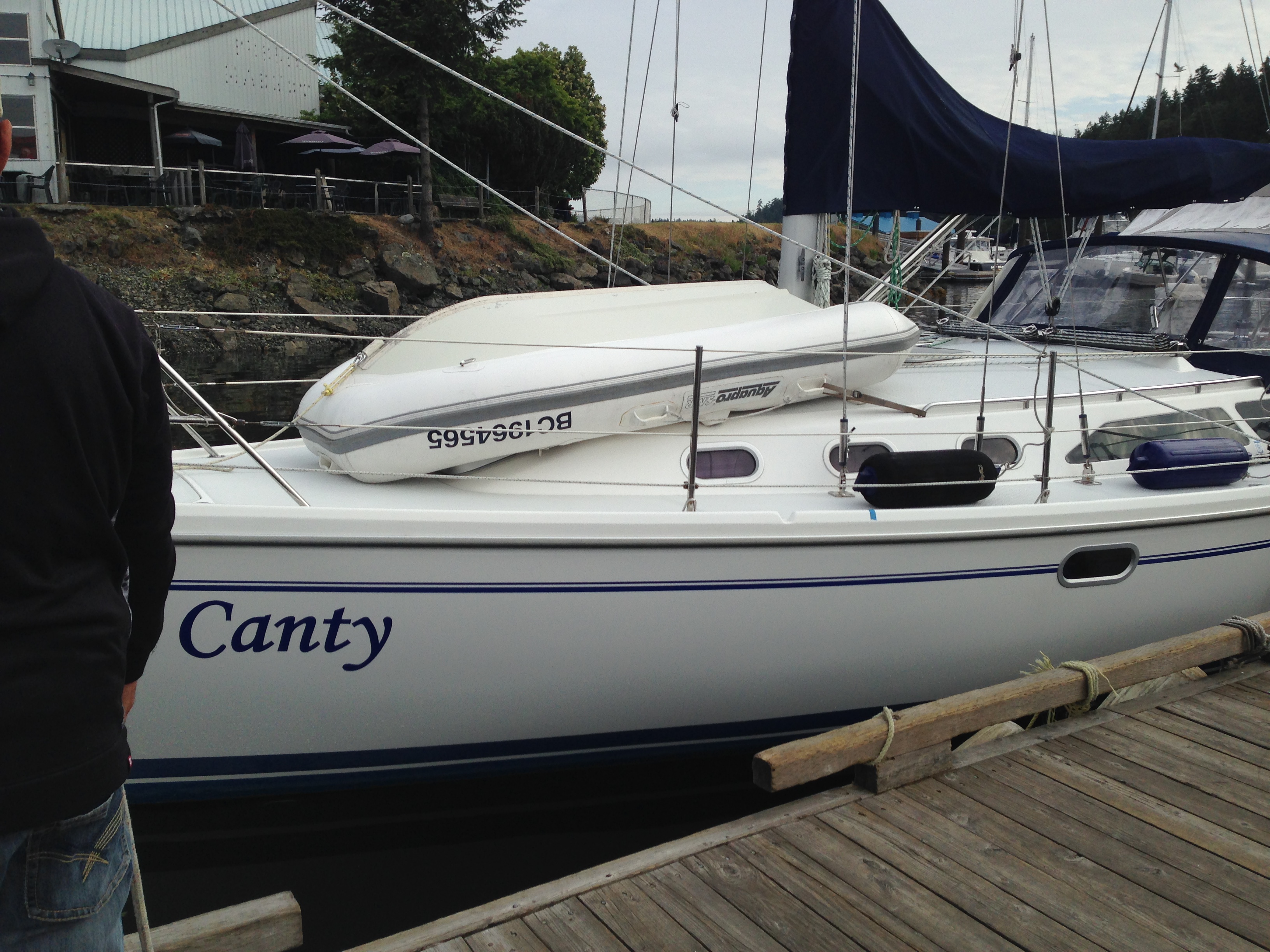
The I spotted Canty waiting to be hauled out. We had met and visited with Paul and Kirsty a few times during the first year of our cruise. They were there to haul out and do their bottom paint. It was nice to catch up and we compared schedules to see if we would meet up later in the month.

My friend Darrell from Schooner Cove also came by and bought me a coffee and we caught up. All in all, it was a reasonably social experience for being stuck in an industrial zone.

It wasn’t the worst experience I have ever had, although I think if both Leslie and I had been aboard, I would have been tempted to find a hotel. But it was sure a relief when we were back in the water and the world started to move again. Boats just aren’t meant to be still. Hopefully it will be a while before we have to endure it again.
—Bruce #Cruising, #Liveaboard
Instagram This Week
The next, next week or so
More excerpts from the logs of Never for Ever.
16 May
- Off the dock at around 1045 hr
- There is a nice NW wind and we are heading south…
- We roll out the jib and then, around noon, we raise the main.
- after a while we were back to motor sailing but around 1400 we caught the wind again and had a lovely downwind sail to the bay (Sturt) at Van Anda on Texada Island.
- Pulled into the Texada Boat club into our favourite spot around 1545 hrs.
- an American Bavaria pulls in in front of us filled with gregarious friendly boaters heading to Desolation
- Then a cutter-rigged Nauticat (very unusual) from Victoria ties up along side them. Nice boat.
- Had a lovely chat with Bob, the wharfinger. Seems the pub and restaurant might actually be reopened for the main cruising season. Bob ( his wife actually) maintains a database of batters so he always greets you by name when he comes down to the dock.
17 May
- off the dock around 10.
- it’s a grey day and the winds are 15-20 from the SE, right on the nose…sigh, Malaspina always does that to us. Maybe we should have kept going yesterday with the lovely downwind sailing.
- L is jonesing to sail so around noon she convinces me to raise the sails. We haul out the main with our nominal “first reef.”
- I man the helm for the first 20 minutes or so then she takes over. We add a bit more reef and she and skippers the rest of the day.
- We tack back and forth for 3 or 4 hours ranging from 5.5 to 6.5 knots of SOG.
- At one point we cross in front of a huge barge by a couple of hundred yards. We had the nominal right of way, but he was a tug under tow with limited maneuverability so had precedence.
- Drop sails around Quarry Bay — the same place we did last time we beat down Malaspina. Great day.
- Dropped anchor in Garden Bay around 1745 hrs
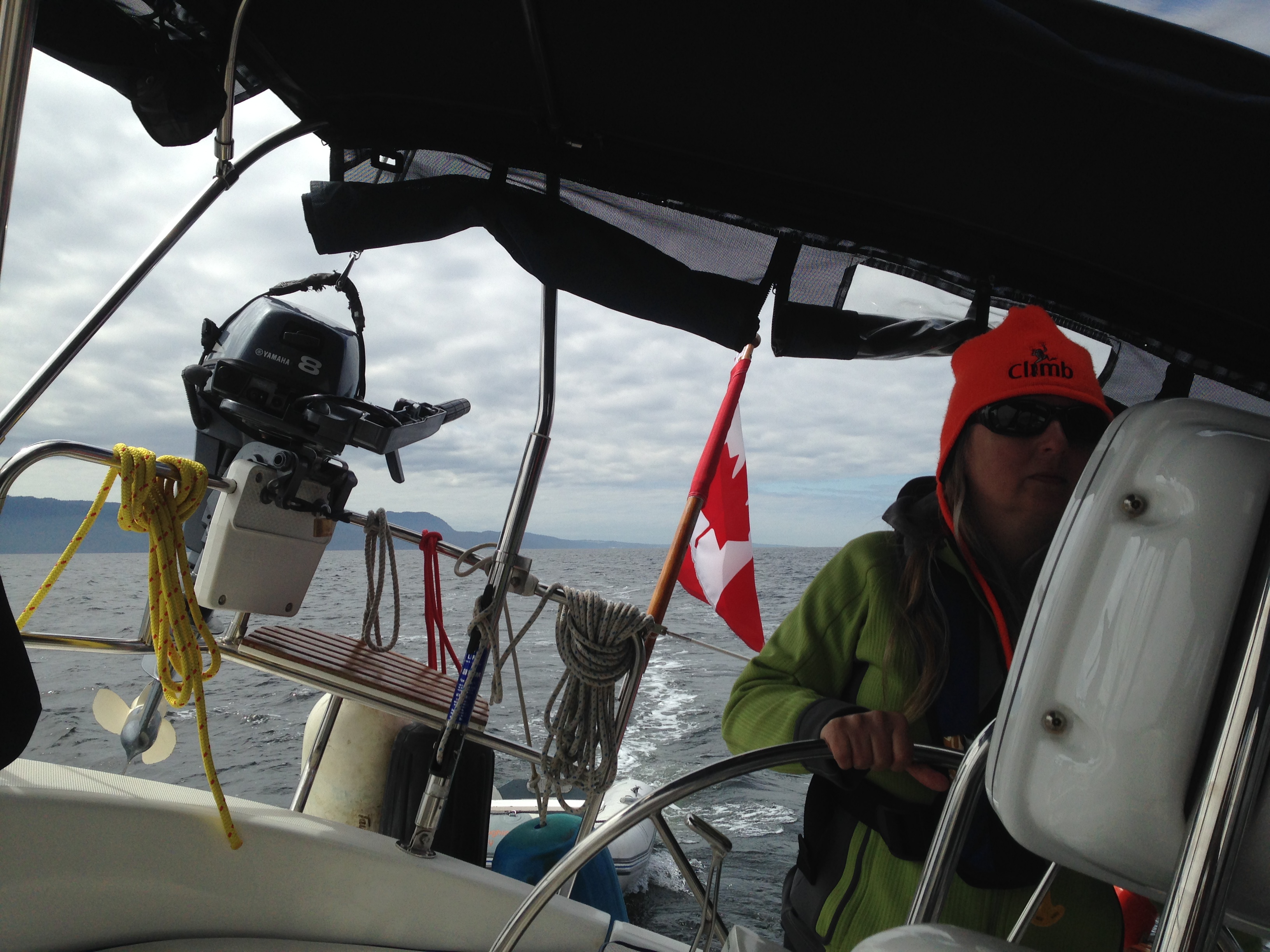
18 May
- I call the Pender Harbour Health Centre to see where L can see a Dr. about her ear. They say they can see us around 11.
- We dinghy over to Maderia Park and then meander down the Sunshine Coast Highway for 15 minutes or so, encountering our very first Turtle Crossing along the way.
- I have to say that was a great clinic. Small towns are great that way.
- We stop at the pharmacy on the way home, load up on drugs and head back to the boat.
19 May
- Up anchor at 0930.
- Fuel up on the way out and then head south to Smuggler Cove for the long weekend.
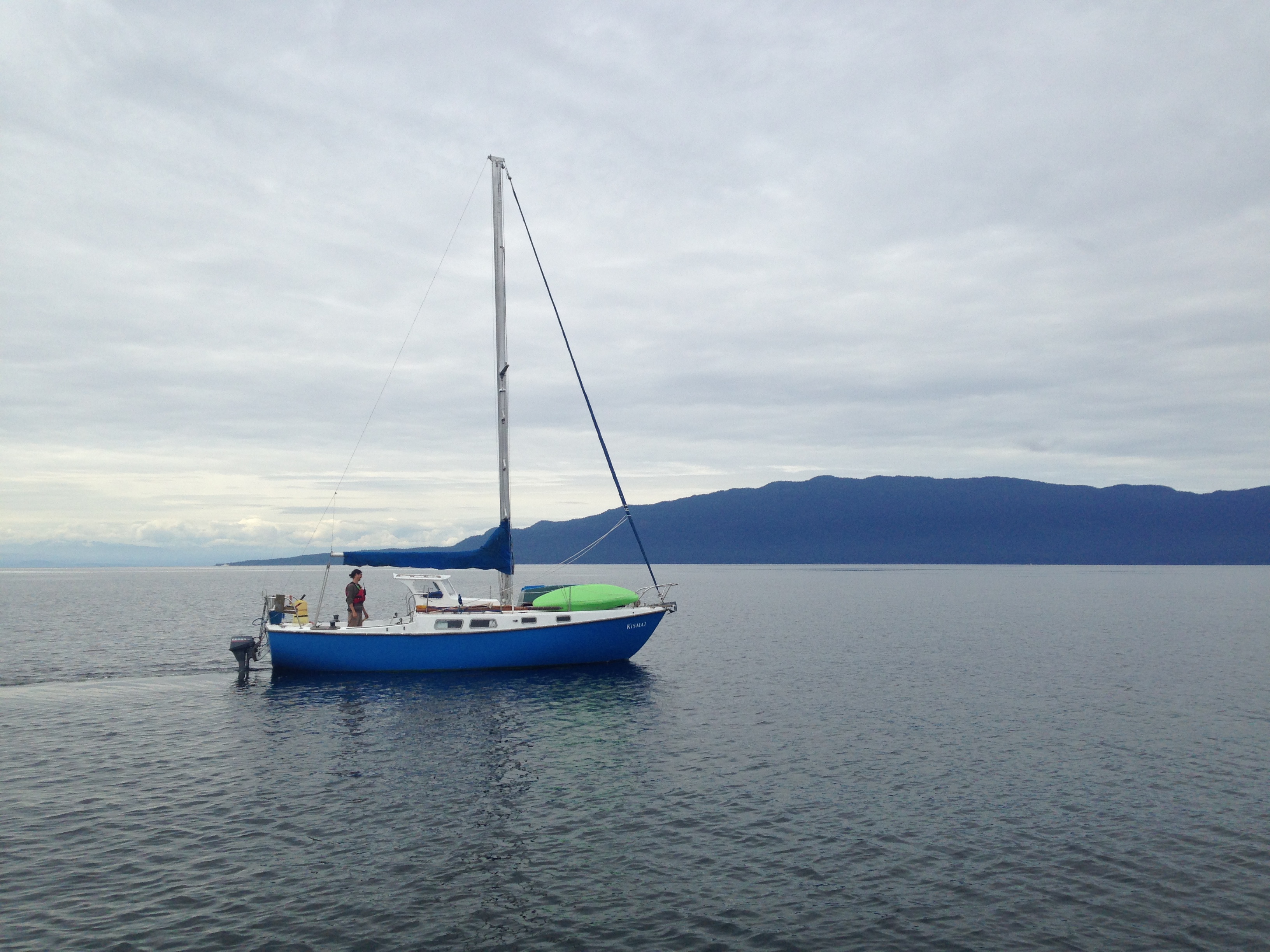
- Just outside Pender I spot a small; blue boat and check it out as I have every other small blue boat. Turns out it is indeed Kismet and Peter (from Victoria).
- After a brief chat on the radio we decide to raft up in the middle of the Malaspina. There is zero wind. we visit for 15 minutes or so and then say our goodbyes. Peter is headed north to start work at Heriot Bay (Kayak guide at Spirit of the West Adventures).
- Arrive Smuggler Cove around 1300 hrs. Stern tie on second try. Cross currents are a real bugger.
- Three Hunters in row after we tie up.
20 May
- Cove fills up. Up to 10 boats at one point just in front cove; more in the back one.
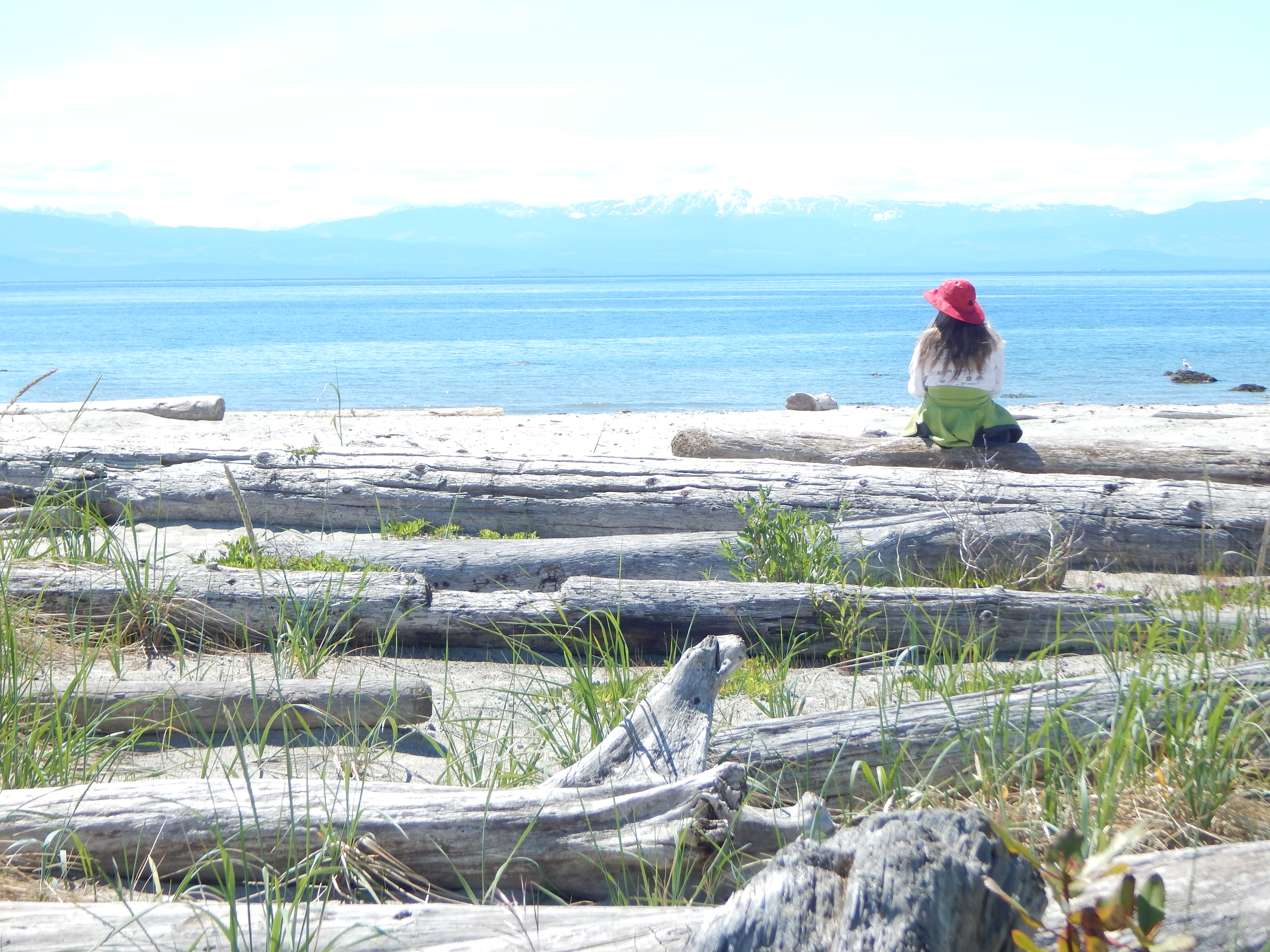
- We head off to Thoramsby Island to explore beach. Hot and beautiful.
- Call and make a reservation at Gibsons Marina…full. 🙁
- They call back a bit later and say a spot opens up 🙂

21 May
- Raise anchor by 8 am.
- A long motor to Gibbons.
- We cross the bar (shoal) mid-tide in 10 feet of water.
- It’s a tight squeeze into our berth; barely a few inches wider than the fender. Docking successful!
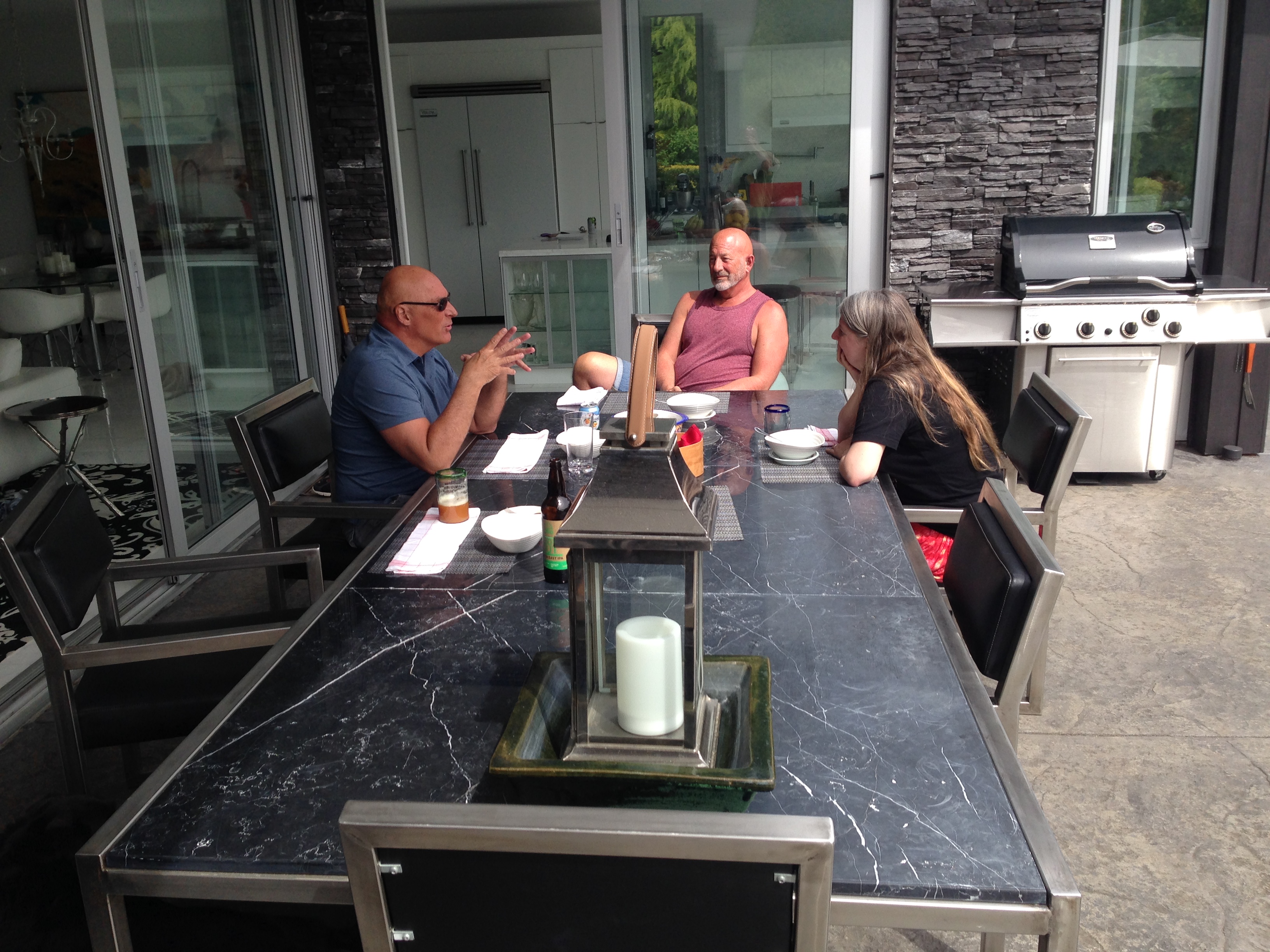
- L’s Uncle comes down to pick us up and we head to Roberts Creek for lunch and a visit. Stunning hillside home!
- Dinner is at the pub.
22 May
- Quiet day while Leslie works on her presentation.
- I clean the boat. It needed it.
23 May
- Move 2 nm to Plumper Cove.
- We anchor with a little less scope than I want as the winds start to climb.
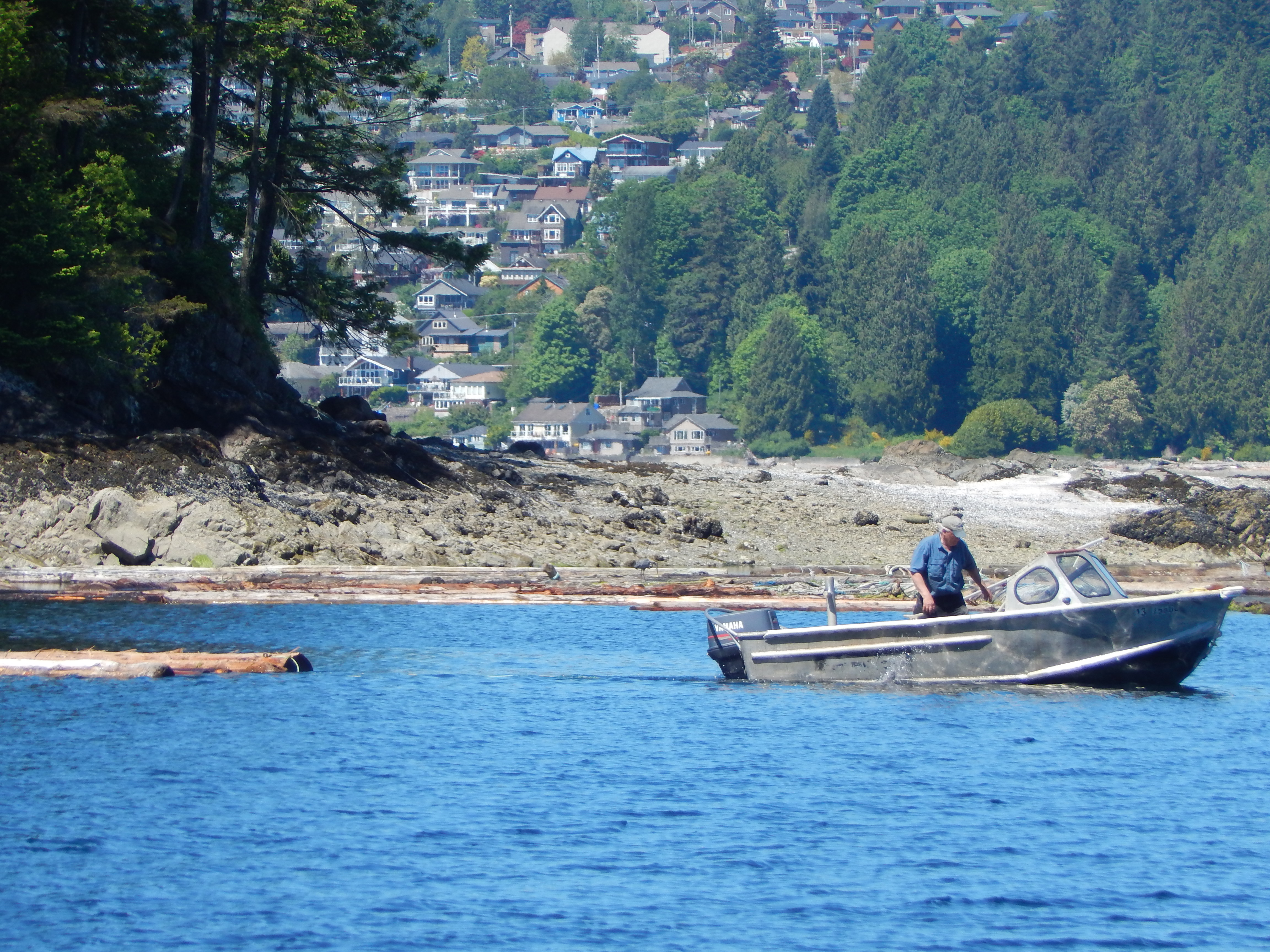
- There is a older gent in an aluminum powerboat towing around stray logs…Relic lives!
- Eventually the boat behind us moves to a mooring buoy so we let out more scope and have a bumpy night.
24 May
- I can see the bar through my binoculars and at low tide, with the wind, it looks like one big long standing wave.
- Winds die.
- Explore Keats Island and do the Marine Park Loop. LOTS of uphill!
25 May
- Raise anchor around 0945 hrs. We take the long way around Keats.
- I take a shower and L runs out the jib in 12-15 knots of wind. We leave the engine running because we want to charge up the batteries for our stay in Nanaimo.
- Bumpy but we do 6 – 6.5 knots pretty consistently in 15-19 knot winds.
- Pull into Nanaimo Harbour around 1430 with the winds still around 15 knots.
- Decide to set anchor using the wind. Works, but when I go to set it using the engine I get the dinghy painter caught in the prop (the whole story).
- Stay at anchor until we can get a tow the next day.
26 May
- 0100 hrs we are up and fending off a Bayfield with too much scope that banged into us. Decide to raft up for the night.
- 0630 hrs we cast off the Bayfield.
- We go into town to shop and walk.
- Visit NewCastle Island at low, low tide. Almost zero water between the two islands.
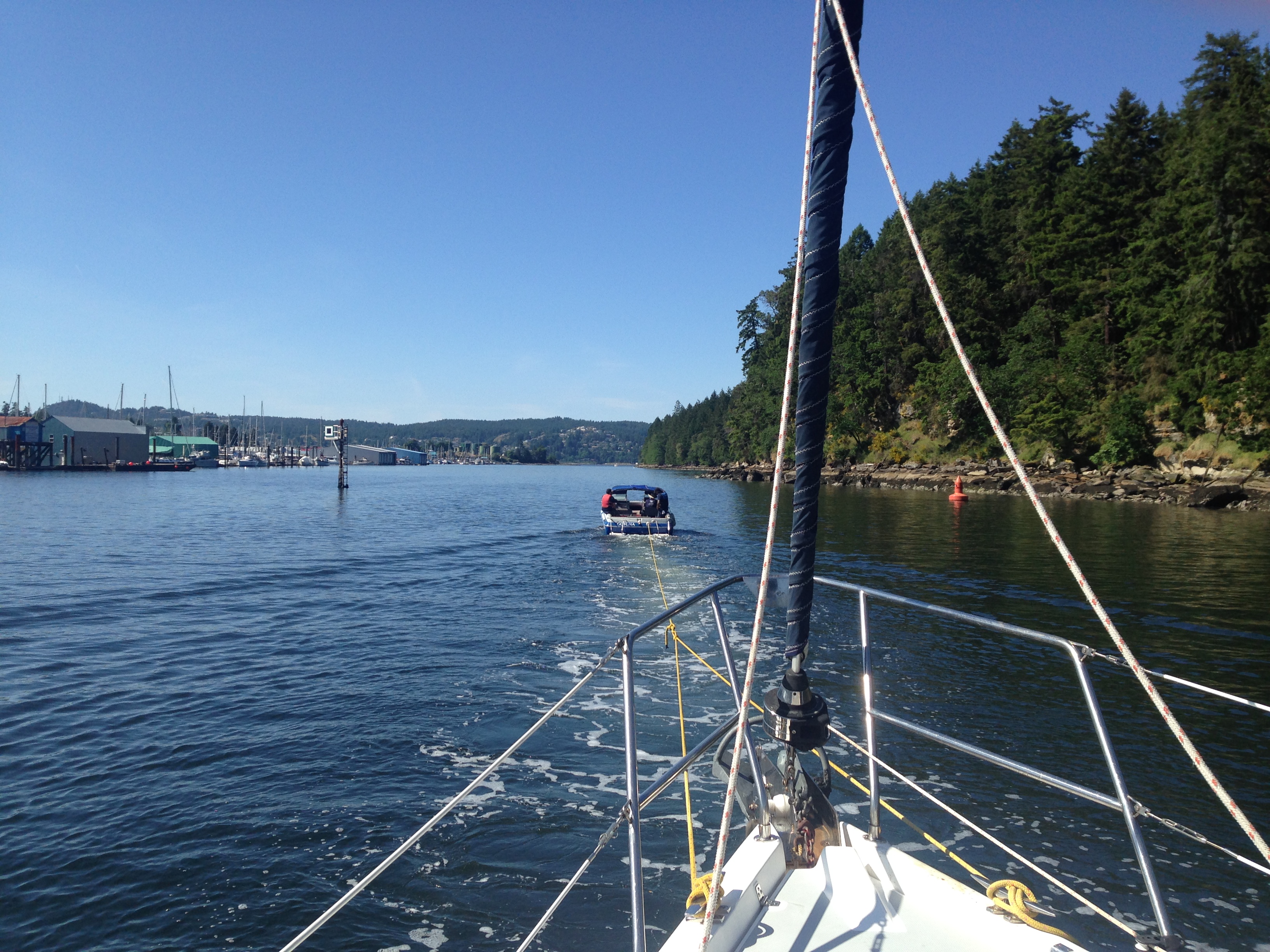
- Ian from NYCSS shows up with crew and tows us to Stones Boatyard.
- Hauled out and on blocks for at least 24 hrs.
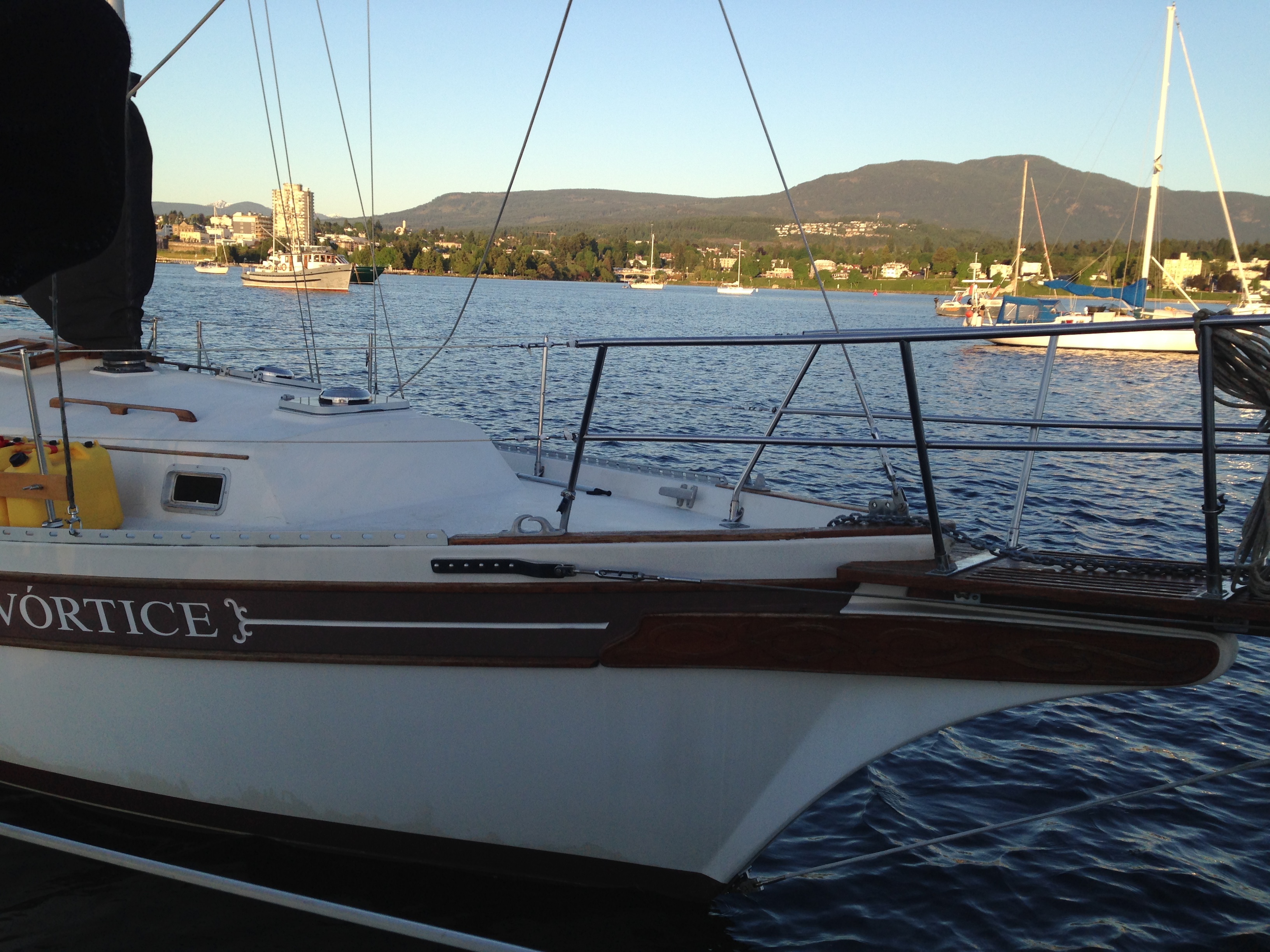
- Cut painter from prop shaft. Turns out the motor mounts are broken. Now we are here for the weekend.
27 May
- HOT!
- Drop off L at Harbour Air for her seaplane ride to #YVR
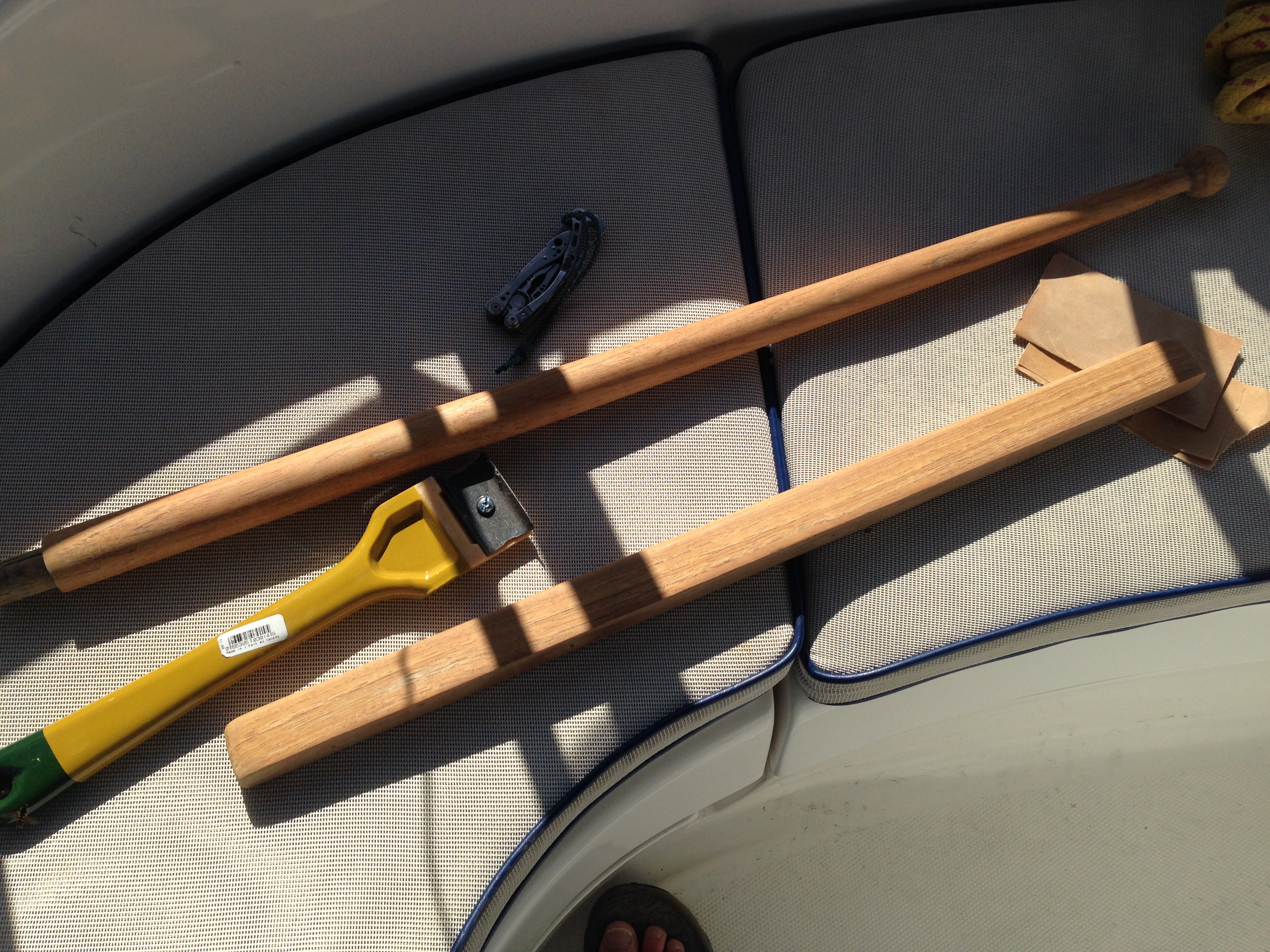
- Scrape teak from hatch and flagstaff. Sand.
- Fill stripped holes for strap brackets in dinghy
- Remove anchor chain and rode

28 May
- Resand teak
- Meet Jim (from Sea Esta X) and Gwen wandering the yard. They are there waiting to pick up Tim and Donna at the ferry.
- Laundry day.
29 May
- First coat of varnish on teak.
- Take down bimini to replace worn velcro and try and build dams from silicone to prevent water dripping.
- Drilled pilot holes for reattaching strap brackets in dinghy. Drill hole strait through 🙁 Luckily the brackets have watertight gaskets so I can stop the damn thing from sinking.
30 May
- Cold and rainy.
- 2nd coat of varnish on teak
- 2 mounts go in in the am.
- Tim and Donna drop by for a visit.
- The last two mounts are installed.
- Try and replace impeller in knot meter. I get it out but a replacement is $120+ so I put the damaged one back in.
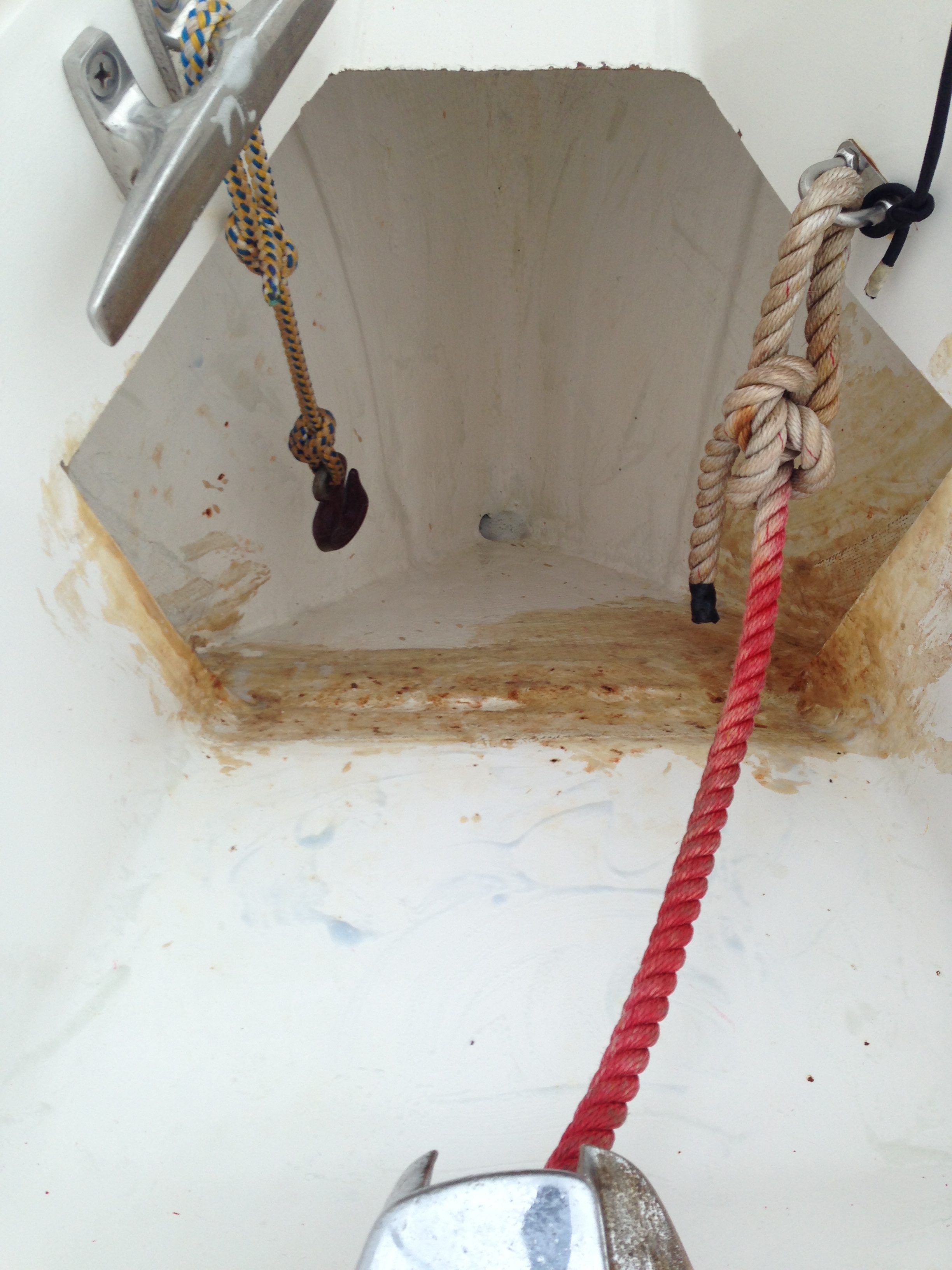
- I scrub the anchor locker and get it ready for new chain.
- Supposedly we are back in the water at 09:30 hrs tomorrow. Fingers crossed.
31 May
- Up at 0530 hrs. Why? I have no idea.
- Spot Canty at the boat lift dock so I go down to chat with Paul and Kristie. They are in for bottom paint.
- As soon as the lift drops Canty, it comes for Never for Ever. We are back in the water. Jared checks engine, tightens injector and Darcy hops aboard to help me move us back to a slip.
- The boat has shifted a bit on the stands so we need to let it settle for a day and then they will check and align the shaft.
- Put the final coat on the teak.
- Anchor is still ashore, waiting for new chain and splice.
- Darryl stops by and we have coffee. Being on the hard is certainly turning out to be social…
- Haul out dinghy on foredeck to clean and prep my drilled hole in hull.
- Alas no chain (it’s G4 and a special order) until Friday
- I’ve got highspeed so I watch Rush on Netflix. Not bad