Done like Dinner
As of 7:19 pm Wednesday we are now the proud owners of a 2003 Hunter 386.
The various surveys had turned up an astounding $8700 of repairs and issues with an additional $3900 being estimated by the engine guys at Stem to Stern. As I mentioned previously the engine guys had a lot of routine maintenance items built into the estimate that no one could reasonable expect the previous owner to be responsible for. So we, (the broker) proposed that the price be adjusted for the total of the survey issues and $2500 of the mechanical ones. And the we waited. And waited. And waited.
Okay, it was only 2 and a half days, and there were a lot of numbers, but it sure seemed like a long time. Be that as it may, eventually we got word back that the seller would like to reduce the mechanical by a further $500 and further reduce a few of the specific estimates by a few hundred here and there. All in all, he was asking for a reduction of a little over a $1000. That seemed fair.
So I said ok.
And then I (we) owned a boat.
Paperwork
I doesn’t seem real to buy a boat a 1000 miles away over the phone. There is nothing really tangible about it: no hand shake, no new boat smell… so life didn’t change much and we (I) were pretty subdued. Friday rolls around and I finally got the official survey documents with valuations so I contacted our insurance company ( I had picked and contacted an insurance company about 2 weeks previously) to let him know the real numbers and update the quote. I didn’t really know when to bind in the insurance so I left it hanging (so I thought) for the weekend.
Well around 4pm our time I start getting documents and emails. First was a notice that the signed bill of sale was … well… signed and on its way. And “Oh, by the way, is the insurance in place yet?” Seems the marinas require insurance in place and the PO (previous owner) needed to cancel his. So wrote back to the insurance broker asking if they could bind the policy immediately. He said yes. Then the Bill of sale arrived along with the Pleasure Craft License transfer.
Now it felt like we owned a boat.
That was soon followed by an Insurance application, a Certificate of Insurance and of course an invoice for the aforementioned insurance. I forwarded the certificate to the yacht broker and we were done. Like dinner.
Now we had ton of other arrangements to make and some bills to add up…
My cellphone sees…
This is the owl on my roof after he saw the camera! #beautiful

My cellphone sees…
Look what we just bought!! 🙂

No news…
No news is good news? Still haven’t heard whether the boat deal is a done deal. Just wanting on a few numbers…I hate numbers. Always wanting to subtract when you want to add or multiply when you want to divide. Stupid numbers.
It’s production week on the mag, so I am keeping busy though. Have a picture:

The Granville Island Boat Yard
Online sketching!
I am so a visual person. Most times if I am trying to explain something I will grope around for a paper and pen to try and sketch it out even if it has nothing to do with a visual concept. Hell, you should see my notes from writing papers in University—tree diagrams and thought bubbles…
Anyway I came across this cool tool today while reading an online argument about pulleys and mechanical advantage. One that I would never have been able to follow without the many sketches involved. It’s an online whiteboard (free) that allows you to quickly sketch something out and then share it. Like this:

Above is a hot link to the image on their site. I don’t know how long it will be hosted there but you can just as easily download the image and host it yourself:

But even if the hot link doesn’t last for ever, this is a totally, totally awesome tool for communicating remotely. https://awwapp.com/
Pre-purchase Conclusions

So the estimates are still rolling in but there looks to be some serious cash involved. At this point the most likely outcome given that we still want the boat, is that the price will be reduced accordingly and we will repair what needs to be repaired.
- The major issues (in my mind) as it stands are:
- re-pitch propellor (including hauling the boat and storage on the hard)
- repair Webasto heater
- repair hot water system
- repair the hull damage
- ensure the galvanic isolator is working
- check/repair the strut bolts
- replace the exhaust elbow
- repair engine mounts
- repair engine alarm
- reapir forestay swivel
The broker’s list of major issues is much longer and probably more accurate, but I am defining major in this case as things I need resolved before committing to the sale and releasing the funds. I would also like to see the current owner kick in on sail repairs, some of the engine maintenance issues and fixing the issues with the hull blisters, but I/we have not yet determined/decided whether we/I would kill the sale over these smaller items.
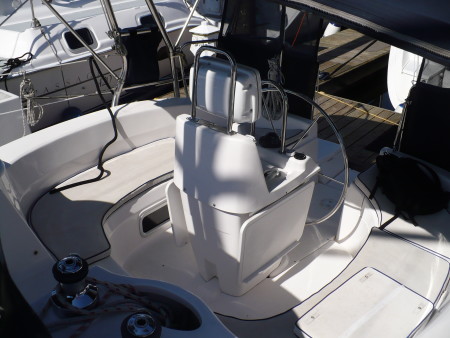
What we (by which I mostly mean the broker) are trying to do now is get final estimates from all the various trades and technicians and work out a plan. If we are pulling the boat to fix the hull and prop, then I might as well get her bottom painted at the same time and fixing the other smaller issues now will save having to do another haulout. But now is the busiest season as everyone is prepping their boats for summer. So maybe we take the cash and stash it away until fall and do the work then, but that comes at an additional cost that has to come out of someone’s pocket. Once the estimate numbers are in (which could/should be in an hour or two), the current owner will commit to his number and then. if Leslie and I like that number, we’ll agree and he will magically be transformed into the previous owner and we will own a boat.
It’s all an intricate dance of order and precedence and yet another reason that I am glad, in the end, to have been able to work with the broker throughout this process. Call me naïve if you want to (even though you shouldn’t) but I truly believe he doing the best deal he can for both parties. And I like that.
So there you have it. We will know in a couple of hours if there are going to be any more posts in this blog.
Surveys 3: The marine survey
The Haulout
Once you’ve brought your boat to the dock by a boat lift you hop out and the lift operators take over. They manoeuvre the boat into a set of slings, adjust those slings so they miss anything important and then slowly lift the boat straight up. The thing to be careful of is that most boats have recommended sling points, but apparently they are not always the best indicators. The Hunter 386’s throughhull for the paddle wheel speed sensor is fairly close to where the sling marks are; the lift operators at Granville Island know this so make sure the slings are a bit aft of the marks to avoid damaging the paddle. Or you can take the paddle out entirely before the lift.
This was scheduled as a ‘lift and hold’ so the lift set the boat down on its keel but left the slings supporting the boat. The surveyors had access to the whole hull but it was going back into the water as soon as they checked it so no need to set up stands.


She came out of the water with a nice collection of mussels on the keel, barnacles on the prop and, as I mentioned in a previous post, a few barnacles wedged in the speed sensor. Once she was out of the water, the brokerage’s people cleaned off the prop and and changed the anodes on the propellor shaft. Now my highschool chemistry is still a bit shaky but the theory is that when two different metals touch — bronze and steel in this case — while in salt water, a current is set up that will eat away at the weaker metal. In order to avoid your boat bits dissolving, you attach sacrificial anodes usually made of zinc that will slowly dissolve instead.

You can see the two new anodes on the prop shaft
In the mean time my surveyor, Tim McGivney and his partner Trevor Salmon from Aegis Marine Surveyors Ltd., showed up and we all shook hands. Then they went to work. What they are looking for is obvious hull damage as well as any hidden damage that might be hiding. In the case of Rainbow Hunter, they only found a few small blisters. Much like a skin blister this is where moisture has penetrated the top layer of fibreglass or gel coast and caused a bubble to form and leave a hole underneath. They aren’t a huge issue although they need to be repaired and if you have a lot that can be a big expense.
There was also a crack in the fibreglass under the moulding on the transom and another crack at the top leading edge of the keel. Again, these turned out to be mostly cosmetic and not a structural or safety issue.
Once the visual inspection is done, they get out their hammers and start tapping the hull front to back, top to bottom. What they are doing is listening to hear if the tone changes, which would indicate damage or water intrusion within the hull itself. Modern boats often have solid fibreglass below the waterline but will use a cored fibreglass system above to keep weight down and prevent the boat from being top heavy. In most cases this is two thin layers of fibreglass with a balsa core sandwiched between them. This provides structural strength but keep the weight down. But like a piece of drywall, if the core gets wet or damaged, the strength disappears and you have potential point of failure. And if the damage is not repaired, intruding water can spread through the core causing rot and the damaged area grows bigger and bigger.
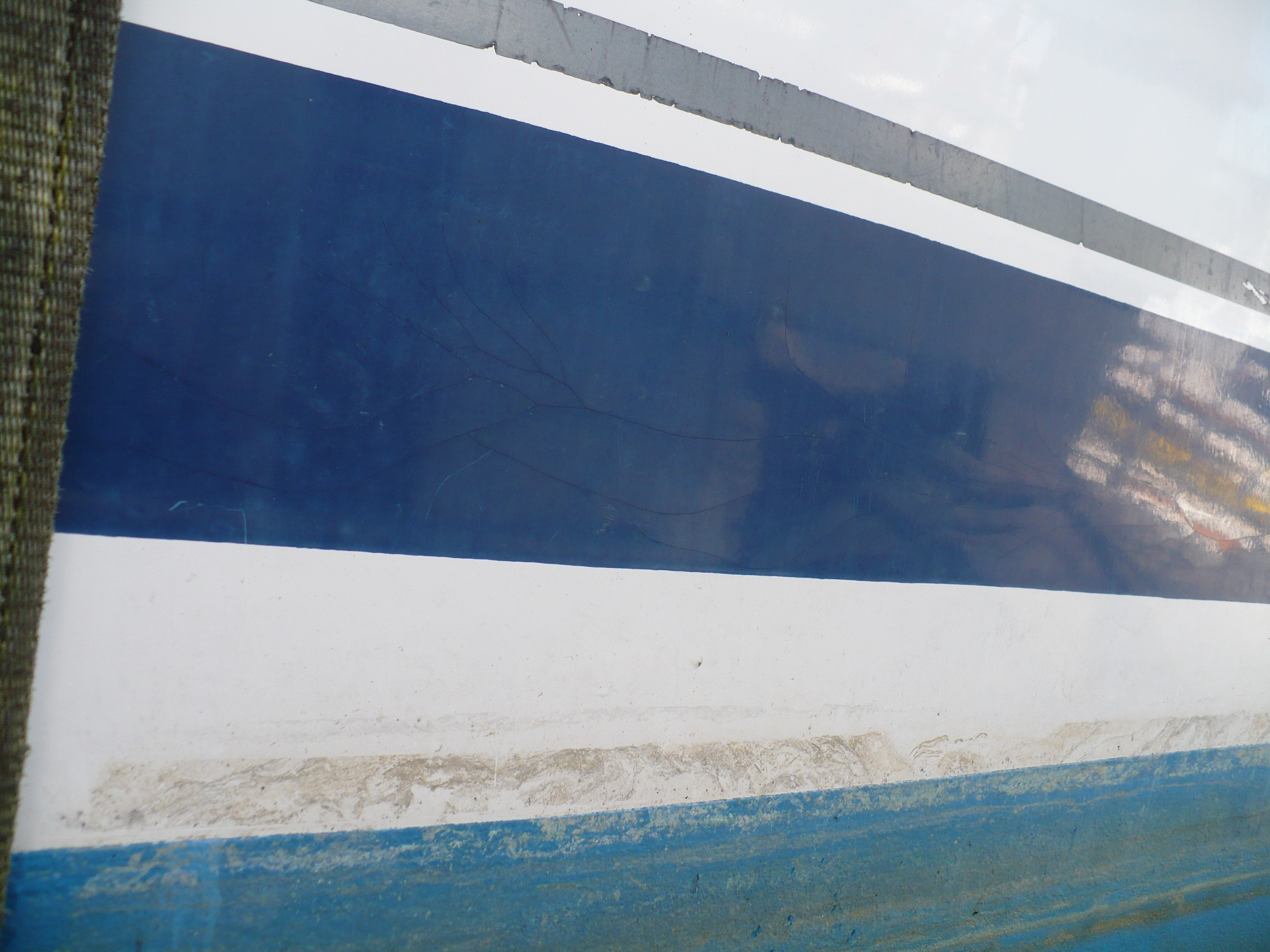
The surveyors found one spot about 2 feet by 3 inches right along the bootline (the stripe that marks the waterline) that had crazing in the gelcoat and the sound definitely changed when tapping. This would be where a hard docking occurred without a fender or perhaps a bad night at dock in bad conditions where the fender slipped out. Regardless it was a problem and will need to be addressed. Talking it over with Tim I was assured that there was no imminent danger and we could easily cruise the season and get it fixed in the fall which might be easier and more cost effective. But this was definitely something to talk to the current owner about.
Other than that the boat passed with flying colours and she was soon on her way back into the water. Back aboard the broker slowly manoeuvred her out and the backed her neatly into the narrow slip.
At this point, I needed to head to West Marine and it had been recommended to me not to pester the surveyors too much in order to not distract them, so I decided to head off to do some shopping and grab a bite. I will acknowledge that there is some common wisdom that says you should stay and follow along through the survey as it is a prime learning opportunity, and I can see the sense in that. But for me I felt that my level of knowledge was so low that it would likely be a hindrance. I know that in my own field I don’t mind talking to others while I am working if they have a base understanding of what I am doing, but it is much more distracting if you have to stop every five minutes to go over the basics. So I left them to it.
The Survey
It was a nice afternoon so after I bought a slice of pizza I wandered the docks and enjoyed the sunshine. Eventually I ended up back at the boat and sat in the cockpit trying to amuse myself. At this point I was hit with my traditional “what the hell am I doing?” rollercoaster jitters. Eventually I called L and we had a pleasant chat and I managed to get over most of it. Otherwise I took pictures (which is really hard to do in a crowded marina) and wandered aimlessly. I was still wondering what the hell I was doing though. Especially as the bill’s started piling up. I hadn’t realized (although I should have) that I had to pay for the lift. This came to $309. At the end of all this I will tabulate the totals and post them, but it is easily going to be over a couple of thousand dollars just to find out if I want to go through with this or not.


While Tim and Trevor were doing the boat, the broker had also arranged for their service manager to doing a complete rigging inspection. Apparently this is usually high on the surveyors’ recommendation list (turns out it was number 7 of 9) and he wanted to get it out of the way. So that was good.
Eventually everyone was all finished up and Tim was handwriting out his conclusions. As soon as he was done he went and made copies for everyone and we three sat in the salon and went over everything. First up was the recommendations. Number one was the exhaust elbow we already new about. Two was a coolant leak. But that turned out to be the previously mentioned heater issue. Three was the hull stuff we had already discussed. Four was a possible issue with the strut bolts. It was possible they were weeping so had to be monitored, but with the coolant leak in the bilge it was impossible to tell yet. If they were weeping they would have to be pulled and re-bedded. An issue the broker had noticed in the keel that might have indicated a previous grounding was noted as most likely a factory alteration and that no evidence of grounding was present. The rest of the recommendations were all things like expired flares and notes to better secure the house batteries etc. All in all a pretty clean report.
There were also tons of other little things that will give me something to do late in the year if this all goes through. Better ventilation for the inverter, some crazing on some of the hatch lenses, stuff like that. It seems there are always things to spend money on when you have a boat.
The Rigging Report
That was it for the day and I caught a cab back to the airport and was soon on my way home. Two days later I received the preliminary rigging report. Again, nothing major but a few things that really should be serviced or looked after.

There was some issues with the upper swivel on the forestay, a crack near one of the chainplates, the steaming light bracket was broken, and the main sail was stretched and the webbing on the clew was worn. Add in a few worn bushing and sheaves, some chafed lines and an excessive amount of tape on some of the fittings allowing for water to collect and induce rust and corrosion. And the winches were all in need of servicing.
But it all adds up. So that meant there were things still to negotiate.
Survey says…
I was out in Vancouver on Thursday to see the boat and be there for the survey. It was a great day and I got an hour’s sailing in and even some sun on my pasty white skin.
The write ups are over on the other site:
Surveys Part I
Surveys Part II
Surveys Part II
We still have to wait until Monday to get all the estimates in and the final negotiations done and then we will know if this is a done deal or not.
Hurry up and wait…
Surveys 2: At sea
The Sea Trial
I flew into Vancouver on the morning of the 9th. Dave of R Shack Island fame picked me up at the airport and delivered me to Granville Island. We introduced ourselves to the broker and he walked us down to the boat. She was huge. I always feel that way the first time I see a boat I might be sailing. They get smaller as soon as your heart rate calms down. And the Granville Island marina is no help with its tight slips and narrow fingers. We chatted for a bit and Dave soon headed off to his next appointment while the broker headed back to the office to “make some calls.” I suspect he just wanted to leave me alone with the boat for a few minutes.

My first glimpse
I started poking around. The owner had left me lots of goodies from custom bedding to a hand held GPS. Dishes, cutlery, pots and placemats were all there as well as utensils and even a dishrack. From a galley point of view she was a turn-key boat.
Up on deck I discovered that the ‘full enclosure’ was unfortunately not so full. The top portion, instead of being clear lexan or acrylic was instead mesh bug screens. On the one had this was great, but on the other it wouldn’t do us much could during the cold months. So there was something we would have to remedy. Not a flaw in the boat though. Other than that there were lots of little perks like canvas winch covers, seat cushions, Alpine stereo speakers in the cockpit and a motor lift for the outboard.
A little bit later the broker showed up and he fired up the engine. Now I am usually a nervous wreck for the first couple of hours on a boat until I acclimate. The damn things look so huge all stuffed into the marinas and if you’ve ever been to Granville Island’s docks you know they are worse than most. On top of that I wasn’t sure who was the captain of this thing, although I was pretty sure I didn’t want it to be me. So when I popped up out of the companionway to see the broker on the dock with the bow and stern dock lines in his hand walking the boat out of the slip, I was a both relieved and intimidated. He calmly finished swinging her stern out of the tight slip and hopped aboard. Then we were pointed up the channel to False Creek and he turned the wheel over to me. I motored under the Burrard Bridge and out into English Bay while he made a few calls. Again I suspect he was just giving me a few moments to myself.


It was a beautiful day and I had my doubts that there would be any sailing but the broker gestured to the flags and smiled. Once out into the bay the difference in experience and confidence between him and I became painfully apparent. Each and every time I had been out in English Bay I had been armed with charts and binoculars and GPS and been nervous as hell. He on the other hand finally got around to turning the instruments on and was busily chatting away about features and benefits of Hunters in general and this boat in particular whilst barely “paying attention” to his surroundings. While I was still trying to figure out where the wind was coming from, he had already pulled out the sails, all the while explaining the benefits of the Selden furling system and soon had us cruising on autopilot on a nice beam reach. At least I think it was a beam reach, because I was still looking at the windex, listening to the broker’s analysis of in mast furling systems and looking out for all the huge cargo ships moored in the Bay. Anyway, before I knew it we were doing 5.5 knots in 11 or 12 knots of wind.

On a side note, we were sailing right by a cargo ship that had apparently been leaking oil. It wasn’t until much later I found out how big a deal that was.

So we sailed back and forth on a couple of different headings while we crawled over the fore deck examining the sails and rigging. There were some worn lines, primarily the traveler sheets and some stitching that needed to be looked at sometime this season. Nothing that was immediately a problem. We took off a few of the enclosure panels and opened up the cockpit space. The sightlines were perfect for me and I wouldn’t have to peak over the dodger or duck to see through it.
The B&R rig was pretty cool and the stays were not continuous from deck to mast meaning you could suffer a partial failure without losing the whole mast. The B&R rig seems to be a bit of a contentious point amongst the old salts, but for beginners like us I think it’s going to be perfect. What it does is provide three attachment points for the mast, each 120° apart, instead of the the traditional 4 points each 90° apart. This eliminates the back stay, removing clutter from the cockpit. The down side is that the spreaders will prevent you from letting the main out all he way when running down wind and, given the lack of a back stay, you can’t tune the rig in the same way. So we might lose a few races.
We also fired up the electronics and checked out the radar and I got a quick Radar 101. Everything on the binnacle worked except the the test switch for the engine alarm, although we had both heard the alarm earlier so we knew it worked. Oh and the speed gauge read 0 knots but even I knew that was likely the sender was gummed up (turns out it was barnacles in the paddle). The autopilot seemed to be fully functional, taking us through a tack, the remote mic worked splendidly and the chart plotter had all sorts of bells and whistles.

The broker snapped a picture of me at the helm, although it was a bit staged because no had actually been steering — or paying much attention to — the boat up to this point. I don’t think we even turned the auto pilot off for the pic. Now I don’t mean to imply we were being careless. I certainly tried to maintain awareness of our surroundings but the broker obviously knew these waters and had no need to consult charts or depths and so didn’t need to do much but avoid hitting the boats in the bay — which was pretty easy since there was no one else out sailing and the big ones weren’t moving.
But we had a noon haulout scheduled so it was very quickly time to head back. We (I actually helped a bit this time) fired up the engine and pulled in the sails and then I motored her back toward the marina. As we approached the slip, the broker took back the wheel and confidently spun her around to back into the dock by the boat lift. The sea trial was over and the bottom inspection was up next.
Surveys 1: The mechanics of it all
In retrospect I am increasingly happy that this deal is going through a broker. It’s 10% well spent in this case. I suppose if one was much more knowledgeable and had the time to do intensive research that a broker would be redundant, but as a buyer it’s not costing me and in the short and long run it will definitely save me a lot of stress and even some money.
First off the broker noted obvious deficiencies and and immediately discussed them with the seller. There was a leak of coolant somewhere, the Webasto heating wasn’t working (probably related), a corroded exhaust elbow and the prop needed to be re-pitched. These were all discussed and dealt with without my even knowing about them.
Then the broker recommended both a surveyor and Yanmar deal to do the mechanical inspection. I checked out the surveyor online (Tim McGivney from Aegis Marine Surveyors) and not only did he get rave reviews from a number of sites and forums, but he was also on an insurance company’s website’s list of approved suppliers. Even though this is the choice of the seller’s broker, he did make the recommendation before I made an offer and the reviews seemed to support his recommendation, so I had no qualms.
The Mechanical Inspection
So earlier this week Ben from Stem to Stern Marine service sent a mechanic down and they went over the boat. Two days later they sent the report to me along with oil analysis for both the engine oil and the transmission oil. These later reports were extra, but I thought at the amount I was spending a few extra hundred wouldn’t hurt. I haven’t got the official bill yet but the estimate was 3–4 hours at $125/hr with the oil sample analysis at $58 each.
The report was pretty detailed. These guys seem to work hard to give you a worst case scenario so that no potential flaws remain. I suppose there is a lot of self interest as well since if I decide to fix everything they will make more money, but its nice to know someone is really grinding the details. For example one of the flaws/recommendations was to replace all the filters with official Yanmar OEM parts instead of the knock-offs currently being used. What this indicates (besides a real anal attention to detail) is that the servicing of the boat has not been done by an authorized Yanmar mechanic and was likely done by the owner. While this isn’t necessarily a bad thing it is an indication that the servicing was not professionally done.
They also made recommendations like replacing the fuel filter with clear sediment bowls. I hadn’t realized there was any other kind so that was good. Apparently most charter boats have the clear bowls installed because it makes checking them easier but they are an ‘extra.’
But other than the exhaust elbow, a flaky engine alarm and a few leaks that need to be checked out, the overall condition looks good. Still the estimate to do all the work is $3900 and the Service Manager said to budget 50% more for potential overruns so we will see what the current owner thinks.
The List
- Checked Hours
- Checked Oil and Oil Filters
- Checked Primary Fuel Filters
- Checked Secondary Fuel Filters
- Checked Alternator Belt
- Checked Raw Water Pump Belt
- Checked Coolant Hoses
- Checked Raw Water Hoses
- Checked Hose Clamps
- Checked Engine Mounts Checked Paint
- Checked Oil Leaks
- Checked Fuel Leaks
- Checked Air Filter
- Checked Exhaust Elbow Checked Steering
- Checked Coolant
- Checked Corrosion Noted Checked Water Leaks
- Checked Electrical
- Checked Starter Motor
- Checked Alternator
- Checked Control Cables Checked Engine Zincs
- Checked Gauges
- Checked Alarms
- Checked Controls
- Checked Oil and Oil Filter Checked Coupler
- Checked Oil Leaks
- Checked Shaft Seal
- Checked Paint
- Checked Bilge Condition Checked Bilge Pump
- Checked Bilge Blower
- Checked Batteries
- Checked Through Hull and Valve