Instagram This Week


Welcome Aboard!
So, you’ve been invited to go sailing or boating with friends. If you’ve never been on a boat before, you need lots of advice — pronto!
On the other hand, if you’re an owner planning to invite non-boating friends aboard, whether for a short tour of local waters or for an overnight excursion, sharing a few tips in advance will ensure that everyone enjoys the experience.
Based on our experiences inviting people aboard and our travels on other people’s boats, here’s a primer for non-boaters taking a voyage on a sailboat or powerboat.

What to Pack
If you have luggage, bring it in a soft-sided bag, such as a sport bag or a backpack. (Bonus points if it’s scrunchable and can be made small!) Space on boats is restricted, so don’t bring unnecessary items, and power is generally limited so curling irons and hair dryers should just stay home. Be sure to bring polarized sunglasses, your camera (plus wrist strap), and your charging cable (if you’re going to be gone for more than 24 hours).
What to Wear
If your image of sailing involves women in bikinis sunbathing on the prow of a sailboat, you’ve never sailed in the Pacific Northwest. The feels-like temperature on a boat is several degrees cooler than the air temperature due to the wind. Your best preparation is layers, including something with long sleeves and a pair of full-length pants. Even if you don’t wear it, bring a jacket especially one that’s waterproof. Bring a hat and wear sunglasses — the effects of sun are amplified by reflections on the water. It is possible to get both a chill and a sunburn at the same time! Also remember you will likely get wet at some point, whether from spray over the dodger or from wading ashore when you beach the dinghy. And it’s salt water, not fresh, so choose your clothes appropriately.
If you feel cold, speak up. Nothing spoils a trip like hypothermia. Your hosts will likely have spare gloves, hats, and other warm gear.
Wear comfortable shoes with white or light-coloured soles. Basic running shoes are great. Don’t wear heels. Don’t wear new shoes that may cause blisters or shoes that might slip off your feet unexpectedly. No hiking boots, work boots, or other cumbersome footwear, please.
Life Jackets
Canadian law requires your hosts to have a life jacket or other PFD (personal flotation device) for every person aboard the vessel. Whether you wear it or not isn’t entirely your choice, however. Some boaters will insist you wear a PFD; others won’t, but will likely encourage you to do so. Respect your hosts’ directions. Remember, it’s your life they’re trying to protect.

Safety Brief
Our friend Tim, a very experienced boater, always gives a friendly but thorough briefing before his boat leaves the dock. As a guest, you should know where the fire extinguisher is, where the first aid kit is, and where the emergency equipment (such as flares) is. If your hosts forget to show you, don’t hesitate to ask. Your hosts may also show you how to make a mayday call on the VHF radio. (Don’t use the radio otherwise: by law, you need an operator’s certificate to use marine radio.)
Your hosts may also go through a quick man overboard drill with you. No one likes to think about someone going overboard, but it’s always a risk. Pay attention to the drill and know where the equipment is. Yes, it’s rare for someone to fall in the water, but preparation can make the difference if it should happen.
Lending a Hand
If you’re going out with experienced boaters, they’re capable of operating their boat on their own, so your assistance isn’t required although your help is welcome. If you want to help, though, ask before you get involved. Changing a crew’s routines unexpectedly can cause problems.
Once the boat is underway, if you want to help with trimming the sails or taking the wheel, just ask. It’s almost never a problem for someone else to take the helm, and extra hands are always welcome on a sailboat. If you’re not sure what to do, please ask; your hosts won’t know what you don’t know if you don’t ask. But remember, sitting back and enjoying being a passenger is perfectly acceptable too.

On the boat deck, there’s one important rule: one hand for the boat and one hand for the task. If you walk forward from the helm, keep a hand on the life lines or the grab bars as you go. It’s just good safety.
Boats have lots of moving rigging. Whether it’s the anchor chain or the various lines and sheets on a sailboat, moving parts can quickly and easily turn an enjoyable cruise into an emergency. Know how to use the winch or windlass safely before you lend a hand, and make sure everyone else around you knows what you are going to do.
Getting away from and returning to the dock can be stressful moments. If your hosts ask you to hold a line or step off the boat, be sure you understand what they’ve asked you to do and that you’re prepared to do it. Don’t try to be heroic: you put yourself and others at risk. On a boat nothing can be fixed by suddenly doing something unexpected. Stay calm and follow instructions. If someone on the dock offers to take a line, hand it over only when the skipper says to do so. Onlookers are often eager to help but don’t always know what the person operating the boat needs. The person at the helm ALWAYS gets to direct.

Going Below
When you go inside the cabin (“below” on a sailboat), you’ll notice that powerboats are fairly roomy and open while sailboats are long and narrow. If you’re going to be aboard for more than a few hours, you need to learn the subtle steps of the “boat dance,” which involves moving in rhythm with others and anticipating when to shift out of the way. Don’t worry, your hosts aren’t judging, and they will move around you when necessary. But you’ll likely find you’re more comfortable if you pay attention to how other people are moving below deck.

When you are sailing, things will often be stowed in such a way so that they don’t move around as the boat heels (notice the angle of the dish rag hanging over the sink)
While underway, you’re likely to be on deck most of the time. When you go below, avoid opening cabinets or drawers while the boat is underway. If there’s something you need, ask your hosts. After you use something, put it back where it came from. Boaters take the idea “ship shape” seriously. And remember that you’re in someone’s home. Resist your snoopy urges.
The Marine Head
Your hosts will likely show you how to operate the toilet, commonly referred to as “the head.” Now is not the time to be shy or squeamish. Marine heads can be touchy, and fixing the head is — as you can imagine — not a pleasant task, so please follow your hosts’ instructions.
DO NOT flush Kleenex, women’s products, or anything non-organic; Even using too much toilet paper can cause a problem. A common boating truism is “Nothing should go in the toilet that you didn’t eat or drink.” Your hosts will be grateful if you follow this advice. Don’t be surprised if your hosts ask you not to flush toilet paper and instead show you a bag or garbage bin. You might find this unusual or gross, but your hosts know their boat, so follow their wishes. Another truism is “If you break it, you fix it.”
Remember that boats are small and the head is a shared space; be courteous in your usage and respectful of other people’s privacy,
Life Aboard
If the trip is planned for longer than half a day, you’ll learn that a big part of boating involves conservation. Both fresh water and electricity are finite resources, so don’t waste them.
Stay hydrated—fill a water bottle at the beginning of the trip and refill it as necessary. Often the boat’s water tanks will be restricted to cooking and washing; drinking water will be carried in separate containers.
Managing water is easy. Don’t let taps run when you’re not using them. If you shower, turn off the water while you lather up, and go easy on the soap and shampoo to make rinsing quicker. Hot water is also at a premium. To heat water you generally need to run the engine or be plugged in to shore power. If you are at anchor for a day or two you will have neither of these things. The hot water generally stays hot for 10 to 12 hours. After that water needs to be heated on the stove.
Same goes for electricity. Avoid opening the fridge unnecessarily: it draws a lot of power. Turn on lights only when you need them, and turn them off when you don’t. Be sure your hosts can spare the power to charge your electronics before you plug them in (most mobile phones are OK, but laptops may require an inverter). Any small appliances are usually not able to be used if you are not plugged into shore power.
Many boaters try to follow the light — early to rise and early to bed. If you’re a night owl, you might want to tuck a flashlight or headlight in your luggage rather than drain the ship’s batteries staying up all night.
Most boats in the PNW will have heaters but they don’t run them constantly. Be prepared that you might wake up to a chilly boat in the morning before the air warms up.

Beer and Boating Don’t Mix
While the boat is underway, there’s no need for alcohol. Raise a glass only when you reach your destination. Remember too that between the sun and wind it’s easy to get dehydrated. Drink lots of water during the day so that first cold beer doesn’t hit you too hard.
Seasickness
Non-boaters often worry about feeling seasick and being embarrassed. Depending on the water and weather, you may in fact start to feel ill. It happens to everyone at some point — don’t be ashamed! The combined noise of the wind, the waves, and the sails (if you’re sailing) or the engine (if you’re motoring) can be overwhelming, too, even if you don’t feel nauseated.
To combat seasickness, stay on deck. Look at the horizon, not at the water. Don’t go below — the effects of motion can be worse inside the cabin. Eat a light meal before you go out — lots of carbs, limited fats, no alcohol. While you’re underway, take small sips of water to stay hydrated and keep your GI system calm. Ask to take the helm; doing a task is often the best preventive for seasickness.
If you’re below deck and think you’ll be sick, use the head, not a sink. If you’re on deck when you feel ill, stick to the leeward side — the side that’s facing away from the wind. (The expression Don’t spit into the wind applies here.)
Home Again, Home Again
When the vessel comes back to its home dock, remember that docking a boat isn’t quite as simple as parking a car. It will take your hosts a while to tie up, connect to power (if applicable), and otherwise secure the boat. Be patient. Your hosts need to work through various steps, sometimes in a specific order, to ensure the safety of their vessel. You’ll be the centre of their attention again in a few minutes.
We love our boat, and we love having guests aboard so we can share our enthusiasm with them. Making our expectations clear at the outset definitely helps a trip go better.
—Herr Doktor #Liveaboard, #Posts
Baking Bread
One of the things I miss most about living aboard is that the freezer (especially on batteries) is not quite up to the job of keeping bread fresh. We make do with preservative-heavy Wonderbread a lot of the time and try and plan things like hotdogs and hamburgers around shopping trips.
But one of our missing crew is a fabulous cook and she had a recipe for a no-knead bread that she would treat us with, so I decided to get her to send it to me after we hit Victoria. It turns out we needed something like a Le Creuset dutch oven, but that wasn’t in the budget. So we headed down to Capital Iron and picked up an old school cast iron pot with lid that would fit in the boat’s oven. Forty dollars later and a bit of seasoning and we were good to go.
Doing some research here I found that apparently no-knead breads are a big thing and I certainly have grown to embrace them. It takes about 5 minutes to blend flour, yeast salt and water and then you put it aside for 18 hours or so and you have great dough for pizza or bread for dinner the next day. These days I usually make a batch or two every week. This recipe was also featured on page 21 of the March issue of T8N Magazine.

C’s Boule

- 3 cups flour
- 1/4 tsp instant yeast
- 1 1/2 tsp salt
- 1 1/2 cups water (room temp or cold)
Put the flour, salt and yeast in a bowl. Add the water. Mix with a wooden spoon until dough is shaggy. No need to knead.
Cover with plastic wrap. Let sit for 12 to 21 hours.
Use as-is for pizza dough.
For a boule, punch down the dough (use flour — it will be sticky), and form it into a ball. Roll the ball in flour, and place it on a large plate. Cover loosely, and let rise until double (1 to 2 hours)
Put a Dutch oven with a lid in the oven, and heat it to 425°F.
Flop the risen dough into the hot Dutch oven, cover and bake in oven for 30 min.
Remove the lid, and bake 15 minutes more.
A few boater caveats
I make a 2/3rds version of this recipe for my smaller cast iron pot. And I usually just put the oven on the highest setting and bake it for a bout 35 minutes before taking the lid off. Then I just monitor it for browning, giving it a thump or two to see if it sounds hollow.
 It makes terrific pizza dough
 Try adding 2 tsp of sugar and cinnamon and a 1/2 cup of raisins
—Captain Why #Liveaboard, #Posts
Instagram This Week
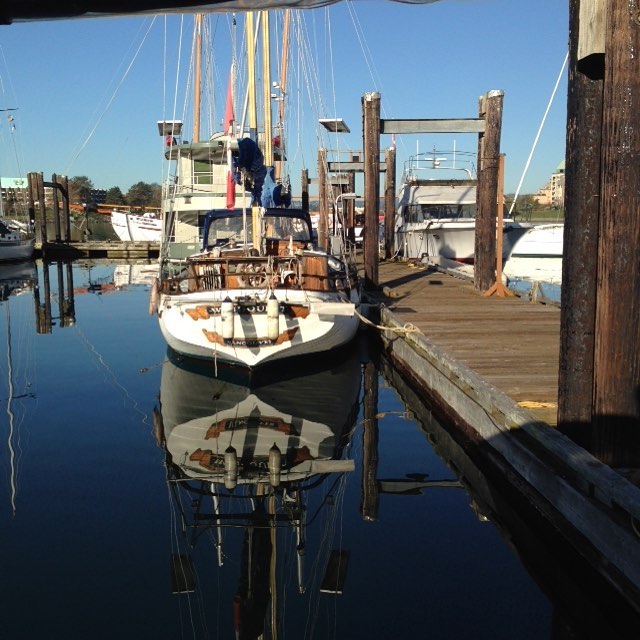
Easter Sail…errr…Cruise
We really hadn’t done much sailing this winter and were still a bit trepidatious about the cold. So we’d been humming and hawing and watching the weather and making no decisions as Easter quickly approached. But our usual office space at the public library was closed Friday, Sunday and Monday and we had no other plans. There was no reason not to go except fear of the cold.
Day the First
So Friday morning I popped my head out the hatch, noticed a couple of boats gone from the docks and said, “Let’s go…” Now apparently, unbeknownst to me, the plan was for us to go, if we were to go, Saturday. But since Friday, Saturday and Monday was forecast to be sunny and Sunday was supposed to be cold and rainy, it made no sense to me not to have at least one nice day to hang out somewhere. Besides those other boats had gone already. And it looked like a few more were prepping. Get the feeling I am easily led? Sometimes… 🙂
Anyway, I checked the freezer and there were at least three days of meals there and tons of backup supplies like pasta and canned stuff. The only critical item was milk for morning tea and we had just enough. So I made a command decision and broke out the checklist and less than 45 minutes later we were rounding Odgen Point and headed for Haro Strait. Somewhere along the process of getting ready we decided on Royal Cove on Portland Island as a destination. We’d spent three or four days there last fall and it was protected and peaceful, and had lots of hiking. My only worry was that being so close to Sidney and Tsehum it might be packed with weekenders. So our fallback would be wandering over to Roche or heading to Tod Inlet or Genoa Bay. It was only 10:45 as we exited Victoria Harbour so we had plenty of time if we needed it.

The forecast 5-10 knots was more like 2-3 so we motored at around 2200 rpm, conserving fuel and enjoying the sunshine. The Nordhavn 40 Aegis (a gorgeous ocean-going trawler that somehow looks less than suited to our cruising area) from B dock pulled out just ahead of us and we followed in its wake — albeit a knot or two slower. Once we passed through Enterprise Channel, we met up with 5 or 6 other boats coming out of Oak Bay and Cadboro Bay and heading east. My suspicions that it was going to be busy were looking correct. But as we all cleared Cadboro point they headed off like stately ducks in a row towards the NE, following after Aegis and presumably off towards San Juan Island.
We motored in the glassy water of Haro Strait past Sidney Spit and enjoyed all the sights and sounds of the busy water off Sidney. I went below to make some no-knead bread dough for the next day while Leslie took care of the helm. A bit later we passed through the many islets and rocks around the north part of Sannich penninsula and entered into Moresby Passage. Right about then I spotted a Beneteau with green canvas ahead and speculated it might be Bula, one of the boats from our dock. Sure enough, as we got closer we confirmed it; they had their sails up and were stubbornly motorsailing their way north. I hailed them on the VHF and it turned out their destination was also Royal Cove. A few minutes later we passed them and then watched the monstrous Coastal Celebration slide by us as we shared the suddenly much narrower passage.
Much to my surprise Royal Cove was empty. We circled around and picked a spot as deep in as we could get on the east side to avoid as much of the ferry swell as possible and dropped anchor. As stern ties go it was one of our better ones and I managed to get the stern in close enough that we could loop the line through the iron ring on shore and back to the boat. That way when we left we could just pull the line without having to row back ashore. Leslie was able to keep the stern pointed basically at the shoreline and only had to do a little maneuvering to give me enough slack to get the line back to the boat. Bula pulled in a few minutes later and tied up a couple of rings down, and we were set for the night. Bula was apparently only here overnight since their girls were keen on the Easter Egg hunt at Poet’s Cove on Pender Island, so we might end up getting the cove to ourselves for most of the weekend.

We stripped back some canvas to let the sun into the cockpit and enjoyed the peace and quiet. You can actually feel the pressure disappear after you turn off the engine and begin to absorb the silence of these islands. Victoria is a great place to be but between the noise, overflying seaplanes and the boat’s constantly running heaters you forget how much pressure a city puts on your senses. The sensation you feel in those first few moments when you are finally settled in at anchor is like that ice cold glass of water on a hot day: just what body and soul needs.

After a while I bestirred myself to make some baked pasta for dinner and then we settled in to watch videos on the laptop before bed. As the sun set it cooled down so we fired up the Webasto for an hour or so before bedtime, added an extra quilt and then snuggled in for the night.
[flexiblemap src=”http://macblaze.ca/kmz/Easternumber1.kml”]
Day the Second
Morning was cold. C-O-L-D! I sprang out of bed, hit the breaker for the heating system, snapped on the Webasto and switched the fans to high; then I dived back under the covers to wait for the boat to heat up. On the way by I glanced at the thermometer and it was reading 8° C (46° F) in the cabin. Brrrrr. But at with the heater at full blast, the cabin doesn’t take long to start warming up. We hadn’t used the diesel heater much since we installed the battery monitor, so I took a few moments to take some readings after I crawled out from under the warm covers. After the initial start-up phase of 6 or 7 minutes, the Webasto seems to draw about 4 or 5 amps. It is a hydronic unit and has 3 radiators with fans: aft cabin, salon and another split between the forward cabin and the front of the salon. The fans draw about another 2 amps each, and it doesn’t seem to make that much difference if they are on high or low. So running the heater draws around 6 or 7 amps, which wasn’t too shabby as long as we were judicious in its use. By 4 pm that day, which was 24 hrs after we arrived, between the fridge, heater and various other lights and such, we’d used about 12% of the battery or 25% of our total available battery power. That gave us 4 days at that rate: not bad.
As the sun came over the trees, I grabbed a blanket and headed out into the cockpit with my book and coffee and settled in to relax. It was a slow day. So slow that we barely left the boat. One short hike out to the point and a slow meander back along the shoreline was the sum total of our physical activity.

Along the way I indulged myself taking pictures of wildflowers and sticking my nose in cracks and crevices along the shore cataloging the sea life. We spotted plenty of the ubiquitous purple starfish and a few smaller orange and white ones. I also spotted a horny orange tube which I dubbed a sea cucumber. Back at the boat I looked it up and I think it was a California Sea Cucumber (Parastichopus californicus), but you tell me…

Back on board we read, I made some dinner rolls for the next day’s lunch and baked the boule (no-knead bread), and then basically we hung around doing very little for the rest of the day. At low tide a small racoon came down to forage and entertain us, and later we watched a kingfisher zoom back and forth hunting dinner.


Leslie couldn’t leave the buns untouched until Sunday so helped herself to an advance copy. Reviews were good. Dinner was pork chops and fresh bread. After a warm, sunny day we left the heater off, played a bit of crib by candlelight and watched Guardians of the Galaxy under a blanket before heading off to bed.
Day the Third
Happy Easter. It seems neither of us had the foresight to buy any chocolate so we had to be satisfied with coffee and tea. The morning was a repeat of Saturday although I think we had acclimatized to the temperature a bit. Sunday was suppose to be rainy but it wasn’t socked in; more of an intermittent thing with moments of sunshine and warmth interspersed with cloud and rain.
We packed a lunch and made some ice tea for our water bottle, then layered up and headed out. Today we were going to loop the whole island and do the one remaining bit of trail we’d never done yet — 6 or 7 kilometres total. Along the way I took a ton of wildflower and mushroom images, but I had only my iPhone so many of the smallest flowers didn’t turn out or were blurry. Spring is an amazing time of year for the amateur botanist; hopefully we will be back at end of April to see the next bunch.

We ran into five or six other parties on the trail, one fellow even doing it in a walking cast and crutches, which is pretty ambitious on some of the rougher parts. They must have all been kayakers, though, as there were only two boats in Princess Bay and one of those had its dinghy still on deck. On the west side of the island a pair of racoons were fishing on the rocks as we walked off-trail along the shoreline, and they seemed pretty put out that they had to wander back to the forest to let us pass. We ate fresh bread and jam for lunch in the sunshine on the midden beach facing Brackman Island and enjoyed the quiet and the view. We had to strip off most of our layers since it was so warm in the sun. But the rain came back about 20 minutes later and we bundled up again and head toward Kanaka Bluffs on the last half of our hike.

The intermittent rain and sunshine produced some lovely visuals with mist rolling off moss-covered boulders and the verdant green forest constantly playing with lights and shadows. Most of it is impossible to capture with a camera but it’s always well worth pausing and taking in the moments that hikes like this present. Even if you are standing around in the rain.

Five hours or so later we arrived back at the boat and stripped off our muddy clothes in exchange for something warm and dry. Then it was back to relaxing until dinner started calling. I fixed up some crispy-skinned, bone-in chicken thighs — one of my all time favourite meals (thanks, C) — and roasted honey-dijon and garlic potatoes.
That night’s video fare was an episode or two of the acclaimed series It’s Always Sunny in Philadelphia. It’s another of those comedy where none of the characters seem to have any redeeming characteristics (we are still reeling bit for watching the British version of The Office). The jury is still out whether it’s going to be part of the rotation or not.
Day the Fourth
Well, it seems we are all hardened up and the heater was barely on at all the next morning. Part of the reason for this trip was to see whether we are ready to leave Victoria for good, and I have to say, if we can count on this amount of sunshine, then I am pretty certain it won’t be much hardship when we decide to go.
The tide was going out and it looked like if we left right away we would catch the current and hit Discovery Island right at peak flow (in the right direction) so we washed up a bit and prepped to go. A lovely boat named Luna Quest had pulled in early the previous evening and the hardy souls aboard (all young men) had braved the frigid water for a quick dip accompanied by some loud expletives. This morning they too were prepping to go so we let them cast off first before we let slip the stern line.
Our departure wasn’t without a bit of drama as the wind swung our stern out towards the dinghy dock ( which I had anticipated) and then we popped the windlass breaker (which I had not) and Leslie had to dive below to reset it. At this point, for some stupid reason, I hit the auto pilot and was bringing in the stern line. The stern cleared the dock with ease but was now drifting towards the shallow water and rocky shore and we were —I thought — over our anchor chain. When I grabbed the wheel to move us off it wouldn’t budge. I yelled forward that maybe the chain was interfering with the rudder, but after the panic-adrenaline cleared, I suddenly remembered that the auto pilot was on. Cursing, I flipped it off, maneuvered the boat to the centre of the cove and willed my heart rate down back to something approaching normal. It’s not the first time I have forgotten about turning on the auto pilot, and I think I am developing a potential dangerous habit.
Exiting the cove, we swung west to follow the curve of Portland Island and headed for home. The winds were around 12-15 knots as we entered the channel so we had high hopes we would be doing some sailing after we cleared the busy waters. The fuel gauge was currently reading below a 1/4 of a tank. We had last filled in Roche Harbour last October, but math said we should have a little over half a tank left. But that was not counting whatever fuel the using the diesel heater during the winter had used, although that was supposed to be minimal. Redoing the math we decided we were good for the 4 or 5 hours we needed to get back to Victoria. But as we approached the islands off Tsehum Harbour I started second-guessing myself and eventually declared a state of “better safe than sorry” and turned in towards Swartz Bay and the Van Isle fuel dock.

I played a bit of chicken with the ferry as we approached the pinch point between the buoy off Knapp Island and Coal Island, but he had plenty of room after I scooted across the channel. Then we turned down John Passage. The only other time I had been down this narrow zigzagged passage was on Tim’s Baltic 42 the day we had decided to do a whole trip with the chart plotter off. So it was a bit of a surprise that my Navionics Platinum charts showed an island in the middle of the channel. Visually I could see nothing and the paper charts said there was nothing. I even checked the Navionics app on my phone and it said there was nothing. But it is still a bit disconcerting to drive your boat through a land mass on the chart plotter. So, for my subconscious’ sake, I ended up skirting the edge of the invisible island. I was still in better-safe-than-sorry mode.

We fuelled up in Tsehum and put in $45 of diesel (14 gallons) — just a bit under half a tank. So I guess our math was right and our gauge was wrong. Good to know it errs on the side of caution, though. Then we motored back out into Haro Strait and headed south in 5 knots of wind directly on our stern. We just didn’t bother with the sails. Instead I headed below for a much n-eded shower since the engine had been busily heating water for the last hour or so.

Two hours later, as we approached Cadbury Point, I scanned the horizon and lo and behold the sailboat off our port bow was Bula, also making her way home. She had her sails up and we decided that, after we darted up Mayor Channel off Trial Island, we would raise our sails and sail home even if the winds were light. Get the feeling we don’t like sailing in narrow channels? That’s just another “bad” habit we need to break. But this turned out to be a bad plan. The winds and currents around Trial Island are confused to say the least and every time we turned the engine off we ended up restarting it to move us further off the island. For awhile there we were actual sailing sideways. Eventually, as we turned into the Strait of Juan de Fuca proper, the winds shifted almost 180° and we were still going nowhere. Bula seemed to be doing okay, but I later confirmed they were motor sailing most of the way until they cleared the currents and channels. Eventually we gave up and motored home. Bula stuck to their guns, though, and headed off into the Strait on a port tack. They arrived back on the dock only about an hour and a half after us so I am guessing they are way better sailors that we are.

As we rounded Ogden Point we dodged a few seaplanes and pulled out the lines and fender in preparation for docking. About 40 minutes later the boat was back in liveaboard mode, all the tanks were topped up and Leslie was enjoying her first hot shower in a couple of days. We then rewarded ourselves with a visit to our favourite pub (Garrick’s Head) for dinner and a couple of pints.
It had been a great weekend and the first, I hope, of many more in the coming weeks.
[flexiblemap src=”http://macblaze.ca/kmz/Easternumber2.kml”]
—Captain Why #Posts
Instagram This Week


Boat Maintenance
They say boating is fixing things in exotic locations. Well it’s not too exotic here but the list of things to do keeps growing. We are hampered somewhat by a lack of tools and materials; I don’t want to buy a bunch of stuff I will have to store and then haul off the boat, but on the other hand paying someone else to do things is cost prohibitive to say the least.

I can tell you for a fact, the bottom’s not this clean now.
So here is the current list of things we need to do before we take off, or at least before the end of June when we get off for the season — in order of importance or likelihood to get done.
- Change oil
- Check all safety equipment
- Check all lights
- Dispose of outdated flares
- Repair fiberglass dings
- Patch shower base
- Clean dinghy & find slow leak
- Rebuild head again
- Fix loose dome light (aft cabin)
- Fix loose plugin (aft cabin)
- Fix faucet
- Fix hydraulic cylinder on freezer
- Scrub rust on stove burners
- Fix velcro on port settee
- Screw panels back in
- Rebuild fresh water pump
- Re-waterproof canvas
- Polish hull topsides
- Haulout and clean the hull
- Change zincs
- Fix antenna connector
- Fix BBQ
- Find anchor leak
Make windlass cover- Find ST 60 covers
- Polish wood
- Refill Head-O-Matic bullet
- Relabel old Rainbow Hunter gear
- Mark anchor rode
- Get new BBQ starters
- Fix autopilot remote
- Service sails
Must do’s
Change Oil
When we tied up for the winter we were pretty close to our 100 hour oil change. The last time we changed it we used all of R Shack Island’s tools and I had been intending to buy my own. Now that we are going to be putting Never for Ever into charter that’s not so wise an investment. So I either buy tools I won’t have any further use for, pay a ridiculous amount of $$ to have someone else do it, or see if I can borrow an oil filter wrench and oil pump and scrounge the rest.
Check all Safety Equipment
We have to check the airhorn, the batteries in the flashlights, expiry dates on flares and fire extinguishers and make sure everything is in an easily accessible space. I also want to take off the life ring and rescue sling to see if the lines are in good shape and ready to be used without mishap.
Check all lights
We had a few burned out or non-functioning navigation lights last fall, so I want to check them all again before we take off.
Dispose of outdated flares
We also have old flares that need to be disposed of properly. Here in Victoria there is a place that will do it for a fee, but I think the Power Squadron will be having a free disposal day sometime this spring.
Repair fiberglass dings
I also have to start in on the dings and gouges in the fiberglass and gelcoat; these are mainly in the cockpit on the nonskid, so I am not sure how I am going to make those look good. But at least one of them looks to be deep enough to be a problem.
Patch shower base
The shower base has a few old dings that were patched with silicone that need attending to. Hopefully I can find something that will not be too ugly but be a bit more permanent.
Clean dinghy & find slow leak
I spent almost a day in October cleaning Laughing Baby and patching her slow leaks. But apparently I didn’t find them all since I still have one pontoon that goes soft after about 2 weeks. And because I wanted to keep the foredeck clear she’s been in the water for 7 months and needs another thorough cleaning.
Rebuild head again
I (we) rebuilt the head last summer but it is already starting to allow a little backflow into the bowl. So either I didn’t do it right or we need to do more in the way of preventative maintenance. Since you can buy the whole pump assemble for slightly more than the rebuild kit, I think that’s how we are going to go this time.
Fix Dome light (aft cabin)
One of the dome lights in the aft cabin spins when you touch it. We both know why, given we’ve hit our heads on it a half dozen times each. Hopefully a quick fix.
Fix plugin (aft cabin)
The 110v socket in the aft cabin is not secured to the bulkhead. Again I am hoping for an easy fix although I suspect something has been stripped or broken.
Fix faucet
The kitchen faucet fell off mid passage last July. I fixed it underway but never got back to it. There is some sort of seal/washer missing from under the counter so the faucet doesn’t pivot smoothly and it is eventually going to work itself loose and fall off again.
Fix hydraulic cylinder on freezer
When we bought the boat the hydraulic lift arm that hold the freezer open wasn’t working. Then it started working. Now it isn’t working again. If I could figure out why, I would be tempted to leave it, but the lid is pretty heavy and I’m afraid it will just come crashing down on someone’s arm.
Scrub rust on stove burners
I noticed the tops of the burners on the stove had lost some enamel and were rusting slightly. I’d like to scrub them down and look to see if there is a heat-resistant paint I can use to coat them again.
Fix velcro on port settee
The port settee cushion works its way out as you sit on it because the velcro on the seat does’t match the velcro on the cushion. I have no idea how that state of affairs came to be.
Screw panels back in
When searching for a fresh water leak, I unscrewed an awful lot of panels and floorboards. Not all of them got screwed back in.
Rebuild fresh water pump
Our fresh water pump goes off for half a second every hour or so. At first I thought it was a leak somewhere, but I couldn’t find one anywhere and now I am convinced the pump is just leaking pressure. Rebuild kits are reasonably affordable so that’s my next step.
Re-waterproof canvas
We cleaned and waterproofed all the canvas in October, but I think it would be good to redo it before we take off for the season.

This seems to be the problem area of the boat with at least three jobs relating to the anchor locker that need to be done
More want than need
Polish hull topsides
We got the hull repainted and polished last year but I never got around to cleaning and polishing the topsides. I’m hoping to borrow or rent a rotary buffer.
Haulout and clean the hull
We will haul the boat before we turn it over to NYC but I would like to at least haul and pressure wash the hull before we take off. We’ll see.
Change zincs
If we do haul then I will change the zincs. They were last changed in April last year so it is probably a good idea. (Zincs are sacrificial anodes that are designed to easily dissolve instead of important metal bits in the harsh and conductive saltwater environment.)
Fix antenna connector
When we were tracing masthead wiring last summer we noticed the VHF antenna cable connector at the base of the mast was a bit corroded. If it’s not already affecting reception it probably will eventually.
Fix BBQ
The heat plate in the BBQ is rusted through. It works fine as is and I have built a heavy duty foil replacement that lasts 4 or 5 months; but I really should order a replacement part. But it is an old BBQ. Maybe a new one is a better idea.
Make windlass coverWe had a leak in the forward cabin that turned out to be a corroded seal in the windlass. So until we can get it replaced we had a sunbrella cover made up to keep it dry.
Find anchor locker leak
There is also a small fresh water leak somewhere forward. No big deal but it does mean the bilge is never dry and you can’t use the storage space immediately aft of the anchor locker without things getting damp. I am still trying to find out what’s leaking.
Find ST 60 covers
When we bought the boat one of the ST 6o instrument covers was missing. And on our first big sail, as things went flying across the cabin, another one went missing. We have searched high and low to no avail. I’d like to see if I can pick up some used ones as replacements.
Polish wood
Apart from general cleaning I would like to apply some oil and/or polish to all the wood in the boat. And there is a lot of wood.
Refill Head-O-Matic bullet
Our head came with a Head-O-Matic system that injects blue stuff into the water with every flush. We ran out and I haven’t found a replacement source yet.
Relabel old Rainbow Hunter gear
There is still a bunch of gear (spare fuel tank, power cord) that has the old boat name on it. We need to go through everything and use a big black marker to relabel.
Mark anchor rode
The anchor rode has red paint on it every so often but we have yet to figure out exactly what the marks stand for. We figure it must be around every 20 feet or so. Regardless, we need to measure it out and put fresh marks on just to make anchoring a bit easier.
Get new BBQ starters
…for starting the stove. We have at least 4 mostly empty starters, but it would be nice to start the season with new ones.
Fix autopilot remote
When we got the AIS working on the chartplotter we somehow (or else it was a coincidence) broke the wireless connection between the autopilot and the remote. While a remote is undeniably a luxury item, it seems silly to have one and not have it work. Still, tracking down the issue seems like it’s going to be expensive.
Service sails
Not strictly necessary since they were serviced in 2014, it would probably be a good idea to haul them down and take them in for a look. Time and money…
Well that’s it so far. I am sure there are going to be a ton of things crop up in the next month or so before we cast off for good, especially as we start to sail more, but for now it’s enough to keep us busy.
—Captain Why #Posts
You can lead a horse to water…
In the category of Clear Insights into Human Behaviour:
Cartwright believes education, not enforcement, is the way to make snowmobiling safer, although it’s unlikely education campaigns will reach everyone, especially that segment of sledders liable to crush their own friends.
Instagram This Week


Instagram This Week


