21 Knots and … Well …
Sailing a new boat is always stressful. Sailing a new boat in 20+ knots is… well… stressful. And we’ve managed to do it twice so far. Up to now, our sojourn into boat ownership was seemingly fated to resemble that of a skinny powerboat with a big stick sticking out of its middle — there had been that little wind — and we hadn’t really given a lot of practical thought to sailing our new toy.
Now for those ’not’ in the know, a knot “is a unit of speed equal to one nautical mile (1.852 km) per hour, approximately 1.151 mph.” You judge your preparations for, and the safeness of, boating on any given day on the speed of the winds.
Marine Wind and Weather Warnings
Weather advisories are based on the following five categories. Only the first two are considered safe for boating.
Light Winds: Light winds are defined as winds with a wind speed less than 12 knots.
Moderate Winds: Moderate winds are defined as winds with a wind speed of 12 to 19 knots.
Strong Winds & Small Craft Warnings: Strong winds are defined as winds with sustained wind speeds in the range of 20 to 33 knots.
Gale Warning: Gale winds are defined as winds with a continuous speed of 34 to 47 knots.
Storm Warning: Storm winds are defined as winds with a continuous speed of 48 to 53 knots.
Our Sailboat
Although the Never for Ever seems quite small in comparison to the ships we regularly share the seaways with, she comes in at 38’9″, or a little under 12 metres, and is not considered a ‘small’ craft — that would be more of an open aluminum fishing boat or a kayak. Our Hunter, while not properly equipped now, is perfectly capable of crossing oceans. This means that the small craft warnings don’t particularly apply to us. Having said that, 30 knots would be quite a ride, but 20–25 is merely exhilarating. Or at least that’s the theory.
There is an inclinometer mounted on my binnacle. It lets me know the amount of heel (the angle the boat is tilted over at) in degrees. It’s a fairly useless measurement. I think some thing like Mild, Worrisome, Scary, Terrifying, and Insane might be a better scale.
It is also important to note that heeling is generally only a problem when sailing close hauled. This is the point of sail going as directly into the wind as possible. And since it’s axiomatic that in the Pacific Northwest you are always going into the wind, it seems to be a fairly common point of sail.
20 Knots: Need a Reef
So a sloop, which is the sail configuration most of us have, consisting of a foresail and a main sail, can easily become overpowered in strong winds due to the large surface area of the sails. So most (all?) of them have a way of reducing the square footage of sail; this process is known as reefing.( As a side note, the reef knot we all know and love is used to tie in the reefs, hence its name.) Reefing a traditional main sail is accomplished by lowering it about three feet and tying down the excess sail at the bottom. If you wish to put in a second reef, you lower the main sail another three feet. The overall effect is to make the size of the triangular sail much smaller, thus reducing the power it generates and the amount of heel it causes. A boat can only go so fast, according to the math, so extra power just makes for a more uncomfortable sail without any speed gains. The two reef points are generally predetermined, with handy grommets to facilitate the process of tying the sail down. Most modern boats have fancy reefing systems using lines that lead to the cockpit so you don’t even have to go out on deck.
This has been the only system we have ever used. In other boats we have, on average, put in the first reef around 15 knots of wind and the second around 19 or 20. Having said that, we have only sailed in 20-plus–knot winds once before.
Alas, the Never for Ever has a roller-furling main, something I have limited experience with and have never reefed. A roller-furling main has a hollow mast and the main sail rolls in and out like a projector screen. In theory (and generally in practice) this is much easier to handle. But I would suggest the first time you try to figure out how to reef, you don’t start with 20 knots of wind. It adds a bit too much spice.
One of the issues is that there are no set reef points. You roll the sail out to a point that is comfortable and engage a ratchet to prevent it from coming out any further. The ratchet, however, is on the mast and comfortable is hard to judge if you are heading straight into the wind with the sails flapping and waves bouncing and you have never done it before.

Eventually I figured out we would have to let the sail out all the way and then bring it back in. I also arbitrarily chose to bring it in about four feet from the end of the mast. At some point I am going to have to break out the Pythagorean math and figure out equivalents.
So we sailed in a diminishing 20-knot wind that eventually settled at 15–16 knots and then dropped to 10. At that point we hove to and let the rest of the sail out and had a nice calm sail. At first the inclinometer should have read Scary–Terrifying, but I wasn’t pointing too high, so that took a lot of pressure off the sails and reduced the heel. We eventually all calmed down and enjoyed the sail. I never actually looked at the inclinometer. It was a bit of a baptism by fire, but we persevered and eventually had fun.
If There Are Two Boats Then It’s a Race

Never for Ever under motor
Two days later in Smuggler Cove, we finally hooked up with R Shack Island, who were to be our traveling companions for the next month or so. When we cast off to head up Malaspina Strait it was dead calm and we motored for a few hours. But as we rounded a small point on Texada the winds came up, and with 11 or 12 knots showing, we decided to sail. Since the winds were racing straight down the Strait, we would be beating to windward: zig-zagging back and forth, trying to point upwind as much as possible to make actual distance.

Never for Ever just starting to heel
About three minutes after we got the sails out, the winds built even more and started to exceed 20 knots; the boat leaned over like a competitive professional yogi doing downward dog. This, needless to say, put us quickly at Insane on the virtual inclinometer, and we immediately hove to. We talked over the reefing procedure first this time and then brought the boat around directly into the wind. Or tried to. The wind kept catching us and swinging us around again every time we tried to take pressure off the sails. We spun in a small circle three or four times before I finally got the sail reefed — about five feet in from the end of the mast this time. It was a bit of entertainment for any other sailors who were watching.

The race is on
By this time the Shack had blown past us and had a hefty head start. So I pointed high. And the wind pushed us over. At one point we had over 30° of heel, which is Terrifying to Insane. The rail, which is the edge of the topside, was slightly under water and we were screaming along. I started to catch the Shack slowly and was pointed a few degrees higher. We might just catch them. Of course this we at the expense of the cleanliness of my shorts and the brewing mutiny of both Leslie and Artemis. The poor cat was very discomforted by the sideways boat. So I eased off a bit, slowed my heart rate to something only excessive and continued in a long, slow chase of our mates.
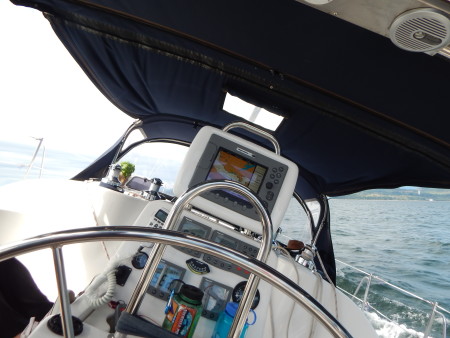
The first tack was a disaster in sailing terms, although I’m not ashamed of it. We lost all way and had to really crank the jib back in, but we got the boat turned and back on course without an incident and just a loss of distance to the Shack. After that, it was matter of finding a good point and getting used to it.
We were still overpowered on the port tack for most of the afternoon. I could probably have taken a couple of feet of sail back in to increase the reef. But the starboard tack was more comfortable and I really didn’t want to stop again.
There was also a Hunter 35 ahead of us and we slowly reeled him in, in a what was now a three-way race. Leslie and I got more and more comfortable and I started to point higher and higher trying to catch the Shack by shortening the distance of my tacks. I never did pass him, but we were almost alongside at one point.
We sailed at a 20–25° heel most of the afternoon (Scary–Terrified), occasionally exceeding 30°. Leslie learned to perch on the side of the cockpit combing like it was a seat and ride comfortably with her bum 12 feet (basically the width of our boat) in the air.

This is us taken from R Shack Island
It was mind-lockingly terrifying and exhilarating and eventually we made peace with it. Not the easiest way to start our sailing experience in the new boat, but we are unlikely to ever be that scared again. Until we hit 30 knots, I guess.
Stowage Leasons Learneds
Stowing gear for sailing involves putting things where they can’t fall and making sure things won’t slide over the fiddles (the lips on the edge of counters etc.). On our first sail we learned through a series of crashes and bangs that stowing for 20 knots is not the same as stowing for 12 knots. On our second big day we learned by way of even bigger crashes and bangs that stowing for 20 knots on a steady port take is not the same stowing for a long day of beating in 20-plus knots.
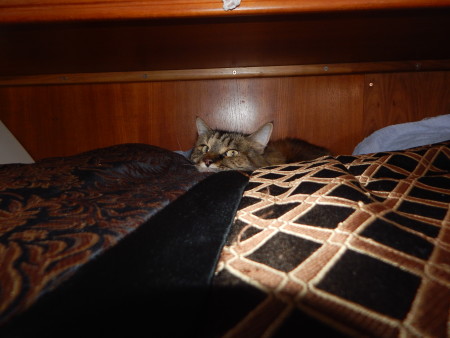
I think by the third trip down after a big crash everything — and I really mean everything — was on the floor, in the sink or, in the case of the poor cat, wedged between something like the pillows and our headboard.
The cockpit wasn’t much better. Cushions, charts, cameras, water bottles and binoculars were strewn across the floor of the cockpit. But eventually everything was wedged or shoved in a corner and the crashing ceased. That probably went a long way to reducing our heart rates right there.

—Captain Why #Posts
My cellphone sees…
At anchor in Squirrel Cove, Cortes Island. Heading north!

My cellphone sees…
Follow the leader with @RShackIsland

Housekeeping Notes
You may or may not know that I am mantaining two blogs. I have decided to try and keep neverforever.ca as a more boat-specific journal and leave the regular trip reports to macblaze.ca
Hopefully that will keep the noise down and not annoy anyone less interested in what I had for dinner or the number of compliments our cat got.
My first report 20 Knots and All’s Well has been posted so if you interested in a report in our first big sail have a visit over there. I hope to post weekly ( or at least regular) links here.
As for us, we’ve met up with R Shack Island and are starting our trek north to the Broughtons. The current plan is roughly Powell River (Westview), the Yucaltas and then try and stay inside until Johnstone Strait calms down.

—Captain Why #Posts
20 Knots and All’s Well
Note: I am currently maintaining two blogs and have decided to keep day-to-day trip report stuff here on my personal blog. I’ll reserve things on Neverforever.ca for more specific “boating topics”
After sitting in Nanaimo for half a week, we felt it was time to move on. R Shack Island was unfortunately delayed and had agreed to meet up with us later. So we set our sights on Secret Cove across the Strait and cast off. The winds were up (15-20 knots) and I wanted to try actually sailing our new boat.
Now here is the thing about us, learning to sail, and new boats. Every single time we have raised the sails in a new boat, it has been stressful, terrifying and generally a total laugh-a-minute circus. And this time was no different. Even though there was good wind, I decided to motor out past Snake Island; that way we would have plenty of sea room for any (inevitable) shenanigans. The seas were quite rough with spray coming over the bow as we were banging straight into them, but the boat handled them fine. So far so good.
Eventually we were far enough out we could attempt to raise the sails without fear of having to head toward anything solid while we figured it all out. Given the winds were peaking at 21 knots, I wanted to start with a reef in. But I’d never actually reefed a furling main, so it was all theory at this point. Our Selden rig has a continuous furling line and on the mast there’s a switch that allows you to switch it from free-running to ratchet. The theory being that when in ratchet mode you can loosen the outhaul and furl in the mainsail without the wind grabbing it coming unfurled again. That’s the theory.
What I failed to think through was this means you have to let the sail out all the way and then ratchet it back in. Starting with the furling line in ratchet mode just means you can’t pull the sail out; a fact that occurred to me after 5 minutes of tugging on the outhaul, looking up jammed mainsail in the manual and scratching my head. You see, my theory had been to pull the sail out only half way from the safety of the cockpit, so I had gone out on deck and engaged the ratchet first.
Eventually I figured it out and switched from head scratching to head smacking. So we let out all the main, engaged the ratchet and then furled it back in about a meter. I had no idea how much reef that was, but in a traditional mainsail I figure we would have at least one reef in and be contemplating a second. This looked roughly like one reef. I hoped. Then we headed off the wind and started sailing north close hauled, but left the motor running just in case. As soon as we started to turn, I unfurled the jib and away we went.

Of course the winds being so strong, we immediately started to heel. Leslie had the helm and was doing a good job, but as things started crashing down below — we never do manage to secure stuff well the first time — and the boat started hitting 20° and we were still looking for the damn tell-tales to try to trim the sails and the various wind instruments were not in agreement and the spray was crashing over the bow and… well, suffice to say the stress levels went up and the confidence levels went down as per usual on our first big sail.
Afterwards there was some discussion about the merits of having your first big sail in 20 knot winds. I mean, after all, it wasn’t likely to get worse and we worked out all the flaws in the system pretty quickly, if only because of sheer panic. That meant the rest of the trip should be relatively benign. Others might say a gradually rising curve of difficulty might be a better scenario, but we’d done that in the Shearwater the first time we sailed in the 20-knot range and all it had done was fill us with false confidence until we were literally doused with cold water. As it turned out, the boat handled the winds just fine as we spent the next 15 minutes trimming and tweaking and getting used to the heel. It’s always a bit terrifying the first time you heel the boat over so far you are literally climbing to get to the high side of the cockpit, but after a few (10 or 15?) minutes you get used to it and gain your confidence that the boat isn’t about to roll over like a breaching whale.
So, poise regained, we sailed in steady winds for an hour or so until they gradually started to drop. Eventually they settled down to around 10 or 12 knots and we were feeling very salty and sailorly cruising along. That’s why we then decided to heave to, shake the reef and let out the rest of the main before heading on our merry way. For the rest of the afternoon the winds continued to drop until they were bouncing around 6 knots on our beam just off the Merry Island lighthouse. I have no idea how fast our boat will actually go in the heavy winds because, frankly, we never did get them trimmed right. We had been doing a steady 5.5 to 6 knots most of the trip, but in the light winds we managed a respectable 3.7 to 4 knots on a broad reach. Eventually, as we got inside Thormanby Island, the winds shifted direction and I hauled in the jib and fired up the engine. We motor sailed through Welcome Passage, cruising along at 6.5 knots while only running at 1800 rpm.
Smuggler’s Cove
The tide was about 3 hours short of high, and after discussing it, we decided to try Smuggler Cove. Smuggler Cove is a marine park just a bit SE of Secret Cove. We had been in there for a look-see once before at low tide but had never stopped. The entrance to Smuggler Cove is a narrow, rock-filled channel with all the rocks showing at low tide and very few of them visible at high. They are all well charted and between your paper charts, your chart plotter and a Mark I eyeball, it’s a pretty safe and easy passage. The challenge comes when, once you are inside, the dozens of boats that are all stern-tied at various angles seem to combine with all the rocks on the charts to make a giant slalom course. We were perfectly prepared to abandon our plan if it was too crowded or seemed too risky.

Luckily, the cove was only moderately populated and a big cliff face with lots of depth and several red-painted metal rings for stern ties was readily available with lots of room on either side to give us a margin for error. Which, it turned out we needed. Learning seems to be like that.
Once again, the “first time in a new boat” syndrome bit us on the ass. We got the anchor down easily enough and our stern pointed at the ring, so I grabbed the 200’ stern line and jumped in the dinghy. I didn’t neatly uncoil the line (unless you’ve rock climbed for years, you can’t imagine how unforgivable a sin this is), I didn’t discuss a plan with Leslie, and I didn’t, in any way, even bother to check for currents. There was one. Right on our beam. That swung the boat 90°. Sigh.
Eventually I got the dinghy ashore and the rope untangled and took a wrap around the metal ring to try to haul the stern back. That was pretty much a lost cause. This left me (with my limited imagination) with little recourse but to begin shouting instructions to Leslie to try to get her to maneuver the boat back to where it had started from. A thus we have set our scene for a very Shakespearean comedy of errors.
There were miscommunications, slapstick hijinks, well-intentioned — but ill-informed — do-gooding, misdirected wrath, intentional malfeasance (on the part of the dastardly current), heroes, heroines and villain (again the current) and even a bear. Well, there was no actual bear, but our hero did growl a bit, especially after falling in the water while exiting the dinghy onto the rocks for the third time.
But, as in all good comedies, it all turned out and eventually we were secure and steady and ready for a bear… I mean a beer. The opening night review read that there was a strong cast and great story, but the actual plot was a bit lacking and it could have used a song or two. In retrospect (don’t you love retrospect?) my big mistake was not discussing the various possible outcomes with Leslie before I exited the boat and then just leaving her in charge of execution. The reviewer noted that attempting to captain a boat from shore is at best an exercise in futility and more generally an act of egoistic stupidity. Our heroine was perfectly capable of dealing with the issue on her own, but it was never made clear it was her issue to deal with, so she just kept trying to interpret the hapless hero’s less-than-coherent shore-based instruction. But at least we amused, amazed and terrified our neighbours, so at least that was something. They definitely got their money’s worth. Thank god there’s still time for some rewrites.
The Three Rs
As the tide rose, a few more boats showed up, and although none of them got caught out as badly as we did, a few did have their share of troubles, and we learned a quite a bit by watching how they chose to resolve their issues. Soon the tie-up rings on shore disappeared beneath the water. The full moon and time of year combined to give us some of the highest tides of the year, rising to 16′ from a low of 2.5′. A few of the later boats had to run their lines through rings a foot or more below the surface.

When we toured the cove by dinghy at low tide the next day, I noted that there were an awful lot of traps for the unwary at Smuggler Cove if one came barreling in here at high tide. It was good to see the lay of the land before we ever attempt to penetrate deeper into the cove. The back cove especially has a treacherous curved entry with a shoal that runs out from the red marker that would be most dangerous with the tide at its mid point.
Despite the long weekend, Smuggler Cove emptied out during the morning and soon there were only four boats left to enjoy the whole front cove, with three or four more tucked away in the back section. It is a beautiful spot to stay and relax, but I imagine most people just treat it as a stop-off spot on their way to and from Desolation Sound. That’s kind of a pity. Next time we intend to stay more than overnight we will brave the much quieter back cove and avoid all the morning and evening traffic.
The other thing of note — and I have no idea why this is — is that it seems this is a cove that inspires outboard use. And by that I mean of the 15 or 20 tenders and dinghies we saw exploring the cove, only one other boat besides us rowed. Everyone else explored the tiny cove using their outboards. Very odd for such a small quiet place. And even though there were quite a few kayaks, I saw more than one kayaker exit back onto the mother ship and then hop aboard the tender, fire up the 15-horse outboard and putt away to explore some more. Very odd indeed.

As for us, well, we rowed, read and relaxed. These are now, hopefully, the three Rs of our boating adventure. At least for the next few months.
Oh, and I finally got the graphics on the bow of the dinghy. Laughing Baby has officially been christened.

My cellphone sees…
The Shack is back! Finally meeting up with @RShackIsland

The First Week or Seven Days and We’re in Nanaimo
It’s been a hectic 7 days for us n00bs. We have moved from our 1900-sq-ft condo in Edmonton onto a 38′ sailboat, transported our poor cat 1200 miles to a new, danger-fraught lifestyle, and had to learn/develop a new routine for just about everything. On the other head we’ve experienced fireworks, seals, lovely rainstorms, and quiet walks along the beach.
A Start
All along our plan was to move aboard and head as soon as feasible to Nanaimo. There is good anchorage there (which means free) along with options for a marina ($1.40/foot or $53.25/night), mooring buoys ($12/night) and even the docks at Newcastle Island ($2/metre or $23 a night). Nanaimo also hosts The Harbour Chandler, a Thriftys, London Drugs, and a BC Liquor store all within a short walking distance of the dinghy dock. Oh and it also has the famous Dinghy Dock pub on Protection Island, accessible only by boat. All this made it the perfect place for us to settle in and provision before we sailed off for parts north.
But still back at Granville Island, we headed up to W 4th Ave and a visit to the No Frills for basic supplies. We had decided to leave the major provisioning until Nanaimo and since we had raided the condo’s kitchen for everything we could think of (except the balsamic vinegar — there were two bottle in the cupboard and I forgot both –sigh!) we didn’t need too much except a couple of days’ meals and some basics.
The walk to the No Frills goes right past the West Marine so we stopped in and browsed our wish list. There were a couple of Mustang PFDs for about $40 so we bought two. This brought our total up to four plus two inflatables. The boat came with six of those cheap, tie around your neck types, but we decided to leave those in the truck. Other than that, everything else looked like it could wait.
Speaking of the truck, I had arranged to keep it at a friend’s house in Surrey until October. Our berth in Victoria would be available October 1, so we were planning on parking the boat for a week or two, and returning home to YEG to finish off closing up the house. So after we had loaded anything extraneous we could think of (extra pillows, used cutlery, pfds, containers etc.), I left Leslie to catsit and drove out to South Surrey. And despite the dubious help of my iPhone’s gps I didn’t manage to get lost. I did arrive a bit early so I checked out the local Canadian Tire for some Velcro wall hangers and a few more small containers. Then Dave gave me a ride back to Granville and we went back to moving in and stowing stuff.

Stowage & Supplies
Putting things away is harder than it seems. First off you need cooperation and consensus. And if you manage to get past that hurdle you also need to remember what you’ve got and where you put it, and then train everyone to put it away in the same space. Living small seems to take a lot of cooperation. We will get it eventually. I hope. Maybe.
I do think an running grocery inventory is going to be necessary. You can’t always see what you’ve got and asking Leslie every five minutes “Did we buy X?” seem to be annoying her; and I can’t afford that until at least week two (or when we are far enough away she can’t abandon ship). And she used to really like lists so…
Another thing we are learning is the importance of usage rates and container sizes. For example, we bought two frozen limades and then ended up going back twice more to get extras. With the heat, we seem to be consuming a lot more of certain things and under- (or over-) estimating what we will use. We have enough pasta to eat until the next century but have run out of granola bars already.
And I figure it will all change as the geography and climates change. Less of a learning curve than a learning cliff. BUt that’s why we are hanging out in Nanaimo to settle in.
More Bills
The amount of money we have spent in this first week is phenomenal. It just goes to show how bad I am at budgeting. I think I set week one’s budget as double a regular week. Well, we are into about 5 times that now. Some of it was unexpected stuff from Specialty Yacht Sales and the work they did on the boat. And of course the dreaded moorage charges. But a lot of it was just underestimating the number of things we would want to add to our cruising inventory.
We’ve picked up things like extra containers, microfiber towels, a solar shower, a few bits of clothing, a popcorn popper, et cetera, et cetera. Very little of it has been extravagant — I’m saving those things for later when Leslie isn’t following me around — and some have already proven their worth (like the solar shower: awesome on Day 3 when the hot water is a distant memory).
But a warning to any readers who are newly provisioning: Week One’s a killer.
Granville Island & Fireworks
We spent the first couple of days at the docks on Granville Island.
Friday A.M. Steve from Jensen Signs showed up to apply the new name. Despite the rain, he got the new graphics applied to the bows and the stern. Later that evening Leslie, Artemis and I gathered on the bow with a bottle of champagne to thank the sea gods for Rainbow Hunter’s good service and to ask them to look over the newly christened Never for Ever. Then we poured them their share and drank the rest. Artemis turned her nose up at her share but that was all right. More for me.


Saturday night there were fireworks in English Bay and we watched them from the cockpit. The bridge obscured a lot of the show, but it was enjoyable and comfortable. We also had a lot of rain over those couple of days and used the enclosure a lot. It doesn’t keep the space really dry — there is leakage where the canvas covers the arch — but it is pretty comfortable and we can set out buckets or something to keep the water contained. Still, if I had $10,000 lying around, I might want to re-design the enclosure.
We also ran into John from Spiritus II. We had met him at the Rendezvous. He was just offloading his visiting kids and grandchild and waiting for his wife. He invited us over for a glass of wine when she (Karen) arrived, and we spent a nice evening chatting. He is another reluctant socialist married to a committed one. We commiserated.
They are also Broughton-bound, so we might run into them again.
Nanaimo Harbour and Newcastle Island
Eventually we cast off and headed across the Strait. As per usual the wind was non-existent and we motored all of the way across. Artemis was a bit put out and spent the entire six hours hiding out in the bow. She had started off in the aft cabin but I moved her forward because it was quieter, and she settled in. She will eventually figure out the best spots, but for now we are shuffling her like new furniture that just can’t seem to find its “right” spot.


We arrived in Nanaimo eventually and tried out our brand-new Rocna (anchor) in the bay. It set first time and we shut down the engine, took a deep breath, and tried not to second-guess everything we had just done. Luckily it was pretty quiet and we had lots of room. There was one powerboat we kept swinging around near but never got closer than about 40 feet. The currents in the bay off Newcastle Island are pretty active and everyone spun a lot. It’s hard to tell where everyone will be at any given moment. The next morning after some of the boats left, we broke out the kellet (Thanks Dave and Margaret!) and adjusted our scope until we were happy and confident. Then we just hung on anchor for three days, enjoying nightly walks in Newcastle Island park and soaking in the ambiance.
Propane Tanks, Parents, and Special Hexes
Nanaimo was fun. The public dock is right downtown and we could dinghy in and shop for groceries, booze, sundries, and boat supplies — all within easy walking distance. Since we are now people of leisure, we decided on lots of small trips rather than staggering around like pack mules on a cross-country trek. First off we had discovered our anchor light wasn’t working, so I picked up a small hoist-able LED and some wire to work on my chart plotter/radio connection at Harbour Chandler, and then we grabbed a day or two’s worth of groceries on the way back. A few more trips over the next couple of days added to our inventory.
Leslie’s parents agreed to come down and visit on Wednesday, so we put our heads together and formulated a plan. Mine clunked hollowly, but hers still seemed a bit full of something. Still it didn’t hurt that much. Rubbing our noggins, we decided that they wouldn’t enjoy the dinghy ride out to the anchorage much, so the plan was to move the boat to the park docks on Newcastle Island. They are free if you are a day visitor and only $2/meter if you stay overnight. I found a nice stern-in berth so everyone could just step through the transom and the climbing and scrambling would be kept to a minimum.
Then we grabbed our two 10-lb propane tanks and headed over in Laughing Baby (the dinghy) to the dock where we had agreed to meet them. Stephen (L’s brother) had come along so the merry mini-van load of us all set off to find a propane place. Apparently the Co-op is the place to go but it is up the highway a bit. We filled one tank, but it turns out our secondary tank (for the BBQ) was out of date and the girl wouldn’t refill it. And the closet place to re-certify it was Chemainus. So we gave up on that and picked up a few disposables for back-up.
We also stopped at Pet Smart for a new harness for Art. The old one was giving us some grief and we wanted an alternative. Then we grabbed lunch at BP.
On the way back we stopped in at Midland Tools. It seems the back of the NavPod that houses the chart plotter was attached using security hexes. These are hex nuts with a pin in the center of the hole, which means you need a special allan key with a matching hole to take them off. Neither the chandlery nor Canadian Tire had any, so a tool place was our last chance. I picked up a complete set of security driver bits for $9.99 (plus PST and GST — I’m still not used to the damn taxes).
Then L et al. took the ferry across to Newcastle and I rode the dinghy solo. Back at the boat I broke in via the forward hatch (Leslie had the key), restowed the tanks, and got ready to cast off. While we were gone a big powerboat had parked in front of us, blocking us in the narrow finger. I enquired as to their willingness to move, and he figured that we would fit in the gap between them and the boat across the finger so there was no need. I expressed doubt in return and he produced a tape measure. So we measured. Turns out there was 14 feet and our beam was only 12 feet 9. Plenty of room (rolls eyes). Anyway, both boats involved expressed a willingness to let us squeeze through and offered assistance, so I agreed.


Once L’s family arrived and was stowed below, she and I fired up and started edging out. The two of us, plus four on one boat and two on the other, managed to hand-bomb the Never For Ever safely through — yikes, there wasn’t even room for the fenders — and we were off and running. Boating is definitely an adventure. Then we invited everyone on deck, and I ran out the jib and killed the engine. We sailed out toward Gabriola in 5 knots of wind making a stately two and a half knots. It was great, great fun.
While we were out After Eight (Pattison’s yacht) pulled out and passed us affording everyone a great view of how the other, other half lives. Seaplanes took off and landed all around us and commercial barges, sailboats, and a stream of traffic coming from Dodd Narrows passed us by. We tacked back and forth a few times in the channel and eventually cruised back to the docks and found a berth on the other side to avoid the squeeze. One and all took a short walk around the park and visited the pavilion until it was time for them to reboard the ferry. Then we said our goodbyes and retired back to the boat.
We decide to pay up and stay the night. The docks at the park are much more communal and family oriented than any others we had stayed at. Lots of day traffic with a bunch of boats casting off around 6-ish. And tons of kids running around and diving off the docks into the warm-ish water. Lots of fun and a completely different ethos than usual when we’ve been at dock.
Last Day
The next morning we called the port to enquire after a berth. We were out of power and short on water and needed to empty the holding tank. They were on a first-come, first-served basis and said there was room, but call again from the breakwater. So we cast off and headed in.
After we were snugged up at I-dock and all plugged in recharging, we headed up to the grocery store for a major provisioning. Between the London Drugs, Thriftys, and the liquor store, we ended up making three trips but eventually were were set for a couple of weeks with a need only to replace fresh stuff at some point.
The dock was yet again another type of community. I have to say it was nice to have power and water, but I much preferred anchoring out when at Nanaimo. It’s just a bit too busy and too commercial. Nothing bad though, just different. We listened to music on the boardwalk, walked down to the fishing wharf and looked out over the harbour, then retired for the night.
So that was our first week. We had watched a couple of episodes of the last season of Gilmore Girls on the laptop and read some books and generally tried to get some stuff done but overall it was busy. It hasn’t been very relaxing yet and we don’t have any firm plans of what we are doing, but all in all it was a pretty successful start. We are waiting for R Shack Island to be put back in the water and make the trip up from Blaine. Then we will head north hopefully to spend most of August in the Broughtons.
Stay tuned.
—Captain Why #Posts
My cellphone sees…
A comedy of errors but we are safely stern-tied in Smugglers Cove.

Costs update…
Wanna buy a boat? Huh. I’ve said it before, a fool and his money…
There is a euphemism in boating refered to as the boat buck. It’s the equivalent of a thousand dollars. Want a new dodger? Slightly over a boat buck. A full enclosure? Call it 10 boat bucks. A new heater? Another boat buck. I’ve also heard boat actually stands for “break out another thousand.” Are we starting to get the picture?
I had entered into this adventure with the idea of buying a turn-key boat and not spending much until we had made the decision about our long-term relationship. Maybe just an anchor as a treat. Fool again I say.

So way back in April I had gone over some of the anticipated costs and then summarized expenditures to date (How Much So Far?), but, since we’ve spent a bunch more, I thought I’d cough up a brief update.
| 4 Trojan Batteries — Because the batteries had some bad cells and we are going to be wanting to live on the hook for days at a time. | $800 |
| Rocna 22 anchor — Because I want to have faith in my anchor. | $600 |
| Head Rebuild Kit — A small leak. I will do the actual repairs myself. | $75 |
| Paper charts — All the way up to the Broughtons. I like paper. Besides it’s still the law in Canada. | $600 |
| Sony Digital Receiver — All our music is digitized. A CD player that couldn’t hook up to an iPod seemed pretty stupid. | $80 |
| Boat Cards — For fun (see below). | $40 |
| Vinyl Lettering (installed) — Installation almost doubled the price, but I’ve screwed up vinyl before. Better to get it right the first time. | $500 |
| Fire Extinguishers — It was a rush and I didn’t have time to get the old ones recertified. | $125 |
| New Flares — Safety requirement. | $200 |
| Rebedding a leaking hatch — Not sure if this was a good expense or not but… | $380 |
| New masthead Nav Light — Sigh. | $100 |
| Temporary moorage at Granville Island — A boating Gotcha. You have to pay for the moorage at the repair yard. Tanstaafl. | $1500 |
| Skipper Delivery Charges — So we could save 1000s in BC sales tax. | $400 |
| A dinghy safety kit — It’s the law. | $50 |
| A new inflatable pfd for Leslie — It’s a comfort thing. | $150 |
| 3 new life jackets — For the dinghy, so we don’t have to use the inflatables and to replace the old scummy ones. | $120 |
| A new windex — So we can see which way the winds are blowing. | $140 |
| Wet Bilge Investigation — Because who likes a wet stinky bilge? | $160 |
| Engine check after overheat — This one ahould be obvious. | $325 |

There are a ton of small things I haven’t recorded, like the new queen sheets, a small cookie sheet, a LED reading lamp, non-skid cat bowls, a new litter box, a few microfiber towels, and even some new fender lines.
There are also a few things we want to get but we will leave until later, stuff like new docking lines ($120+) and new fenders ($50 each), another folding seat and of course some way to generate power. But the moneytree seems a bit bereft and Patience is starting to whack me upside the head cause she wants some attention.
—Captain Why #Equipment, #Posts
My cellphone sees…
Why yes, I did drive my boat through that gap. With lots of help.
