Category: On the Water
Welcome Aboard!
So, you’ve been invited to go sailing or boating with friends. If you’ve never been on a boat before, you need lots of advice — pronto!
On the other hand, if you’re an owner planning to invite non-boating friends aboard, whether for a short tour of local waters or for an overnight excursion, sharing a few tips in advance will ensure that everyone enjoys the experience.
Based on our experiences inviting people aboard and our travels on other people’s boats, here’s a primer for non-boaters taking a voyage on a sailboat or powerboat.

What to Pack
If you have luggage, bring it in a soft-sided bag, such as a sport bag or a backpack. (Bonus points if it’s scrunchable and can be made small!) Space on boats is restricted, so don’t bring unnecessary items, and power is generally limited so curling irons and hair dryers should just stay home. Be sure to bring polarized sunglasses, your camera (plus wrist strap), and your charging cable (if you’re going to be gone for more than 24 hours).
What to Wear
If your image of sailing involves women in bikinis sunbathing on the prow of a sailboat, you’ve never sailed in the Pacific Northwest. The feels-like temperature on a boat is several degrees cooler than the air temperature due to the wind. Your best preparation is layers, including something with long sleeves and a pair of full-length pants. Even if you don’t wear it, bring a jacket especially one that’s waterproof. Bring a hat and wear sunglasses — the effects of sun are amplified by reflections on the water. It is possible to get both a chill and a sunburn at the same time! Also remember you will likely get wet at some point, whether from spray over the dodger or from wading ashore when you beach the dinghy. And it’s salt water, not fresh, so choose your clothes appropriately.
If you feel cold, speak up. Nothing spoils a trip like hypothermia. Your hosts will likely have spare gloves, hats, and other warm gear.
Wear comfortable shoes with white or light-coloured soles. Basic running shoes are great. Don’t wear heels. Don’t wear new shoes that may cause blisters or shoes that might slip off your feet unexpectedly. No hiking boots, work boots, or other cumbersome footwear, please.
Life Jackets
Canadian law requires your hosts to have a life jacket or other PFD (personal flotation device) for every person aboard the vessel. Whether you wear it or not isn’t entirely your choice, however. Some boaters will insist you wear a PFD; others won’t, but will likely encourage you to do so. Respect your hosts’ directions. Remember, it’s your life they’re trying to protect.

Safety Brief
Our friend Tim, a very experienced boater, always gives a friendly but thorough briefing before his boat leaves the dock. As a guest, you should know where the fire extinguisher is, where the first aid kit is, and where the emergency equipment (such as flares) is. If your hosts forget to show you, don’t hesitate to ask. Your hosts may also show you how to make a mayday call on the VHF radio. (Don’t use the radio otherwise: by law, you need an operator’s certificate to use marine radio.)
Your hosts may also go through a quick man overboard drill with you. No one likes to think about someone going overboard, but it’s always a risk. Pay attention to the drill and know where the equipment is. Yes, it’s rare for someone to fall in the water, but preparation can make the difference if it should happen.
Lending a Hand
If you’re going out with experienced boaters, they’re capable of operating their boat on their own, so your assistance isn’t required although your help is welcome. If you want to help, though, ask before you get involved. Changing a crew’s routines unexpectedly can cause problems.
Once the boat is underway, if you want to help with trimming the sails or taking the wheel, just ask. It’s almost never a problem for someone else to take the helm, and extra hands are always welcome on a sailboat. If you’re not sure what to do, please ask; your hosts won’t know what you don’t know if you don’t ask. But remember, sitting back and enjoying being a passenger is perfectly acceptable too.

On the boat deck, there’s one important rule: one hand for the boat and one hand for the task. If you walk forward from the helm, keep a hand on the life lines or the grab bars as you go. It’s just good safety.
Boats have lots of moving rigging. Whether it’s the anchor chain or the various lines and sheets on a sailboat, moving parts can quickly and easily turn an enjoyable cruise into an emergency. Know how to use the winch or windlass safely before you lend a hand, and make sure everyone else around you knows what you are going to do.
Getting away from and returning to the dock can be stressful moments. If your hosts ask you to hold a line or step off the boat, be sure you understand what they’ve asked you to do and that you’re prepared to do it. Don’t try to be heroic: you put yourself and others at risk. On a boat nothing can be fixed by suddenly doing something unexpected. Stay calm and follow instructions. If someone on the dock offers to take a line, hand it over only when the skipper says to do so. Onlookers are often eager to help but don’t always know what the person operating the boat needs. The person at the helm ALWAYS gets to direct.

Going Below
When you go inside the cabin (“below” on a sailboat), you’ll notice that powerboats are fairly roomy and open while sailboats are long and narrow. If you’re going to be aboard for more than a few hours, you need to learn the subtle steps of the “boat dance,” which involves moving in rhythm with others and anticipating when to shift out of the way. Don’t worry, your hosts aren’t judging, and they will move around you when necessary. But you’ll likely find you’re more comfortable if you pay attention to how other people are moving below deck.

When you are sailing, things will often be stowed in such a way so that they don’t move around as the boat heels (notice the angle of the dish rag hanging over the sink)
While underway, you’re likely to be on deck most of the time. When you go below, avoid opening cabinets or drawers while the boat is underway. If there’s something you need, ask your hosts. After you use something, put it back where it came from. Boaters take the idea “ship shape” seriously. And remember that you’re in someone’s home. Resist your snoopy urges.
The Marine Head
Your hosts will likely show you how to operate the toilet, commonly referred to as “the head.” Now is not the time to be shy or squeamish. Marine heads can be touchy, and fixing the head is — as you can imagine — not a pleasant task, so please follow your hosts’ instructions.
DO NOT flush Kleenex, women’s products, or anything non-organic; Even using too much toilet paper can cause a problem. A common boating truism is “Nothing should go in the toilet that you didn’t eat or drink.” Your hosts will be grateful if you follow this advice. Don’t be surprised if your hosts ask you not to flush toilet paper and instead show you a bag or garbage bin. You might find this unusual or gross, but your hosts know their boat, so follow their wishes. Another truism is “If you break it, you fix it.”
Remember that boats are small and the head is a shared space; be courteous in your usage and respectful of other people’s privacy,
Life Aboard
If the trip is planned for longer than half a day, you’ll learn that a big part of boating involves conservation. Both fresh water and electricity are finite resources, so don’t waste them.
Stay hydrated—fill a water bottle at the beginning of the trip and refill it as necessary. Often the boat’s water tanks will be restricted to cooking and washing; drinking water will be carried in separate containers.
Managing water is easy. Don’t let taps run when you’re not using them. If you shower, turn off the water while you lather up, and go easy on the soap and shampoo to make rinsing quicker. Hot water is also at a premium. To heat water you generally need to run the engine or be plugged in to shore power. If you are at anchor for a day or two you will have neither of these things. The hot water generally stays hot for 10 to 12 hours. After that water needs to be heated on the stove.
Same goes for electricity. Avoid opening the fridge unnecessarily: it draws a lot of power. Turn on lights only when you need them, and turn them off when you don’t. Be sure your hosts can spare the power to charge your electronics before you plug them in (most mobile phones are OK, but laptops may require an inverter). Any small appliances are usually not able to be used if you are not plugged into shore power.
Many boaters try to follow the light — early to rise and early to bed. If you’re a night owl, you might want to tuck a flashlight or headlight in your luggage rather than drain the ship’s batteries staying up all night.
Most boats in the PNW will have heaters but they don’t run them constantly. Be prepared that you might wake up to a chilly boat in the morning before the air warms up.

Beer and Boating Don’t Mix
While the boat is underway, there’s no need for alcohol. Raise a glass only when you reach your destination. Remember too that between the sun and wind it’s easy to get dehydrated. Drink lots of water during the day so that first cold beer doesn’t hit you too hard.
Seasickness
Non-boaters often worry about feeling seasick and being embarrassed. Depending on the water and weather, you may in fact start to feel ill. It happens to everyone at some point — don’t be ashamed! The combined noise of the wind, the waves, and the sails (if you’re sailing) or the engine (if you’re motoring) can be overwhelming, too, even if you don’t feel nauseated.
To combat seasickness, stay on deck. Look at the horizon, not at the water. Don’t go below — the effects of motion can be worse inside the cabin. Eat a light meal before you go out — lots of carbs, limited fats, no alcohol. While you’re underway, take small sips of water to stay hydrated and keep your GI system calm. Ask to take the helm; doing a task is often the best preventive for seasickness.
If you’re below deck and think you’ll be sick, use the head, not a sink. If you’re on deck when you feel ill, stick to the leeward side — the side that’s facing away from the wind. (The expression Don’t spit into the wind applies here.)
Home Again, Home Again
When the vessel comes back to its home dock, remember that docking a boat isn’t quite as simple as parking a car. It will take your hosts a while to tie up, connect to power (if applicable), and otherwise secure the boat. Be patient. Your hosts need to work through various steps, sometimes in a specific order, to ensure the safety of their vessel. You’ll be the centre of their attention again in a few minutes.
We love our boat, and we love having guests aboard so we can share our enthusiasm with them. Making our expectations clear at the outset definitely helps a trip go better.
—Herr Doktor #Liveaboard, #Posts
Baking Bread
One of the things I miss most about living aboard is that the freezer (especially on batteries) is not quite up to the job of keeping bread fresh. We make do with preservative-heavy Wonderbread a lot of the time and try and plan things like hotdogs and hamburgers around shopping trips.
But one of our missing crew is a fabulous cook and she had a recipe for a no-knead bread that she would treat us with, so I decided to get her to send it to me after we hit Victoria. It turns out we needed something like a Le Creuset dutch oven, but that wasn’t in the budget. So we headed down to Capital Iron and picked up an old school cast iron pot with lid that would fit in the boat’s oven. Forty dollars later and a bit of seasoning and we were good to go.
Doing some research here I found that apparently no-knead breads are a big thing and I certainly have grown to embrace them. It takes about 5 minutes to blend flour, yeast salt and water and then you put it aside for 18 hours or so and you have great dough for pizza or bread for dinner the next day. These days I usually make a batch or two every week. This recipe was also featured on page 21 of the March issue of T8N Magazine.

C’s Boule

- 3 cups flour
- 1/4 tsp instant yeast
- 1 1/2 tsp salt
- 1 1/2 cups water (room temp or cold)
Put the flour, salt and yeast in a bowl. Add the water. Mix with a wooden spoon until dough is shaggy. No need to knead.
Cover with plastic wrap. Let sit for 12 to 21 hours.
Use as-is for pizza dough.
For a boule, punch down the dough (use flour — it will be sticky), and form it into a ball. Roll the ball in flour, and place it on a large plate. Cover loosely, and let rise until double (1 to 2 hours)
Put a Dutch oven with a lid in the oven, and heat it to 425°F.
Flop the risen dough into the hot Dutch oven, cover and bake in oven for 30 min.
Remove the lid, and bake 15 minutes more.
A few boater caveats
I make a 2/3rds version of this recipe for my smaller cast iron pot. And I usually just put the oven on the highest setting and bake it for a bout 35 minutes before taking the lid off. Then I just monitor it for browning, giving it a thump or two to see if it sounds hollow.
 It makes terrific pizza dough
 Try adding 2 tsp of sugar and cinnamon and a 1/2 cup of raisins
—Captain Why #Liveaboard, #Posts
Easter Sail…errr…Cruise
We really hadn’t done much sailing this winter and were still a bit trepidatious about the cold. So we’d been humming and hawing and watching the weather and making no decisions as Easter quickly approached. But our usual office space at the public library was closed Friday, Sunday and Monday and we had no other plans. There was no reason not to go except fear of the cold.
Day the First
So Friday morning I popped my head out the hatch, noticed a couple of boats gone from the docks and said, “Let’s go…” Now apparently, unbeknownst to me, the plan was for us to go, if we were to go, Saturday. But since Friday, Saturday and Monday was forecast to be sunny and Sunday was supposed to be cold and rainy, it made no sense to me not to have at least one nice day to hang out somewhere. Besides those other boats had gone already. And it looked like a few more were prepping. Get the feeling I am easily led? Sometimes… 🙂
Anyway, I checked the freezer and there were at least three days of meals there and tons of backup supplies like pasta and canned stuff. The only critical item was milk for morning tea and we had just enough. So I made a command decision and broke out the checklist and less than 45 minutes later we were rounding Odgen Point and headed for Haro Strait. Somewhere along the process of getting ready we decided on Royal Cove on Portland Island as a destination. We’d spent three or four days there last fall and it was protected and peaceful, and had lots of hiking. My only worry was that being so close to Sidney and Tsehum it might be packed with weekenders. So our fallback would be wandering over to Roche or heading to Tod Inlet or Genoa Bay. It was only 10:45 as we exited Victoria Harbour so we had plenty of time if we needed it.

The forecast 5-10 knots was more like 2-3 so we motored at around 2200 rpm, conserving fuel and enjoying the sunshine. The Nordhavn 40 Aegis (a gorgeous ocean-going trawler that somehow looks less than suited to our cruising area) from B dock pulled out just ahead of us and we followed in its wake — albeit a knot or two slower. Once we passed through Enterprise Channel, we met up with 5 or 6 other boats coming out of Oak Bay and Cadboro Bay and heading east. My suspicions that it was going to be busy were looking correct. But as we all cleared Cadboro point they headed off like stately ducks in a row towards the NE, following after Aegis and presumably off towards San Juan Island.
We motored in the glassy water of Haro Strait past Sidney Spit and enjoyed all the sights and sounds of the busy water off Sidney. I went below to make some no-knead bread dough for the next day while Leslie took care of the helm. A bit later we passed through the many islets and rocks around the north part of Sannich penninsula and entered into Moresby Passage. Right about then I spotted a Beneteau with green canvas ahead and speculated it might be Bula, one of the boats from our dock. Sure enough, as we got closer we confirmed it; they had their sails up and were stubbornly motorsailing their way north. I hailed them on the VHF and it turned out their destination was also Royal Cove. A few minutes later we passed them and then watched the monstrous Coastal Celebration slide by us as we shared the suddenly much narrower passage.
Much to my surprise Royal Cove was empty. We circled around and picked a spot as deep in as we could get on the east side to avoid as much of the ferry swell as possible and dropped anchor. As stern ties go it was one of our better ones and I managed to get the stern in close enough that we could loop the line through the iron ring on shore and back to the boat. That way when we left we could just pull the line without having to row back ashore. Leslie was able to keep the stern pointed basically at the shoreline and only had to do a little maneuvering to give me enough slack to get the line back to the boat. Bula pulled in a few minutes later and tied up a couple of rings down, and we were set for the night. Bula was apparently only here overnight since their girls were keen on the Easter Egg hunt at Poet’s Cove on Pender Island, so we might end up getting the cove to ourselves for most of the weekend.

We stripped back some canvas to let the sun into the cockpit and enjoyed the peace and quiet. You can actually feel the pressure disappear after you turn off the engine and begin to absorb the silence of these islands. Victoria is a great place to be but between the noise, overflying seaplanes and the boat’s constantly running heaters you forget how much pressure a city puts on your senses. The sensation you feel in those first few moments when you are finally settled in at anchor is like that ice cold glass of water on a hot day: just what body and soul needs.

After a while I bestirred myself to make some baked pasta for dinner and then we settled in to watch videos on the laptop before bed. As the sun set it cooled down so we fired up the Webasto for an hour or so before bedtime, added an extra quilt and then snuggled in for the night.
[flexiblemap src=”http://macblaze.ca/kmz/Easternumber1.kml”]
Day the Second
Morning was cold. C-O-L-D! I sprang out of bed, hit the breaker for the heating system, snapped on the Webasto and switched the fans to high; then I dived back under the covers to wait for the boat to heat up. On the way by I glanced at the thermometer and it was reading 8° C (46° F) in the cabin. Brrrrr. But at with the heater at full blast, the cabin doesn’t take long to start warming up. We hadn’t used the diesel heater much since we installed the battery monitor, so I took a few moments to take some readings after I crawled out from under the warm covers. After the initial start-up phase of 6 or 7 minutes, the Webasto seems to draw about 4 or 5 amps. It is a hydronic unit and has 3 radiators with fans: aft cabin, salon and another split between the forward cabin and the front of the salon. The fans draw about another 2 amps each, and it doesn’t seem to make that much difference if they are on high or low. So running the heater draws around 6 or 7 amps, which wasn’t too shabby as long as we were judicious in its use. By 4 pm that day, which was 24 hrs after we arrived, between the fridge, heater and various other lights and such, we’d used about 12% of the battery or 25% of our total available battery power. That gave us 4 days at that rate: not bad.
As the sun came over the trees, I grabbed a blanket and headed out into the cockpit with my book and coffee and settled in to relax. It was a slow day. So slow that we barely left the boat. One short hike out to the point and a slow meander back along the shoreline was the sum total of our physical activity.

Along the way I indulged myself taking pictures of wildflowers and sticking my nose in cracks and crevices along the shore cataloging the sea life. We spotted plenty of the ubiquitous purple starfish and a few smaller orange and white ones. I also spotted a horny orange tube which I dubbed a sea cucumber. Back at the boat I looked it up and I think it was a California Sea Cucumber (Parastichopus californicus), but you tell me…

Back on board we read, I made some dinner rolls for the next day’s lunch and baked the boule (no-knead bread), and then basically we hung around doing very little for the rest of the day. At low tide a small racoon came down to forage and entertain us, and later we watched a kingfisher zoom back and forth hunting dinner.


Leslie couldn’t leave the buns untouched until Sunday so helped herself to an advance copy. Reviews were good. Dinner was pork chops and fresh bread. After a warm, sunny day we left the heater off, played a bit of crib by candlelight and watched Guardians of the Galaxy under a blanket before heading off to bed.
Day the Third
Happy Easter. It seems neither of us had the foresight to buy any chocolate so we had to be satisfied with coffee and tea. The morning was a repeat of Saturday although I think we had acclimatized to the temperature a bit. Sunday was suppose to be rainy but it wasn’t socked in; more of an intermittent thing with moments of sunshine and warmth interspersed with cloud and rain.
We packed a lunch and made some ice tea for our water bottle, then layered up and headed out. Today we were going to loop the whole island and do the one remaining bit of trail we’d never done yet — 6 or 7 kilometres total. Along the way I took a ton of wildflower and mushroom images, but I had only my iPhone so many of the smallest flowers didn’t turn out or were blurry. Spring is an amazing time of year for the amateur botanist; hopefully we will be back at end of April to see the next bunch.

We ran into five or six other parties on the trail, one fellow even doing it in a walking cast and crutches, which is pretty ambitious on some of the rougher parts. They must have all been kayakers, though, as there were only two boats in Princess Bay and one of those had its dinghy still on deck. On the west side of the island a pair of racoons were fishing on the rocks as we walked off-trail along the shoreline, and they seemed pretty put out that they had to wander back to the forest to let us pass. We ate fresh bread and jam for lunch in the sunshine on the midden beach facing Brackman Island and enjoyed the quiet and the view. We had to strip off most of our layers since it was so warm in the sun. But the rain came back about 20 minutes later and we bundled up again and head toward Kanaka Bluffs on the last half of our hike.

The intermittent rain and sunshine produced some lovely visuals with mist rolling off moss-covered boulders and the verdant green forest constantly playing with lights and shadows. Most of it is impossible to capture with a camera but it’s always well worth pausing and taking in the moments that hikes like this present. Even if you are standing around in the rain.

Five hours or so later we arrived back at the boat and stripped off our muddy clothes in exchange for something warm and dry. Then it was back to relaxing until dinner started calling. I fixed up some crispy-skinned, bone-in chicken thighs — one of my all time favourite meals (thanks, C) — and roasted honey-dijon and garlic potatoes.
That night’s video fare was an episode or two of the acclaimed series It’s Always Sunny in Philadelphia. It’s another of those comedy where none of the characters seem to have any redeeming characteristics (we are still reeling bit for watching the British version of The Office). The jury is still out whether it’s going to be part of the rotation or not.
Day the Fourth
Well, it seems we are all hardened up and the heater was barely on at all the next morning. Part of the reason for this trip was to see whether we are ready to leave Victoria for good, and I have to say, if we can count on this amount of sunshine, then I am pretty certain it won’t be much hardship when we decide to go.
The tide was going out and it looked like if we left right away we would catch the current and hit Discovery Island right at peak flow (in the right direction) so we washed up a bit and prepped to go. A lovely boat named Luna Quest had pulled in early the previous evening and the hardy souls aboard (all young men) had braved the frigid water for a quick dip accompanied by some loud expletives. This morning they too were prepping to go so we let them cast off first before we let slip the stern line.
Our departure wasn’t without a bit of drama as the wind swung our stern out towards the dinghy dock ( which I had anticipated) and then we popped the windlass breaker (which I had not) and Leslie had to dive below to reset it. At this point, for some stupid reason, I hit the auto pilot and was bringing in the stern line. The stern cleared the dock with ease but was now drifting towards the shallow water and rocky shore and we were —I thought — over our anchor chain. When I grabbed the wheel to move us off it wouldn’t budge. I yelled forward that maybe the chain was interfering with the rudder, but after the panic-adrenaline cleared, I suddenly remembered that the auto pilot was on. Cursing, I flipped it off, maneuvered the boat to the centre of the cove and willed my heart rate down back to something approaching normal. It’s not the first time I have forgotten about turning on the auto pilot, and I think I am developing a potential dangerous habit.
Exiting the cove, we swung west to follow the curve of Portland Island and headed for home. The winds were around 12-15 knots as we entered the channel so we had high hopes we would be doing some sailing after we cleared the busy waters. The fuel gauge was currently reading below a 1/4 of a tank. We had last filled in Roche Harbour last October, but math said we should have a little over half a tank left. But that was not counting whatever fuel the using the diesel heater during the winter had used, although that was supposed to be minimal. Redoing the math we decided we were good for the 4 or 5 hours we needed to get back to Victoria. But as we approached the islands off Tsehum Harbour I started second-guessing myself and eventually declared a state of “better safe than sorry” and turned in towards Swartz Bay and the Van Isle fuel dock.

I played a bit of chicken with the ferry as we approached the pinch point between the buoy off Knapp Island and Coal Island, but he had plenty of room after I scooted across the channel. Then we turned down John Passage. The only other time I had been down this narrow zigzagged passage was on Tim’s Baltic 42 the day we had decided to do a whole trip with the chart plotter off. So it was a bit of a surprise that my Navionics Platinum charts showed an island in the middle of the channel. Visually I could see nothing and the paper charts said there was nothing. I even checked the Navionics app on my phone and it said there was nothing. But it is still a bit disconcerting to drive your boat through a land mass on the chart plotter. So, for my subconscious’ sake, I ended up skirting the edge of the invisible island. I was still in better-safe-than-sorry mode.

We fuelled up in Tsehum and put in $45 of diesel (14 gallons) — just a bit under half a tank. So I guess our math was right and our gauge was wrong. Good to know it errs on the side of caution, though. Then we motored back out into Haro Strait and headed south in 5 knots of wind directly on our stern. We just didn’t bother with the sails. Instead I headed below for a much n-eded shower since the engine had been busily heating water for the last hour or so.

Two hours later, as we approached Cadbury Point, I scanned the horizon and lo and behold the sailboat off our port bow was Bula, also making her way home. She had her sails up and we decided that, after we darted up Mayor Channel off Trial Island, we would raise our sails and sail home even if the winds were light. Get the feeling we don’t like sailing in narrow channels? That’s just another “bad” habit we need to break. But this turned out to be a bad plan. The winds and currents around Trial Island are confused to say the least and every time we turned the engine off we ended up restarting it to move us further off the island. For awhile there we were actual sailing sideways. Eventually, as we turned into the Strait of Juan de Fuca proper, the winds shifted almost 180° and we were still going nowhere. Bula seemed to be doing okay, but I later confirmed they were motor sailing most of the way until they cleared the currents and channels. Eventually we gave up and motored home. Bula stuck to their guns, though, and headed off into the Strait on a port tack. They arrived back on the dock only about an hour and a half after us so I am guessing they are way better sailors that we are.

As we rounded Ogden Point we dodged a few seaplanes and pulled out the lines and fender in preparation for docking. About 40 minutes later the boat was back in liveaboard mode, all the tanks were topped up and Leslie was enjoying her first hot shower in a couple of days. We then rewarded ourselves with a visit to our favourite pub (Garrick’s Head) for dinner and a couple of pints.
It had been a great weekend and the first, I hope, of many more in the coming weeks.
[flexiblemap src=”http://macblaze.ca/kmz/Easternumber2.kml”]
—Captain Why #Posts
Boat Maintenance
They say boating is fixing things in exotic locations. Well it’s not too exotic here but the list of things to do keeps growing. We are hampered somewhat by a lack of tools and materials; I don’t want to buy a bunch of stuff I will have to store and then haul off the boat, but on the other hand paying someone else to do things is cost prohibitive to say the least.

I can tell you for a fact, the bottom’s not this clean now.
So here is the current list of things we need to do before we take off, or at least before the end of June when we get off for the season — in order of importance or likelihood to get done.
- Change oil
- Check all safety equipment
- Check all lights
- Dispose of outdated flares
- Repair fiberglass dings
- Patch shower base
- Clean dinghy & find slow leak
- Rebuild head again
- Fix loose dome light (aft cabin)
- Fix loose plugin (aft cabin)
- Fix faucet
- Fix hydraulic cylinder on freezer
- Scrub rust on stove burners
- Fix velcro on port settee
- Screw panels back in
- Rebuild fresh water pump
- Re-waterproof canvas
- Polish hull topsides
- Haulout and clean the hull
- Change zincs
- Fix antenna connector
- Fix BBQ
- Find anchor leak
Make windlass cover- Find ST 60 covers
- Polish wood
- Refill Head-O-Matic bullet
- Relabel old Rainbow Hunter gear
- Mark anchor rode
- Get new BBQ starters
- Fix autopilot remote
- Service sails
Must do’s
Change Oil
When we tied up for the winter we were pretty close to our 100 hour oil change. The last time we changed it we used all of R Shack Island’s tools and I had been intending to buy my own. Now that we are going to be putting Never for Ever into charter that’s not so wise an investment. So I either buy tools I won’t have any further use for, pay a ridiculous amount of $$ to have someone else do it, or see if I can borrow an oil filter wrench and oil pump and scrounge the rest.
Check all Safety Equipment
We have to check the airhorn, the batteries in the flashlights, expiry dates on flares and fire extinguishers and make sure everything is in an easily accessible space. I also want to take off the life ring and rescue sling to see if the lines are in good shape and ready to be used without mishap.
Check all lights
We had a few burned out or non-functioning navigation lights last fall, so I want to check them all again before we take off.
Dispose of outdated flares
We also have old flares that need to be disposed of properly. Here in Victoria there is a place that will do it for a fee, but I think the Power Squadron will be having a free disposal day sometime this spring.
Repair fiberglass dings
I also have to start in on the dings and gouges in the fiberglass and gelcoat; these are mainly in the cockpit on the nonskid, so I am not sure how I am going to make those look good. But at least one of them looks to be deep enough to be a problem.
Patch shower base
The shower base has a few old dings that were patched with silicone that need attending to. Hopefully I can find something that will not be too ugly but be a bit more permanent.
Clean dinghy & find slow leak
I spent almost a day in October cleaning Laughing Baby and patching her slow leaks. But apparently I didn’t find them all since I still have one pontoon that goes soft after about 2 weeks. And because I wanted to keep the foredeck clear she’s been in the water for 7 months and needs another thorough cleaning.
Rebuild head again
I (we) rebuilt the head last summer but it is already starting to allow a little backflow into the bowl. So either I didn’t do it right or we need to do more in the way of preventative maintenance. Since you can buy the whole pump assemble for slightly more than the rebuild kit, I think that’s how we are going to go this time.
Fix Dome light (aft cabin)
One of the dome lights in the aft cabin spins when you touch it. We both know why, given we’ve hit our heads on it a half dozen times each. Hopefully a quick fix.
Fix plugin (aft cabin)
The 110v socket in the aft cabin is not secured to the bulkhead. Again I am hoping for an easy fix although I suspect something has been stripped or broken.
Fix faucet
The kitchen faucet fell off mid passage last July. I fixed it underway but never got back to it. There is some sort of seal/washer missing from under the counter so the faucet doesn’t pivot smoothly and it is eventually going to work itself loose and fall off again.
Fix hydraulic cylinder on freezer
When we bought the boat the hydraulic lift arm that hold the freezer open wasn’t working. Then it started working. Now it isn’t working again. If I could figure out why, I would be tempted to leave it, but the lid is pretty heavy and I’m afraid it will just come crashing down on someone’s arm.
Scrub rust on stove burners
I noticed the tops of the burners on the stove had lost some enamel and were rusting slightly. I’d like to scrub them down and look to see if there is a heat-resistant paint I can use to coat them again.
Fix velcro on port settee
The port settee cushion works its way out as you sit on it because the velcro on the seat does’t match the velcro on the cushion. I have no idea how that state of affairs came to be.
Screw panels back in
When searching for a fresh water leak, I unscrewed an awful lot of panels and floorboards. Not all of them got screwed back in.
Rebuild fresh water pump
Our fresh water pump goes off for half a second every hour or so. At first I thought it was a leak somewhere, but I couldn’t find one anywhere and now I am convinced the pump is just leaking pressure. Rebuild kits are reasonably affordable so that’s my next step.
Re-waterproof canvas
We cleaned and waterproofed all the canvas in October, but I think it would be good to redo it before we take off for the season.

This seems to be the problem area of the boat with at least three jobs relating to the anchor locker that need to be done
More want than need
Polish hull topsides
We got the hull repainted and polished last year but I never got around to cleaning and polishing the topsides. I’m hoping to borrow or rent a rotary buffer.
Haulout and clean the hull
We will haul the boat before we turn it over to NYC but I would like to at least haul and pressure wash the hull before we take off. We’ll see.
Change zincs
If we do haul then I will change the zincs. They were last changed in April last year so it is probably a good idea. (Zincs are sacrificial anodes that are designed to easily dissolve instead of important metal bits in the harsh and conductive saltwater environment.)
Fix antenna connector
When we were tracing masthead wiring last summer we noticed the VHF antenna cable connector at the base of the mast was a bit corroded. If it’s not already affecting reception it probably will eventually.
Fix BBQ
The heat plate in the BBQ is rusted through. It works fine as is and I have built a heavy duty foil replacement that lasts 4 or 5 months; but I really should order a replacement part. But it is an old BBQ. Maybe a new one is a better idea.
Make windlass coverWe had a leak in the forward cabin that turned out to be a corroded seal in the windlass. So until we can get it replaced we had a sunbrella cover made up to keep it dry.
Find anchor locker leak
There is also a small fresh water leak somewhere forward. No big deal but it does mean the bilge is never dry and you can’t use the storage space immediately aft of the anchor locker without things getting damp. I am still trying to find out what’s leaking.
Find ST 60 covers
When we bought the boat one of the ST 6o instrument covers was missing. And on our first big sail, as things went flying across the cabin, another one went missing. We have searched high and low to no avail. I’d like to see if I can pick up some used ones as replacements.
Polish wood
Apart from general cleaning I would like to apply some oil and/or polish to all the wood in the boat. And there is a lot of wood.
Refill Head-O-Matic bullet
Our head came with a Head-O-Matic system that injects blue stuff into the water with every flush. We ran out and I haven’t found a replacement source yet.
Relabel old Rainbow Hunter gear
There is still a bunch of gear (spare fuel tank, power cord) that has the old boat name on it. We need to go through everything and use a big black marker to relabel.
Mark anchor rode
The anchor rode has red paint on it every so often but we have yet to figure out exactly what the marks stand for. We figure it must be around every 20 feet or so. Regardless, we need to measure it out and put fresh marks on just to make anchoring a bit easier.
Get new BBQ starters
…for starting the stove. We have at least 4 mostly empty starters, but it would be nice to start the season with new ones.
Fix autopilot remote
When we got the AIS working on the chartplotter we somehow (or else it was a coincidence) broke the wireless connection between the autopilot and the remote. While a remote is undeniably a luxury item, it seems silly to have one and not have it work. Still, tracking down the issue seems like it’s going to be expensive.
Service sails
Not strictly necessary since they were serviced in 2014, it would probably be a good idea to haul them down and take them in for a look. Time and money…
Well that’s it so far. I am sure there are going to be a ton of things crop up in the next month or so before we cast off for good, especially as we start to sail more, but for now it’s enough to keep us busy.
—Captain Why #Posts
Log Book Round Up
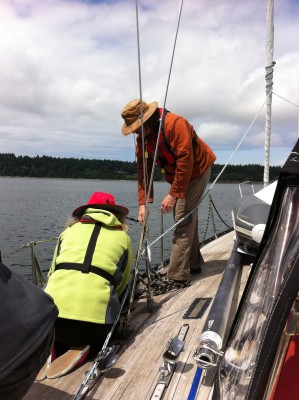
Leslie and I have been boating for a number of years now and I record pretty much all of our data. I finally got around to updating my electronic logbook from 2015 and the numbers are in.
To date Leslie and I have:
- logged 2967.5 nm (5492 km). That’s about the distance from Edmonton to the Dominican Republic
- been cruising a total of 163 days
- been as far south as the Strait of Juan (48°18’11.3″N 123°33’39.8″W)
- been as far north as Bull Harbour, Hope Island (50°55’05.3″N 127°56’07.8″W)
- been as far west as 10 km off Cape Scott int eh Pacific Ocean (50°42’19.6″N 128°34’19.8″W)
- and been as far east as Point Roberts (48°58’37.1″N 123°03’50.2″W)
In 2015 we managed 1678.15 nm (3107.9 km) and 97 days of cruising (not including our liveaboard time in Victoria). We hope to match that in 2016 before we have go home but it’s unlikely unless we take off in March.
But here’s hoping…

A Boater’s Guide to Victoria
When we first arrived in Victoria, I was mildly surprised to find it doesn’t especially cater to the cruising crowd; I mean it’s definitely not like Nanaimo, where the big three (food, booze and boat parts) are all within a short walking distance. But in retrospect it makes more sense to think of Victoria more as the tourist destination it is rather than a cruising mecca despite the numerous marinas. Still, there are a ton of liveaboards here, both permanent and temporary, and I bet the traffic is pretty high in the summer, so it must be a bit difficult for newcomers to find all the necessities.

A view of the Causeway docks from the museum
So here’s my contribution to the the cruising scene: my Boater’s Guide to Visiting Victoria. These are the places we frequent and all of the services we have found so far. Pretty much everything is accessible within walking distance, although it is good to have a cart of some sort if you are loading up on heavier items. In terms of traditional shopping, there is too much to mention, so if you are flush with cash and have an urge to spend, Victoria is the place for you. I have tried to locate as many as possible of the essentials and the complete, interactive version of the map can be found here: Custom Google Map.
Marinas, Groceries & Liquor

There are three main marinas you are likely to stay at:
A: Wharf Street • GVHA (Greater Victoria Harbour Association); very central; close to showers and laundry; right beside busy parking lot and floatplane docks.
B: Causeway (Ship’s Point) • GVHA; right across from the Empress; lots of tourist passersby; these docks are often closed to the public (during the Swiftsure Race, the Boat Show, etc.), so you might have to raft up at Wharf Street.
(w) Showers & Laundry • 4 showers (1 loonie for 3 minutes) with a wheelchair accessible unit, and two large washers and dryers.
(o) GVHA Office • The building on the corner of Wharf and Fort—6th floor. Great people!
C: Coast Victoria Harbourside Hotel & Marina • Use of pool and gym facilities; a bit more isolated; no locked gates – their link.
And there are three grocery locations, all reasonably equidistant from the Wharf Street docks:
1: Save-On Foods • Typical grocery store, a bit more of a hike than the others.
2: Market on Yates • Smaller store, great meat, produce and baked goods, smaller selection.
3: Thrifty’s • Full-service grocery, nice selection.
And of course there are three liquor stores (actually there are a lot more, but these are the three we mainly use):
4: The Strath Liquor Store • A bit touristy with slightly higher prices, great selection of BC wines.
5: Spinnakers Beer Store • An unbelievable selection of local and import craft beers with a small selection of wine and liquor.
6: BC Liquor • Good general selection and good prices.
Amenities

1: Trotac Marine • Full-service chandler for recreational and commercial boaters; too far to walk so take a cab or hop the number 11 bus on Douglas Street between View and Yates.
2: Capital Iron • There’s No Store Like It! Seriously, there just isn’t. A little bit of everything from housewares to marine stuff. A good selection of line, spares like light bulbs, fenders, etc.
3: Quadra Mohawk • A gas station with full propane services. A bit of a hike, but we use our grocery cart to haul the tanks and it’s manageable.
4: Marine Fuel • Diesel and gasoline as well as used oil disposal.
5: GVHA Pumpout • Uses tokens that can be purchased from the Marina Office, marina dock staff, the fuel dock or Grilligan’s at Fisherman’s Wharf.
6: Customs Dock • Manned during peak season, phone in at other times.
Other Services

1: Jeune Bros Tent & Awning • Not a boating canvas specialist, but they do have a good selection of material and can whip up a BBQ cover if you need one.
2: Post Office/Shoppers Drug Mart • An all-in-one stop for mail, sundries and basic food items.
3: Broad Street Dental • I had to visit an dentist and I highly recommend these guys. Friendly, quality service and they fit me in that day.
4: Monks Office Supply • All the regular stationery supplies as well as copying, colour printing and fax services.
5: GVPL (Public Library) • Lots of room to lounge around, free wireless and computer terminals if you have a membership.
Banks • All the major banks have branches on Douglas Street including (top to bottom) BMO, CIBC, RBC and TD Canada Trust.
A: MEC (Mountain Equipment Coop) • For all things outdoors.
B: The Bay Centre • A standard mall with lots of clothing stores, cell phone retailers and a Sport Chek.
C: 7-Eleven • Lottery tickets, junk food, cigarettes and really cheap hotdogs that aren’t half bad.
Entertainment
There is so much in reach of the docks, but a lot of it is really tourist oriented. Here are just a small few of our favourite haunts. But remember there are tons more things to do and places to eat and it’s well worth exploring.

A: The Joint Pizza • Eat-in or take-out or even by the slice. Great pizza any way you get it.
B: Darcy’s Pub • Not too touristy and live music most nights.
C: Garrick’s Head Pub • Fun brew pub with a rotating section of local craft beers. Real wood-burning fireplace in the back.
D: Ali Baba Pizza • Pizza by the slice. Our go-to lunch eatery.
E: John’s Place • Apparently a must-do for the breakfast crowd, we haven’t made it there yet. A dock mate of ours works there.
Coffee Joints • They are everywhere. Just head east and you will run into 100s of them. Give Murchie’s Tea and Coffee a try (right beside Munro’s) if you want the real old Victoria experience.
1: Crag X Climbing Gym • A great workout in a brand-new facility. Bouldering, top roping and lead climbing—awesome fun.
2: Cineplex Odeon • First-run movie theatre.
3: Munro’s Books • A traditional must for any bibliophile. And Russell Books is just a block and a bit down Fort Street.
4: Royal British Columbia Museum and IMAX • If you are here for a while, get a season’s pass and make it your rainy-day destination.
Destinations
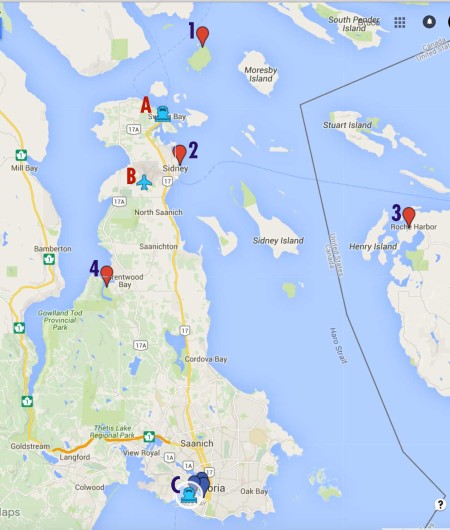
A: Swartz Bay (BC Ferries) • Ferries leaving to Vancouver as well as the Gulf Islands. About an hour bus ride ($2.50) from downtown Victoria. The #70 is more direct than the #72.
B: Victoria International Airport • Around $55 to $60 for a cab, or two buses from downtown.
C: Inner Harbour Ferries • The Victoria Clipper makes daily high-speed runs (walk-on only) to Seattle and the M.V. Coho (vehicles and passengers) crosses to Port Angeles several times a day.
Float Plane Dock • Right beside the Wharf Street docks, you can catch Harbour Air‘s flights to Vancouver or Gulf Island destinations or Kenmore Air to Seattle.
Some Easy Sailing Destinations
1: Royal Cove, Portland Island • A great anchorage that is an easy one-day trip from Victoria.
2: Sidney Marina • A nice marina in the lovely little town of Sidney. Home of a couple of charter companies and a great place to shop … especially for old books. Around the corner is Tsehum Harbour with fuel, haulouts and more.
3: Roche Harbor, USA • A short sail away and a wonderful place to overnight, either on the docks or anchored (we like Garrison Bay just a bit south from there). It makes a better stopover place in shoulder season when it’s not so busy.
4: Butchart Gardens • You can visit Butchart by bus, but a better way to do it is to sail there. Free private mooring balls and your own back door into this magical garden. Great for any season.

The Wharf Street docks
Wrap Up
Disclaimer: Victoria is still new to us. We’d visited as tourists but never really bothered to learn the city. I know that I’ve missed a lot in this brief list and I might just keep adding to it—minus the maps, they’re just too much work :-). I will keep updating the online version, though, to match any text I add.
Hopefully this will help someone else’s visit to this beautiful city go a bit smoother.
—Captain Why #Liveaboard, #Posts
A Holiday Monday Sail
Monday was a holiday in BC. It was warm, sunny and blowing 5 to 15 in the San Juan East Entrance so we decided to go for a sail. Actually it turns out it wasn’t much of an original idea as several other boats cast off as well and we all went out to enjoy the day. It took an hour or so to get the boat ready, but eventually we cast off. Once we cleared the Victoria harbour entrance we rolled out the sails and decided to head dead downwind and try and make it out to Race Rocks.
 Red line for our trip out downwind; Blue line for the close hauled trip back (rough approximations)
I’d recently gotten my preventer situation all sorted out, so I was eager to give the new system a try. The winds were blowing about 12 knots just off the dock, but by the time we were clear of the harbour they had settled down to about 8…perfect for some wing on wing action. Once we got it rigged correctly (I managed to forget about going under the jib sheets and tried a few variations on which winch I was going to use), Leslie sailed for a couple of hours with little or no effort required. It’s amazing how much easier it is to sail downwind when you only have to worry about luffing the jib.

Now Hunters aren’t known for their downwind performance due to the B&R rig (our spreaders are swept back so you can’t put the mainsail out as far and our small jib doesn’t help much—see the image above) but I have to say, in light winds we do pretty good. We were doing 2.5 knots in about 6 knots of breeze and 4-ish in the 8 to 9 knots.
The HMCS Whitehorse (a Kingston class coastal defence ship) popped out of Esquimalt as we headed south and eventually got on our track before veering to port and then coming up along side. Since Leslie had gone below and it looked like I would have to jibe anyway, I also went to port to see if I could scare them. After all I was a sailboat and had the right of way. I let go the preventer from the cockpit, centered the main and jibed all by myself much to L’s consternation. Still, it proved the system worked. Unfortunately for me, I had misjudged the Whitehorse’s speed and she passed by without really noticing us. Eventually she crossed back in front of us and went to stooge around in Pedder Bay.

Victoria from about half way to Race Rocks. If you squint really hard you can see Mount Baker centre-right)
As we approached the lighthouse on Race Rocks we decided not to run the passage and simple came in close. The water was starting to churn up so we decided to tack around and start heading back upwind. The winds had start to slowly build so by the time we hit Race Rocks the apparent wind was around 11 knots. As we swung around and headed up wind it banged up to around 15 knots and of course the current had changed so we hit really choppy water where minutes before it had been calm and peaceful. So we decided to try a reef.
I had been doing a lot of reading about reefing Hunter’s big roller furling main and decided to try out a few of the theories. All in all they worked like a charm:
- first, rather than trying to judge how much sail we had reefed by trying to look a the boom which is mostly obscured by our enclosure, I used the mast. We rolled in the main until the top of the sail hit the top spreader which, as it turns out, is about 6 feet in.
- second, rather than turning up into the wind, we just loosened the mail sheet and vang and let the boom swing out. This allowed us to maintain some way with just the jib.
- third, rather than screwing with going on deck and engaging the furling ratchet, we controlled the sail with the furling lines. I tailed the outhaul, while Leslie, leaving the furl-out line uncleated, pulled on the furl-in line until we were a bit past the top spreader. Then we locked off the furling lines and tightened the sail with the outhaul.
- Then we pulled in the main sheet and powered up the main, going from about 2 knots to almost 6.
It all went pretty smoothly. At least smoother than a lot of our previous reefing scenarios. I think there is something to be said for the “simplicity” of a traditional main when it comes to reefing. At least in the process. But I imagine with a bit more practice this too will start to seem simple. And it turns out the top spreader is a perfect reef point for about 14 to 18 knots of wind. We were heeled about 10–20° most of the time the winds were in that range and the weather helm was pretty negligible.

Of course the winds weren’t going to be that cooperative. After our first tack, they started to climb and now ranged from 19 to 21 knots. Another reef was looking necessary. But since we weren’t really going anywhere and we had cleared Albert Head, we just tacked again and settled into steady 17 to 19 knots which was pretty comfortable with the reef we had in.
By this time we and all the fishing boats had been joined by the HMCS Ottawa, one of our Halifax class frigates. She came out of Esquimault and also started stooging around, mostly off our starboard. When I turned towards her she scurried off so I guess we’re just plain scary. Or my sailing is… On one of our tacks she did get close enough to our stern that we got a good impression of her size. I am not sure what the two RCN ships were doing but they were tracking back and forth in a definite pattern so it was some sort of training exercise.
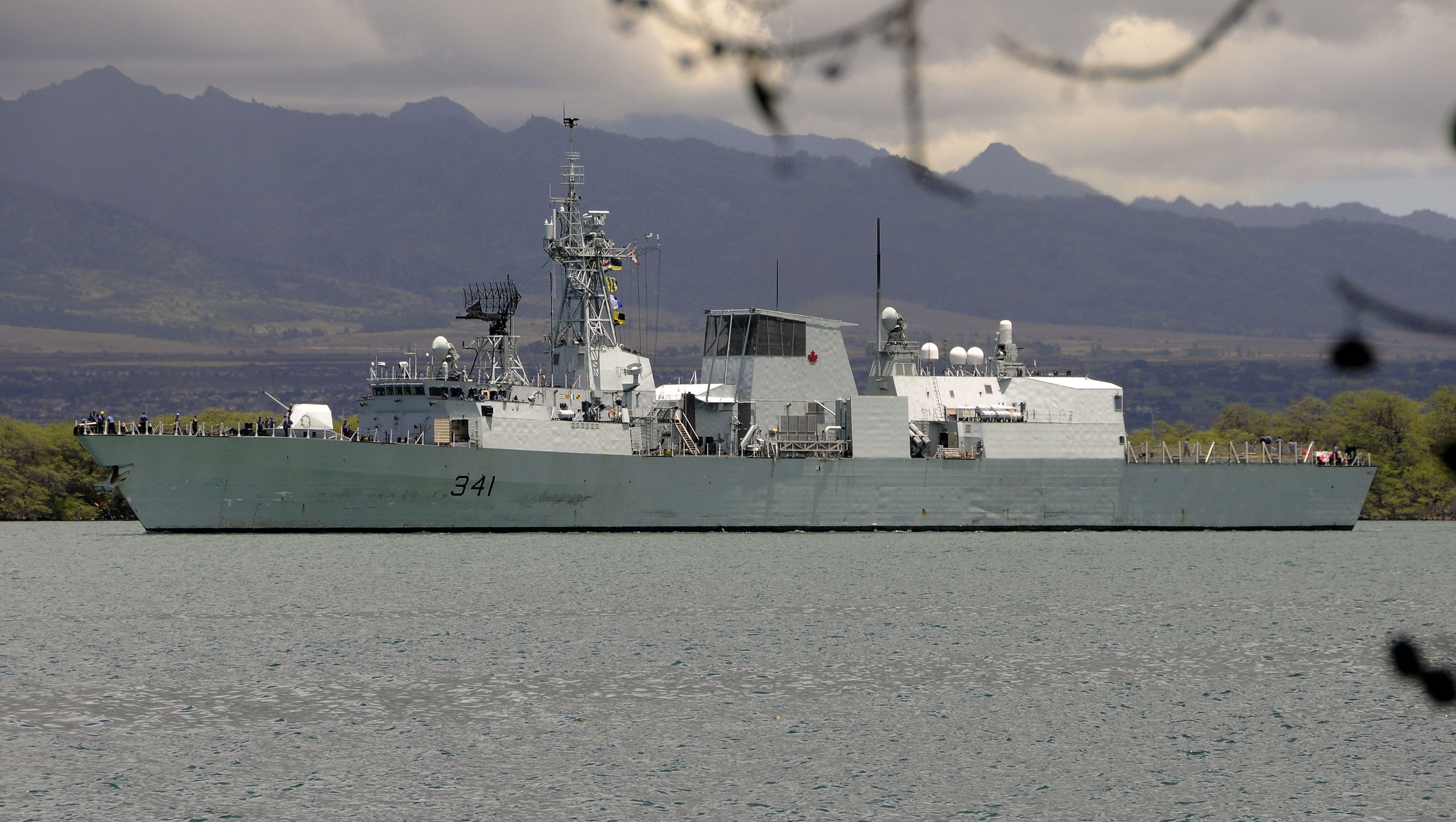
(image courtesy of Wikipedia)
As we came back towards Victoria we crossed paths with a Nauticat 33 with all three sails up and (I) immediately started racing. I certainly have a career in racing slower boats because we caught up and passed them in no time at all. It must be weird sailing one of those from high up on the stern. We tacked back and forth a couple of times still experiencing winds anywhere from 16 to 21 knots but the Nauticat tacked a lot less and plodded along quite steadily. For us, it was a lot of fun and a 25–30° heel doesn’t seem so bad if it’s not happening because of gusts.

(image courtesy of nauticat.com)
They eventually dropped their sails outside the breakwater while we tacked once more and sailed right up to the coast guard station. On the way in we spotted SpringTide which is the big whale watching cruiser that is normally tied up off our bow, so I knew we had an easy docking ahead of us with lots of extra room. We fired up the engine and pulled down the sails in the outer harbour and slowly motored back to our berth.
As we pulled into our spot the wind was pushing us off the dock which was a first for us in Victoria. I muffed it a bit so was glad for the extra room courtesy of the missing SpringTide. One of our dock mates was also on hand to grab a line but Leslie wisely demurred from handing him her midship line and tossed him the bow line instead. It never pays for us to vary our docking routine and while I am pretty sure this guy was way more salty than I will ever be, we’ve had a few bad experiences with dockside “help”.
It was a great day on the water followed by a couple of cold ones to close it off.
A Word on Dock Gravity
It seems we haven’t done as much sailing as I had intended when we got to Victoria. One of the reasons why is that a liveaboard boat in the marina quickly becomes unsailable without a lot of work. We have an electronic checklist that goes through all the major tasks to get her ready for the water, including untying all the things we have tied down and tying down a bunch of things we don’t. We put everything away and clear off all the tables etc. but inevitably, as soon as you start to heel, all hell breaks loose and all the drawers and cupboards you haven’t latched come flying open and things that you thought were stable suddenly gain momentum and bang and crash down below.
On our trip today this was pretty incremental. A few bounces in the 10 knots, a few bangs and crashes in the 18 knots and a couple of monumental clangs in the 21 (that was mostly the tea kettle breaking loose and, I think, a couple of cans from the forward locker). I suppose we will learn, but it never fails that something goes for a ride no matter how much we prepare.
Coming back in you have another good hour or so of battening and organizing to do to get back to liveaboard mode. Running rigging need to be secured against banging, extra dock lines and fenders put out for those stormy nights, enclosure needs to be all snugged down again, sailing gear stored out of the way, cushions piled and tucked out of the way and of course all the books need to come out from the nooks and crannies we had stuffed them in. After a great sail like that it does all seems worth while, but after a few days or weeks have passed you get more and more reluctant to go through it all just for a few hours of fun. I’ll have to be sure to come back and read this post again the next time I get wingey about wanting to go sailing…

—Captain Why #Posts
The Beginning of the End
When I was boat shopping last year I came a cross a fellow selling his Tartan 41 after a year’s sabbatical with his family. Actually it wasn’t yet after. He was still 6 months from the end but he had already started to make plans. I was a bit shocked at that but, now that we are half way through our own sabbatical, it makes a bunch more sense. So now we too have been planning what to do come the end of our year in July and it looks like we have officially decided.

The three options we considered were:
Keep the boat. We’d be responsible for paying all the costs and maintenance and hopefully be able to sail her 4-6 weeks a year. But that’s not really enough sailing to justify owning a boat.
Sell the boat. The Canadian dollar is low but since boat prices are pegged to the U.S. dollar that means it is a good time to sell. We might even break even on the sale (minus all the costs we put into her). But then we would be back to square zero and, given the cost of chartering, likely back down to a max of 2 weeks sailing a year.
Put her into charter. We keep the boat but put her into charter with a local company. We are still responsible for all the costs but hopefully we get some revenue from her to offset costs. This means losing a substantial portion of the sailing season, but hopefully we still get 4-6 weeks on the shoulder.
Well, as of yesterday, we have officially decided that we are going to put her into charter for a couple of seasons and see how that goes.
The Nitty Gritty
 Most of our chartering in the past has been done through Nanaimo Yacht Charters and we have a pretty good relationship with Ian, Shari and Lorraine who own and operate the business. I had done a lot of research when we first started chartering, so it was a no brainer for us to start there and, after a bit of asking around, it didn’t look like we would find a better home for Never for Ever.
They have a range of boats for offer already but it looked like the Hunter 386 would fill a good niche for them. And we know from personal experience how good their customer service is. Nanaimo is easy to reach and within striking distance of Desolation, the Sunshine Coast and the Gulf Islands. All in all I am happy with our decision. So, starting in July this year, you too can cruise the PNW and help add to Never for Ever’s story. Just click here for the listing 🙂

At Last — the first boat we ever chartered from NYC
So what’s the deal? Well, we are responsible for turning over a fully functioning, well maintained yacht to them, equipped with a standard set of accessories like plates and cutlery, tender, outboard, safety equipment etc. and they then become responsible for maintaining the boat and finding customers to charter her out on a week by week basis. We still bear all the costs of moorage, insurance, parts, labour etc. but also receive around 60% of the revenue (See more here). They look after her in the winter season and we don’t have to worry about pretty much anything. The guys at NYC —and pretty much everyone we talked to here in the industry— are pretty upfront that, with our short season, we are unlikely to see a profit, but should, on average, pay all the maintenance and upkeep costs. Putting your boat into charter in the Caribbean or the Med with a company like Sunsail or Moorings can often pay enough to also cover payments on a new boat but that is unlikely here. That’s why you rarely see brand new boats offered for charter in the PNW. The risk, for us, is that the value of the boat will decrease over time and usage and we won’t get any of our money back out. Still, as an older boat, she is more likely to hold her current value than a newer boat would and we won’t have the costs of chartering anymore.

Stones Marina, where NYC keeps it’s fleet.
We are allowed to take her out whenever we want with the understanding that they have her available for at least 10 weeks and that we don’t monopolize the high season of July and August. Which makes sense because we would just be negating the whole reason for putting her into charter in the first place. We would also be responsible for turnover costs just like any other client: cleaning, boat checks etc. But the upside is that we can just show up and the boat will be ready to go. If we were on our own it would likely be a several days (or more) of maintenance and prep every time we came back to the coast before we would be able to go sailing. So if we restrict ourselves to May and June we should be able to get the best of both worlds.
The only real downside is the risk you take with letting any old yahoo take the boat out. But hell, only a few years ago we were one of those yahoos and isn’t that what insurance is for? Still, NYC is responsible for vetting charterers and ensuring they have the minimum required skills and experience.
So What’s Next
Aggravatingly enough, this does mean a few more costs to us. Obviously we will have get Never for Ever hauled and checked over before we turn her over. We will also have to invest in some cutlery and plates, a few more life jackets and replace some extra stuff like flashlights and some tools that I don’t want to leave behind. The only real big hit is that we are asked to supply a complete set of charts and navigational tools that then become the property of NYC. I get the reasoning behind it (it’s very likely to be lost or damaged through wear and attrition), but I just bought all that stuff for myself and am not sure if I want other people wrecking it and replacing it is costly. Still, NYC has offered to arrange storage for us if we want to keep our personal stuff there for our use when we are out. I will have look at the cost/benefit of that before we decided. And of course, any toys or bells and whistles we leave behind adds to the desirability of the boat and makes us more money.
But we still have 6 more months for ourselves to go. We are hoping to get in a bunch of sailing trips in February and March and are tentatively thinking we will cast off again permanently in April. I’d love to hit the Broughtons again but Puget Sound, The Broken Group off Ucuelet, and Desolation Sound are all on the list. Now that the deal is done, we can focus on enjoying our time and experiencing even more of this amazing region before the real world once again intrudes.

Where to next?
—Captain Why #Posts
Things I’ve learned: 2015 edition
At the end of last year’s season I had posted this list of Things I’ve Learned on my personal blog but I’ve decided it’s time for an update.

Now, with two seasons of cruising 5 weeks or more under our belts, we have “learned” a lot of things, some of which we already knew—sort of, and some we just thought we did. And of course some that never even occurred to us. So here’s my new list of things we’ve learned, in no particular order:
- Reefing a roller furling main is more complicated than you think it should be
- You never practice reefing your roller furling main when the winds are calm. But you should…
- What is it they say about schedules being the most dangerous thing in boating? Yup.
- Boats leak from the damnest places
- Trying to find where boats leak generally leads to profanity
- Propane is either hard to find or right in front of your face: there is no middle ground
- A wheeled grocery cart is a godsend
- Check the dates on propane tanks
- Wind against current is… interesting
- Idiot lights are idiotic
- Voltmeters are the devil’s tool
- Sailing from start to finish is a great, great day
- Ocean swell. Huh, who knew…
- A little leak in the canvas is way more annoying than just taking it down and getting wet
- Walk-through transoms are awesome. And you almost never get to use them
- Finally having a dinghy that can get up on plane is more fun than strictly necessary
- Things fall overboard
- A 29 knot gust with too much sail out is scary-scarier-scariest
- You can sail “quite fine” at 30° heel. But later you can’t really figure out why you did
- Water slapping on your transom when you are tied up stern to the waves is really, really annoying
- Dolphins are the best. Two hours with the same two dolphins is transformative
- My son has orca-fu. Four sightings in the one week he was aboard…
- Things they don’t tell you about stern tying: stern tying more often than not includes: wet feet, losing track of the tender’s painter (and often the tender itself), ophidiophobia, leaks in the dinghy, bizarre knots in 240′ of line, coiling a wet, stinky bundle of 240′ of line, searching for rings below the water, climbing cliffs above the water, trying comically to pull on 100′ of line while floating in a dinghy, being exactly 2′ short when you get back to the boat, and interesting “discussions” between skipper and crew when the skipper is the one ashore
- Stern tying is hilarious when other people are doing it
- You can do 2 knots in 4 knots of wind, but you can’t do 5 knots in 10 knots of wind, you wouldn’t want to do 10 knots in 20 knots of wind and you don’t care how fast you are going in 30 knots of wind
- The remote for the auto-pilot is addictive. You are left feeling very hollow when it stops working
- Having extra fenders is great; stowing extra fenders is a pain
- There are things you never seem to learn: leaving the hatch almost all the way open is not the same thing as leaving it all the way open. Yup, still hurts.
- Seriously, where the hell am I supposed to stow the damn spare gasoline!
- Pillows magically attract mildew
- Other people’s diesel heaters can be annoying; yours is just comfortable
- Just because the nice lady on the radio said back in on a starboard side tie, doesn’t mean you should stubbornly try, and fail, a half dozen times when the wind is against you
- Other cruisers are suddenly very helpful with lines after you fail a half dozen times on a windy day on a crowded dock
- 4 different crews working together trying to tie your boat up on a windy day on a crowded dock are actually much less effective than a single crew and a less stubborn skipper. Comedically less effective even…
- Any completed docking without damage can be deemed a successful docking (or so I keep telling myself)
- Battery monitors are mysterious and addictive, but not the devil’s tool
- After September, you can never have enough blankets
- Fleece sheets—fleece, not flannel—are the best thing ever in a cold, damp boat
- The split ring from your keychain is not a good substitute when you break/lose a stainless steel one
- In the narrow channels of the Broughtons, it often seems your mast is poking up into the low lying cloud
- In the narrow channels of the Broughtons, sea planes quite often fly under the low lying cloud
- In the narrow channels of the Broughtons, low lying cloud can be scarier than fog
- Docks have gravity. Once you are tied up for a while, it gets harder and harder to untie in less-than-perfect conditions
- A 14″ laptop screen is just fine. Black Books is just as funny
- Nothing beats the evening light at Big Bay on Stuart Island. Seriously…every time…
- Don’t trust that the work they said they were going to do at the top of your mast is the work they did at the top of your mast
- Getting to the top of your mast is hard
- The bottom of your dinghy is disgusting after a season trailing behind your boat
- If you have 105′ of chain, then 105′ of chain is almost always the perfect amount of chain to put out
- The difference between Roche Harbor and Garrison Bay is night and day. Together they make for a great couple of days.
- Getting anchorage advice from fellow cruisers is great
- Taking anchorage advice from fellow cruisers can be … dangerous
And here’s a few from the previous list that are so worth repeating:
- Fridges in a sailboat are…quirky
- BBQs make a real mess on the transom
- Gauges that measure liquids (water, diesel, holding tanks) never seem to work
- Powerboaters really are, well, oblivious

Tides. Huh.
Stuart Island Community Association Dock

And this was fun…why?
—Captain Why #Posts
Preventers
In an old post I mentioned the importance of preventers. But given the nature of the Never for Ever‘s B&R rig and our cockpit enclosure, I have never managed to rig one the completely satisfied me. A preventer, in case you are wondering, is a method of preventing the boom from swinging accidentally and sometimes violently from one side of the boat to another. When sailing downwind your mainsail is generally out as far as possible and when gybing (moving the sail from one side to another as your stern moves through the wind ), one always centers the boom before turning the boat to ensure the boom is moved from one side to the other under control. But in the case of an accidental gybe, the boom can fly across the cockpit generating line-snapping forces and being a huge danger to anyone in its path.
There are all sorts of fancy boom brakes available but the simplest way to rig a preventer is by tying the boom into position. The issue on our Hunter 386 is that the only place to tie off a preventer that I have access to is midway down the boom and it isn’t easy to tie that off to anyplace except the chain plates (or worse a stanchion). The angles involved don’t give me much reassurance about the rig’s ability to handle any of the massive forces an accidental gybe can generate.
Well I decided the other day to shake off the old Google-fu and see what the internet had to say. And lo and behold Selden’s website pointed out the obvious solution. Their downloadable Hints and Advice Guide from the rigging section spelled it all out and also solved a minor mystery for me.

One of the lines that came with the boat (that I had previously used to try and rig a preventer with) was a length of about 8 feet of braided line with a eye splice in one end. I could never figure out why this line was a part of the boat’s inventory, but used it as a handy line when I needed a short length. Turns out it was used as part of the preventer but not in a way I had imagined.
The line was meant to be pre-tied to the outer end fitting of the boom and then temporarily attached spliced eye end to the kicker slider. This means you don’t have to worry about accessing the end of the boom when at sea (something that due to our bimini I gave up on almost immediately).

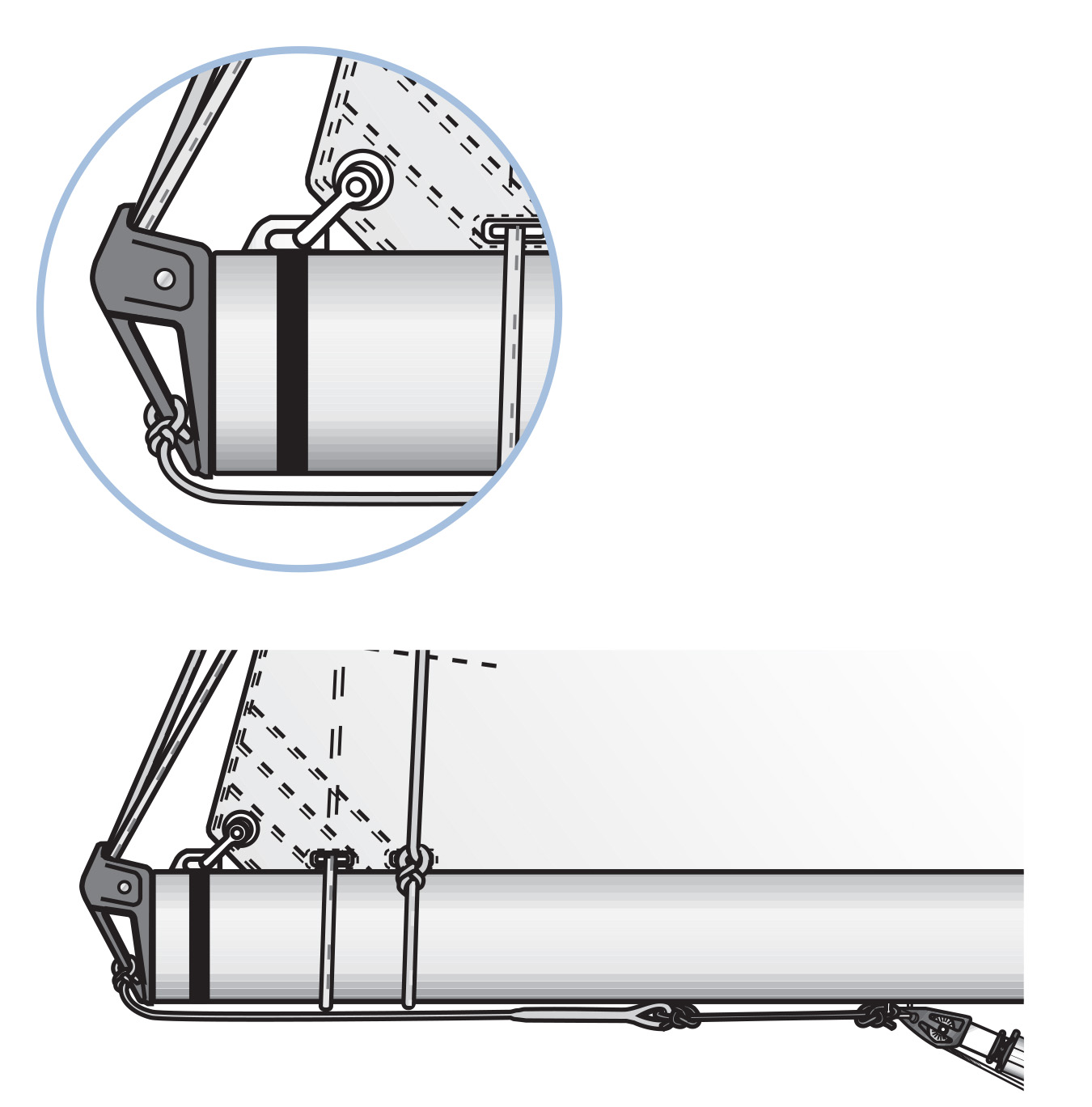
Then, when rigging the preventer, you tie off a “preventer guy” to the loop and lead it forward to the bow cleat (or a snatch block if I ever get a spare). If the line is long enough you can lead it back to the cockpit so you don’t have to go forward to release the setup.

The manual also stated “The preventer guy must not be fitted to the centre of the boom since that could cause damage, especially if the end of the boom goes into the water as a result of rolling” which is what I had been doing and had been wholly dissatisfied with. Turns out I am getting some good sailorly instincts after all…
—Captain Why #Equipment, #Posts