Manual Boating: a putting-your-boat-in-charter update
As we worked our way north we had stopped in at NYC (Nanaimo Yacht Charters & Sailing School) to check in and make arrangements to turn the boat over to them before July.Previously I have discussed putting Never for Ever in charter and that time is fast approaching. In fact, after talking it over with Lorraine when we stopped in, we all decided we would bring the boat in on June 19th and be completely off her by the 23rd. That would give everyone time to clean her top to bottom and make sure any remaining things on my to do list were done before the first charterer boards on June 30. Last time I asked, Never for Ever has been booked for about 6 of the 8 weeks available in July/August. Not bad for a new boat in the fleet. That does mean we have less than 2 weeks left to explore Desolation though.
We also need to haul her and survey her as much as possible to ascertain her state of being as she enters charter and avoid any possible conflicts in the future. There are a lot of little details like that that I want to take care of to avoid having any fuss later on. I have a lot of trust in the crew at NYC and we have a good working relationship, but the more we have documented the less potential for conflict there is.
 So as we hung on the hook in Von Donop Inlet, one of our tasks was to finalize the revisions to the official charter manual. This manual includes all the standard charter info and then details the systems on our particular boat, as well as documenting any how-to’s or processes we deem necessary for safe, fun and easy use by people who will be aboard for as little as a week. It is an amazing exercise to think through all the systems and steps and then try and record them in a coherent and orderly manner. I found it particularly fascinating to uncover all the small routines that we had internalized and reexamine some of the unconscious habits we had gained. While for most owners it would be a lot of work for little gain, I would almost want to suggest that everyone go through the exercise. Certainly if you were selling your boat it would be an massive boon to the buyer. Take a look at the end of this post to see the Table of Contents as it stands now.
Also as a result of this exercise, my next task — not specifically meant for the charterers — is going to be discovering and recording all the vestigial systems that previous owners had added or removed, things like the breaker marked “Battery Charger” that does nothing as far as I can tell. And hopefully we will remove some of the old wiring while we are at it.

I am also trying to finish off as many of the outstanding chores as I can, working on the dinghy (fixing the oarlocks), repairing dings and gouges and cleaning some of the accumulated dirt. One of the things about charter companies is that they are so helpful and accommodating you forget that everything has a price tag and it all gets billed back to you. We do get discounted rates on labour, but I want to do as much as possible myself to avoid unnecessary charges. And frankly I want the boat to be in as good a shape as possible for the charterers. Nothing is more frustrating than the small annoyances that could have been avoided. It’s relatively easy to forgive or at least accommodate major issues like breakdowns — there are always established mechanisms to resolve those — but having to deal with piddly things like broken latches or flaky equipment is just annoying and rarely comes with any recompense. So I want to avoid that as much as I can and hopefully build up some good will.
And I really am hoping that we can make enough money to invest in a few things as well, like upgrading the canvas or adding a TV back to the boat (it used to have one and wiring is still there). But I guess we will see.
Battery Update
We spent 4 nights at Von Donop and left with 11.5 volts and 53% of capacity showing on the battery monitor. According to the “amps used” meter we had used 217 amps of our usable 225 amps (out of 450 amps available). For those of you who don’t already know, the health of a lead acid battery is best maintained by not running them below 50% capacity or 12.2 volts. Unfortunately an accurate voltage can only be measured after the batteries have rested with no load for 12 hours or more — something virtually impossible to do if you are actively using them. When we installed our battery monitor last year it involved placing a shunt in the main connection from the battery which allows the monitor to measure the amount of current that flows through the system. Theoretically this gives you a more accurate way to gauge the state of the batteries. Previously we would only go three nights without at least running the diesel for an hour or two as the voltage would be reading 12.2 or 12.3v. Now, given our total 450 amp/hr capacity and more accurate measurements, we are able to go for 4 complete days without any sort of charging.

So when we left Von Donop, we decided to head back to Gorge Harbour (approx 2 hrs) rather than make a run for Lund (approx 4 hrs) to pick up some supplies and charge the batteries. As a result we ran the diesel for around two and a half hours and our 50-amp alternator managed to put 76 amps (30.4 amps an hour) back into the batteries and bringing us back to 70%. Pretty good considering the alternator isn’t really meant to work that hard. One of the options we are considering is upgrading to a 100 amp alternator with a smart regulator. This would put more amps faster into the batteries and allow us to get a few more nights without having to go to a dock for a full charge. The other plans include adding some solar or buying a portable generator. Oddly enough all three methods of getting more juice involve roughly the same investment: around $1200.
So right now it appears one full day/night is 12% of capacity or around 55 amps which mean running the diesel for at least an hour and a half. I am not sure how much the revs need to be to maintain that but we ran at 2400 rpm most of the way to Gorge. That gives us 4 solid days which is pretty good and we can likely street that if we do some travelling in between.
The next few days
We ate the Floathouse Restaurant while we were at Gorge. It’s still early season so the food is a bit more pub that it is in high season where the menu is much more sophisticated and pricey, but that suited us just fine. The dock also had a few more visitors than when wed been in the harbour the week before. The season is stating to pick up.
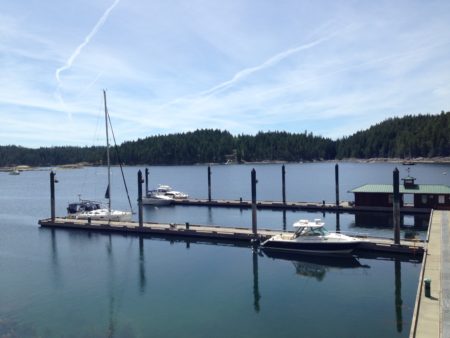
The next morning we cast off and motored (still no wind) into Desolation Sound proper and headed for Grace Harbour. As we entered the harbour there was only one big powerboat and two other sailboats — no need to stern tie as there was still plenty of room. We tucked into the far end of the bay as far from everyone as we could and settled in to enjoy a couple of days of hot weather and sunshine.

Over the next few days a few boats came and went and they inevitably anchored as close to us as they could. This is a well-documented and (and bemoaned) phenomenon in the cruising world. People always want to cluster rather than spreading out and enjoying a little solitude. It reached its peak on the third day when 4 sailboats arrived from the Gibsons Yacht Club and immediately dropped anchor beside us. Then a fifth one came in a few hours later and hemmed us in on the other side. This last one made us a bit nervous as the wind had built up and shifted south; our anchor and rode had spun 180° so we weren’t too sure of where everyone’s anchors were and were a bit apprehensive about the possibility of dragging. That stormy night we had 13 boats for company in the harbour, but thankfully they mostly left and were only 5 the next morning to enjoy the sun that came back out.

Desolation Sound means it is warm enough to swim. Still a bit chilly though — Brrrrrrr!
One bright note was the boat that anchored closest to us from the Gibsons flotilla turned out to be Ocean Grace (Larry and Sheila) whom we had met on the Broughtons flotilla a few years ago. We’d also run into them last August in Squirrel Cove — just another one of those ‘small world’ episodes. They came over in the afternoon for a visit and we caught up and got to show them the boat as they hadn’t seen it last year.
We plan to stick out the full four days and leave for Lund to hopefully pick up some produce, as we are down to one onion, one clove of garlic and half a root of ginger — I’m not sure what that means for dinner tonight, but I am guessing it will be something pasta-ish.
And of course we need to charge the batteries again.
Never for Ever Operation Manual
Table of Contents
- THINGS YOU SHOULD KNOW
- NAVIGATING AND SAILING IN TIDAL WATERS
- AREA WHISKY GOLF
- QUICK REFERENCE GUIDE
- VESSEL SPECIFICATIONS
- SAFETY EQUIPMENT
- Life Jackets
- Flares & Air Horn
- Wooden Bungs
- Flashlights
- Fire Extinguishers
- First Aid Kit
- Emergency Tiller
- Life Ring & Floating Line
- Lifesling Rescue System
- ENGINE AND TRANSMISSION
- Engine
- Starting And Stopping The Engine
- Engine Salt Water-Cooling System
- Changing The Raw Water Pump Impellor:
- Operating The Gearshift/Throttle Control
- Engine Alarm Systems
- Tool Kit /Top Up Oil Spares 14 Batteries
- NAVIGATION AND ELECTRICAL EQUIPMENT:
- Speed And Depth Sounder
- Speed Log
- Autopilot
- Garmin FishfInder
- GPS
- Radar
- AC Panel And Shore Power
- Battery Monitor & Inverter
- Troubleshooting Low Batteries
- VHF Radio
- Stereo System: Sony Media Player
- ON DECK
- The anchor windlass
- Spare Anchor
- Propane
- BBQ
- The Water Tank
- The Diesel Tank
- Holding Tank
- Tank Systems Monitor
- The Outboard Motor
- SAILS AND FURLING MECHANISMS
- In Mast Furling
- Mainsail Reefing & Furling
- Downwind Preventer
- Genoa Furling
- BELOW DECK
- The Stove
- Smoke Detector
- Microwave
- Refrigeration
- Water Pressure System
- Cabin Heat
- Hot Water
- Bilge pumps
- Shower Drain Pump
- Toilets
- Holding Tanks and Macerator
- Dinette Table
- GENERAL SAFETY ISSUES AND INFORMATION
- Locker Lids
- Propane
- Barbecue
- Outboard motor gasoline:
- Thru-Hulls & Drains
- CONTACT INFORMATION
- RETURNING THE YACHT
- DE-BRIEFING AFTER THE CRUISE
- Photographs
—Captain Why #Charter, #Posts
Instagram This Week



Early-Season Cruising In Desolation Sound
Our cruising career, as short as it’s been, is notable for one somewhat atypical feature. Our first cruise and learn was at the end of April, we’ve spent June in the Broughtons, circumnavigated Vancouver Island in late May and are once again enjoying May — and now June — cruising Desolation Sound. Sure, we have done some chartering in July and last year spent August in the Broughtons, but all in all it seems we have spent an unusual amount of time avoiding the high season and crowded anchorages.
And you know what? I am beginning to think I like it that way.
Leaving Sturt, we decided to head up to Rebecca Spit on Quadra Island. It seemed we might still need to stay in cellphone/internet range and I also wanted to check in on Peter and his boat Kismet. Peter is a young fellow we shared the dock with in Victoria. He spends his summer guiding kayaks with an outfit out of Heriot Bay, so he had bought a small sailboat to live on while he was there. He’d left Victoria a week before us, and I wanted to check in, catch up and maybe buy him a beer. The day after we dropped anchor off Rebecca Spit, I motored over to Heriot Bay to find Kismet tied up to the government dock but no sign of Peter. I left a note saying we’d be around for a few days, but he never got back to us — likely out on a multi-day trip. Or maybe he didn’t like free beer.

A very quiet afternoon at Rebecca Spit
We were one of only three boats at Rebecca Spit. And all three of us stayed at least three days. This, I think, is one of the things I like so much about early-season cruising. Last year on our way up to the Broughtons in late July we stopped for the night in Squirrel Cove. It was packed. We actually cruised around for almost half an hour trying to find a spot to anchor that suited our sensibilities and my poor ability to judge distances. And then, once we hit the Broughtons a week later, we were sharing anchorages with one or two other boats at the most. Much better. I may not be getting much practice making decisions on where to anchor in busy anchorages, but I think the benefits of having anchorages to ourselves outweigh the losses to my skill set.
On the way back from my visit to Kismet, I saw a parade going up the spit toward the picnic grounds. Turns out it was the local May Day celebration and the town was out in full force despite the slight rain. I collected Leslie and we wandered around and enjoyed the festivities that seemed to have a steampunk theme. We briefly considered (and then thought the better of) challenging the locals at the greased pole climbing contest. After a bit we climbed back into Laughing Baby and headed back over to Heriot Bay and had a coffee at the local shop in order to use their wifi to move some files around.
I love and miss small towns. While I waited in line, the barista ran out of whole milk, so the customer in front of me volunteered to walk over to the store and get some. “Sure,” said the barista, “tell them to put on my account.” That just doesn’t happen in the city.
After three quiet nights on the hook we wandered over to Taku Resort — again we were the only boat on the dock — and enjoyed another benefit of early-season cruising: their low-season rate of $1.15/foot with power included. Considering their regular rate was around $1.75, it was unlikely we would stay there without the discount. Actually, I also checked at the Heriot Bay Inn and Marina and their low-season rate was an amazing $0.50/foot. After we tied up we hauled our accumulated laundry up the hill, charged up the batteries and topped up the water tank. One last trip to Heriot Bay to get a few fresh provisions and the next morning we were ready to go.

All alone at Taku Resort.
Next we made the short trip through Uganda Passage on our way to Gorge Harbour. Either our chart plotter is wrong or the green buoys have drifted south, but our track through the passage off Shark Spit had us on the wrong side of the buoys as we negotiated the s-turn. When we came back the next day I kept an eye on the depth sounder, and if I had to guess, I would say the chart plotter was correct and the buoys had moved — but I wouldn’t put any money on it.
At Gorge we motored into the far west end to drop our hook. The docks at the Gorge Harbour Resort were empty except for one boat, and it looked like we were the only transients at anchor (one sailboat did join us at anchor later that evening). Leslie had had the helm from castoff to arrival so we (I) decided to switch our usual roles for anchoring as well. Normally she “mans” the windlass and I look after the helm, but we both need practice at the other’s jobs. What made this anchoring more difficult than usual is that the bay was crowded with moored boats — some swinging and some moored fore and aft — and even more empty mooring buoys. We needed to judge the distances so that our greater swing wouldn’t send us into these static targets if the wind came up. And of course the anchor decided to drag for one of the first times ever. Eventually we got a good hold, but then wind or current or something decided to move us over our chain and we ended up on the opposite side of the anchor. But it was all good and we had a quiet night — albeit a bit closer to one moored boat than we had anticipated.
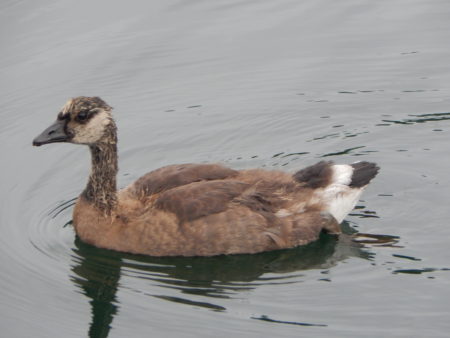
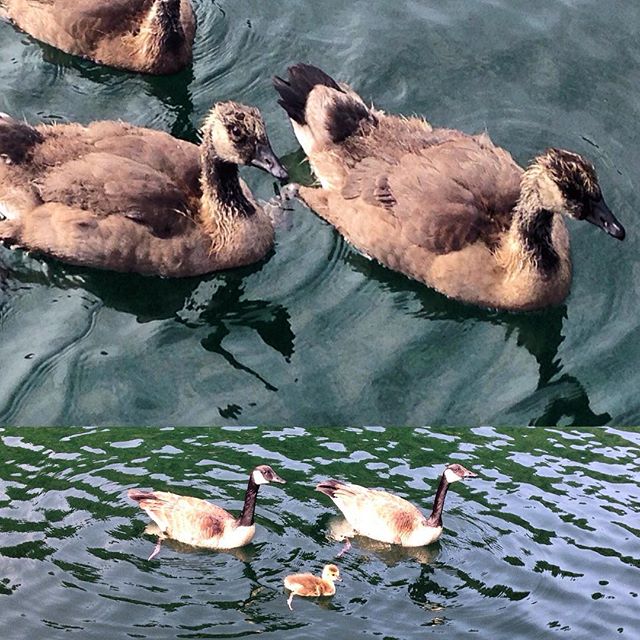
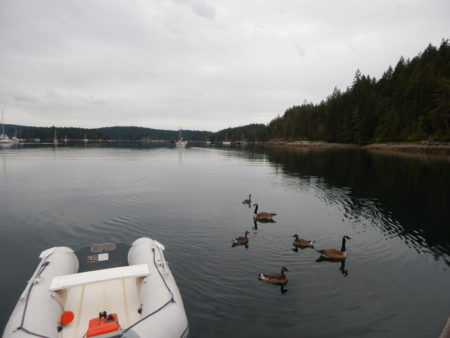
The harbour was populated by a family of geese with goslings in that awkward teenage phase. I can’t say I have ever seen Canada geese in such a disreputable state before, with half grown-in feathers and a seemingly sun-faded colouration. We were also entertained by both a kingfisher and the local otter fishing for dinner — the otter seemed to have much better success. Speaking of dinner, the highlight of ours was when I dropped the ceramic bowl of tomato salad, laden with onions, garlic and olive oil, on the companionway steps. It, predictably, shattered and the bowl shards, salad and oil exploded, managing to land in three separate cabins, just as I need to get the chops off the BBQ and the orzo out of the water. I treated myself to an extra glass of wine for dinner. Desert was still-warm brownies that Leslie had whipped up, so with that, and the wine, in the end all turned out good.
Before dinner we did row up to the resort, but the restaurant was closed and the store held nothing appealing except Leslie finally found a copy of The Curve of Time. Everywhere we went last year people asked if we had read it and we had seen copies for sale at every stop. But after we had decided to buy it this spring, it was out of stock every place we checked from Sidney to Desolation. The bookseller in Madeira Park had copies backordered and figured it was because Whitecap had put out an anniversary edition hardcover and it must have sold out. But we finally have our own copy.
The next morning we figured Gorge just wasn’t where the cool kids were, so we decided to move on. I had wanted to visit Von Donop Inlet, and it has a reputation as a must-do that was often crowded. It seemed perfect for an early-season visit. It was only a short two and half hour motor, so we raised anchor at around 11 am and, after fuelling up at the resort, headed back toward Uganda Passage and then turned north to follow the coast of Cortes Island. There was one sailboat boat anchored at the lagoon, two in the next small bay and we joined three others and two powerboats in the bigger bay at the far south end. Plenty of room for everyone.
I did notice that all of the sailboats here were outfitted as serious cruisers. Actually since we left Nanaimo we haven’t really seen very many Hunters or Beneteaus or other boats of that ilk other than ones from charter companies. Still, Never for Ever, Hunter that she is, is serving us just fine, even if she’s not as fancy or well outfitted. We are grateful for the “full” enclosure to keep the wind and rain out of the cockpit, and I find myself wishing we had invested in a generator or some solar to extend our visits at anchorages. Even a larger alternator would help, because after 3 or 4 nights on the hook, motoring is not enough to put charge back into the batteries for another extended stay.

Jellyfish photography is hard!
It’s beautiful here in Von Donop and we are getting a bit of rain that transforms the hilly scenery into a misty and mystical place. The other bays are worth exploring by dinghy and there are trails here as well so we plan to do some hiking. And oddly enough, we have a better cell signal here than we did at Gorge.
The plan as it stands now is to stay here a couple of days, then head off to Grace Harbour. But who really knows what we’ll do? We don’t.

Exploring the entrance to the lagoon in Van Donop

Our version of a quiet evening stroll
—Captain Why #Posts
A Hot Time on Texada
The Texada Boat Club is one of my favourite places to visit — despite its creaky dock. We’ve been lucky enough to get the same, stern-in spot almost every time we’ve visited; it backs up onto their small covered float with two picnic tables, flower pots, a tent to keep the rain and sun off and a small book exchange. There is water and and 15 amp power available and garbage can be dropped off for $3/bag. Bob and his wife Maggie, the wharfingers, maintain a database of visiting boats so if you’ve been there before you might get greeted by name, which can come as a bit of a surprise to those not “in the know.” All this for only $.70/ft!

The flowers at our favourite spot from our last visit to the Boat Club.
This year we shared the dock with a little 27 footer on its way to Victoria. The older fellow was going to join up with his son and daughter, both of whom had boats, and they were going for a family cruise. I think I need to get my extended family cruising, as that plan sounded just grand. The small bay (the inlet part Sturt Bay) across from the Boat Club usually has one or two boats hanging on the hook and I have always assumed that’s all it had room for. Well last night there was a trimaran really far in and 6 other sailboats as well. And there still looked like there was plenty of room for more. We will have to give it a try. I am noticing that this early-season cruising is popular with the more salty crowd and the anchorages are more popular than the docks.
But if you do come to the Boat Club for a visit, just grab a spot on the most westerly dock which generally has plenty of room and Bob will come by in the evening to settle up.
When he came down, Bob let us know that tragedy had struck that afternoon. The Texada Island Inn, a short walk from the docks, had burned down. I walked up today to survey the damage and the hotel looks completely gutted, although the restaurant section seemed better off. The fireman I talked to said he figured it was a write-off but it would, of course, be up to the insurance companies. Meanwhile that means the only restaurant and bar in town is closed indefinitely. He did mention that this might be a boon for the local Legion and hopefully they would extend their hours. Not much help for visiting boaters though.

 I cruised the town on my way back. Not much to see although they had a nice sized market and an interesting direction sign post; all in all a typical small, small town with lots of personality. I also came across a hummingbird feeder with more hummingbirds than I can count buzzing around it like bees. For a prairie boy like me this counts as a most amazing sight, and I stood there amongst the barking neighbourhood dogs for a few minutes staring. The local cat on the porch just through disdainful glance at me and then continued to ignore all the activity in fine cat fashion.
We had motored up from Pender the day before straight into the 12-15 knot winds, staring enviously at all the boats running downwind, making better time than us with just their genoas flying. Despite the number of times I have travelled up and down the Malaspina strait, I have yet to do it with the wind anywhere but on my nose. I have had some fine sails beating into the wind, but it would be nice to be able to have it at my back just once. At least the decks got a good washing.
And now we are pausing here briefly so we have a good cell reception to allow Leslie to finish some work on her book. Then we will likely head for the wilds of Desolation Sound — Grace Harbour or Roscoe Bay — to hang and drink in the rugged beauty and, hopefully, solitude.
—Captain Why #Posts
Instagram This Week


Gazing upon some (Internet) Stars
Like many would be boaters, I spent, and spend, a lot of time reading other boaters’ blogs and watching YouTube channels made by fellow cruisers. And, as we put in more and more time on the water, I am starting to actual encounter some of these “famous” people in our travels. Over the winter in Victoria, we saw My Second Wind from Living Aboard Boats at dock in Westbay although did not manage to meet Curtis — he’s heading to Alaska this summer so maybe we will encounter him on our way back south. I also saw Gudgeon — who’s blog gudgeonblog.ca I have followed since it started as nothing more than a dream of buying a boat and living aboard — tied up at Fishermans’ Wharf numerous times and did manage to exchange a few emails with Matt.
But since leaving Princess Louisa, the brushes have started to come fast and furious. Yahtzee, (threesheetsnw.com/yahtzee) whose master is Andy Cross of Three Sheets NW fame, was just entering Malibu Rapids as we exited, so we missed him by the tiniest margins. He subsequently wrote a blog post about his visit that reflects my feelings almost exactly. But now I know he’s around.
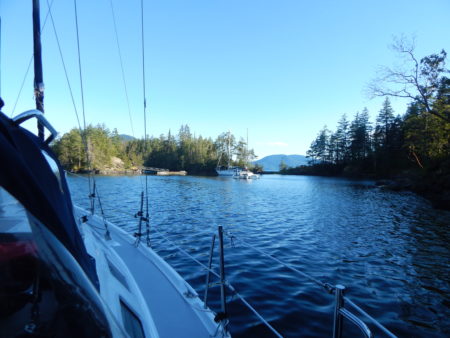
The beautiful Harmony Islands

Emerald Steel at twilight

S/V Cambria the next morning as we were leaving.
For now, we are spending the night at the Texada Boat Club in Sturt Bay, in my favourite spot on the dock. If all goes well with the last of the edits, then next we will head for Desolation and some quiet time in Grace Harbour. If not, we might pop over to Rebecca Spit and anchor there for a spell so we still have access to internet and also access to a great anchorage. And I have great hopes to meet a whole lot more people — famous or not — in the time we have left aboard.
Some local YouTube channels I follow
Life is Like Sailing
Hundred Rabbits
Sailing Maiweh
S/V Pardon my French
Other YouTube channels I follow
White Spot Pirates
Sailing Uma
Sailing La Vagabonde
and of course S/V Delos
A few other favourite “local” blogs
S/V Asunto
Pacific Sailors
S/V Violet Hour
Stories of Aeolus
—Captain Why #Posts
The Pilgrimage to Princess Louisa Inlet

From the very first moment I ever considered boating in the PNW, a journey to Princess Louisa Inlet has been held up as the quintessential, must-do voyage. Every guidebook, every charter company’s trip planner, every boater we met, all talked about the beauty and majesty of that mystical destination. But frankly, after a season or two of visiting some of the “popular” destinations and then getting the chance to explore some destinations off the beaten path, I had almost decided to give Princess Louisa a pass. At the very most, my latest plan was to charter a powerboat and get in and get out so I wouldn’t have to deal with the crowds that are generally associated with the “must do’s” but still be able to say I’d seen it. And yes, I realize I was being a bit cynical.
But as we pulled out of Smuggler Cove, we talked it over and decided that the week before the Victoria Day long weekend was probably our best shot at a quiet visit and the high-water slack at Malibu Rapids was currently somewhere between 5 and 6 p.m. so we could still have a reasonable start for the five- to six-hour trip up the various reaches to Malibu Rapids at the mouth of Princess Louisa. So we decided, what the hell, let’s give Louisa a chance.
We departed Smuggler Cove in a light fog and motored up Agamemnon Channel doing a bit of radar review, and a couple of hours later arrived at Backeddy Resort and Marina outside Egmont. I had given the Bathgate General Store, Resort and Marina located right in Egmont a call as we wanted to pick up some fresh produce there instead of stopping at Madiera Park in Pender Harbour. But the lady on the phone informed me it was too shallow for sailboats although there was some space at the government dock. As we still wanted to top up the water and batteries we opted for Backeddy. Backeddy has strong currents and a lot of bouncing and rolling when the powerboats and tugs go by, but it settles down at night although the $60 tab I could have done without. Safely tied up we lowered the outboard onto the dinghy and took off for Egmont. But our trip was to no avail; the only fresh produce available was potatoes and yams, the former of which we had and the latter not in any way a part of my dietary preferences.
The next morning we cleaned up a bit and cast off around 10 a.m.; at an average of 5.5 knots, it would get us there at around 4 p.m. for the 5:05 slack. I went to the trouble of setting up a route on the chartplotter so we could keep an eye on the ETAs between waypoints as we progressed. This turned out to be some brilliant foresight because at 2400 rpm we started off doing 6.5 knots, well above my estimated average. As the long journey progressed I kept dropping the revs until, on the last legs, we were putting along at a mere 1900 rpm and still maintaining a 5.5 knot SOG (speed over ground).
The journey up the various reaches (Prince of Wales, Princess Royal Reach and Queens Reach) is a different kind of trip than we’ve taken before. There was zero traffic the whole way except for one tug coming out of a logging camp. The legs are long and straight with great visibility and forty-five minutes to an hour between turns. And we saw very little detritus and no logs whatsoever in the water. This meant we could set up the autopilot on each leg to head to the next waypoint and then relax in the beautiful weather and scenery with a slightly less vigilant watch; the alarm (not that we relied on it) would make sure we made our turn. It was a lot like I imagine an offshore watch would be like.
Given the the good speed we were making we spent the last 4 or 5 nautical miles idling along the tiny beaches in the lower part of Queens Reach, and then let out the sails to almost drift in the 5- or 6-knot winds while we waited for the turn. I could see on the AIS that the small cruise ship Safari Queen was waiting on the other side to make the transit. She made a securité call at around 20 minutes to 5 announcing her intentions and then came through. We waited until 10 minutes to 5 before starting our run, making the actual transit about 10 minutes before full slack. We had about a knot of current pushing us, but it was uneventful in the extreme. Once on the other side the mountains seem to close in, and the 5-mile trip to the end of the inlet is breathtaking, surrounded by high cliffs and, at this time of year, dozens and dozens of waterfalls.
At the end of the inlet, four boats were already tied up to the docks, and one was anchored at the base of the falls. Two other followed us in, but that still left plenty of room on the spacious docks. The use of the docks (and five mooring balls behind Macdonald Island) is free but a suggested donation is recommended.
When we visited Newfoundland’s Gros Morne National Park many years ago we had taken a tourist boat trip up Western Brook Pond, the Newfoundlanders’ understated name for a massive fjord. The trip through Princess Louisa was both slightly less, and slightly more, impressive and awe-inspiring. But unlike Gros Morne, the kicker at Princess Louisa is rounding a final corner and seeing the long narrow valley that wraps around Chatterbox Falls, funnelling the water down over 1500 feet to the base where the docks are. This view disappears once you get in close, so be sure to take it slow and savour the multiple cascades from mountain top to sea level as you approach.
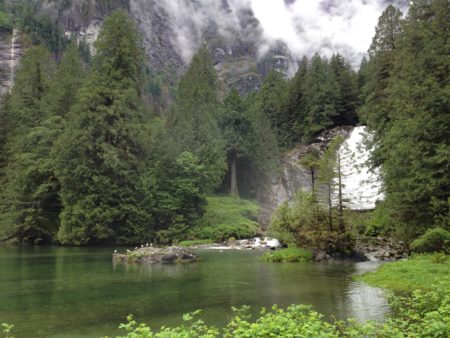
Besides the large UnCruise boat that had left as we arrived, another tourboat — a high-speed zodiac out of Egmont — made several trips in with its visitors bundled up in survival suits. The guide said it was about an hour and a half trip out for them including stops. Each trip he would pause so they could take pictures at the base of the falls and then allow them 30 minutes to explore before bundling them back aboard and zooming off for home. Several other boats came and went during our visit, including a lovely old wooden powerboat built in the 1920s, with a maximum of eight boats on the docks at any given time. I imagine this is very quiet compared to July or August — they have a suggested 72 hour maximum to ensure everyone gets a chance. A few of the other boats stayed for more than two evenings, but one boat arrived on the evening slack and left the next day by noon — that seems like such a waste an experience.
 The first thing that hit us after we had Never for Ever secured to the dock was the taste of the air. The base of the falls is much bigger than we expected, and the moist, cool air produced by the crashing water was loaded with smells and tastes that can most aptly be described as clean and fresh. This sensation occurred again and again during our stay as we would round a corner on a path or poke our heads up from below. It was as if every scent produced by the verdant growth was buoyed up by the dense air and delivered gently to our nostrils. Throughout our stay both Leslie and I would remark on it each time we strayed from our boat.
The second thing we noticed is the sound. The background roar of the falls never leaves. Your voices are a bit louder while you are here, you don’t hear the powerboat running his engines, and you fall asleep to the sound of a “fan” you just can’t shut off. For all its volume, it’s much subtler than the scent of the place. The air hits your senses in waves, coming and going, but the sound is always there, in the background until you notice it at the oddest moments.
When we walked up to the base of the Chatterbox Falls I — having for some strange reason changed from synthetics to cottons — got appropriately drenched by the ever-present mist. Thousands of litres of water are pounding down the mountain side, throwing water in every direction. Between the shadows and the immense amount of water and spray in the air, it’s difficult to get a picture that appropriately captures the grandeur of Chatterbox Falls, but I had fun trying. Later, when the wind came up and blew the mist back against the falls, I did manage to get a few clearer images of the water cascading down the rocks that might, somehow, capture the essence of the experience.
Low tide is also a very interesting time here. The sandbars created by the many outflows of water extend quite a distance beyond the base of the falls and makes for great sand cats and interesting exploring. Swimming here is not advised because of the presence of lions mane jelly fish (and, I imagine, the glacier cold water). Along the docks there were hundreds of jellyfish swimming in the water ranging from a few inches to more than a foot across. We also found many unfortunate ones lying on the rock where they were trapped by the receding tides. We wonder if they can survive their time out of the water, but the dead ones we saw floating later as the tide came back in seems to indicate they can’t. The shore is littered with clam shells, and a myriad collection of basalt and granite stones with a full complement of sizes from the tiniest specks to bowling-ball-size rocks. The action of the outflow tends to group them according to their size so as you explore you find these collections of similar diameter sand, gravel, stones and rocks.

At one point the wind came up in late afternoon and the boat at anchor began to swing. Normally the current from the falls is enough to keep a boat bow towards shore. Waggoners recommends a stern anchor in case of such winds but they obviously didn’t have one. After an hour or two of anchor watch they joined us on the dock, noting that after the second time their anchor dragged they had lost confidence that it was going to hold. And, in the way of such things, the wind died a few minutes after they were safely tied up. Other than that brief spell, the weather remained very calm, albeit cloudy and rainy on the secondhand third day.
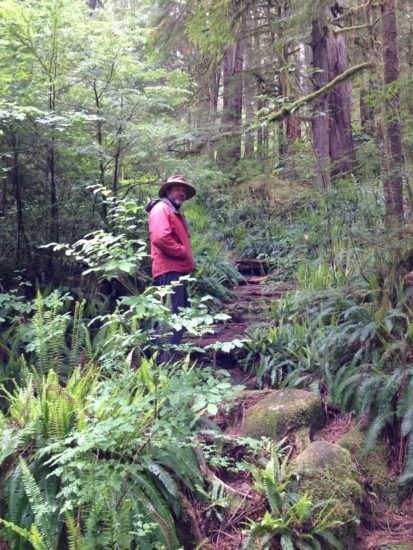

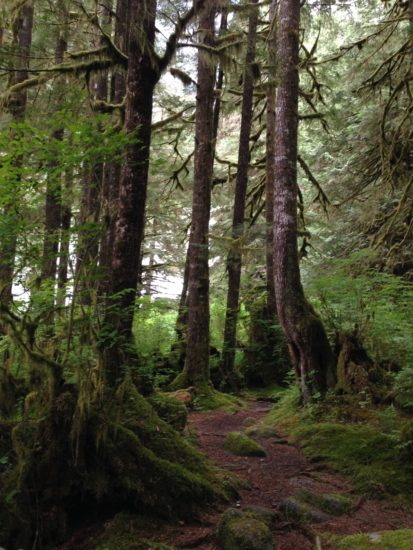
There are few trails here, and some picnic tables and fire pits, with one larger shelter and fire pit built by the Princess Louisa International Society. But other than at low tide, exploring and hiking is pretty much limited to one “arduous” trail with a 500-meter elevation gain up to an old trapper’s cabin. On our short walks we did find lovely displays of Nootka roses that added their scent to the air, Queen Anne’s Lace in bloom, plenty of red and orange salmonberries to feed your inner bear, and lots of tiny wildflowers, including some native bleeding hearts (Dicentra formosa) and silverweed (Potentilla anseria).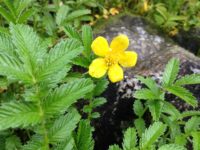 Here and there in the mostly coniferous forest, broad maple trees are covered with moss and the word verdant realizes its true meaning in this moist, healthy ecosystem with lush undergrowth and soaring deciduous and coniferous trees that create a canopy coloured in myriad shades of green.
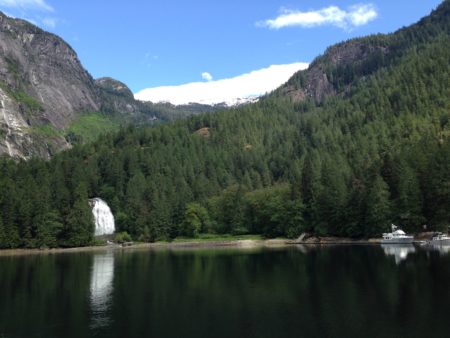
A magnificent place. I can see how it might lose some of its wonder in high season, and the circumstances created by distance and geography certainly lend themselves to the tendency to make it one of those spots where you arrive, take in the splendour and move on. But, as in so much of the beautiful coast of B.C., if you come at a quiet time and take the time to just sit and appreciate, you will find much to keep mind and soul fed for days. We certainly did.
After I wrote this post, but before I posted it, Andy Cross from Yahtzee posted a remarkably similar post. They were entering Malibu as we were leaving. Well worth a read.
—Captain Why #Posts
Instagram This Week


Stern tie Shenanigans
So a couple of nights ago we were stern-tied in Smuggler Cove, only one of three boats. Calm, peaceful and quiet. Then three more boats show up. Then another. Then a south wind starts to blow right on the beam and three more show up. And all of them attempt to tie up south of us.

At one point we had the cove pretty much to ourselves
We had left Nanaimo behind a couple of days earlier and crossed the Strait. We managed to sail for about an hour before the winds died down, then motored the rest of the way. Unusual for this time of year, the winds were coming from the north and showed no sign of change for at least five or six days. We spent a night at Secret Cove Marina to top up the water and batteries and enjoyed a half-price pre-season discount. The next morning we did the short motor to Smuggler Cove to relax and start settling into cruising mode.
I deliberately tied up on the north end of the cove as last time we were here it was also a north wind and I, and everyone trying to tie up, had been blown south, which made it difficult to stern tie upwind of another boat. Well, best-laid plans and all that — it didn’t work out so well.
The first three boats in tied up at the far south end of the first cove, well away from us. The next boat in, a Hunter from a charter company, thankfully also attempted a ring well away us, but later gave up and moved because they couldn’t get their anchor to hold (they eventually moved again and may even have left, but I was too busy to notice).
They were replaced by the first of two boats that came in at the same time. The skipper bravely tried to keep control of the stern but eventually the boat swung in a 360° circle and managed to wrap the as-yet-untied stern line around the boat. They got it straightened out, but the poor fellow with shore duty somehow set off his inflatable and was fighting the wind, the dinghy painter and the stern line with this big yellow doughnut around his neck. Eventually they did get tied up, but their anchor started to drag and their stern crept precariously close to the shore. They eventually gave up, raised the anchor and left altogether. I noticed they left their line behind — although they were back bright and early the next morning to retrieve it — so I am not sure what prompted the exit.
But I barely noticed any of this at the time. Because, and please forgive my hyperbolic judgementalism, the “sailors without a plan” had arrived at the same time and proceeded to keep me distracted for the next hour. It was obvious from the beginning they had no plan, very little clue and an old, cantankerous boat with a helmsman who, as far as I could tell, was so decrepit, he didn’t stand up once throughout the whole debacle.
They initially dropped their anchor in the middle of the cove and looked like they were going to tie up off our bow, nose into the wind, 90° to us, alongside a lovely Bayfield ketch. They did drop their anchor a bit far out for that, though. I remember saying to Leslie, “I wonder what their plan is?” Plan… Ha!
They launched their dinghy with an engine that wouldn’t start and only one oar. The fellow in the dinghy had instructions, but obviously was not an experienced cruiser so really didn’t know what was going on. The skipper of the ketch was out on his deck giving him advice and, it turns out, offering to take the stern line while they got things straightened out. That was the first time of many that I thought I might go help. He eventually made it to shore. But now for some reason, he (or they) gave up on that idea.
Meanwhile their boat is not anchored well and is threatening my neighbour’s bow as the helmsman fails to gain any stability in the situation and the boat is running back and forth over the anchor. At this point I am still fairly sympathetic, as I have done much worse and provided even more hilarious entertainment. Still, a banged-up old boat with literally shredded sails and three aged crew — the sole seemingly competent person was a woman who wasn’t doing any of the jobs requiring competence — doesn’t leave me with high hopes for success.
Someone decides to shift tactics and the dingy heads to the rings just upwind of us. They had a reel of 1000-plus feet of stern line, so the fellow in the dinghy was able to put out a lot of line, leaving most of it floating in swirls off our bow. Now I’m starting to get a bit concerned as their plan would swing their boat from being nose into the wind to beam on, immediately upwind of us. I know from experience that this is not an easy task in calm water and virtually impossible in any sort of wind without a lot of muscling, and the boat did not look like it backed up well. Still, I remain hopeful and we continue to keep an eye on them, tempted once again to go lend a hand.
There they are with hundreds of feet of line in the water, the boat motoring back and forth over its anchor and the fellow in the dinghy looking lost on shore until I point out two nearest rings. Of course he chooses the one 20 feet from ours rather than the one further away. Of course he does. He crawls up on the rock and loops his line through the ring, then hops back into the dinghy. Then he discovers his line is tangled around the ring. I grab my jacket. And the boat on the other end of the line starts to do weird circles. I put my shoes on. And his outboard wouldn’t start again. That’s when I hop in our dinghy, fire up the outboard and make a beeline for shore. While he gets his engine restarted, I quickly untangle his line and start to feed it through the ring and he heads back to the boat.
Well, that’s when we find out, unbeknownst to dinghy dude and me, that the crew on the boat have pulled up the fricking anchor. So they are motoring around dragging hundreds of feet of floating line while loosely tied to the shore. Just upwind of us. In 15-knot bloody winds!
They circle around to drop their anchor again, but this time 40 or so feet south of our bow. We have 80 feet of rode out so the fact that they are dropping the anchor just in front of us makes me very nervous for what the night will hold. Silly me. As soon as they get the anchor down and let out a little scope, they start drifting right into us. By now I am back in the dinghy and rush over and get between the boats while they drop one — yes, one — fender. Of course they drop it to the waterline where it won’t do any good, and of course the loose line is more likely to foul one of the dinghy props. The fellow in the dinghy follows my example and gets between the two sterns while I position myself just forward of the beams. I tell Leslie to start our engine. Just in case.
So there we are, beam to beam, separated by two dinghies holding the boats apart and the full weight of both boats on my anchor and my stern line. That’s when the person at their wheel decides to drive straight ahead. Which, at the angle we are now at, would be straight over my anchor rode and would likely knock my anchor loose as well. A little firm talk convinces him otherwise, but suddenly he’s taking direction from me, the guy stuck in a dinghy between two boats, rather than paying attention to what the hell is going on. Bugger.
By walking their bow off our boat, we get them fended off and pointed almost upwind, and they start to pull the anchor and move off. And then drop the bloody thing only 10 feet further on, and we do the whole bloody thing again. Seriously. Almost an exact repeat, but this time their stern is farther back and they almost take out our stern line. Once again, I’m stuck being a human fender between the two boats, and we manage to fend them off. Then we did it ONE MORE TIME. Seriously seriously. They did it again, and this time neither of us got the dinghies in between in time and they actually scraped the sides of the boats together (no damage, thankfully — I believe it was rub rail to lifelines).
I have no friggin’ clue what their “plan” was. Plan… Ha! I have no idea what they thought was going to happen. Or if any of them were even thinking by this point.
I wedge the dinghy back in between again and finally manage to get my dinghy bow to their beam and give it some throttle. Doing this, I could now push them away and keep them away while they tried to pull in the copious amounts of stern line floating around.
Oh, and I left out the part where loops of the stern line they had retrieved started to tighten, catch on loose objects in their cockpit and fling objects around the still-seated helmsman. It was one of those moments where you are suspended between fear and hope something bad would happen to him. Luckily for my future peace of mind, fear won out and I desperately wished he wouldn’t lose an eye in the chaos. I also remember almost screaming at the woman reeling in the line as she got her fingers wrapped in it as it started to tighten on their winch. It’s amazing how much gibbering the back of your mind can do while you are concentrating on the job at hand.
Eventually they get the line in and between their winch and me pushing their boat, they get the stern over. The situation settled out with a too-tight stern line, too little rode and boats way too close for comfort on a tide rising another 10 feet. But they were happy; someone even quipped that it hadn’t been as bad a stern tie as some Navy captain had once done. Me? Not so happy and not so confident that we were done with the drama.
Actually, I kept waiting for them to catch their breath and leave; or at least try again (somewhere else) with everything a bit more secure. But nope. They were definitely there for the night.
So we ate dinner (in the cockpit), played some cards (in the cockpit) and watched the sun slowly set (in the cockpit). I eventually decided to tie the dinghy alongside as a fender for when their anchor dragged and they swung their bow into us in the middle of the night. And we confirmed a plan B for loosing our stern line if we should need to escape from their dragging anchor. Then we retired below and listened to the winds climb. I checked again at midnight, right around high tide, and all was still well. Although they had no anchor light showing…sigh.
Elsewhere in the cove one of the first three boats that had looked to be decently anchored further down also must have dragged. It was a 45-foot, almost new charter boat that had a full crew and a speedy little dinghy that had been zipping back and forth. So they tried, sensibly, to tie up beside the Bayfield, nose into the wind, but then abandoned the attempt. I found out the next day they gave the boat too much throttle and pulled their own anchor. So they also, again sensibly, abandoned Smuggler Cove and joined what must have been a growing party at Secret Cove Marina.
Oh — I left out the guy anchoring later in the evening, dropping his anchor just off the neighbouring ketch’s bow with around a 2:1 scope and a gale forecast. There were some words between the two boats until he finally moved. Unfortunately his new spot was closer to us and our uncomfortable neighbours, still with a small scope and still no stern tie. But all the fight was out of me by then.
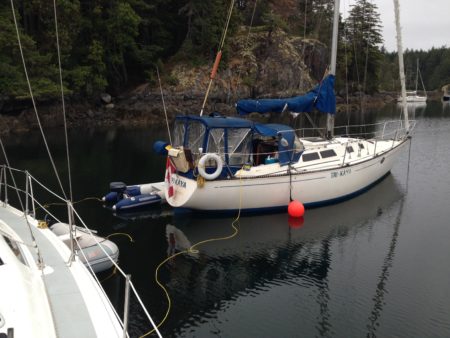
The morning after.
Well, in the morning I woke up to calm winds and the sight of our pestiferous neighbour’s stern floating serenely 5 feet off our dinghy with lovely little coils of thin yellow line floating alongside. Seems the wind had sawn through their patently insufficient stern line (it looked maybe 3/8″ poly but sure as hell was not 1/2 or 3/4 inch that every other bloody boat I’ve ever been on had — and yes I was, at this point, completely out of patience). Anyway, their line had parted and they had swung stern into us. Thank god their anchor held. Still, I imagine when the line parted and the winds were up, they must have been bouncing off our dinghy.
So I waited with my coffee. My old professor used to say “comedy is excess.” This was bloody hilarious. Eventually around 9 a.m. they poked their heads up. Their heater had been on for an hour but no one had thought to check on their precarious anchor and pathetic line.
“Oh,” she said. “At least we didn’t touch.”
“Oh,” I replied, “I think we probably did.”
“Ah,” she said. “Good thing you put the dinghy there.”
“Yes.”
“Well, I think we’ll move the boat and just anchor in the middle while we get ready to go.”
“Ah. Well, then. Good luck,” I rejoined.
So they moved out to where they had dropped anchor the first time, and just swung for a couple of hours. At least there was no wind. It turns out they were part of the larger group of six boats, two of which were the ones who had bailed the day before. I wish these guys had have been that sensible.
The fellow and his wife from the Bayfield ketch that was initially threatened by the shenanigans came by to say he had videos of the whole thing. We watched one later, relived the whole thing, had a beer, toured his boat and made a new friend.
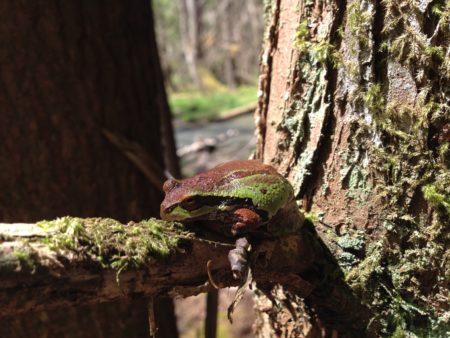
Leslie spotted this little guy on one of our hikes.
Other than that, it was an uneventful visit.
I will post the video later if I can…
—Captain Why #Posts
Instagram This Week


