Vancouver to San Diego Part 3
Sept 4
6:50 am awake
Get up, get dressed in the semi-dark and try to remember where you put everything night before so you don’t destroy your night vision. But there’s coffee when you emerge so it’s all ok.
7:30 am depart
Its a calm morning and Sea Esta casts us off and we slowly drift away. Then it’s simply a matter of firing up the engine and we are off.
While Sea Esta raised their anchor we take a slow tour of the harbour and docks and then follow them out into the strait.
8:56 am
Cape Flattery. That’s the big left turn moment when we exit the relatively protected waters of the Strait of Juan de Fuca and head south along the rugged Washington and Oregon coast. As with all these momentous moments in my sailing career to date it was a non-event.
We turned south and continued to motor in a small swell with no winds. Still it’s an accomplishment and we will be in the Pacific for the rest of the trip.
9:35 am
48° 20.5334′ N,124° 45.3532′ W
We spotted a humpback and watched him sound with a flap of his massive tail.
One thing of note is that the U.S. weather broadcasts are quite different than the Canadian ones. Their male voice is much more stern and authoritative but it still has some quirks. The one that got me was the hourly announcement that there was no pleasurable precipitation. I kept wonder what that was. A warm rain? Enough rain for a good shower? Maybe it would rain hard enough to be like one of those massaging shower heads? Eventually I figured out it was measurable not pleasurable which took the mystery out of it and ironically enough reduced the pleasure.
11:00 am
48° 12.0367′ N,124° 47.9520′ W
Nothing happening. No wind, swells, lots of water.
1:00 pm
48° 0.9295′ N,124° 46.0987′ W
See above.
Sea Esta is zigzagging trying to limit their roll. The Baltic’s deep keel and heavier displacement makes it a gentler boat than the Catalina in Rollin seas. They, however, have a full enclosure so I don’t feel very sorry for them.
1:36 pm
Tim whipped out his harmonica, well one of them: he has seven I think (A B C D E F & G), and treated us to some solos. He’s pretty good although like most amateur musicians he insists he’s not so hot.
Be that as it may he did attract a couple of porpoises for our visual pleasure. They didnt stick around long–probably more punk oriented and just not fans of the blues.
The Catalina kept rolling and performed even more zigzagging to try and keep the swell off their quarter and we just plowed steadily along.
Eventually we came in sight of Cake Rock which resembles nothing less than a giant cake. Go figure. It did mean we were getting in sight of the entrance to La Push so that was exciting.
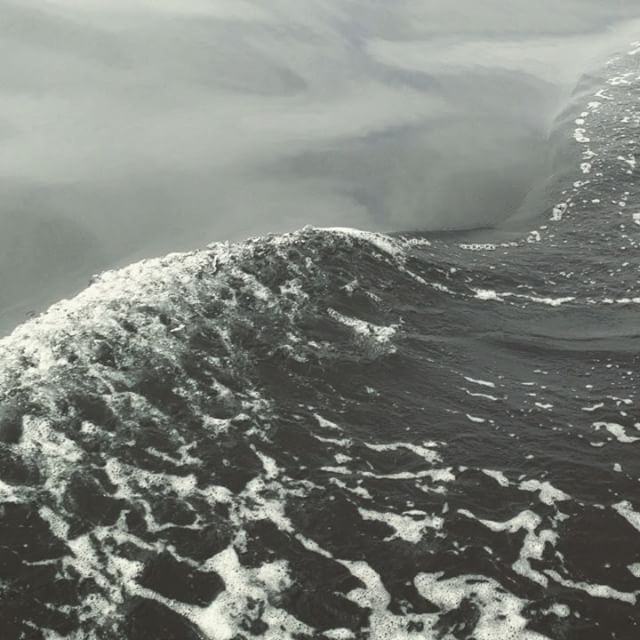
There weren’t even ripples on the water and I spent some time on the side deck watching our bow wake disturb the glassy water of the Pacific. Mesmerizing and beautiful. So I shared it on Instagram.
A little later a couple more porpoises came by but no one wanted to play.
2:55 pm arrived
La Push, WA
47° 54.7037′ N,124° 38.2175′ W
La Push was our first bar entrance but it was a non-event. Beautiful, but other than having to pay attention to the buoyage it was no different than entering any other harbour for us. Most (all?) of the ports in Washington and Oregon are in river mouths. That means there is usually a delta of some sort where the water crashing in from the pacific both suddenly shallows and constricts. This can make for some big waves and dangerous conditions. The Columbia River bar is said to be one of the most dangerous and treacherous in the world. But like the tidal rapids in the PNW, if you pay attention to the weather and time it right they should be no issue. We have plenty more to do so I guess we’ll see.
No one was answering on the radio so we picked random slips and tied up. A Fishery guy did pop over to see if we had caught anything but that was it. We never did find anyone and so ended up with a free night of moorage.
I headed out for a walk as everyone else was talking about going for a run and I didn’t want to get swept up in their insanity. It’s a native community but there is a terrific beach on the other side of the breakwaters and tons of tourists camping and staying in some beautiful waterfront cottages.
I went looking for some sunscreen but they were sold out; huh. Along he way I encountered Jim and Mark staring down the beach. Apparently they had lost Donna. A bit later I found Tim who had likewise lost Donna. Donna is starting to remind me a bit of Leslie who also has a habit of getting lost.
Back on board we had a visit from Lucky Girl who is a Selene trawler (maybe 40-45 feet). Apparently they were in Neah Bay last night as well but we hadn’t spotted them in the dark. They were on their way to Portland and also were planning on stopping in Gray’s Harbor next.
Then it was time for a beer. Jim and Mark popped over and we discussed plans. There was a bit of a heated discussion on safety, pfds and mob drills but it was all resolved in the time-honoured fashion of each to his own.
Dinner was tasty burgers and after we did a few chores like topping up the water tank and engine checks. I will admit sitting in the evening air that I gained an appreciation of Leonard Cohen. Although since I don’t really know his stuff I did embarrass myself by asking who we were listening to. I mean I’ve heard all the songs before by different performers but who actually listens to Leonard Cohen? I guess from now on that’ll be me.
The rest of the evening was spent sitting quietly on deck with the funky disco led lights and relaxing.
Sept 5
5:50 am awake
6:00 am depart
We beat Sea Esta and Lucky Girl off the dock and across the bar but the trawler soon passed us and the two sailboats angled out to sea. breakfast was waffles which Donna did in this cool single-sided waffle pan.
7:23 am
We put the head sail out in winds SW at 5 knots. Pretty soon we were cruising along at 6.0 knots with the motor still running.
Eventually though we had to roll the sails back in, but Sea Esta stubbornly kept her main out and zigzagged back and forth.
9:15 am
47° 37.8264′ N,124° 37.9374′ W
We picked up an AT&T about about 5 nm offshore so everyone immediately checks their phones like a bunch of teenagers.
A bit later we spotted a couple of other boats but they were going the other way.
11:00 am
47° 30.0859′ N,124° 29.5289′ W
At this point we are motoring 3 nm offshore but decide to move in closer so we could at least enjoy the scenery. So Tim had a nap and I played that boater favourite, Bird or Crab Trap. There are a lot of crab traps.
12:25 pm
A bazillion birds started flocking to a spot just off the starboard side with dolphins diving in and around them. Then suddenly they all took off and moved ahead of us and gathered again. There were pelicans, cormorants, gulls and and something I am calling murrelets but who the hell knows what they really are. Anyway, we guess it was a herring ball but whatever it was it was cool to see the birds converging.
Speaking of birds, I keep seeing these black stubby gull-like birds swooping mere inches above the water and moving up and down with the swells. It’s a terrific but of acrobatic flying.
2:50 pm
47° 8.7814′ N,124° 16.2876′ W
Still motoring.
3:50 pm
A couple of porpoises came along and were cavorting in the rain that finally caught up to us. I am starting to get wet.
5:30 pm
46° 54.7574′ N,124° 10.5088′ W
Still wet but at least we are crossing a relatively benign bar.
6:24 pm arrived
46° 54.6005′ N,124° 6.7178′ W
Westport Marina, Gray’s Harbor
It was a 68 nm day but we are settled in the transient moorage at Westport Marina in Gray’s Harbor, Washington. Tim and I break out the tarp to keep the rain out and sit relaxing and enjoying a Bud.
It’s a huge fishing town, really reminds me of the oil patch. A local deckhand looking for work stopped by to chat and beg a glass of water. Sounds like fishing is another boom and bust industry for the workers.
The transient space is only $25 but the facilities are pretty sparse. I am starting to dream of a hot shower. Dinner was pressure cooked ribs but I too tired to gorge.
9:14 pm Lights out
Instagram This Week
Vancouver to San Diego Part 2
September 2
8:00 am Depart
We got up to a rainy morning and had coffee before it was time to go. Breakfast was toast (Donna has a toaster and isn’t afraid to use it!) and jam and, in Tim’s case, peanut butter, peanut butter and more peanut butter.
Jim and his crewman Mark had talked game about going for a run at 6 am, but apparently that was a fair weather plan as they didn’t emerge until close to departure time. We cast off from them and headed out of the bay. Northwest Passage turned to starboard and Sea Esta X turned to port to go around Sucia. We met up on the south side with us in the lead.
We spotted some sea lions cohabiting with seals on reef off Sucia. Apparently détente is possible.
The wind was 12-15 knots on nose and it was rainy and wet and cold the whole way. Most of the trip was using Auto with us huddled behind the dodger drinking tea and watching the U.S. go by.
Vendovi Island
48° 36.883′ N, 122° 36.741′ W
Our first destination was Vendovi Island, a nature conservancy whose caretakers were authors of some west coast cruising guides (Pacific Mexico and Sea of Cortes by Shawn Breeding and Heather Bansmer). They parked their boat, Om Shanti, at the dock there and lived in the caretaker’s house on this relatively untouched island…talk about a good gig.
After picking up the books and getting them signed, we all chatted for a while picking up hints from these 7-year veterans of the Mexican coast. Then we cast off and headed the shorter distance into Anacortes.
2:50 pm arrive at Cap Sante Marina, Anacortes
48° 30.8050′ N,122° 36.3141′ W
We followed the buoys down a dredged channel and behind a huge breakwater and pulled up to the fuel dock to top up. We put in 47 U.S. gallons of diesel and then filled the tanks now lashed to the rails with another 20 gallons. We should be good to go now if we get any wind.
We moved over to the Anacortes Yacht Club reciprocal docks but there was no room. Tim magically finessed us into a tight berth along side but it wasn’t actually available for us to use. A lovely fellow from Vancouver volunteered to give us his space and we moved over and snugged right up to the dock with Sea Esta X rafted to us.
I headed into town to check with customs on check-in numbers and buy some beer. Customs for some reason was closed. After exploring a bit I ran into Donna who’d found a buy 2, get 1 free deal and was loaded down with 36 cans of Bud. I offered to buy a case and helped her haul her loot back to the boat.
After that it was some more work on our boards, hacksawing the bolts flush. I also updated the android tablet with current charts for the west coast and Mexico. And then I hit the showers. Pro tip: if the showers are cheap and you are wearing quick dry synthetics, then why not start the shower wearing them and get some clothes washing done at the same time.
Back at the boat Nancy and Ken, who are Mexico cruisers and buddies of Tim and Donna were waiting for us so we could go out and grab a beer and a burger. We ended up at The Brown Lantern Ale House which is a lovely small town pub with friendly people and great service.
I chatted with Mark a bit—he’s the Bruce equivalent on Sea Esta. While he’s retired now, it turns out he was a Guinness comms and public relations guy and has lived all over the world. Talk about a sweet job. He is also on board until San Diego but he has a deadline since he’s got a flight to the UK to catch at the end of the month.
Back on board I did a bit of blogging and uploading with the marinas crappy free wifi and then hit the sack in anticipation of a 5:30 departure.
September 3
5:27 am depart
While Tim said I didn’t actually need to get up for our departure I woke up when the engine fired up and headed out on deck. I guess I got an extra half an hour sleep out of the deal.
Turns out the port running light was out. Luckily Tim had a LED patio light that had red as one of the options. He tied it to the port side of the cabin top and voila, problem solved. Later he discovered a bit of corrosion and managed to fix it properly.
Once again the magic coffee appeared and I sipped it as we made our way out the various passages in the dark on our way out to the Strait of Juan de Fuca. I think the food service in this boat is one of its best features. Seriously, Donna takes great care of us.
7:30 am
48° 26.4301′ N,122° 46.8465′ W
Crossing below Lopez Island, motoring straight into 15 knots of wind.
8:23
After we passed the bottom of Lopez Island we rolled out the jib and sailed along quite pleasantly for a while. Eventually we had to raise a double-reefed main so we could point a bit higher but holy mackerel this Baltic goes faster on just the jib than my Hunter usually does with full sails out.
9:00
Raised main with 2nd reef. Spotted some orca near the bottom of San Juan Island. We head in a little closer and watched as we sailed by.
11:00
10-15 knot winds with a 2 knot push has us up to 9 knots over ground. We sail past Victoria and I said hello again old chum.
12:10
48° 20.8495′ N,123° 27.2491′ W
Wind died in the lee of Royal Rhodes since we couldn’t point high enough to clear it. So we rolled in the jib and fired up the engine to clear Race Rocks.
Eventually we killed the engines again and sailed through Race Passage noting that Tim’s Lowrance still has a problem with showing the islets around Race rocks at certain zoom levels. We didn’t quite hit that invisible island but…
3:05 pm
48° 18.3264′ N,123° 47.9652′ W
Engines on again and we spot two humpbacks off port side. 2 minutes later several orca appear off the starboard. It’s a whale-apolooza!
We also spotted 3 cruise ships in a row inbound to Victoria—gonna be hopping there tonight.
4:57
48° 17.3705′ N,124° 2.7739′ W
Dozens of humpbacks. Dozens! I wouldn’t have been surprised if there were as many as 50 out there but the buggers are hard to count. We are surrounded on all sides. Tim spotted some breaching but I only saw the humongous splashes. But there were some diving and some resting on the surface and some just swimming around in no particular hurry. Every time we passed some by we would see more in the distance and the show went on and on.
We finally lost sight of the last one at around 5:45. Absolutely incredible. I got some great video.
After that it was basically motoring into current and wind, making about 4 to 5 knots for hours. I went below around 6:30 to lie down and read for an hour or so. While I was gone the tide finally switched again and we ended the trip doing around 8 knots.
9:08 pm
48° 22.4064 N, 124° 37.1292 W
Neah Bay, Wa
We are rafted up to Sea Esta who made it in an hour ahead (they motored more) while it was still light. It’s dark but it looks to be a fairly vibrant fishing community.
We enjoyed a communal dinner aboard Sea Esta and cracked open a welcome beer and made plans before hitting the sack. It was 11 hours motoring or motor sailing in a 15 hour-ish day, but at least it was good sailing while it lasted. Tomorrow is a short day but it will be our first in the mighty North Pacific Ocean.
Vancouver to San Diego Part 1
Forgive the odd image placement. It’s hard to do on the phone.
August 31
7:30 am
53° 16.0117′ N,113° 41.8405′ W
Up at some ridiculous hour and off we go. While it was bone dry at our condo we were surrounded in four sides by lightening. At 6 in the morning it is kind of eerie since your brain isn’t function at full speed yet. By the time we were half way round the Henday (our ring road) the rain had started and we just tried to keep out of the maniacal morning commuters’ way and still stay between the nearly invisible lines.
Still we made good time and arrived at the airport barely 40 minutes after leaving the front door. There was an tender but not so tearful goodbye and L drive off leaving me to my dates for the next few weeks.
For those who don’t already know I am joining my friends Tim and Donna on their Baltic 42 as they begin their journey to Mexico. I am just sailing the Vancouver to San Diego leg and get to miss all the boring stuff in the sunny south.
By the time I got through security and made my way down to gate bazillion-and-one I had barely sat down before they called the pre boarding. Since I had emergency row seats I got to stand right back up and board. We started boarding at 7:10 for an 8 o’clock flight. These things are getting more and more inefficient.
8:30 am
49° 16.2889′ N,123° 8.2490′ W
And hour and a bit later I grabbed my bag at YVR and after a bunch of waffling decided to grab a cab. It took me straight to Granville island with my overly heavy duffle and I waddled down the dock to where I saw Northwest Passage tucked up against a powerboat.
There was no one aboard so I called Tim. They were at Starbucks borrowing wifi so I dumped my gear aboard and headed out. The boat looked like it was still undergoing refitting more than something set to cruise a couple of thousand miles south but then boats always look like that up until the last minute.

After a quick greeting I headed off to visit West Marine while Tim and Donna headed back to the boat. I scoped out some prices and then walked a few more blocks to Steveston Marine chandlers. I picked up an inflatable off with an integrated harness and tried on a few jackets before deciding to buy the WestMarine house brand instead. So back I went and picked up a jacket and a pair of cruising boots (fancy sailing gumboots) and then hauled my loot back to the boat.
1 pm
The rest of the day was spent doing odds and ends. We installed a 110 plug in the vberth and a twin 12v/usb plug at the chart table. These were fairly simple jobs but involved a lot of boat yoga so I was a tad stiff later.
Next up was bolting deck rails on the stanchions for lashing spare tanks we have 1 gas tank, 4 diesel tanks and 4 water tanks, all 5 gallons each. Along the way I managed to drop Tim’s favourite crescent wrench overboard. Losing other people’s tools seems to be becoming a habit for me.
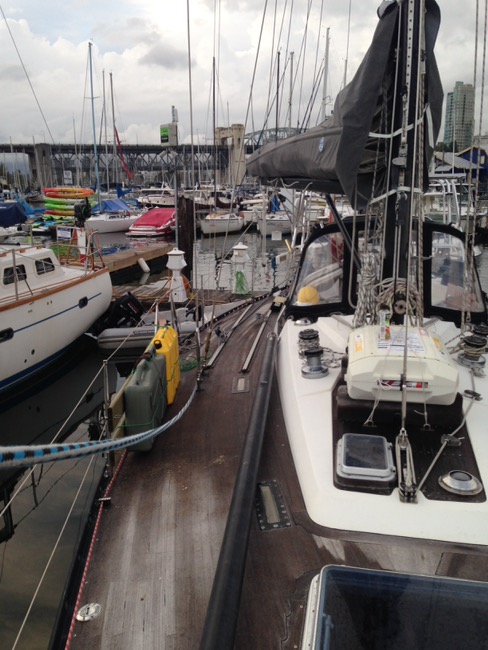
Once those were done we then worked on a grab rail for the dodger. this involved wonderful the docks trying to find something we could bend this 3-foot piece of stainless steel over so it would match the existing curve. Pretty much every system we came up with was almost guaranteed to kink the thing rather than add a bend but like the manly men we are we persevered. Well actually Tim persevered. I eventually got bored and wandered off after declaring the task impossible. Of course now we have a handy, perfectly curved, stainless steel grab rail attached to the front of the dodger so I guess we all know who won and crushed in that scenario.
Supper was a late night bbq’d steak and that was pretty much it for Day 1. I crawled into my berth and resolved to actually get organized later.
September 1
8:00 am departure
I wandered up to the shore to have a lovely hot 6 minute shower and was back on board and ready to go by 8. We were supposed to meet up with our traveling companion Sea Esta X out in English Bay by 8:30. Sea Esta is Tim’s boat, a Catalina 42, and he is also taking it south. His crew was joining us in Point Roberts where we would clear into the U.S.

The winds were South 10-15 knots so of course we were going south. We did roll out the jib and actually had a good sail with the winds climbing over 20 knots at one point. One long tack took us out towards Sandheads.
10:47
49° 7.1764′ N,123° 19.0649′ W
We spotted some dolphins around out among all the fishing boats at the mouth of the Fraser River.
A bit later we tacked to get closer to shore but right around Tsawwassen we gave up, rolled in the sail and motored the rest of the way.
1:57
Point Roberts
48° 58.5899′ N,123° 3.8183′ W
2 hours plus at customs. I’m not sure what kind of bureaucratic hell the CPB officers dwell in but it has to be some sort of punishment. There were multiple, multiple phone calls, visits from at least two different pairs of officers, more phone calls and contradictory instructions. But the only question they asked was what was my job which they decided was irrelevant since I was just heading home right away.
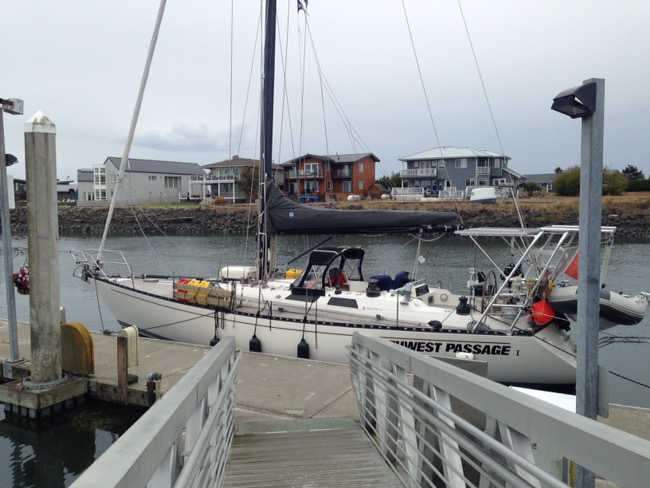
Eventually they did issue us our cruising license although they had to phone us the actual clearance number since their system kept crashing and we were free to cast off.
4:06 departure
In the long interim the winds had turned to light so we motored against the current towards Sucia Island. Intermittent dolphins visited along the way and we had a pleasant trip across the bottom of the Strait of Georgia.
6:56
48° 45.679′ N, 122° 54.951′ W
Sucia Island
After we pulled into Shallow Bay on the north side of Sucia I brought us alongside and we rafted to Sea Esta X rather than dropping our own hook. The Catalina is rather luxuriously appointed so we abandoned ship in favour of a cold beer under their canvas.

An hour or so later dinner on deck was corn and pollock burgers and then it was time to hit the sack.
Logo Design for Dummies
This is a short article I wrote for August issue of T8N magazine on 8 tips for good logo design. Nothing earth shattering and written to fit into their 8s section.
###
A Logo Is Worth a Thousand Words
Every good logo tells a story. In fact, your logo is often the first introduction that potential customers have to your business and, therefore, needs to be able to stand on its own as your front-line brand ambassador. Tall order? A little, but with more and more customers wanting to feel a connection to the brands they support, the role of your logo as a brand ambassador becomes increasingly important. So what makes a logo a good logo? And just how does it tell your story? Here are 8 tips to consider…
Always Consider This
If in doubt, leave it out. If you can’t rationalize something in your logo, chances are it should be removed. When your logo is at its simplest, it’s probably at its strongest. Be ruthless.
1. Ask the Whys
Why do you have a logo? Who does it target? What is its purpose? If you can answer these deceptively easy questions, you are well on your way to creating a great logo. Time spent figuring this out is probably the single most valuable thing you can do when considering logo design. And don’t forget: since every good logo tells a story, yours should be filled with meaning (both obvious and hidden) and even occasionally whimsical—did you know the Apple logo has a “byte” missing?

2. Keep It Simple
Name the first three logos that pop into your mind, and chances are they are clear and uncomplicated (at least on the surface). Simple but powerful logos almost always prove the best at standing the test of time. Trust in that.
3. Logotype vs. Logomark
People often confuse a logomark (think Nike’s swoosh) with a logotype, which uses the name of the brand rather than a symbol or icon (think Google or Disney).
A logotype is often the easiest and most all-around logo to use since it identifies the name of the company or product, as well as expresses the brand. But it is also often bulkier and is sometimes more difficult to use in situations where something smaller and simpler would work better.
A logomark can help enhance brand identity. This is especially true if your mark happens to be a representation of your product or service. And if a logomark is marketed correctly, it can often be more identifiable than a logotype, as exemplified by the Apple or Lululemon logos.

4. Shape, Proportion & Symmetry
Where does your logo need to appear? If you do a lot of sponsorships, the logo will often appear at the bottom of a sign or poster, along with a lot of other logos. Do you have (or want) a strong web presence? Will your advertising strategy involve TV? How about print? The shape and proportion of your logo may affect how it fits in different applications or media, so try out the basic shape in as many situations as possible.
A symmetrical logo is aesthetically pleasing and will encourage more symmetry in whatever application it’s used in. Asymmetry can carry a complexity that communicates different emotions—anything from laid-back to intense or moody. There is no right answer, but take a moment to carefully consider the implications.
5. Colour & Tone
Make no mistake, your colour choice will communicate ideas. Lego’s red, for example, reflects passion and energy, Starbucks green speaks to nature and freshness and Intel’s blue conveys professionalism and sincerity. Consider your message before committing to a colour choice.
Remember, too, that for a logo to be really useful, it needs to work in black and white or even in reverse (as white on a dark background). So colour should be the last decision you make.

6. Active vs. Passive
Consider your business and consider your brand. Should your logo convey a sense of movement and activity? Red Bull’s charging bull and Twitter’s flying bird are both instilled with motion and energy, which complements their brands. What do you want your potential customers to feel?
7. Negative Space
Don’t forget that the shapes in your logo can often convey more than one image. The right facing arrow embedded in the FedEx logo is the classic example of using negative space to add meaning. But also consider the simplicity of the white peacock in NBC’s rainbow of tail feathers or the clever “1” in the Formula 1 logo. Used correctly, negative space can allow you to add more elements to the design without increasing the complexity.

8. Consider Custom Type
When it comes to good logo design, a typeface should be unique. A custom, hand-drawn typeface is always better than something standard or that you download off the Internet—just take a look at the timelessness of Coca-Cola. A custom type helps ensure that your unique logo will stay that way. But if you can’t afford a completely custom font, at least customize any pre-existing font to make it your own.?
###
8 Biggest Logo Mistakes
- Overdoing the special effects. More is not better.
- Using too many fonts. Use one or two at most.
- Not considering its scalability. Does it work as well tiny as it does on
a billboard? - Being too trendy. Don’t just jump aboard the bandwagon—stand out!
- Being too abstract. Don’t leave your customers guessing.
- Leaving it to an amateur. Cousin Bob may be cheap, but you inevitably get what you pay for.
- Relying on stock art. It’s the quickest way to look like everyone else.
- Relying on colour to be effective. All too often, colour is a luxury you can’t afford.
Did You Know?
 Since the time of Euclid, people have studied and used the golden ratio, which in mathematics, is when the ratio of two quantities is the same as the ratio of their sum to the larger of the two quantities. Good logo design often makes use of such classic principles. Despite the fact that the bite out of the Apple logo seems to violate the symmetry of the logo, if you break it down, you can see that they put a lot of work into applying math to the design.
Note: many people think the strict adherence to the Golden Ratio in the Apple logo is a bit of a myth but I think the use of proportion and symmetry still shine through regardless of the precise math.
Instagram This Week


Instagram This Week


Instagram This Week




Heading Down the Coast
No, we are not taking Never for Ever out into the pacific (yet). But yes, I am heading south aboard a friend’s boat.

Ever since we managed to basically motor around Vancouver Island, I have been hankering to get back out “offshore” to see if it is something I actually want to do on my own. Well Northwest Passage, the Baltic 42 we did our circumnavigation on, is heading south next month to Zihuatanejo for a few years and they were looking for a hand for the “crappy”part down the west coast of the U.S. before they join up with the Baha Haha in San Diego. After a lot of humming and hawing I finally decided that — YOLO being the philosophy de jour — I might as well take advantage of the opportunity.

There are generally two options once you turn south after exiting the Strait of Juan de Fuca. One is to head offshore 20 miles or so and head strait to San Francisco. This is the most generally popular option because many of the ports available on the rugged Oregon coast are subject to weather and feature some of the roughest weather around — some say in the world. This means sailing 10-14 days straight. The other option, obviously, is to try and harbour hop down and sleep in a harbour most nights, hoping the weather allows getting in close to shore. At this point we are going to be trying for option 2, but I assume that option 1 is always available if the weather doesn’t cooperate.

After we leave San Francisco, which should be around 2 weeks after leaving Vancouver, we set sail again and make our way to San Diego which is another week away. That leg of the trip offers a lot more options for places to stop. So in a perfect world the trip should take around 3 weeks, with lots of hard sailing and tons of experience for me.
The tentative cast off date is September 1st, weather depending. I will likely fly out the day before and pick up a few personal provisions before board the boat. I haven’t yet decided if I will blog the whole trip or just post a summary when it’s all done. I guess that will be decided by just how much of interest actually happens.
—Captain Why #Posts
Instagram This Week

