I’ve Got New Crew
So the good news is that that Never for Ever has been booked for charter pretty steadily this season. The bad news is that if I want to go cruising again in 2017 it will have to wait until October. But what the hell, how cold could it be… 😉
And, since Leslie is back at work (although ironically it looks like she will be in Minnesota at a conference when I head out), I had to do some recruiting for crew. After some pleading, couple of old friends volunteered. These are guys I have known since high school, but the last time we travelled together was a highjinx-filled attempt to drive to Vancouver for a weekend from southern Alberta. And one of them is the guy who ostensibly taught me to sail, albeit in Lasers and on a lake. The other, as far as I know, isn’t much of a water person.
New Crew

Passenger or crew?
This will be the first time I have headed out on a cruise with a) someone other than Leslie and b) an all n00b crew, and that has me thinking a bit about what cruising my own boat with new crew entails. My conclusions? Well, for one thing, I have to up my game. I can no longer rely on having a familiar and trusted partner to consult and double-check my decisions. Leslie and I have learned to sail together and, although I technically have more qualifications (at least on paper), she has been there throughout the process, learning at her own pace. The result is our cruising status quo has always been more of a partnership than the traditional hierarchical captain/crew arrangement.

The original team.
With new crew the balance of responsibility shifts completely onto my shoulders. Back when we did a lot of rock climbing, we once hired climbing guides to take us up the apron on the Squamish Chief and I asked my guide (from the most excellent Squamish Rock Guides) how he could trust us as unknowns to belay him up the mountain. His reply was that he essentially had to be confident that he could climb it solo. Looking ahead, I think that this is going to be true for me as well. Sure it will be nice to have help, but I am going to have to be able to do all the main operations by myself and then really work on my communication skills so I can transmit expectations and be confident that we are all safe. And that starts with a little review of what to expect when you are expecting (to cruise). We have previously done up a Boat Briefing Checklist for passengers, so that takes care of the basics. And the point of this post is to serve as a review of any other factors that I need to consider.
Skill Sets
So what are the minimum skills I expect from crewmember? And which ones will I actually need? A lot of my reading has stressed the difference between passengers and crew. I’ve had passengers before and expected them to do very little other than avoid clogging the head. But I have always had crew and I am not sure I am up to sailing solo in any but the most benign conditions. And October in the Salish Sea always has the possibility of some “interesting” weather.
So I started the specific skills I might take for granted. Thinking about it — and going back through my Competent Crew workbook — I concluded there were only a few really important ones that I either need to teach or ensure are done correctly.

Remember when we didn’t know what one of these was!
And number one skill will be knot tying and line handling. Because if I want to complete the trip with things like fenders, tenders and fingers intact, I am going to have to have faith in how lines are handled and made fast. For me the three main knots are the clove hitch (fenders and tying up to bull rails), the round turn with two half hitches (fenders and general securing of things like the dinghy) and a cleat hitch (self-evidently for attaching things to cleats). In the case of any stressful dockings or moorings, I might not have time to double check everyone’s knots so it would be good to be confident that nothing gets loose right when it shouldn’t.
Flaking and storing lines is also important although I can always find time to do that myself later. I do think it is important to communicate the difference between coiling and properly flaking. When were climbing, a properly stored line often was literally a matter of life and death, but most people tend to be pretty casual about handling “rope.”
In the end, it’s not the actual sailing I worry about because I have been conscientious enough to take the time to learn to do most things solo (although now that I think of it, I haven’t practiced reefing by myself). It’s docking, anchoring and basic seamanship that have always up to now been two person operations.
Ah docking. Is it a skill or a procedure? Leslie and I have a great system and although we can switch up the roles (and often do when it’s straight forward), when conditions are challenging as with a strong current or wind, I man the helm and she takes care of securing us to the dock. With new crew, lines and fenders can be set well in advance so that’s not an issue and we can talk through the steps and let everyone know what to expect before approaching a dock. And I don’t anticipate going into a strange marina, so I should know the general layout of anywhere we are likely to stop. But will my new crew know what to do once we are alongside?
One issue/skill set which we should probably practice before we leave the dock will be dealing with bull rails. Here in the PNW, marinas generally have rails running the length of the docks for boats to tie up to rather than cleats. Most often these consist of a 4×4 rail that is supported 4 inches off the dock every 8 feet or so. When tying up you generally wrap your line around the rail and tie off with a clove hitch. It’s easy to do with practice, but can look a wee bit gordian if you don’t understand what the lines are doing.

That’s a knot?
If you are called on by the skipper to secure a line quickly (indicted on our boat by the instruction to “take a wrap”), the thing to do is wrap the dock line over the top of the rail, tuck it under the gap and over the top again. That gives you enough friction to stop the boat if necessary but is still easy enough to slacken or cast off again if necessary.
Competent Crew? Competent Captain?
But there’s the rub, how do I ensure my new line handlers know when things are necessary? Some of my most hilarious hijinks on a dock have been when someone secured a line and I lost control of my own boat. Shudder.
Good communication should take care of that but that’s on me. I have been informed that I have a bad habit of mumbling and assuming people can read my mind. In a high-stress docking situation that habit just might be a bit of an issue.
 So we will go over the various procedures of docking and undocking, anchoring and weighing anchor, and general boat handling before hand. Doing it out loud should also reinforce it for me and remind me that I can’t assume anything, which I think is the biggest danger I am going to face. Thankfully I’m not proud and have been known to radio ahead and let the marina know just how incompetent we are so we can have plenty of theoretically competent people on dock to help out. If we take things slow and easy and avoid those rare docking situations where “gusto” is called for we (I) should do ok.
Anchoring is another thing I have never attempted solo although I know its theoretically possible. I intend to review the steps, maybe even write down the math and make sure we review each time we approach an anchorage. They say that the most dangerous time in learning any skill is when you have achieved unconscious competency…that’s when you get complacent.
Sailing Away
Hopefully there will be wind. It would be nice to get in a couple of good sails and nothing gets people working together like beating into the wind, tacking back and forth. Plenty of repetitive actions and a little excitement to get the adrenaline flowing. I am looking forward to some good times.

Competent Crew 101
Things to review either before we leave the dock or before actually attempting:
- Basic safety orientation (see Briefing Checklist)
- The running rigging
- The sails (roller furling jib and mainsail)
- Reefing
- Knots & line handling
- Winches
- Line handling dockside
- Points of sail
- Gybing & the boom
- Windlass operation
- MOB 2.0
- VHF & distress signals
- Dinghy & outboard
- Basic chart reading and buoyage
- Tides and tidal rapids
- Basic terminology (port & starboard, etc.)
- Using the engine
- Fueling

What the hell is all that?
—Bruce #Cruising
Instagram This Week


#stainedglass #whaletail

Thought of the day…
“…learn who you are,
and who you are not.”(I love this couple: https://youtu.be/sUC7ub1zpHE)
Knowing yourself has always struck me as the easier of the two goals. Accepting who you are not…well, that’s the tough one, isn’t it.
Auto backup iPhone
I am trying to problem solve an issue with photos syncing to my phone and every time I have to test it it backs up the full 50 gig of data making this process extraordinarily long and tedious. But it seems you can disable that feature using terminal. I record it here for posterity …
If you are synchronizing to a Mac:
1. Close iTunes on your Mac.
2. Launch Terminal.
3. Type
defaults write com.apple.iTunes DeviceBackupsDisabled -bool true
and press Enter.
4. If you want to re-enable automatic backups, type
defaults write com.apple.iTunes DeviceBackupsDisabled -bool false
and press Enter.
Instagram This Week

Instagram This Week


Instagram This Week


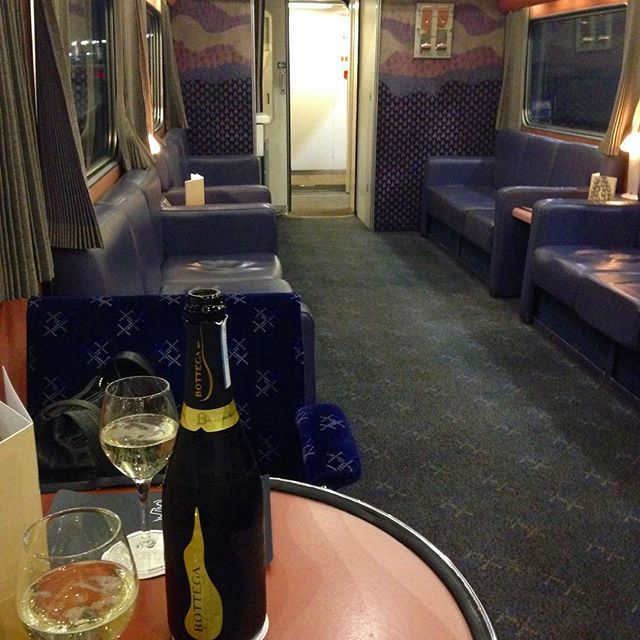


Londinium
July 4
We got on a plane. It was 5:45 pm. Then for six hours we sat. It. Ever got dark. Then we got off the plane (in the middle of the airfield) and it was 6:45 the next morning.
Flying to Iceland is weird.
July 5
Iceland Air has many, many planes. Reykjavik has about 6 gates. Their solution is to offload you in the middle of the tarmac and load you on a bus and drive you, dodging planes and ground crew the entire way, to the terminal.
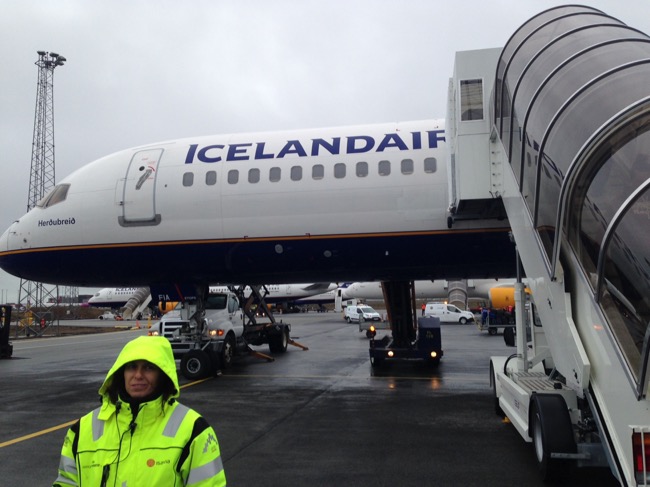
Then, if you are catching a connecting flight like we were, you line up at a gate, they load you back on a bus and then drive you all the way back to the middle of the tarmac and load you on the plane right beside the one you just got off of. Presumably you luggage just took the more efficient route of transiting the 100 feet between cargo holds.
Then it was 3 hours to Gatwick and the end of any peace and quiet. London is a loud place. With all the go, go, go you don’t notice it until you head down a quiet university lane and the sudden cessation of the constant cacophony wraps around you like a comforting blanket.
Arriving at Gatwick, you are processed in a classic hurry-up-and-wait system that rushers you through the airport and spits you out in the terminal lobby. We wandered over to the airport concierge and bought Oyster passes for the transit system and 2 tickets for the Gatwick express to Victoria Station. Then a quick transfer to the Undergoumd and we were crossing the street in Kensington to our hotel.

It’s a small room on the 3rd floor of an old Edwardian row house. There are a lot of old Edwardian row houses. Or at least what I think are old Edwardian row houses. But what do I know about row houses? They could be Georgian row houses for all I know…but I like the ring of Edwardian row houses so there you go.
We dumped our stuff, grabbed a quick shower and went for pizza and prosecco. At this point it was 3 pm local time and I hadn’t slept so we decided one of those hop-on,hop-off bus tours would be just the ticket for staying awake until evening.
So for four hours we looped around London listening to a travelogue, seeing all the main sites and picking up tidbits like Mews were old back alleys for the carriage houses and most of what I think of London is actually Westminster.

Eventually around 9 the bus dropped us off Right by the hotel so we grabbed another shower and crashed.
July 6
Breakfast in the basement and we walked down to the Imperial College to check out L’s conference site. Then it was the tube to Westminster and we hopped on a one-way river tour which had been included with yesterday’s bus tickets.
We saw the river side and disembarked at the Tower of London. It’s way bigger than I imagined. Somehow it’s never really represented as a fortress but it really is. We decided against the 20 pound tickets and just walked around. It certainly makes more sense now that I’ve seen it. Especially the riverside…

Then we ducked into All Hallows Church. Standing their gazing at the ceiling we were approached by an older gentleman that invited us to stay for a pipe organ concert in about 15 minutes. We had a chat about the history of the place. Apparently it was bombed out in the war and when it was rebuilt the ceiling and supports were cast from concrete due to all the shortages in lumber etc after the war. Apparently houses cont first priority on building materials. Makes sense but it’s one of those “aftermath” things we rarely think about.

It had a small crypt with some Roman artifacts and the obligatory diorama. I love dioramas. This one looked remarkable similar to the one in Trier but I suppose that’s not surprising as the Romans were distinctly unimaginative when it came to designing new towns.
Upstairs the organ recital had started so we sat in the pews for a bit and took in the Schumann and Bach and enjoyed the cool air and free wifi.
Christopher Wren’ St Paul’s was on my list so we decided to walk there next. Unlike every other church we have explored this one had a 20 pound admission. But it was on the list so we coughed up the cash and wandered in.
It was unlike any other cathedral I’d seen. The closest in feel was St Andrews in Bordeaux, but it had much cleaner lines and little of the gothic left. There was a concert scheduled for that evening so we were treated to some strings and pipe organ as the musicians practiced. No photos allowed in the cathedral so I sneaked a few.

Then we headed up to the whispering gallery in the dome but opted not to queue up to go up to the golden gallery for a view of the city.
Exiting the cathedral we wandered down Fleet Street and decided to grab a meal. I spotted a small pub and we popped in. As far as I could tell we were the only tourists in the place.
Apparently English pub etiquette is to line up at the bar and order your drink and food. When it’s time for a refill you queue up again with your empty and exchange it for a new pint. The beer is mostly warm which was a fact I had forgot about the English. L had two ciders and I tried a couple of local ales. Pretty good stuff.

Eventually we wandered out and headed to Blackfriars to catch the tube homeward. We hadn’t any plans for the evenings so we decided to wander Harrods until they kicked us out.

It was much different than I expected. At first it seemed little more than a giant Bay with endless cosmetics but after we headed up a few floors it started to regain a bit of its mystique. Eventually they kicked us out and we walked home and zonked out for the night.
Instagram This Week


Private Moorings? Le Sigh…
We’ve only been cruising the PNW for five years or so and it is already starting to bug me. Every year when we set out, anchorages that we enjoyed the previous year are now limited or inaccessible because of private mooring balls. Entire harbours are now full of permanent moorages and any hope of anchoring has completely disappeared. And try as I may to see both sides of the issue, it really bugs me.

The Rules
The first thing you have to realize is, in Canada at least, that the waters of the Salish Sea fall under the control of the Federal Government. That means while derelict and abandoned boats (another issue entirely) are becoming problems in many harbours, there isn’t a clean and straightforward path for the various jurisdictions to deal with them. Places like Nanaimo and Victoria have been working for years to clean up the mess of boats and are faced with issues like legitimate authority, murky ownership and disposal costs.
One of the things that has seemed to help is that the Canada Shipping Act 2001 (CSA 2001) now includes specific regulations on how to mark private mooring buoys. This included contact information. It further states that when a private buoy does not meet legal standards, the Minister may remove or order the owner to modify it to meet current standards. And The Navigable Waters Protection Act (NWPA), which protects the public right of navigation in all Canadian waters, states, “No work shall be built or placed in, on, over, under, through or across any navigable water unless it is approved by the Minister.” And Transport Canada considers mooring buoys as “works” under the NWPA. Of course enforcement is spotty. Or, more accurately, almost non-existent where it doesn’t interfere with commercial traffic.
I can’t believe every single one of the new “legal” moorage buoys I have seen has been reviewed and approved by the Feds. And given the strange triumvirate we have up here in Canada between the Coast Guard, RCMP, and Fisheries Department, I am not sure who is actually responsible for enforcement (I think the Americans got this one right with their Coast Guard). And I can’t imagine that any of them wander around with a database of GPS coordinates detailing “approved” buoys; as far as I can tell there are no licence or registration numbers attached to private buoyage and no other way to track them. I do know it is often left to local government to deal with any issues arising in their local waters and only in larger urban places like Vancouver, Victoria or Nanaimo have I heard of any successful regulation.
I suppose there is some consolation in the fact that at least the newer buoys popping up everywhere tend to conform to the regulations. But it doesn’t really seem to make the problem any easier to deal with.
Mooring Positive
I am not completely down on mooring balls. A couple of years ago I was looking for a temporary place for our boat and a friend had a new mooring buoy in Degnen Bay that we contemplated using. I also found a few to rent in places like Cadboro Bay and Tsehum. A mooring buoy would have been a great, cost-effective option for us and I really appreciated the opportunity. Finding moorage is often difficult and expensive, and it is one of those factors that tends to make boating a more elite activity, Imagine if you had to pay to park your car in your garage. It would make you think twice about owning one.

Private moorings outside Gibsons mean there is more room for everyone.
And a good mooring field can cram a heck of a lot more boats into a harbour and — if done correctly — can do it much more safely and effectively than just having a bunch of boats anchored out all year. If I lived on the coast full time and could have a permanent moorage for a reasonable one-time cost I would would be pretty gung-ho. Owning a boat has been a long-time dream for me and who am I to deny anyone else something that takes them closer to their dreams.
Private moorings can also make bad or mediocre anchorages safer to use. And rather than building one of those monster docks that seem to choke the the life out of the shorelines of places like Pender Harbour, boats can be kept out on a mooring making the whole shoreline more beautiful. What could possibly be wrong with that?
And while I won’t swear they are better for the environment up here in the PNW, they are used to help save the sea bottom in the tropics. Who knows how much better the crabbing would be if we stopped tearing up the bottom in popular anchorages. (OK, maybe it’s not that likely but still…)
The Parker Ridge Effect
The dilemma for me falls under a phenomenon I refer personally to as the Parker Ridge Effect. Parker Ridge is a short but steep hike in the Canadian Rockies that takes you to the top of a ridge overlooking the Saskatchewan Glacier and the Columbia Icefields. I first hiked it in my early 20s and blithely cut across the switchbacks and trampled the delicate alpine terrain with no thought other than to get to the top the quickest way possible. Years later I went back and the entire trail was marked with “No Cutting Across…” and “Stay ON The Trail” signs and had huge areas blocked off for trail rehabilitation. And I quipped something along the lines of “If only the other people would stop wrecking things for everyone, then I would still be able to cut across the switchbacks…” I received a baleful look in response and I dutifully stayed on the trail.
Because you see, it’s not that shortcuts (or mooring balls) are in any way inherently wrong, and it’s also not (unfortunately) that there are idiots out there wrecking it for the rest of us (although there are). The real issue is there are too many people all wanting to do something the local environment can’t handle. And if we don’t regulate it (a word that occasionally makes me shudder), then the combined selfishness and/or thoughtlessness of us common people in pursuit of our own, largely innocent goals, means that eventually it will be unavailable to everyone. And that, as much as it irks me, includes me.
The Downside of Private Balls
First and foremost they are crowding out anchorages. I mentioned Degnen Bay. The only place left to anchor here is in what is (according to a local) technically a seaplane right-of-way. Silva Bay also has virtually zero anchorage space left. The same for Telegraph Harbour. I laugh every time I see Tsehum written up as having an anchorage. When we visited Ganges in May, I kept an eye out for anchoring room and didn’t spot a single place left where I might want to drop a hook. And places like Garden Bay, Nanaimo, Heriot Bay, and Montague all had less space than last time we’d visited due to private mooring balls. I get that locals want inexpensive and convenient moorage, but not all cruisers are wealthy yacht owners and $50-70/night at a marina is a big hit. Visiting boaters want inexpensive and convenient options too.
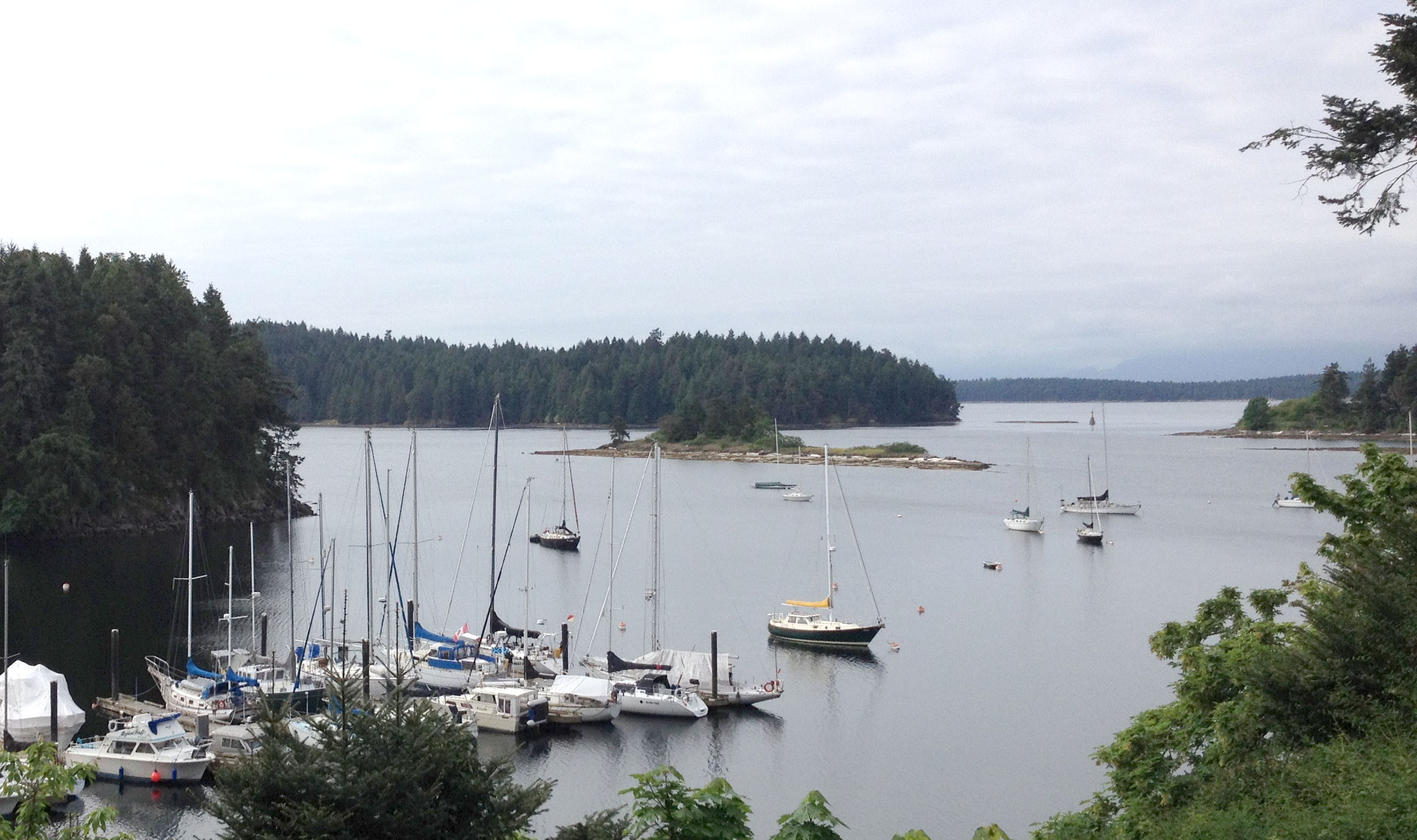
Not much room left in Degnen Bay.

Degnen Bay from the other angle.
For relative beginners like us, another thing that is really irksome is that anchoring in the mix of randomly spaced mooring balls and other anchored boats is hard. A boat on a mooring line doesn’t swing the same way, and with multiple mooring balls in the anchorage, distances that are already tricky (for us) to judge suddenly become a geometrical nightmare. And if the mooring balls are empty or occupied by a dinghy, we have no idea how much swing the owner’s boat will have when (or if—more about that later) it returns.
Funny story. I was caught out in Garden Bay when I went to anchor in our favourite spot off the Royal Van docks. Our spot was occupied by an old aluminum boat tied to what I thought was a mooring buoy. So I grumbled a bit and anchored some distance over with lots of room for the owner of the mooring buoy to tie up a fairly large boat. Half a day later the aluminum boat was ominously closing in on me, and I was starting to doubt my ability to judge distances again. That evening the owner showed up in a slightly larger aluminum and told me that in fact the float marked the end of his (permanent) 150 foot anchor rode and that we were destined to go bump in the night. So we moved.
What this does illustrate —even though it was, in the end, not so much about mooring balls — is that if permanent moorages are made badly or thoughtlessly, they are just plain stupid. We’ve all experienced an anchorage where the first few people in haven’t been overly considerate and a cove that could hold 10 boats now only has room for 4. But that situation resolves itself eventually as people move on. When people are being thoughtless about where they drop their permanent mooring, then an anchorage can be virtually ruined for anyone else on a permanent basis. Not cool.

Mooring ball or anchor? You tell me…
And since the balls are private, they take up the space even when not being used. And I know for a fact that some of these moorings go unused for long periods of time. I even know of a few people who have dropped moorings in places on the off chance they may need them later and have no intention of using them. I suppose some people will go ahead and tie up anyway and move on if the owner comes back, but that’s not really my schtick. Especially if it involves an already-crowded space and the potential of having to relocate in the middle of the night. So all that previously useful communal anchorage space is now taken up by a bunch of seldom-used or unused private balls. Talk about inefficient.
So What’s the Answer?

Sure some of them are park buoys, but those are mostly empty. Except for a few anchored boats, the rest are private ones in one of my favourite anchorages.
Realistically? There isn’t one. Like all Parker Ridge Effect scenarios, growth in popularity and ease of access means the amount of people wanting cheap moorage will continue to grow and transients are, by their very nature, at a disadvantage. The congestion is just going to continue and likely get worse; unless we start spending tons of tax dollars on regulation and enforcement — and frankly, it wouldn’t work any better than posting speed limits prevents speeding. And to be fair, I guess that a lot of cruisers occupy the “tourist” slot and it’s not unreasonable for them to contribute to local economies by paying for their moorage. But we took up cruising to avoid that “tourist” stigma, and I while I enjoy a day at the docks hobnobbing and sampling the local wares, I would much rather swing on my hook in Mark Bay and stare at the lights of Nanaimo, happily self-sufficient. That is, until there’s no more room left for me.
Disclaimer: a lot of the preceding is based on my own personal knowledge and interpretation of the rules governing mooring and I did some background research but make no guarantees about the completeness or accuracy of the facts as I state them.
—Bruce #Cruising