The Pilgrimage to Princess Louisa Inlet

From the very first moment I ever considered boating in the PNW, a journey to Princess Louisa Inlet has been held up as the quintessential, must-do voyage. Every guidebook, every charter company’s trip planner, every boater we met, all talked about the beauty and majesty of that mystical destination. But frankly, after a season or two of visiting some of the “popular” destinations and then getting the chance to explore some destinations off the beaten path, I had almost decided to give Princess Louisa a pass. At the very most, my latest plan was to charter a powerboat and get in and get out so I wouldn’t have to deal with the crowds that are generally associated with the “must do’s” but still be able to say I’d seen it. And yes, I realize I was being a bit cynical.
But as we pulled out of Smuggler Cove, we talked it over and decided that the week before the Victoria Day long weekend was probably our best shot at a quiet visit and the high-water slack at Malibu Rapids was currently somewhere between 5 and 6 p.m. so we could still have a reasonable start for the five- to six-hour trip up the various reaches to Malibu Rapids at the mouth of Princess Louisa. So we decided, what the hell, let’s give Louisa a chance.
We departed Smuggler Cove in a light fog and motored up Agamemnon Channel doing a bit of radar review, and a couple of hours later arrived at Backeddy Resort and Marina outside Egmont. I had given the Bathgate General Store, Resort and Marina located right in Egmont a call as we wanted to pick up some fresh produce there instead of stopping at Madiera Park in Pender Harbour. But the lady on the phone informed me it was too shallow for sailboats although there was some space at the government dock. As we still wanted to top up the water and batteries we opted for Backeddy. Backeddy has strong currents and a lot of bouncing and rolling when the powerboats and tugs go by, but it settles down at night although the $60 tab I could have done without. Safely tied up we lowered the outboard onto the dinghy and took off for Egmont. But our trip was to no avail; the only fresh produce available was potatoes and yams, the former of which we had and the latter not in any way a part of my dietary preferences.
The next morning we cleaned up a bit and cast off around 10 a.m.; at an average of 5.5 knots, it would get us there at around 4 p.m. for the 5:05 slack. I went to the trouble of setting up a route on the chartplotter so we could keep an eye on the ETAs between waypoints as we progressed. This turned out to be some brilliant foresight because at 2400 rpm we started off doing 6.5 knots, well above my estimated average. As the long journey progressed I kept dropping the revs until, on the last legs, we were putting along at a mere 1900 rpm and still maintaining a 5.5 knot SOG (speed over ground).
The journey up the various reaches (Prince of Wales, Princess Royal Reach and Queens Reach) is a different kind of trip than we’ve taken before. There was zero traffic the whole way except for one tug coming out of a logging camp. The legs are long and straight with great visibility and forty-five minutes to an hour between turns. And we saw very little detritus and no logs whatsoever in the water. This meant we could set up the autopilot on each leg to head to the next waypoint and then relax in the beautiful weather and scenery with a slightly less vigilant watch; the alarm (not that we relied on it) would make sure we made our turn. It was a lot like I imagine an offshore watch would be like.
Given the the good speed we were making we spent the last 4 or 5 nautical miles idling along the tiny beaches in the lower part of Queens Reach, and then let out the sails to almost drift in the 5- or 6-knot winds while we waited for the turn. I could see on the AIS that the small cruise ship Safari Queen was waiting on the other side to make the transit. She made a securité call at around 20 minutes to 5 announcing her intentions and then came through. We waited until 10 minutes to 5 before starting our run, making the actual transit about 10 minutes before full slack. We had about a knot of current pushing us, but it was uneventful in the extreme. Once on the other side the mountains seem to close in, and the 5-mile trip to the end of the inlet is breathtaking, surrounded by high cliffs and, at this time of year, dozens and dozens of waterfalls.
At the end of the inlet, four boats were already tied up to the docks, and one was anchored at the base of the falls. Two other followed us in, but that still left plenty of room on the spacious docks. The use of the docks (and five mooring balls behind Macdonald Island) is free but a suggested donation is recommended.
When we visited Newfoundland’s Gros Morne National Park many years ago we had taken a tourist boat trip up Western Brook Pond, the Newfoundlanders’ understated name for a massive fjord. The trip through Princess Louisa was both slightly less, and slightly more, impressive and awe-inspiring. But unlike Gros Morne, the kicker at Princess Louisa is rounding a final corner and seeing the long narrow valley that wraps around Chatterbox Falls, funnelling the water down over 1500 feet to the base where the docks are. This view disappears once you get in close, so be sure to take it slow and savour the multiple cascades from mountain top to sea level as you approach.
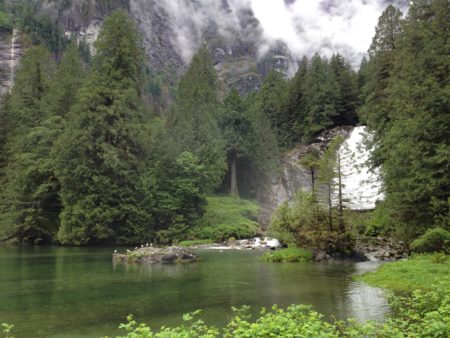
Besides the large UnCruise boat that had left as we arrived, another tourboat — a high-speed zodiac out of Egmont — made several trips in with its visitors bundled up in survival suits. The guide said it was about an hour and a half trip out for them including stops. Each trip he would pause so they could take pictures at the base of the falls and then allow them 30 minutes to explore before bundling them back aboard and zooming off for home. Several other boats came and went during our visit, including a lovely old wooden powerboat built in the 1920s, with a maximum of eight boats on the docks at any given time. I imagine this is very quiet compared to July or August — they have a suggested 72 hour maximum to ensure everyone gets a chance. A few of the other boats stayed for more than two evenings, but one boat arrived on the evening slack and left the next day by noon — that seems like such a waste an experience.
 The first thing that hit us after we had Never for Ever secured to the dock was the taste of the air. The base of the falls is much bigger than we expected, and the moist, cool air produced by the crashing water was loaded with smells and tastes that can most aptly be described as clean and fresh. This sensation occurred again and again during our stay as we would round a corner on a path or poke our heads up from below. It was as if every scent produced by the verdant growth was buoyed up by the dense air and delivered gently to our nostrils. Throughout our stay both Leslie and I would remark on it each time we strayed from our boat.
The second thing we noticed is the sound. The background roar of the falls never leaves. Your voices are a bit louder while you are here, you don’t hear the powerboat running his engines, and you fall asleep to the sound of a “fan” you just can’t shut off. For all its volume, it’s much subtler than the scent of the place. The air hits your senses in waves, coming and going, but the sound is always there, in the background until you notice it at the oddest moments.
When we walked up to the base of the Chatterbox Falls I — having for some strange reason changed from synthetics to cottons — got appropriately drenched by the ever-present mist. Thousands of litres of water are pounding down the mountain side, throwing water in every direction. Between the shadows and the immense amount of water and spray in the air, it’s difficult to get a picture that appropriately captures the grandeur of Chatterbox Falls, but I had fun trying. Later, when the wind came up and blew the mist back against the falls, I did manage to get a few clearer images of the water cascading down the rocks that might, somehow, capture the essence of the experience.
Low tide is also a very interesting time here. The sandbars created by the many outflows of water extend quite a distance beyond the base of the falls and makes for great sand cats and interesting exploring. Swimming here is not advised because of the presence of lions mane jelly fish (and, I imagine, the glacier cold water). Along the docks there were hundreds of jellyfish swimming in the water ranging from a few inches to more than a foot across. We also found many unfortunate ones lying on the rock where they were trapped by the receding tides. We wonder if they can survive their time out of the water, but the dead ones we saw floating later as the tide came back in seems to indicate they can’t. The shore is littered with clam shells, and a myriad collection of basalt and granite stones with a full complement of sizes from the tiniest specks to bowling-ball-size rocks. The action of the outflow tends to group them according to their size so as you explore you find these collections of similar diameter sand, gravel, stones and rocks.

At one point the wind came up in late afternoon and the boat at anchor began to swing. Normally the current from the falls is enough to keep a boat bow towards shore. Waggoners recommends a stern anchor in case of such winds but they obviously didn’t have one. After an hour or two of anchor watch they joined us on the dock, noting that after the second time their anchor dragged they had lost confidence that it was going to hold. And, in the way of such things, the wind died a few minutes after they were safely tied up. Other than that brief spell, the weather remained very calm, albeit cloudy and rainy on the secondhand third day.
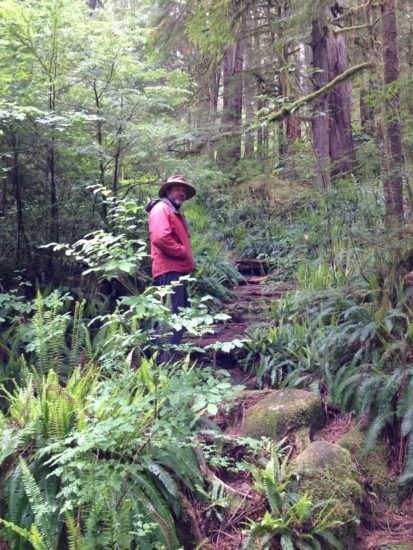

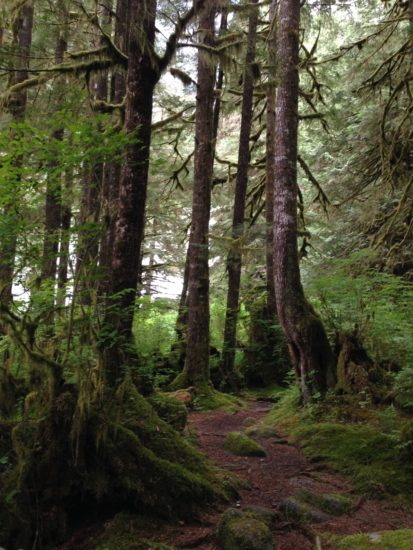
There are few trails here, and some picnic tables and fire pits, with one larger shelter and fire pit built by the Princess Louisa International Society. But other than at low tide, exploring and hiking is pretty much limited to one “arduous” trail with a 500-meter elevation gain up to an old trapper’s cabin. On our short walks we did find lovely displays of Nootka roses that added their scent to the air, Queen Anne’s Lace in bloom, plenty of red and orange salmonberries to feed your inner bear, and lots of tiny wildflowers, including some native bleeding hearts (Dicentra formosa) and silverweed (Potentilla anseria).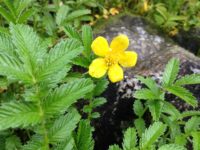 Here and there in the mostly coniferous forest, broad maple trees are covered with moss and the word verdant realizes its true meaning in this moist, healthy ecosystem with lush undergrowth and soaring deciduous and coniferous trees that create a canopy coloured in myriad shades of green.
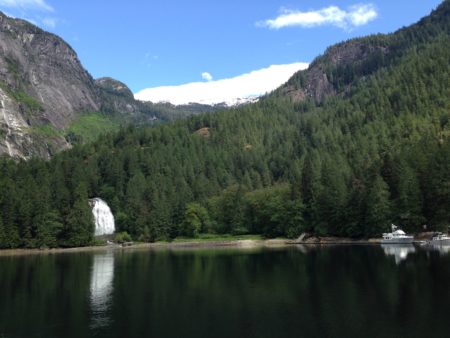
A magnificent place. I can see how it might lose some of its wonder in high season, and the circumstances created by distance and geography certainly lend themselves to the tendency to make it one of those spots where you arrive, take in the splendour and move on. But, as in so much of the beautiful coast of B.C., if you come at a quiet time and take the time to just sit and appreciate, you will find much to keep mind and soul fed for days. We certainly did.
After I wrote this post, but before I posted it, Andy Cross from Yahtzee posted a remarkably similar post. They were entering Malibu as we were leaving. Well worth a read.
—Captain Why #Posts
Instagram This Week


Stern tie Shenanigans
So a couple of nights ago we were stern-tied in Smuggler Cove, only one of three boats. Calm, peaceful and quiet. Then three more boats show up. Then another. Then a south wind starts to blow right on the beam and three more show up. And all of them attempt to tie up south of us.

At one point we had the cove pretty much to ourselves
We had left Nanaimo behind a couple of days earlier and crossed the Strait. We managed to sail for about an hour before the winds died down, then motored the rest of the way. Unusual for this time of year, the winds were coming from the north and showed no sign of change for at least five or six days. We spent a night at Secret Cove Marina to top up the water and batteries and enjoyed a half-price pre-season discount. The next morning we did the short motor to Smuggler Cove to relax and start settling into cruising mode.
I deliberately tied up on the north end of the cove as last time we were here it was also a north wind and I, and everyone trying to tie up, had been blown south, which made it difficult to stern tie upwind of another boat. Well, best-laid plans and all that — it didn’t work out so well.
The first three boats in tied up at the far south end of the first cove, well away from us. The next boat in, a Hunter from a charter company, thankfully also attempted a ring well away us, but later gave up and moved because they couldn’t get their anchor to hold (they eventually moved again and may even have left, but I was too busy to notice).
They were replaced by the first of two boats that came in at the same time. The skipper bravely tried to keep control of the stern but eventually the boat swung in a 360° circle and managed to wrap the as-yet-untied stern line around the boat. They got it straightened out, but the poor fellow with shore duty somehow set off his inflatable and was fighting the wind, the dinghy painter and the stern line with this big yellow doughnut around his neck. Eventually they did get tied up, but their anchor started to drag and their stern crept precariously close to the shore. They eventually gave up, raised the anchor and left altogether. I noticed they left their line behind — although they were back bright and early the next morning to retrieve it — so I am not sure what prompted the exit.
But I barely noticed any of this at the time. Because, and please forgive my hyperbolic judgementalism, the “sailors without a plan” had arrived at the same time and proceeded to keep me distracted for the next hour. It was obvious from the beginning they had no plan, very little clue and an old, cantankerous boat with a helmsman who, as far as I could tell, was so decrepit, he didn’t stand up once throughout the whole debacle.
They initially dropped their anchor in the middle of the cove and looked like they were going to tie up off our bow, nose into the wind, 90° to us, alongside a lovely Bayfield ketch. They did drop their anchor a bit far out for that, though. I remember saying to Leslie, “I wonder what their plan is?” Plan… Ha!
They launched their dinghy with an engine that wouldn’t start and only one oar. The fellow in the dinghy had instructions, but obviously was not an experienced cruiser so really didn’t know what was going on. The skipper of the ketch was out on his deck giving him advice and, it turns out, offering to take the stern line while they got things straightened out. That was the first time of many that I thought I might go help. He eventually made it to shore. But now for some reason, he (or they) gave up on that idea.
Meanwhile their boat is not anchored well and is threatening my neighbour’s bow as the helmsman fails to gain any stability in the situation and the boat is running back and forth over the anchor. At this point I am still fairly sympathetic, as I have done much worse and provided even more hilarious entertainment. Still, a banged-up old boat with literally shredded sails and three aged crew — the sole seemingly competent person was a woman who wasn’t doing any of the jobs requiring competence — doesn’t leave me with high hopes for success.
Someone decides to shift tactics and the dingy heads to the rings just upwind of us. They had a reel of 1000-plus feet of stern line, so the fellow in the dinghy was able to put out a lot of line, leaving most of it floating in swirls off our bow. Now I’m starting to get a bit concerned as their plan would swing their boat from being nose into the wind to beam on, immediately upwind of us. I know from experience that this is not an easy task in calm water and virtually impossible in any sort of wind without a lot of muscling, and the boat did not look like it backed up well. Still, I remain hopeful and we continue to keep an eye on them, tempted once again to go lend a hand.
There they are with hundreds of feet of line in the water, the boat motoring back and forth over its anchor and the fellow in the dinghy looking lost on shore until I point out two nearest rings. Of course he chooses the one 20 feet from ours rather than the one further away. Of course he does. He crawls up on the rock and loops his line through the ring, then hops back into the dinghy. Then he discovers his line is tangled around the ring. I grab my jacket. And the boat on the other end of the line starts to do weird circles. I put my shoes on. And his outboard wouldn’t start again. That’s when I hop in our dinghy, fire up the outboard and make a beeline for shore. While he gets his engine restarted, I quickly untangle his line and start to feed it through the ring and he heads back to the boat.
Well, that’s when we find out, unbeknownst to dinghy dude and me, that the crew on the boat have pulled up the fricking anchor. So they are motoring around dragging hundreds of feet of floating line while loosely tied to the shore. Just upwind of us. In 15-knot bloody winds!
They circle around to drop their anchor again, but this time 40 or so feet south of our bow. We have 80 feet of rode out so the fact that they are dropping the anchor just in front of us makes me very nervous for what the night will hold. Silly me. As soon as they get the anchor down and let out a little scope, they start drifting right into us. By now I am back in the dinghy and rush over and get between the boats while they drop one — yes, one — fender. Of course they drop it to the waterline where it won’t do any good, and of course the loose line is more likely to foul one of the dinghy props. The fellow in the dinghy follows my example and gets between the two sterns while I position myself just forward of the beams. I tell Leslie to start our engine. Just in case.
So there we are, beam to beam, separated by two dinghies holding the boats apart and the full weight of both boats on my anchor and my stern line. That’s when the person at their wheel decides to drive straight ahead. Which, at the angle we are now at, would be straight over my anchor rode and would likely knock my anchor loose as well. A little firm talk convinces him otherwise, but suddenly he’s taking direction from me, the guy stuck in a dinghy between two boats, rather than paying attention to what the hell is going on. Bugger.
By walking their bow off our boat, we get them fended off and pointed almost upwind, and they start to pull the anchor and move off. And then drop the bloody thing only 10 feet further on, and we do the whole bloody thing again. Seriously. Almost an exact repeat, but this time their stern is farther back and they almost take out our stern line. Once again, I’m stuck being a human fender between the two boats, and we manage to fend them off. Then we did it ONE MORE TIME. Seriously seriously. They did it again, and this time neither of us got the dinghies in between in time and they actually scraped the sides of the boats together (no damage, thankfully — I believe it was rub rail to lifelines).
I have no friggin’ clue what their “plan” was. Plan… Ha! I have no idea what they thought was going to happen. Or if any of them were even thinking by this point.
I wedge the dinghy back in between again and finally manage to get my dinghy bow to their beam and give it some throttle. Doing this, I could now push them away and keep them away while they tried to pull in the copious amounts of stern line floating around.
Oh, and I left out the part where loops of the stern line they had retrieved started to tighten, catch on loose objects in their cockpit and fling objects around the still-seated helmsman. It was one of those moments where you are suspended between fear and hope something bad would happen to him. Luckily for my future peace of mind, fear won out and I desperately wished he wouldn’t lose an eye in the chaos. I also remember almost screaming at the woman reeling in the line as she got her fingers wrapped in it as it started to tighten on their winch. It’s amazing how much gibbering the back of your mind can do while you are concentrating on the job at hand.
Eventually they get the line in and between their winch and me pushing their boat, they get the stern over. The situation settled out with a too-tight stern line, too little rode and boats way too close for comfort on a tide rising another 10 feet. But they were happy; someone even quipped that it hadn’t been as bad a stern tie as some Navy captain had once done. Me? Not so happy and not so confident that we were done with the drama.
Actually, I kept waiting for them to catch their breath and leave; or at least try again (somewhere else) with everything a bit more secure. But nope. They were definitely there for the night.
So we ate dinner (in the cockpit), played some cards (in the cockpit) and watched the sun slowly set (in the cockpit). I eventually decided to tie the dinghy alongside as a fender for when their anchor dragged and they swung their bow into us in the middle of the night. And we confirmed a plan B for loosing our stern line if we should need to escape from their dragging anchor. Then we retired below and listened to the winds climb. I checked again at midnight, right around high tide, and all was still well. Although they had no anchor light showing…sigh.
Elsewhere in the cove one of the first three boats that had looked to be decently anchored further down also must have dragged. It was a 45-foot, almost new charter boat that had a full crew and a speedy little dinghy that had been zipping back and forth. So they tried, sensibly, to tie up beside the Bayfield, nose into the wind, but then abandoned the attempt. I found out the next day they gave the boat too much throttle and pulled their own anchor. So they also, again sensibly, abandoned Smuggler Cove and joined what must have been a growing party at Secret Cove Marina.
Oh — I left out the guy anchoring later in the evening, dropping his anchor just off the neighbouring ketch’s bow with around a 2:1 scope and a gale forecast. There were some words between the two boats until he finally moved. Unfortunately his new spot was closer to us and our uncomfortable neighbours, still with a small scope and still no stern tie. But all the fight was out of me by then.
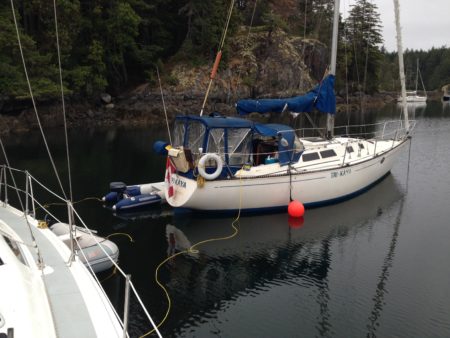
The morning after.
Well, in the morning I woke up to calm winds and the sight of our pestiferous neighbour’s stern floating serenely 5 feet off our dinghy with lovely little coils of thin yellow line floating alongside. Seems the wind had sawn through their patently insufficient stern line (it looked maybe 3/8″ poly but sure as hell was not 1/2 or 3/4 inch that every other bloody boat I’ve ever been on had — and yes I was, at this point, completely out of patience). Anyway, their line had parted and they had swung stern into us. Thank god their anchor held. Still, I imagine when the line parted and the winds were up, they must have been bouncing off our dinghy.
So I waited with my coffee. My old professor used to say “comedy is excess.” This was bloody hilarious. Eventually around 9 a.m. they poked their heads up. Their heater had been on for an hour but no one had thought to check on their precarious anchor and pathetic line.
“Oh,” she said. “At least we didn’t touch.”
“Oh,” I replied, “I think we probably did.”
“Ah,” she said. “Good thing you put the dinghy there.”
“Yes.”
“Well, I think we’ll move the boat and just anchor in the middle while we get ready to go.”
“Ah. Well, then. Good luck,” I rejoined.
So they moved out to where they had dropped anchor the first time, and just swung for a couple of hours. At least there was no wind. It turns out they were part of the larger group of six boats, two of which were the ones who had bailed the day before. I wish these guys had have been that sensible.
The fellow and his wife from the Bayfield ketch that was initially threatened by the shenanigans came by to say he had videos of the whole thing. We watched one later, relived the whole thing, had a beer, toured his boat and made a new friend.
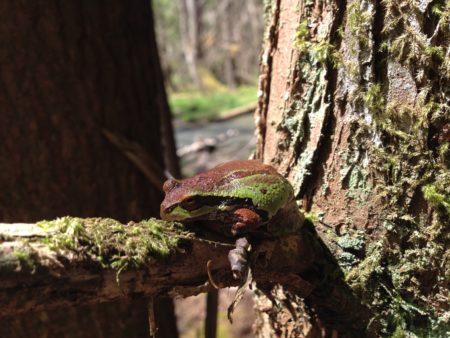
Leslie spotted this little guy on one of our hikes.
Other than that, it was an uneventful visit.
I will post the video later if I can…
—Captain Why #Posts
Instagram This Week


Good Turns…
 Thursday’s Child has far to go…
Thursday’s Child is a almost new Hunter 33 we first encountered at the Hunter Rendezvous last year. This year she is anchored off our stern in Protection Bay in Nanaimo’s harbour. What’s notable about her is not evident in the above picture.
This morning I was enjoying the almost noon sun in our cockpit when I glanced up and saw a dinghy floating off the shoals at the entrance to Newcastle Island Passage. At second glance I noticed that there was no one in said dinghy. It occurred to me it might be tied off to a float or anchored, but as I watched it really did look like it was drifting. So I hopped in Laughing Baby and putted off to check. As I circled it, it appeared it did have a line in the water but on closer inspection I determined that line was not attached to anything. A quick glance revealed no overt identification although there was a bag with a towel. I grabbed the submerged line and started slowly back to Never for Ever, scanning the shore and the docks for anyone frantically waving.
Back at our boat I had a closer look, but there didn’t seem to be anything that indicated the owners other than a dog’s life jacket and the aforementioned bag with woman’s shower gear. So L cast me off again as we had decided I would head for the docks as the first likely place to ask around. As I circled the boat, I noticed Thursday’s Child was sans dinghy and thought I would hail her on the way by, just in case. Sure enough the owner popped up with a confused look on her face wondering what I was doing with her dinghy. She was obviously relieved as there is nothing quite so unnerving as being stuck on a boat with no way to get to shore. Since she was in the midst of an important call, we tied off the boat, exchanged names and thanks and I zoomed back home. All’s well that ends well.
Low Tide and The Last Few Days

For what it’s worth, our itinerary, since leaving Victoria for good, has been Montague Harbour, Wallace Island and Nanaimo. And the supposedly steady south winds have been determinedly north—right on the nose the whole way. We did manage an hour or two of beating int 20 knot winds while waiting for slack at Dodds Narrows.
The last few days have had some extraordinary low tides, all less than a foot of datum. So we decided, obviously, to spend them in the shallowest cove around: Conover Cove on Wallace Island. We had attempted to visit numerous times before but the small cove has always previously been filled to capacity. We pulled in just after low tide and as soon as we hit the bar we hit 0′ on the depth meter. Now I have my meter set for 6′ below the zero mark which gives me about a 2.5 foot buffer. Usually I am glad for that, but in this particular case it was unnerving to not actually know my real depth. We set up to stern tie in a fairly strong NW wind and managed to do a great job of it; except for one small thing. We had initially set the anchor stern into the wind, parallel to the shore. This allowed me to row ashore and get a line tied off without the stern swinging downwind and me having to wrestle it back like int previous attempts. What I failed to account for in my brilliant plan was that this meant the anchor would have to swing almost 180° to reset in the strong wind hitting us on the beam and that my scope didn’t really take into account the actual distance from the shore. As it was we did successfully tie up with a strong wind hitting us on the beam, the stern sitting in 5.5′ of water (I measured), 35′ of chain out and an anchor that I wasn’t 100% had reset. And the tide tomorrow was going to be about .3 of foot lower.
So I hummed, hawed, dithered and rowed to the dock to see if there was space, and then decided to move the boat tot he dock. And there we sat for 3 days. And every day around noon, the three or so sailboat skippers would start peering into the water below their keels. No one actually touched bottom but Private Passage, the Hunter Vision 36, figured they had scant inches left on one particular afternoon.
The other effect of the low low tides (and high high as well—one day there was a difference of over 14 feet), was that the bar I had blithely motored across to enter Conover Cove caught two less lucky sailors out. The first motored slowly into the sandier center bit and got hung up for 4 or 5 minutes before backing out and heading for deeper waters. The second, a lovely custom Ted Brewer, hit the rocky portion on the north side of the entrance with a resounding clang and hung up. Luckily the tide was still rising. Unluckily the tide was still rising and a strong current kept pushing the stern closer to shore. After a tense 10 minutes or so, she finally floated off and cleared the rocky shore line with room to spare. Undaunted by his miscalculation the skipper brought her around through the center of the entrance and joined us on the dock a few minutes later none the worse for wear.
I also learned another helpful tidbit about naming boats. I gave them a call on the VHF to see if they needed anything but they didn’t answer. Who did answer after my second call was Victoria Coast Guard. Seems that Judith Anne sounds a bit too close to Pan Pan and they wanted to clarify my enunciation. I guess that takes HeyDay off the list of potential boat names.

We added our bit to the old shack on Wallace Island that has tons of carved signs and mementos.
 The upside of low low tides is it did afford us some great beachcombing and a fascinating hour of floating in the sandy shallows watching the fingerlings, baby crabs and burbling clams, and a fun afternoon checking out the exposed rocks. We spotted some starfish (so happy to see them making a comeback) and what I believe were sea cucumbers (above) as well as the requisite clams, oysters, mussels and of course barnacles. The cove itself was filled with birds, from swallows and hummingbirds to a pair of vultures and we were entertained by both osprey and Bald Eagles fishing.
I do have to say though, as nice as Wallace Island is, I think I prefer Portland. More nature, less people and somehow more serene.
We are in Nanaimo for a few days doing some errands and then plan on heading up the Sunshine Coast to Desolation Sound. Still waiting for those south winds though.
—Captain Why #Posts
Instagram This Week


Sailing our Hunter 386

When I was buying Never for Ever I noticed a distinct dearth of online info about Hunter 386s. They were only made for two years and, while very similar to the previous two models —the 380 and the 376— I nevertheless thought there would be more information. But it seems Hunter owners are not the most gregarious bunch. When we visited the Victoria Boat Show a couple of days ago, it gave me some different design choices to compare to, so here is my contribution to the canon of the Hunter 386; hopefully someone, somewhere, will find it useful.
Let’s start with a little pro and con or, more appropriately, what I like and dislike. Keep in mind we bought our boat to live aboard full time for 8 to 12 months, but I have to say I would probably make the same ratings even if it was a part-time cruiser. We haven’t sailed a lot of other boats, but this is based on the ones we have and the ones we’ve toured at boat shows.
Positives
- Aft berth: big doesn’t even begin to describe it. And tons of storage…
- Rails over companionway: there are two convenient and useful grab rails at the top of the companion way, something I noticed that was not there in a lot of the newer boats we toured
- Hatch over shower: it allows the moisture out and our solar showers in, so we can use the space for its intended purpose when at anchor
- Solid shower lid: I had originally wanted a completely separate shower but the 386 has a solid fiberglass lid that covers the head 100%. Five or six swipes with a squeegee and the head is good to use again without having to do any extra wiping down
- Shower sump: no switch to pump out the shower as it (and the fridge) drains into a sump with a float switch
- Slot for hatch boards: the 386 has a nice slot on the companionway wall to store the hatchboards. Finding a place to stow them was something that irritated me on other boats we sailed.
- Easy access to engine: there is easy access to 3 sides of the engine. It does lose points because the impeller is on the one side that has no access.
- Storage: we haven’t been able to fill all the interior storage even after 10 months aboard.
- Galley arrangement: there is a good balance of counter and appliances. And the L-shape makes preparing food pretty convenient. Not perfect but better than most boats I have cooked on.
- Bridge deck: originally I thought I wouldn’t like the step up to the companionway from the cockpit, but we soon learned to love it as a continuation of the cockpit seating and a great place to wedge yourself in and relax underway
- Tankage: A weeks worth of water even at our most wasteful settings and pretty much the same for the holding tank. I suppose more would be better, but it hit the right spot for us
- Wet locker: I suppose all boats have one, but ours is right by the shower so that makes dealing with wet gear super convenient
- Walk through transom and transom itself: easy to use and the transom has enough flat spaces that it makes dealing with the outboard and embarking and disembarking the dinghy pretty darn easy
- Light and lights: tons of natural light and about a zillion lights inside. I suppose this is actually a negative when it comes to replacing them with LEDs but we’ve managed so far to get a way with just replacing one or two in each space.
Negatives
- Little locker space in the cockpit: my biggest beef, although a pretty petty one. We have fenders dangling from everywhere
- Large center binnacle (small cockpit tables): Again, for two of us it’s not a big deal but socializing is constrained by the big pedestal in the center of the cockpit
- Salon table: Stupid. Dumb. Idiotic. Need I go on? It is a bit too high for comfort and about an inch and a half too big on each side. Sliding in and out of the bench seats is an exercise in yoga and you are going to bang you knees on the leaf; there is no avoiding it. When time and money permit I will be cutting it down
- Wave slap under stern: I haven’t encountered this on other boats but when you are tied up stern into the waves, even small ripples will slap up under the transom (right where your head is) and drive you crazy until you get used to it
- Aft cleats: The aft cleats are right behind the arch making reaching below the rails a bit of a pain and bringing the lines forward even more so. And if you have canvas, well…
- Small v-berth: The room gained in the aft cabin is lost in the v-berth. But we slept up there for a week and it’s not impossible; it just doesn’t hold a candle to other v-berths we’ve been in
- V-berth vanity: why? I suppose it’s nice to wash your face before you emerge for the day but the space could be used better
- Light switch positions: while there are tons of lights, some of them are in odd places. The worst are the reading lights in the aft cabin; you have to get out of bed and reach up to turn them off. We bought an LED reading light that also runs off AAs. Best thing we added
- Anchor locker and chain: the chain piles up and binds. I know this is common, but I really hate the idea of continually reaching down to pile chain when raising the anchor. It wouldn’t take much to adjust the design
- Better shower drain: while I love the shower sump, the drain hose needs to be a bit bigger and the sump should be a bit lower so drainage is improved
- Crowded aft rails: another common issue but just a foot more rail on the aft end would make it a bit less crowded after all the requisite toys are mounted
- The arch: the arch over the cockpit is great but it means that any enclosure has to accommodate it. As a result, water pools and then seeps around the arch to drip on the seats; a common issue, I hear, with poorly designed bimini’s on Hunters
Not Sure
- Jib winches on deckhouse: I am still of two minds about this. With the autotack feature of the autopilot I can come out from behind the wheel and help tack or even single hand, but having winches on the sides of the cockpit would make it a whole lot easier
- Big freezer: it’s a huge freezer. With two levels. But it’s a huge power suck. And the bottom level is inaccessible without emptying the upper level first. Right now we maintain a steady love/hate relationship
Add Ons: My 386
- Webasto Hydronic Heater: other than sounding like 747 taxiing right below our heads when I fire it up on cool mornings, the Webasto has worked out well. It doesn’t use too much battery and it heats the boat up pretty efficiently. I do think having one of the fan units split between the front cabin and the salon is a mistake, but that’s something we can rectify
- Full Cockpit cushions: bonus!
- Dodger height: perfect for me so I don’t have to crouch or stand on my tippytoes.
- Nova lift for outboard: with an 8 horse, 4-stroke on the aft rail, the lift is perfect for the two of us. And it set up to use one of the cabin-top winches so the weight is no issue
- Remote for Auto pilot: we “broke” the remote last fall and have been sailing without it and I hadn’t realized how much I enjoyed it when I had it. It makes dodging crabpots and floating logs so much easier as I can remained perched on the side or even be up on the bow. I was overjoyed to find the wire a tech had knocked loose last year
- Enclosure: we have a “full” enclosure. I hate the design of the side panels that allow access from the sides as they are too far forward and make getting in and out hard without removing them entirely. The PO also chose to use mesh on the aft side panels instead of solid clear material. Not solid enough to prevent bugs from coming in and useless at keeping rain out. At best they provide air flow and shade
On the water
The Hunter 386 sails pretty well. I admit to having a bigger learning curve than I thought I would learning to reef her and getting the wheel balanced in winds over 15 knots. The first reef really should go in around 12 or 13 knots but we usually tough it out until we have a steady 15. The shoal keel doesn’t do us any favours but I will admit to a predisposition to trying to point too high in general so it’s not really a negative. And with the huge main, she sails fantastic in light winds. I have nothing to say about the B&R rig. The huge main took a little adjustment but our downwind sailing has been limited and I never really expect to go fast dead down wind anyway.

She manoeuvres well in close quarters, and docking has been a breeze except for those times I have managed screw it up. I’m not sure if it’s the Campbell Sailer prop, but prop walk is hardly noticeable, making backing up pretty easy as well.
All the lines and controls are well situated and, other than the aforementioned aft cleats, we have little or no issue with any aspects of handling her. There is room to get out from behind the wheel without crawling over the seats and the big binnacle at least affords lots of places to brace yourself when you are heeling. The lifeline gates are almost on the beam so are perfect for boarding and docking when you are not lucky enough to get a stern-in berth.
The 40 HP Yanmar is powerful enough for push her along at 7+ knots when there is no current and our cruising rpms of 2400 she does a steady 5.5 to 6 knots with fuel consumption of about .7 or .8 gallons (2 litres or so) an hour.
My Conclusion
I’m not sure if the Hunter 386 is my forever perfect boat but she has been perfect for us for out liveaboard year and I intend to enjoy her for at least a few more years herein the PNW.
—Captain Why #Equipment, #Posts
Instagram This Week


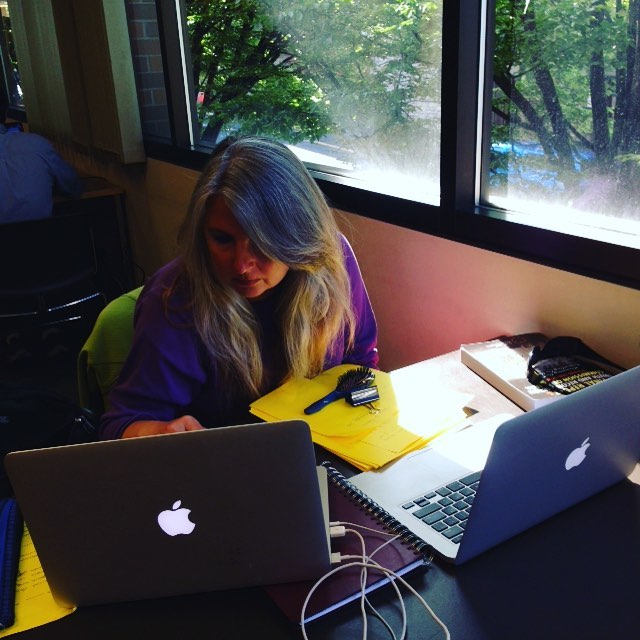


Guests Aboard: A Week with Parents

Welcome guests for a few days cruising.
We slipped our lines on Tuesday and motored out of the harbour on our way to Sidney. I needed an oil change and wanted to get someone to look at my stuffing box, so I had booked Vector Yacht Services in Tsehum for 8 a.m. Wednesday morning. Also my parents were flying into Sidney for a week on Wednesday evening, so it looked like it would all work out. We timed our departure to hit Enterprise around slack and planned to ride the flood all the way to Sidney. Luckily the bizarre currents off Victoria were in our favour and we got an almost 2 knot push all the way to Trial Island as well. If we were staying in the area I would definitely be buying a Current Atlas so these things wouldn’t be such a surprise. But, as a result, we cut almost an hour off our estimated time. The wind, as usual, was on the nose the whole way.
We had a nice stern-in berth waiting for us at Sidney and since they are still on winter rates the price was right. As soon as we were tied up and settled, we grabbed the grocery cart and backpacks and headed off to the convenient Fairway Market to provision. This was really our first taste of having guests aboard because after having the boat to ourselves for almost 10 months we had to consider other people’s tastes and of course work out portion sizes. My parents — both circling around the 70 mark (although mom was a bit of a cradle robber) — were going to be here for around a week and —weather dependent — we might be away from dock the whole time. So we had to consider both amount and tastes when getting perishables like milk, bread and greens and had to double up on meat portions and other produce. The corollary to this of course, is that our finely-tuned storage methodology was thrown out the door and we had to start stuffing things in a bit willy nilly. It’s amazing how much an extra litre of milk or loaf of bread can change how you usually stow things in the fridge or freezer, to say nothing of where you put all that extra beer.

Sunrise on Haro Strait
The next morning we were up early and had cast off by 7:30 to make the 2 or 3 nm trip over to Tsehum. The entrance to Vector’s docks is buried in amongst the public wharfs and boat houses and we gave up searching eventually and phoned in for directions. Then we had to back into a tiny slip around a 100° corner, but there were plenty of hands on the dock to make sure I didn’t screw up. For the next hour or so I watched the pro’s change my oil and oil filters and install the two new fuel filters I already had. It came to a grand total of $200 and change including tax; a bit more than I wanted to pay but it was good to watch someone change the racor (fuel filter) as there was a bit of a trick to handling the gravity feed. And it saved me buying the tools. Then we cast off and were tied up back in Sidney a little after 10 a.m.

Crowded, but great service at Vector Yacht Services
I had been delaying laundry since I knew Sidney had great facilities with lots of machines so that was the next chore. We did all the blankets, sheets and towels as well as our regular accumulation of clothes. Sidney is also only $2.50/load which saves us $.50/load over our Wharf Street facilities. However the machines wouldn’t take twoonies so that rendered my loonie/twoonie stash useless and we had to buy a bunch more loonies and quarters to get all five loads done. The marina office is great and was able to provide all our cash changing needs.
The next chore was to rearrange the boat to accommodate two more people. We decided we would move into the “garage” (v-berth) and give up the aft cabin for our guests. In addition, we would have to raise the salon table to eat on thus giving up our “lounge” with it’s blankets and pillows. What this means is that even without worrying about the additional bodies and their gear, we had a lot of rearranging to do to find stowage for cushions, pillows, charts and sundry gear that normally was just stored in the v-berth. Then we had to clear out shelf and locker space so they would have a place to unpack and find room for our stuff in the smaller forward cabin. But a couple of hours of rearranging resulted in something that was serviceable and sailable, albeit a bit cluttered looking.
Then we wandered beautiful Sidney by the Sea, enjoy the warm day before grabbing a bus to meet my parents at the airport. After all the arrival greetings and rituals, we grabbed a cab back to the marina and started to settle them in. First up was my orientation and safety lecture. I had been working on a check list for guests, so this was my first opportunity to try it out. All in all I think it went pretty well — at least everyone stayed safe and the visit was relatively drama-free. Dinner was bbq’d burgers, beer and great company. The weather has turned so we are back to eating in the cockpit. Later I baked raison bread for breakfast and then we chatted for the rest of the evening. I grabbed a late-evening shower before we all hit the sack.

And we’re off
The weather look like it would hold to Sunday so we cast off the next morning for Butchart Gardens after topping up the water tanks. The wind was negligible so we motored most of the way around the top of Saanich Peninsula. Along the way my dad screwed with my Garmin fish finder — which I had never used —and we spotted a few fish, which gave us some hope for later. Soon enough we pulled into the small inlet across from Butchart and started for their free mooring balls. I noticed that most of the dock was roped off with plastic yellow tape but didn’t give it much thought. So we grabbed a mooring ball and my dad and I rowed ashore to set the stern line; having a coxswain sure makes that exercise easier. But about 2 minutes after we had got back from securing the stern tie, someone hailed us from the dock and told us the back entrance was closed and we would have to either go over to Brentwood Bay and take the bus or around to Tod Inlet and hike in. Disappointed that the famous “back door” was closed, we lowered the motor onto Laughing Baby and then gently loaded our passengers before taking off. With a full load of 4 passengers the trip was neither quick nor dry, but we made it down to the park docks with little drama.

The docks in Tod Inlet — a 10 minute walk from Butchart’s front gates
Butchart was stunning as always and the tulip beds were pretty phenomenal considering the ones in Victoria were almost gone. When we were entering, I checked in at the info booth and it turns out there was some question about whether or not they would let us stay at their mooring buoys, but eventually after passing the buck a few times, someone ok’d us to spend the night. We wandered the gardens for a few hours before heading back to the boat.


Back on board, dad set up the fishing gear he had brought along and mooched (?) off the bow while the rest of us relaxed. I made some more bread for dinner and did a small pork roast in the oven. It was a quiet and calm evening except for the Canada geese and we relaxed and visited in the fading sun before calling it a day.

No fish, but then, that’s not the point, is it?
Moving on
The next morning was coffee on deck (perk’d for the special guests) and general relaxing. Eventually everyone was up and around, so it was time to cast off. We decided to make use of all the extra crew, so I put my mom at the wheel while I cast off the stern line and my dad and Leslie took on slipping the bow line. Mom manoeuvred us around the mooring balls and took us out of the bay, and we headed up the inlet for Portland Island.

Taking us out of the cove.
The winds were about 6 to 7 knots on the nose but we decided to sail anyway since we had all day. And since we were only making about 3 knots, my dad broke out the fishing gear, while my mom tacked us back and forth for an hour or so. Eventually we decided we weren’t making enough way ( I think we were going mostly sideways) so we furled the jib and started motor-sailing towards Patricia Bay — but we kept the revs down and continued to troll as we slowly made our way north towards Satellite Channel.

Competent crew at the helm while under sail.

Trolling in Saanich Inlet.
Despite the presence of three or four other boats trolling we didn’t even get a nibble and, as we we turned east at the top of the peninsula, the winds started to climb. So we hauled in the fishing gear, killed the engine and started to sail towards the north side of Portland Island, our destination. The winds quickly climbed to 12–15 knots and we were racing along close hauled for a while, but after about 3 or 4 tacks the slightly alarmed look on my mom’s face convinced me that heeling just wasn’t her thing. So we turned into the wind, furled the sails and motored the last 15 minutes to Royal Cove.
 Stern tying again, we dropped anchor this time and Leslie was thrilled with our newly renewed chain markings. Once again the extra crew made the whole process easier and more stress-free; turns out an extra set of hands is a good thing. The winds were out of the north and it would turn out to be our bumpiest stay in Royal Cove ever. But it was never that bad and it gave my parents an opportunity to experience a little boat rocking. We settled in and decided on a small hike. So we loaded up the dinghy and rowed over to the dock to hike out to Arbutus Point. Turns out that loading 4 people in a dingy off the transom is not the easiest operation and it took some shuffling to keep everything balanced.
 After a 10 minute hike, we spent an hour or two exploring the midden beaches and shoals in a flood tide, spotted some ducks, otters, and anemones and generally soaked in the atmosphere. The point was also populated by tons of kayakers enjoying the spring weather. On the way out and back we saw plenty of new wildflowers but unfortunately none of my pictures turned out.

That evening we enjoy another lovely sunset while I cooked up some baked pasta. Later we retired below and broke out the crib board and played a few hands of fourhanded crib — it didn’t go well for one of the teams.
Weather forecasting
We had intended to spend the day on Portland and either head home late in the day Saturday or perhaps see if the weather window would stretch to Sunday. But Sunday’s forecast never improved and it started to look like the winds Saturday afternoon were swinging south and were going to be higher than predicted. Since I wasn’t sure about the sea legs of our guests and really didn’t want to have to fight the winds all the way, we decided to catch the last of the morning ebb tide and head back to Victoria. Before we cast off, I took the leftover red spray paint from marking our anchor rode ashore and sprayed the 5 metal stern-tie rings that are permanently embedded in the rocks. Hopefully that will make finding them easier for others.
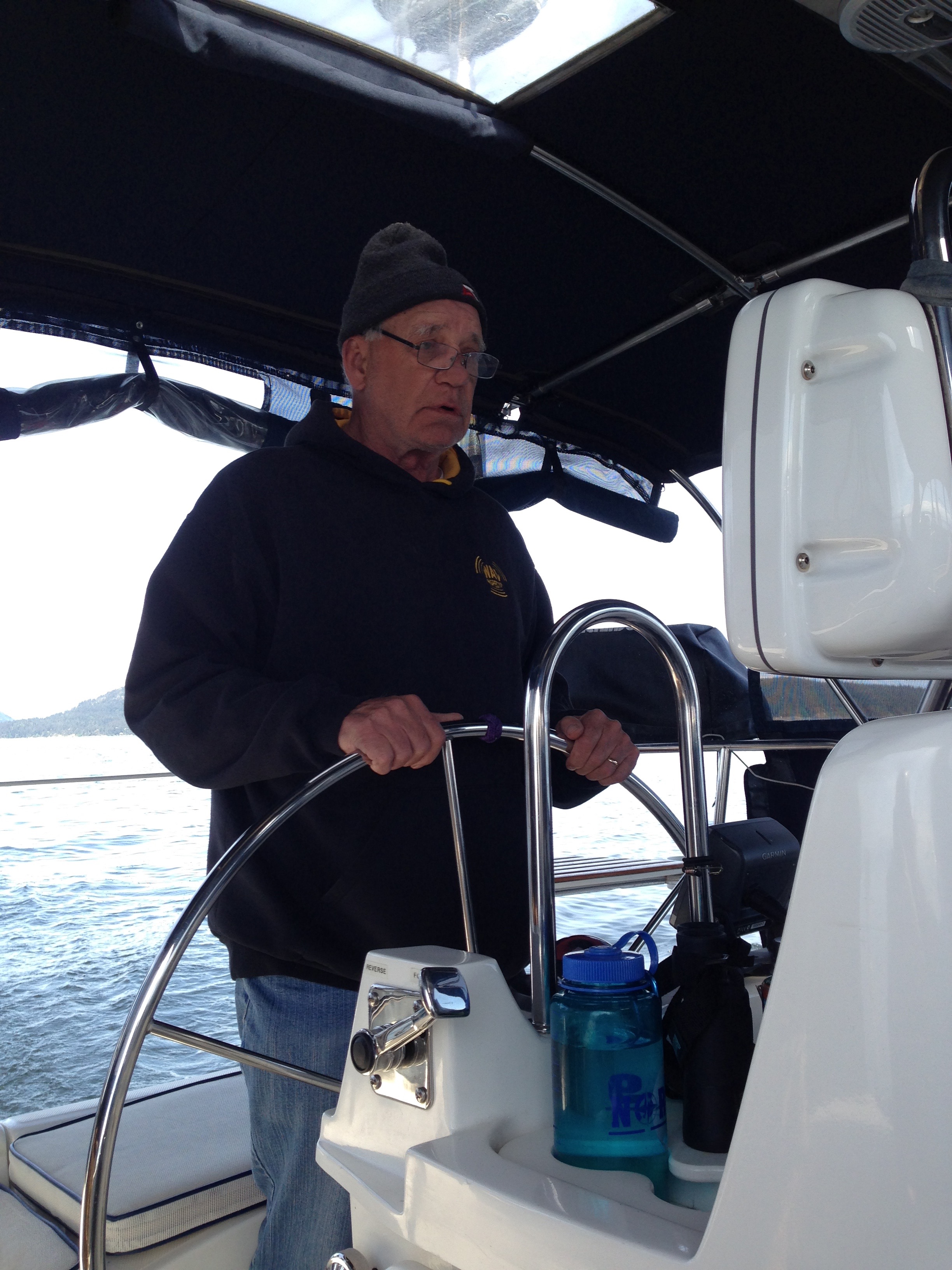 Once again all hands on deck made casting off a breeze and my dad motored us out of the cove and around the east end of Portland, while Leslie and I joined my mom on the foredeck to enjoy the sunshine and views. But as soon as we turned south the wind came up and it got a bit too cold for sunbathing so we carefully made our way back down the side decks and cosy’d up under the enclosure.
I decided to grab a shower since the engine was running and left Leslie and my dad to navigate us among the islands and rocks off Sidney. At one point the current was so strong we hit 9 knots over ground. After that we figured it was just a few hours of motoring south. But unfortunately the forecast was wrong and the winds picked up to 15 knots or so almost immediately and, of course, were right on the nose. The wind over current meant the waves were pretty short and steep and it turned out to be a bouncy few hours with some spectacular spray over the bow. But everyone seemed to have the right constitutions for sailing and it turned out it was a fairly enjoyable passage despite the bumpiness.
 As we approached Baynes Channel and Cardboro Point we noticed about 10 or 15 sailboats headed towards us with spinnakers flying. It seems we were about to motor straight into a regatta or race out of Cadboro Bay. It looked like they were using the V29 lateral buoy off Johnstone reef as their turn point and sure enough, just as we passed it, three boats doused their spinnakers and came racing around the marker pretty much on a collision course with us. I really had no idea what the etiquette was in these situations other than the knowledge they had the right of way — and that I didn’t want to ruin anyone’s race. So I went hard to starboard and pointed at the stern of the last of three boats and watched them cross my bow meters away. Then we turned back onto our original course and dodged the oncoming boats that hadn’t made the turn yet. One of the original three decided to short tack and they came screaming back across our stern, the sides covered in rail meat (crewmembers whose job is primarily to be portable ballast). They tacked back and forth generally on our course off our stern and as they turned into Baynes channel they weren’t that far behind us. Just goes to show sailing in good wind can be faster than motoring. I altered course one more time in Baynes Channel to allow the other two boats who were again on a collision course to slip through ahead of us.
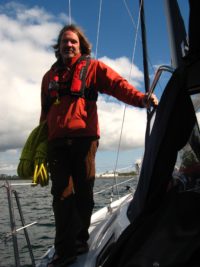
 The current was against us the rest of the way in and was running about 3 knots in Enterprise Channel so we had a bumpy and slow transit through there. My phone rang just about then and it turned out to be the GVHA informing me that the search and rescue guys had found a huge (40′) floating log in the harbour and decided to tie it up to our spot. This meant we were going to have to tie up on the outside of D dock until someone could arrange to move it — not likely until Monday. So an hour and bit of motoring later we turned past Ogden Point and entered Victoria’s Inner Harbour. I did a slow circle around to show off the sights from the water. Then we nestled in between two big boats on the outside of the Wharf Street and tied up. It’s really exposed out there and the winds were up so it was a bit of a rough night; but everyone survived and it was another “great” introduction to the cruising lifestyle.
Visiting Victoria
Sunday morning we spent relaxing, then visited Capital Iron for some last minute fishing gear and then in the afternoon, we hit the RBCM (the museum) for some edumatcation and an IMAX film; we have season’s passes to both so it was a cheap date. A nice sushi dinner finished off the night and then there was some more closely fought cribbage.
 Monday we were up and ready to go early, since we were going to try and do some fishing off Constance Bank. I don’t have a downrigger but we hoped that the gear my dad had brought with him would be enough to get some action going. Rumour has it that the springs are right on the bottom this time of year, so it was not going to be a sure thing. We motored out of the harbour and then spent four or five hours bouncing around outside generally enjoying the sun and the company. The HMCS Calgary joined us for a while doing manoeuvres, and at one point we saw them do a high speed turn in which I am sure they had 20° of heel. It’s one thing to do that in a sailboat but in a 5000 tonne, 450 foot warship it must be something else. We didn’t get any bites, despite having bought the the flashiest flasher you ever saw, but it was a great day to spend the day.
On the way in we stopped to fuel up and I hailed the GVHA on 66A to make sure they had cleared the log from our spot. They had, so we tied up in our regular berth and went through the steps to set the boat up for land-life again, including getting our highspeed internet back. I am really going to miss that when we cast off in the next week or so.
 In the afternoon we toured the grounds of St Annes school, popped into the duck pond at Beacon Hill and slid by the Spinnaker’s beer store in James Bay. It was a bit too long of a walk for everyone involved (except Leslie the spring chicken) and we started taking rest stops as we made our way back to the boat. But where better to sit and watch the world go by than in Victoria in the spring. There were roses and lilacs and peonies blooming and it still isn’t even May.
Dinner was on mom so the rest of us relaxed while she prepped some stuffed chicken breasts for our last big meal together. Monday night ended with a few more crib hands, solidly consolidating the lead for one particular team and then we tucked in for the last night aboard.
In conclusion
On Tuesday my parents grabbed a cab at the Harbour Air terminal for their trip back to the airport and we went back to the boat to spend an hour or two trying to put her back into shape for the two of us. But since we are planning on leaving Victoria for good in a week, we ended up with a more hybrid configuration than normal because we will be making her cruise ready soon enough. And that was pretty much it for our guest adventure.
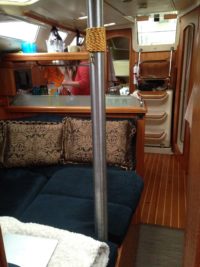 While I was surprised at how much we had to rearrange to accommodate guests, I was even more surprised at the fact that two extra bodies didn’t make the boat seem crowded. It helped the weather was mostly good and we spent a lot more time out in the cockpit than we had during the winter. Morning coffee out there was especially pleasant as it allowed people to wake up at their own pace and gave every one some space. But overall the fact that everyone was cheerful and cooperative went a long way to maximizing the personal and social space aboard. It would depend on the guests, but I think 4 people wouldn’t be uncomfortable for a couple of weeks or, if everyone was of the right mindset, even longer.
And despite being inexperienced, it was still amazingly helpful having an extra set of hands to take the wheel or keep a watch. And stern tying is 200% easier with a couple of extra bodies. Still, Never for Ever is not just our boat, she’s our home, and it’s nice to have her back the way we are used to.
—Captain Why #Liveaboard, #Posts
Instagram This Week