Category: D’autres
Drugs on board … & being sick
When we first moved aboard, I spent some time assembling a good first aid kit to supplement the one already aboard. I also stocked up on Tylenol and Advil and made sure to include a good supply of Robaxacet as my back had developed an insidious habit of spasming at the worst moments and rendering me virtually incapacitated for a few days. Luckily, so far, my back seems to enjoy sailing and I have been thankfully spasm free whenever we’ve been aboard. On my last visit to my dentist, the inestimable Dr. Frank insisted I accept a prescription for a good antibiotic in case we found ourselves far from assistance and suffering from tooth pain (I later was grateful for this foresight).
But the one thing I didn’t stock then and failed to include on this year’s cruise was any cold or sinus medication. Which I assume was some sort of subconscious and misplaced optimism, as we always have some sort of decongestant and/or antihistamine stocked in the medicine cabinet at home. And, as it turns out, we paid for that oversight.
The onset
It had been a bad start. For the first week or so I had been feeling nauseated. I blamed it at first on the disruption of my eating schedule and later on a fairly recent addition of cholesterol meds. We checked in with a pharmacist in Madeira Park, but he felt it highly unlikely the meds were to blame.
Just as I was getting over that, my allergies (which tend to plague me continually in a low-level manner while in Alberta and had, to date, disappeared on the West Coast) returned with a vengeance. It had been five years or more since I had a bad attack that involved a weird post-nasal drip that accumulates assorted crud in the back of my throat and will set off spasms of hacking and coughing every time I shift positions, but it was back and now I found myself incapacitated for minutes at a time as my body’s involuntary reflexes tried to prevent me from choking to death. Trust me, they were so bad that sometimes in the middle of these violent coughing fits, I might have chosen the more sedate choking option.
And of course, we were smack in the middle of Desolation Sound at this point with no easy options for acquiring any antihistamines. So I toughed it out.
I’m not sure who got the cold first, but it doesn’t matter. Suddenly it seemed that both Leslie and I were in the grips of monster chests colds, hacking, coughing and dripping in concert.
On a boat, feeling like cr@p
I have occasionally wondered what being sick aboard would be like, but for some reason I usually imagined it would involve some sort of intestinal problem — probably because that seemed the worst case scenario — and not something that was catching. So there we were, having infected each other, drained of energy and will, and completely without any of the world’s modern miracle drugs other than Extra Strength Tylenol to help. It was the nights that were the worst as both of us have been conditioned by years of habit to load up on OTC drugs when we’re sick, to help us at least get a partial night’s sleep before they wear off.

And despite my previous post’s happy endorsement of spring cruising, the rain didn’t help. On some of the rainier days, there was very little to keep our minds off our suffering stuck below in a cool damp boat. The Webasto got fired up perhaps a bit more than would have been our usual practice.
We were swinging on the hook in Von Donop when I made the executive decision that a few days at dock were called for, and so we raised the anchor and made for Heriot Bay, shore power and, best of all, a supply of medication.
On the road back to better
We tied up at Taku Resort and immediately tromped off to the Market. The selection was limited, but Leslie chose to indulge in her faithful NeoCitran while I opted for a combined cure to both my now incipient head cold and the persisting background allergies: Sinutab Allergies. We loaded up and spent two days on the dock reveling in electric heat, all the hot water we wanted and the ability to walk away from what we regarded as our own personal plague ship.
Of course we didn’t do that much walking, preferring to huddle miserably below. After a couple of days we decided that if that’s the way it was, we might as well go somewhere more picturesque so, after forgoing the worst of the drugs for a day, cast off for the Octopus Islands. And there we sat for a few more days in alternating sun and rain and slowly recovered.

At least I did. My cold slowly receded, although my allergies remained (albeit at a much reduced level thanks to the drugs). But Leslie’s illness had unfortunately settled into her ears, which stubbornly refused to drain, and she was starting to count down to a flight to Toronto that she absolutely did not want to make with blocked eustachian tubes.
The D-word.
Right about then we started paying attention to medical facilities. Or at least I did. Talking it over, we decided if L’s ears weren’t better by a week before her flight, we would bustle off to a doctor for some serious drugs. Of course, walk-in clinics didn’t seem to be overly abundant in Desolation Sound, so we shifted our short-term plans accordingly.

The days went by and with the help of some Benadryl I picked up in Lund, I beat my symptoms into a mere five-minute, first-thing-in-the-morning coughing session. Leslie’s ears did not, however, improve. And so we continued to move slowly south toward more populated parts.

A sign you will be sure to encounter on your walk tot he Pender Harbour Health Centre
A few days short of our one-week deadline we found ourselves back on the hook in Pender Harbour. I gave Pender Harbour Health Centre a call the morning after we arrived to get some advice on the nearest place to have Leslie’s ears looked at. It turned out they had a both nurse and a doctor available and could we be there by 11? I secured directions (a 10-minute walk south down the highway) and we started to get ready.
The A-word.
There are a lot of things about small towns that can be irritating, but Madeira Park—indeed the whole Pender Harbour area—has just the right balance between services and population to make things like going to the doctor a joy. We arrived about a half hour early and Leslie was bustled in five minutes later. I could hear her laughing, and 15 minutes later she emerged with a smile and a prescription.
It turns out that the issue with her ears was not the dreaded infection but instead a symptom of … wait for it … allergies.
“There are lot of things on the coast that cause allergic reactions,” the doctor told her authoritatively.
“But we spent a year here without being affected,” she protested. “And we returned a month ago.”
“Indeed,” he rebutted, “the exact conditions that might bring on such an attack.”
“Oh,” she rejoined weakly, “I see.”
“Indeed,” the doctor repeated kindly.
So we strolled back to town and Leslie filled a familiar (to me) prescription for steroids and we loaded up on Benadryl. Apparently Benadryl, according to the nurse practitioner, should be an essential part of any first-aid kit. Free from “helpful” additives, it’s a pure antihistamine useful in many situations.
And now we wait.

Aftermath
What makes this all poignantly ironic is that just as I was feeling a bit better I read Slow Boat’s (Riveted) latest post about stocking up for their annual Alaska cruise, where they made the point of stocking up with a healthy (pun intended) supply of Nyquill, pointing out how hard it could be to obtain and… Alas, such wisdom delivered only a bit too late. One of the less obvious dangers of cruising too early in the season: you miss the latest crop of internet sagacity.
We are on the mend now and harbour a desperate hope that this allergic reaction is just a fluke and not to become an annual trial. But if it does, I guaranteed next year we will be better prepared and fully stocked up with all the latest medical chemistry to beat our bodies into submission.
—Bruce #Cruising, #Equipment
Spring Cruising: The April Edition

Our first real experience with boating in the PNW was a Powerboat Cruise and Learn in late April. We motored the Gulf Islands for a week learning the ropes (literally) and learning the basics. Since then we seem to have spent a lot of time aboard in May and June, and I have to say I am really not sure the warmth of July and August are enough to offset the benefits of early-season cruising.
Anchoring Out
Now this is where the real joy is. Smuggler Cove: we had it to ourselves. Garden Bay: again we were the only boat anchored out. We had the entire Copeland Islands chain to ourselves. Prideaux Haven had one, yes one, boat in it, and we shared Melanie Cove with one other boat, both of us swinging in the centre. We stayed two nights in Squirrel Cove and shared it with two other boats the first night and absolutely no one the next. Last time I was in Squirrel Cove it was August and I think there were close to two hundred boats anchored there. The difference is simply mind blowing.

Teakerne Arm, Rebecca Spit, Von Donop Inlet: all the same. Occasionally there will be another boat there, but if you stay a few days you inevitably get the place to yourself. And as we meet more and more of the other boaters, they all say the same thing: spring is the time to be cruising, especially Desolation Sound.
You get the opportunity to visit a lot pf places without the stress of a large audience watching you screw up your stern tie (our first attempt in the deep water off Cassel Lake Falls is a story in itself) or worrying about finding a place to spend the night. It also means you can swing freely in places where you might otherwise have to stern tie.
Enjoy it all
It’s a bit too early for good fishing unless you have a down rigger, and the whales are just returning, but there is still plenty to enjoy, especially if you like puttering around the shores. Eagles are everywhere and the clear, undisturbed water is teeming with life from Lion’s Mane jellyfish to coral. We’ve seen more sea cucumbers in the past week than I have ever seen before.

The trails are wet and occasionally a bit challenging, but I entertained myself by clearing deadfall to make the walk easier for the next hikers and by keeping an eye on the ground for all the flora and fauna to be seen. I love wildflowers and spring affords me the opportunity to see a whole new range of them and practice my bad photography. Even the lichens are in bloom!

And the colours are fantastic. The days are already getting pretty long, and the play of sun and clouds across the mountains and water creates some pretty mesmerizing and ethereal scenes. Words aren’t enough and I’m just not a good enough photographer to capture the beauty. You have to see it for yourself. Really.
So what do you need?
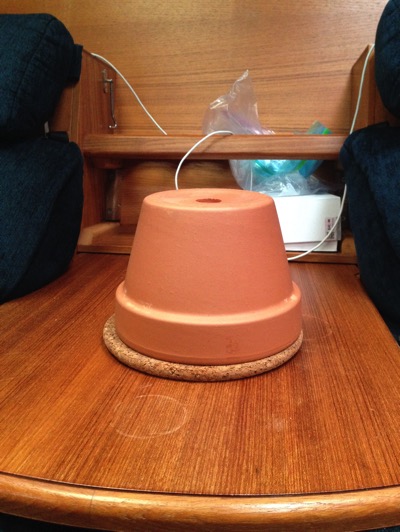
Let’s start with a little background. Never for Ever is a 2003 Hunter 386. She has all the common amenities: gas stove, fridge and freezer, BBQ, head, etc. In addition to that she has a diesel fired Webasto hydronic heater with 3 separate “zones.” That allows us to heat the boat any time we want, although when all the fans are running she is using about 6 amp/hrs (that means that if we run it for 2 hours we use about 12 amp/hrs which is about a quarter of our normal daily allotment). We also have the best-ever fleece sheets that make crawling into a cold bed a non-issue. In addition we have tons of candles and a little candle/clay pot heating system that can take the chill off an evening as the sun goes down.
In the cockpit we have most of a full enclosure (because the mesh side panels don’t completely block the wind). Best of all, the two clear panels that attach to our dodger almost completely block any wind when underway. And while the bimini does leak a bit where it attaches to the arch, we are generally snug and dry in the cockpit even if it is raining.
Back to batteries. We have enough capacity to last four days without plugging in or firing up the engine if we are miserly with the heat, and three days if we stay warm. And it’s often warmer out in the morning sunshine than it is below so we can abandon the cabin if it’s cool but not cold enough to bother with the heater. What’s too cold? 10° C sends me running for the heater when I wake up and 13° C probably means we’ll tough it out with a nice hot coffee/tea to get us started.
What’s This Got to Do with Spring Cruising?
Well, it’s important to realize that for us, in a moderately equipped boat, cruising in the early months is a lot like camping in the mountains. It can be cold and damp at night, but the days generally make up for it — with the occasional rainy day spent relaxing under canvas. A fancy powerboat with a generator can probably leave the heat on continuously and may have lots of canvas-enclosed “sunrooms” that make it all more luxurious. As in the aforementioned camping reference, the trick is to stay dry, layer up and use positive words like “brisk” and “invigorating.”

But if you can accept the fact that you are going to wear layers, enjoy a splash of rain now and again, and expect to need an extra quilt or two, then there is lots to recommend about cruising the PNW in April and May and very little to fear.
Weather
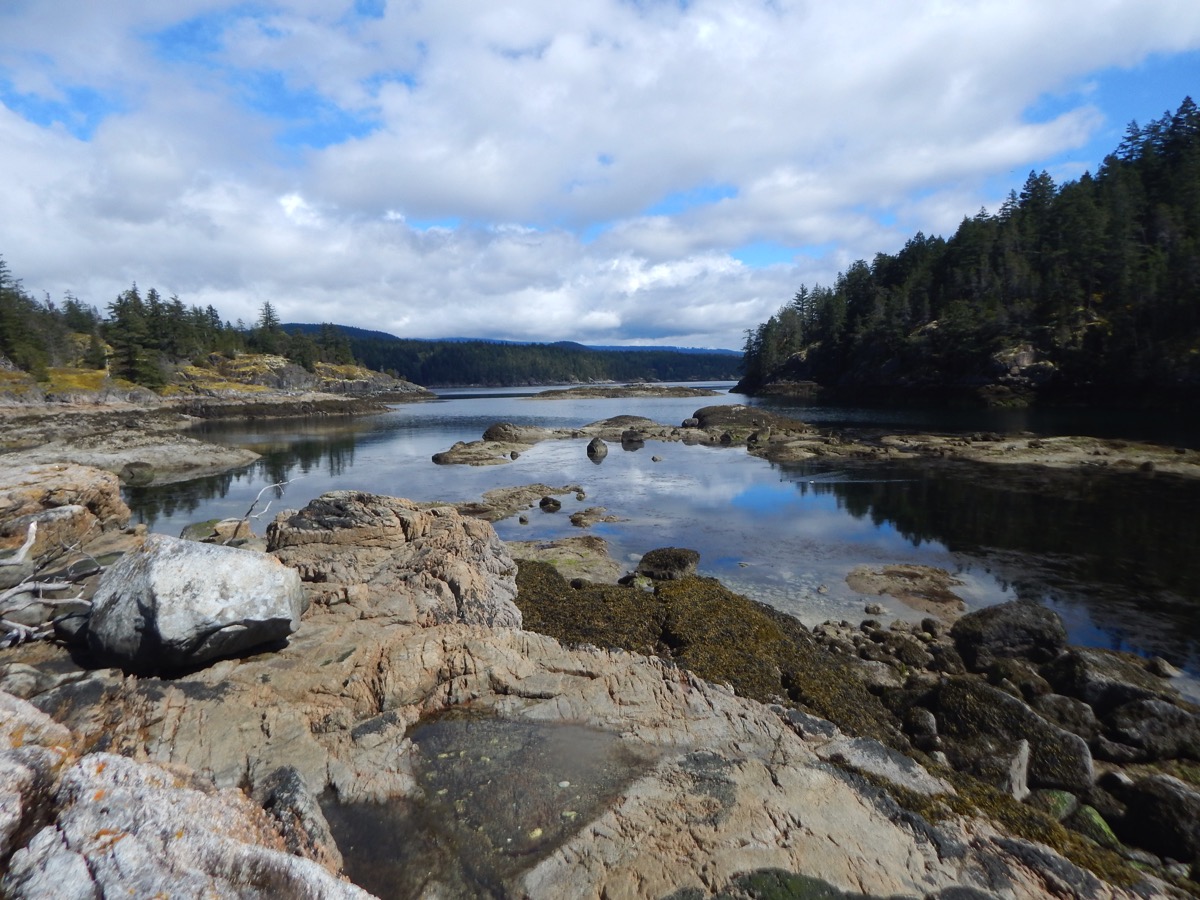
It’s not that bad. Really. This year we headed up to Desolation Sound in mid-April and we have averaged rain two or three days a week, but it often happens over night or early in the day. Some of our best days have seen us getting up to steady rain and motoring for a few hours as it clears to have fantastic sunny weather when we arrive to explore our new anchorage. Daytime temperatures are usually in the 15–16°C range, which is plenty warm if the sun is out. The nights can get cold, but bring your favourite down sleeping bag and you won’t care. And the sound of rain at night is soothing.
The winds are good if you are a sailor. and not all that bad if you don’t mind bashing into a 20-knot head wind occasionally (we don’t). And the distances to most places are so short (an hour or two) that even a bad day doesn’t last long.

I do think early-season cruising should be more of a relaxed affair—the more time you have, the better. That way bad weather days are spent relaxing or walking a rainforest in the rain (which I firmly believe everyone should do at least once in their life). If you don’t have the time to outwait the weather (rarely longer than a day or two), then some destinations can be a bit more difficult.
Marinas and Resorts
The other thing to be aware of is that a lot of places aren’t open yet or have limited services. Contrary to expectation, trying to get space at public docks like Chemainus or Westview in Powell River is actually harder since they have not yet opened up space for the summer transient traffic. The restaurant at Gorge Harbour isn’t open for dinner, Refuge Cove has only limited services and, if you go further north, most of the places in the Broughtons like Port Harvey or Pierre’s will have dock space but few or no supplies available.

On the other hand, Taku Resort off Rebecca Spit has off-season rates, which means you can afford to tie up there. And Heriot Bay is similarly inexpensive at just over a dollar a foot. This makes supply and laundry days much more affordable if you are out for any length of time.
A couple of days ago we pulled into the public dock at Squirrel Cove and tied up. We did some resupply, washed all of our laundry and recharged our almost-dead batteries and were off to the main anchorage four hours later. No competition for space and no rushing. Glorious.
So What’s Stopping You?
I realize some of us don’t have much time, and “wasting” it on a spring cruise rather than waiting until high summer seems shortsighted or foolish. I just don’t think it is. It all depends what you want out of the experience. I value serenity and beauty, solitude and newness. Others might prefer the more social aspects of hanging out in a big anchorage with dozens of other boats, and I will admit that occasionally I wish we had some other boats around to entertain me. After all, we are all part of a community.
Still, if I wanted warmth and sunshine and crowds, I would likely spend my money in Mexico or the Caribbean. What the PNW offers is beauty and more beauty. A sense of wild, untouched landscapes and the opportunity to explore them at my own pace. Oh, if I can swing it, I will definitely come back in July and August, but I truly don’t think that the opportunities afforded by an early-season cruise should be missed by anyone who can afford to give it a try.
—Bruce #Cruising
Instagram This Week

Liveaboard vs Cruising: The Problem with Stuff
One week and counting.
After originally planning to drive, we’ve decided to fly out to the coast and should once again be on board Never for Ever late in the day next Thursday. I can’t wait. Still no decisions on where we are going cruising, but Yahtzee is heading up the west side of the Island and I am green with envy. Maybe not this year, but dammit it’s on the list.
Moving Stuff
Unfortunately the decision to fly has introduced a few wrinkles. When we left the boat last June we put bunch of our stuff into storage, but a bunch more stuff came home with us with the intent to take it back this spring. And on top of that I picked up some gear for my Pacific coast trip. We’d planned to haul it all back out with us in the car — I’d actually bought the bloody hatchback specifically for that purpose. But now, given the airlines current baggage policies and the added fact we are taking a float plane from YVR to Nanaimo, my well-planned gear and provision lists are out the window and we are back to square one.

So now I am going through everything and rating each between 1 and 3 to indicate their relative importance. 1’s will definitely be coming, 2’s will be fit in according to space and 3’s will most likely be staying behind.
What’s The Problem
So what’s the big deal? Never for Ever is now a charter boat and she comes with everything one needs. Right?
And there-in lies the real topic of this post. The boat certainly does come with everything for a successful vacation and, with the added benefit of our personal blankets, linens, and various kitchen doodads we left in storage, it should be comfortable enough. But the crux is the question of how comfortable is comfortable enough? After spending a whole year aboard we grew to have certain minimum standards and expectations. Two frypans for instance. I learned to prepare a lot of things using the two pan method and now there is only one left aboard. Oh and my Staub casserole dish, clay garlic pot, and good cutting board all make life easier. And my good knives … And that’s just the galley. I have a bunch of new books I wanted to bring out, some comfort items like bath mats, extra sheets and pillowcases, my favourite pillow, and sundries like a better first aid kit and a new sewing kit. Then there is the cordage, clips and other bits of hardware I had intended on bringing out. Add in our personal gear for two months and it’s just not all going to fit in the 35 lbs each we are allowed by Seair.
Some things are just minor (in)conveniences, our favourite blanket and laptop stand that make watching movies in the evenings a bit more comfie or some extra soft bath towels, but then I’ve got my new sailing boots, coastal jacket, and water walkers along with cold weather gear like long johns, scarves, gloves and rain gear which are bit more important. I had also intended to bring our small inverter, a spare set of binoculars, a few new LED emergency lights and a new Canadian flag.

The sailing gear box at home.
Tools. That’s the big one. I don’t have a specific boat set so I brought 90% of them home. And sadly that’s where they are going to stay this year. And that means a whole whack of boat projects just disappeared from list. Sigh.
Small Things Make a Big Difference
Again, what’s the big deal? It’s subtle but I’ll take a stab at explaining it. Like the heading says, small things make a big difference and when contemplating spending two months on a small boat before summer really takes hold, it’s truly about the seemingly minor things. For example, a good kitchen knife changed my life when I finally got one and 2 months using a bad one is just not worth it. It will be coming. And my good casserole dish? The thick clay heats well and cleans easily; it makes certain dishes easy and fun and without it a whole bunch of menu items get crossed off the list: this one is currently rated a 2 on my 1–3 scale of importance. Hell, I’m old enough that sleeping on an uncomfortable pillow is…well… uncomfortable. I want my good pillow dammit. A good night’s sleep is damn important.
 Small things indeed but understand one key point: after living aboard the boat familiar routines are reassuring and their absence can allow small frustrations to build. I am a firm believer in looking after the details and letting the bigger picture take care of itself. But if I can’t take my stuff, then it’s harder to manage the details as well as I want, and then the whole trip risks seeming somehow…less-than.
But Is That Really the Issue?
Well no. The issue really comes down to the difference between living aboard and cruising.
Cruising — to me — is more of a series of small journeys strung together. You are only in each location for a short period of time so you make the most of it and put off “real life” for later. It’s relaxing (in its own way) and you live the adventure in the moment. I enjoy it, I really do. But our year of living aboard showed me that cruising (by my definition) isn’t sustainable; “life” is after all inherent in “living” aboard.
And you know what? Surprisingly I liked that. A lot.
The difference between cruising and living aboard is most easily illustrated by — although not by a long shot limited to — the tools. Things on the boat break. Or need improvement. Or just cry out for a tinkering or two when you are hanging on the hooks and looking for something to do. If it is just a cruise of week or two, or even three, you will likely just wait until you get home to have a go at repairs/upgrades etc. But living aboard means you are away full-time and these things go on the list that you are constantly (and futilely) working to reduce. It’s part of the lifestyle and frankly it’s kind of fulfilling when you McGyver the rigging in the middle of Von Donop Inlet with just what you have to hand. After all, you are just hanging there for 4 days so you might as well get something done. Right? And without the tools I won’t be able to do much without heading back to the base at Nanaimo.

A few of the things that won’t likely make it back to the boat this trip.
So there you are, dealing with life’s little problems, soaking in the lifestyle, watching the rain fall and enjoying your 3-day-old bread —that’s the life. And, just like living ashore, it is the small, personal things that made living aboard more than just workable—they made them comfortable. And comfort is my beginning point for transforming things from enjoyable to joyous. When we are comfy and toasty in our cold-weather gear, then a cold, wet sail in 25+ knots is an adventure and not a trial. When the end of a cold rainy day brings a piping hot cheese-baked pasta dish with fresh bread, it imbues that day with pleasant memories, not ones of scraping baked-on gunk off a pan. And when you finally beat that broken head into submission and emerge to breathe in the glory of an isolated inlet in our beautiful PNW, it makes a sweaty, uncomfortable, mostly gross task seem a monumental accomplishment. That and the beer you’ve been thinking about all afternoon.
But At the End of the Day
This little setback just reminds me of what I really enjoy about the boating lifestyle and the kinds of little things we learned during our liveaboard phase. Doing it again is high on my current list of possible futures so I guess we will start building some new expectations and getting ready to settle in once again.
So ya, I am a bit put out by the fact that I have to leave a bunch of stuff behind, and I have been prioritizing and re-prioritizing all week, and will likely continue to do so until we head to the airport. But I’m not really complaining, because in a week’s time I will be once again aboard our boat with nothing more important to do than just live my life and I’m grateful for that.
…I’m just not going to guarantee I won’t be spending the first few days enjoying Nanaimo’s beautiful harbour and buying everything I just scratched off my list.
—Bruce #Equipment, #Liveaboard
This year’s wish list
Last year around this time I posted up my to do list to get ready for the season. This year, due to having Never for Ever in charter, my actual To Do list will be limited sending the email that commits to our arrival date (hopefully late April) and the boat should be ready to go when we arrive. All we will need to do is grab our gear out of storage and settle in.
But that doesn’t mean I don’t have things I want to do or, more specifically, want to buy. So far our additions to the boat have been rather modest. We picked up a Rocna anchor before we set off, installed a new Sony Media Player the first couple of days aboard, and added a Battery Monitor Kit after we returned from the Broughtons. But other than that we haven’t added much to the boat despite my grand plans. But hopefully, finances willing, I will get to add a few new toys this season.
But the real question is, since we are no longer full-time cruising, how much to invest in this baot and how much to save for our “forever” boat.
First up may or may not be a new windlass. The seals on our old one are shot and in heavy seas water streams down into the front cabin. Not good. But the thing is old enough that parts are a problem. If we can find the parts, well, all is well and good. If not, then we will be in the market for a new windlass.
Then I went through my old wish lists (pre-purchase) and, leaving out the things that came with the boat, compared them to what I want to add after being full time cruisers.
Old List
- Generator/100 amp alternator
- Wifi Booster
- AIS
- Hammock
- Code 0 sail
- Dyson Mini Vac
- Water maker
New List
- Generator/solar
- Wifi booster (cell phone booster)
- TV and a way to stream to it.
- Range finder (binoculars)
- Stadium Seats
- LED lights (more)
- Stone baking ware

Some things haven’t changed. And some have.
- On-the-hook power is still the number one item we wish we could improve, but no matter how we look at it, it’s a boat buck or two (~$1000–$2000) that I don’t have. And frankly it’s not as big a concern if we aren’t spending months on the boat. Still, a generator would be nice since we could just take it with us if/when we move on to another boat so I keep an eye out on Kijiji to see if there are any good deals. Solar is likely also a non-starter but I am still planning out various scenarios just in case. I’ve abandoned upgrading the alternator since it would mean changing the pulleys, as well as getting a smart regulator on top of the alternator. Solar would almost be cheaper. And frankly I don’t want to do that much motoring anyway.
- Connectivity. We constantly blew over our data plan last year until we wised up and increased it. I am really wishy-washy about this. I figure it’s around $500 all in to set up a booster, antenna and a wireless router. Is that reasonable if we are only sailing two weeks? No. Eight weeks? Probably.
- AIS? I hooked up the Standard Horizon to the chartplotter and now have an AIS receiver; I don’t think a transmitter is necessary at this point. So now #3 is a TV and some way to connect it to my harddrive full of movies. Never for Ever once had a TV mounted on the front bulkhead — the lovely coastal art covers the holes — and it still has a dvd player mounted under the chartplotter. The folks at Cunning Little Plan installed a TV and DVD player converted to 12v and their’s seems like a feasible plan. Call it $225 for the electronics and probably another $50 for hardware and wire. Leslie is against the idea but I think it will add value to the charter and grant us a bit more comfort when we are watching movies.
- Hammock? It’s just fallen off the list for now. Rangefinder Binoculars? I suck at distances in anchorages and love a good pair of binoculars so it seems like an obvious choice— only $200! I think of this item as more of a”special treat” though so I’m pretty sure it won’t be happening unless I come into some “extra” cash.
- Let’s dispense with the rest of the old list (Code Zero sail, Dyson mini-vac and watermaker) by saying “too extravagant, not enough utility.” Stadium seats however are cheaper, more practical and directly add to comfort. We had won a West Marine folding seat at the Hunter Rendezvous and I really like it despite the fact I have wrecked the foam already. A couple more at $80 a pop more would perfect.
- LED lights. Around $20 each we already have at least one LED in each cabin so that’s good enough for now but we should get on with replacing all of them.
- Donna from Northwest Passage had a bunch of stoneware baking pans and I loved them. She got hers from Pampered Chef and I have my eye on at least a nice cookie sheet and a loaf pan (around $40 each)

So what is likely? I think the TV, maybe a couple of LEDs and at least one seat. And as I said I will keep my eye out for a good deal on a generator but being able to stay on the hook for a few extra days only saves me $50/night—it’ll have to be a good deal. The rest will rely on finding the right deal at the right time. Or maybe I’ll save my money and spend it on beer, after all beer is important. Right?.
—Bruce #Equipment
A Tale of Two Videos
Nanaimo Yacht Charters has taken a brand new Lagoon 42 into its fleet — man that’s one beautiful boat, I really, really want to take it for a spin — and the owner has been busy trying to promote it with a Youtube Channel and a Facebook Page. One of the things he has done is shoot a few videos with Ian and Beth MacPherson, two of the principles over at NYCSS. Well, for those who don’t know it it, one of the ways I’ve made my living is as a graphic professional and frankly, the graphics on those videos were killing me. So since I needed to brush up on my After Effects skills anyway, this spurred me to offer to put together some intro’s and outro’s as a refresher that they could use. This 2 minute video was the result of that.
I also worked on some motion graphics for Never for Ever for my future movie-making efforts and finally posted a video round up of our sailing trip to the Broughtons on my Youtube Channel. It’s a work in progress but I bought a GoPro knock off and hope to do a lot more filming this year.
Then the owner of Water Dragon (the new Lagoon) contacted me to see if he could have a copy of the promo as well. After a bit of back and forth he also gave me the file for the Q & A video (sans intro since I shamefacedly admitted it was that which had spurred me to start editing video again) and used it as another project. I recut it, added a few flourishes, tried to fix the lighting and essentially learned a whole lot about how much I don’t know about Adobe Premiere.
Still, it looks ok and I think it actually is a great video for anyone who is tinkering with the idea of chartering. I certainly would have like to see something like this back when we started toying with the idea of learning to cruise. I really couldn’t believe how easy it was. So take a look. (If you’d like to see the original to compare the before and after, it can be found here.)
—Bruce #Charter
Mid winter checkup
Actually after years at working in a greenhouse I tend to think of this time of year as spring — we’d have finished cleaning out the winter crop of poinsettias and well into planting and seeding crops for the coming summer. It’s stuck with me much to the consternation and confusion of friends and family alike. So, this past week the 2017 Waggoner’s came out — you can pick up your free digital version here and I also decided to take advantage of a Boat Show special and pick up the complete set of Salish Sea Pilots for only $34.95 CAD. And since it’s “spring” and we decided not to head to the Vancouver Boat Show this weekend, I thought I’d start on some 2017 cruising planning.


Our intention, now that the boat is committed to charter, is to try and sail as much as possible from the time exams are over (mid to late April) until the first of July and then leave the boat for charter clients in the high season: July, August and September. Our early season cruise last year turned out just fine and L and I don’t mind the cooler weather, especially since it comes with a dearth of crowds. The first hiccup in that plan however was a couple of weeks ago when NYCSS called me up and asked if they could have the boat for the 19th of June. And, since we had intended an extended cruise beforehand, could they have it several days earlier to do the extra cleaning needed for the turnaround. We talked it over and decided that we could make that work; luckily the exam schedule this year works so that we could head to the coast mid April if we do want full two months for ourselves.
How Long?
And that brings up the first question. Do we want to go cruising for two full months or do we want to just head out for shorter stints? So far I have no commitments that will stop us from heading out, but that also means I will have to turn down anything that comes up between now and then — something I am leery to commit to. If we only go for a shorter period we would likely stay in the Gulf Islands or maybe the San Juans, but there are still plenty of new places left to explore.
 The 2017 Hunter Rendezvous is June 1–4 this year and it was a lot of fun the first time we went; I wouldn’t mind doing it again. I’ve also semi-committed the boat to a “boy’s weekend” in Schooner Cove in mid-May which would give me chance to show her off to a bunch of old friends and have some fun. If I did both of these things it would mean making at least two trips out if we didn’t decide to go for the duration. Driving over and over again can get wearying and flying gets expensive (although we would definitely have to drive the first time to haul our gear). For now all we are doing is marking dates on a calendar.
How Far?
Two months might seem like a lot of time to cruise considering we did Vancouver to the Broughtons and back in a 3 week trip a few years ago, but we’ve finally learned to slow down. As charterers ourselves we got caught up in the moving-to-a-new-place-everyday idea since time was limited, but there is a lot to be said of swinging on the hook for three or four days and leisurely taking in all the beauty that is the Pacific Northwest. We are definitely converts to taking it slow. I don’t think I would want to do the trip to the Broughtons in less than a month now and even six weeks seems like a minimum. But with potentially 8 weeks available, where would we like to go?
Exploring Puget Sound is high on my list, but preliminary research makes a lot of it out to be more marina hopping than anchoring out, and we are looking to maintain last year’s ratio of four or five to one (nights anchored to nights on dock). This is because we want to a) save money and b) get the aforementioned “slow” time in. I haven’t ruled it out yet and my visit to Anacortes on NorthWest Passage intrigued me so maybe we will at least give the northern reaches of Puget a try.
I also wanted to spend time in False Creek (Vancouver) last year and we never did. You can pick up a two-week anchoring permit for free online and it might be nice to hang out in Vancouver just for fun. We’ve only ever been at Specialty Yacht Sales’ docks on Granville Island and that was more business than pleasure. it’s pretty central and from there we could head up Indian Arm, Howe Sound, cross back to the Gulf Islands or cruise south into the U.S. All good possibilities.
Desolation Sound is also within pretty easy reach, although last year we were at least a month kicking around there and I enjoyed the pace so I wouldn’t want to do it any faster. But there are still plenty of new places to explore and tons of old ones that I would love to revisit. Definitely a possibility if we decided to take the whole two months. And staying in the Gulf Islands or revisiting Victoria whether we only have two weeks or manage an extended trip is a similar situation, still tons of places to explore.

And of course we could head north to the Broughtons. I haven’t yet looked to see who might not be open in early May and I know the weather would still be quite cold and wet, but if we commit to the whole two months I might be tempted to give it a try. I really love it up there.
Other, less likely, possibilities include circumnavigating Vancouver Island, Heading up the Strait of Juan de Fuca and visiting the Broken Group or Ucluelet or heading up to Bella Bella or Ocean Falls. Any of these might require some investment in equipment and a good weather window but I won’t say no just yet. My successful trip down the coast to LA has made me a bit more adventurous.
To Do’s
I will probably do another post on my “wishlist” for the boat as it is growing more and more extensive, but I do need to consider how much work I want to do on the boat at some point. The more work, the later we take off from the docks. One of the high points of having Never for Ever in charter is that she will be prepped and ready to cruise when we step on the dock. and I don’t actually have to do anything.
But having said that, I do want to do some of the work myself since there are still lots of things about her that I have yet to learn. Ian and the crew at NYCSS are working on my leaky windlass over the winter (they are still hoping to source parts to rebuild it so I don’t have to replace it) and I would like to reinstall it myself. She also has the wiring (and a dvd player) already installed for a tv so I am thinking of buying a cheap 12v unit and mounting it on the bulkhead. The rest of the projects come down to money and I will have to start budgeting.
Decision Time
Luckily we don’t have to decide anything final just yet. The boat is reserved for our use until June 17th and the only pressing thing to consider is registering for the Rendezvous. But Lawrence is adept at squeezing boats in and as much as he’d like us to register early I don’t think he would turn us away if we put it off.
So what does that mean? Well I (we) will continue to think up plans until the perfect one comes along and then we will head out and enjoy our first season as absentee owners. The only thing for sure is that we will go sailing for at least three weeks and then who knows…maybe will get stuck in some far off port. It wouldn’t be the worst thing.

—Captain Why #Posts
I’m a novelist…Not!

As of right now I am 49,359 words into NaNoWriMo (National Novel Writing Month), a self-regulated challenge to write a “novel” in less than thirty days. For the purposes of the challenge a novel is loosely defined as 50,000 words. This mean that in order to successfully complete the challenge you need to write approximately 1600 words each and every day. Hopefully with this entry I will complete my last 700 words one day early and be able to finish off a few other writing projects that have been back-burnered.
So why do it? Well if you visit nanowrimo.org/faq you will find lots of who’s, what’s, where’s, and why’s, but frankly it is simply a way to get people writing, stretching their brains and exerting their creative muscles.
It actually sounded pretty easy. I set up a chart that marked 1700 words a day with a target of writing 2500 words a day and then taking weekends off. Then I challenged myself to write 3000 words a day as a personal goal. Well, the first four days I easily wrote my 3000 word goal, and then only managed to do it again for four other days. Life can get in the way and creativity is apparently not an infinite resource. Who knew? Sometimes you just can’t go on in the face of your own personal doubts or sheer boredom with continuing down a path that seems to be going nowhere. And I found that I couldn’t afford to go back and edit or even proof what I had written; if I did I would get caught up in rewriting and spend two hours and only add a couple of hundred words to the count. And eh count became all important as the days slipped by.
But back to my strategies. I know from years of personal experience that home is not my productive place. After spending most of the winter in Victoria’s library watching Leslie be productive, I decided to find a home in our local branch for the duration. Daily I showed up just before opening time at 10 am and joined the queue. Most days I got the same carrel although once or twice I missed out and had to substitute another. I wore my noise cancelling headphones and eschewed a power source. That way I was fairly isolated and knew I wouldn’t be able to play any power-hungry games. The library has internet — both EPL and Shaw — but I tried to use it only for research or an online thesaurus. Most days wrote for 3 hours as I soon discovered that I was good for around 1000 words an hour and that, after three hours, I really lost focus.
I chose to write in IA writer Classic because I had it on my phone, ipad and laptop, it was able to sync files across the cloud and offered “distraction-free” writing features. In the end a pretty good choice. They have gone on beyond the classic version so I don’t know if its available any more but I still like it al lot.
And there you are: twenty-nine days of writing… sort of. And how did it go? Well, that depends.
First the numbers. I figure after this I will end up with around 51,000 words all said and done. As I mentioned I set a target of 20 days writing with 2500 words each day. Well I wrote on 25 days with a maximum of word count of 3281 and minimum of 224 words (actually the minimum was 8 but I’m not going to count that one). I might add the day-to-day achievements below as an afterthought.
And did I finish a novel? No. Not even close. In fact I gave up and restarted at least three times. I hadn’t decided that I was going to do this until a few days before the start of November, so my plan was so vague as to be almost nonexistent and my outline was a quick sketch based on a a few writing advice sites. It looked pretty much like this:
**Hook**
How can you escape when you bring it all with you? Just go…
**1st Plot Point**
*Conflict: why there is a story*
Running from death of family
*Journey of discovery*
***Pinch Point***
*apply pressure to character*
Hole in the Wall Rapids
**Mid point**
*move from reaction to action*
Arrive Broughtons. Reading log book
** 2nd Plot Point**
*obtain what is necessary to go forward*
Defining fear
***Pinch Point***
*apply pressure to character*
Windlass shot. Boat almost sinks
**Resolution**
*What does the ending look like?*
Killer whales hunting porpoises
It wasn’t much. I even had to come up with a title to sign up for “contest” so I simply called it Go. After I started, I think I hit about 6,000 words that were written in order before I got bored and skipped ahead to another scene/chapter. And it pretty much went to hell after that. I was aiming for literary fiction since I figured that’s where the bigs bucks were (it’s a joke people) but frankly, despite the amount of literary stuff I have read, I have never really grokked it. I spent time with the a Miriam Toews novel that was on the shelf behind my carrel and started lugging around Tom Wharton’s Icefields to use as inspiration. Next I started adding in different viewpoints and trying my hand at bitter and resentful. I flipped for 1st person to third person and back again. But eventually I just couldn’t go on. A lot of the reason I abandoned it comes from the 1500 words a day pressure. There was no room to go back and rewrite or reshape and so I found I was forced to either continue drifting or just restart.
So I took a break and did some other writing and added the word totals to the challenge. I figured fair was fair and writing was writing. Including this blog entry… so if you don’t like it, then tough.
Okay, so I had determined I wasn’t going to write any of my own particular poison (schlocky Sci-Fi) because A) there was no money in it (not so much a joke this time), and B) it wasn’t going to teach me enough about my potential to be a famous writer, so that left my next favourite genre which was humour. So I started again, recasting the characters and telling the same story from a completely different viewpoint. And it was fun. For a while. And then it got boring — both the exercise and the story. And while I was willing to accept the exercise being a drag, no one wants to read a humour book that isn’t funny. Seriously. Being consistently funny is hard.
My next strategy was to go for a short story. I had a pretty good idea what the conclusion of my story was going to be, so why not try and compress the whole thing into a short story. The problem with that was that I hate short stories. I have read a lot of the classics courtesy of a short story course in university, but frankly they always left me wanting. Still, you never know; nothing ventured etc.
I did it. 6800 or so words later I had a beginning, middle and end that I might, maybe, someday be willing to show someone. Which is more than I can say about the preceding 35,000 or so words. It would need a lot of editing and rewriting but it was a story. Of course it left me 8000 words short and I had just blown my big story idea.
Another idea, one which I know very little about but had been floating around for a month or so, was trying my hand at a piece of creative non-fiction. I had been toying with the idea of writing up some of my thoughts and experiences of our year away but had a lot of concerns about publishing my personal opinions about other people or experiences that could be discerned as hurtful. I also have a notoriously vague memory that likes to compress time and events into wholes that, while generally truthful are not entirely accurate. So I’d been talking to Land C about creative non-fiction and the boundaries and limitations of this “new” genre.
So I decided, well, to hell with research, why not just start swinging. I’ve done a lot of blogging over the years and am pretty comfortable with the travelogue but what was missing was my interpretation of what it was I was seeing and maybe some back story about why I see the world the way I do. So with my personal ignorance safely riding up on my shoulder, I set out to tell the story of why I (we) decided to leave everything behind and live on small boat for a year. The next 8000 words zipped by and I barely got started. I have no idea if the attempt at introspection works and I do know that it will need a lot more humour if I want to avoid insulting everyone I know but who knows if it will ever see the light of day anyway. I also have a lot of thinking to do about the wholeness of the truth and the honesty of including/excluding people in a story that can never be wholly my own. As well I have to think about the value of describing events or incidents from the perspective of emotional lows and highs; the resulting distortion is valid and real in the moment but presents a skewed perspective that can be damaging to the story and even to the ongoing relationships you have to have with reality. In short I have a lot of thinking to do.
Which brings me to the conclusion. Or conclusions I guess. Just what did I come away with? I have never been one for rewriting but I have to say this exercise has taught me that even though I generally don’t want to go back, the simple fact is that writing anything over 3000 words demands, actually demands, that you go back and rework and recast. Resisting that unsought-for imperative was probably the hardest thing to do during the month.
I also now know that 3000 words a day is still a breeze — I knew that from my essay writing days as an English major — but writing 3000 words a day, or 3000 words a week that flows from page to page and idea to idea is so hard as to border on impossible. Especially if you are trying to be creative, maintain a style or voice and still consider the readers’ reactions and engagement. Freakin’ hard. I have much, much more respect for those writers that manage to weave those stories, to balance and manage those images and ideas that make a story more art than craft. The craft is hard, the art is likely beyond me.
I also realized that the genres and the boxes that we as readers and we as publishers like to put books into are the very things that should be the enemies of all writers. Doing the expected is a trap that no one will appreciate one one-hundredth as much as they will when you are breaking the rules. And that’s hard too. Really freakin’ hard.
So there you go. 29 days. 51,036 words. And a lot of spent brain cells.

Logo Design for Dummies
This is a short article I wrote for August issue of T8N magazine on 8 tips for good logo design. Nothing earth shattering and written to fit into their 8s section.
###
A Logo Is Worth a Thousand Words
Every good logo tells a story. In fact, your logo is often the first introduction that potential customers have to your business and, therefore, needs to be able to stand on its own as your front-line brand ambassador. Tall order? A little, but with more and more customers wanting to feel a connection to the brands they support, the role of your logo as a brand ambassador becomes increasingly important. So what makes a logo a good logo? And just how does it tell your story? Here are 8 tips to consider…
Always Consider This
If in doubt, leave it out. If you can’t rationalize something in your logo, chances are it should be removed. When your logo is at its simplest, it’s probably at its strongest. Be ruthless.
1. Ask the Whys
Why do you have a logo? Who does it target? What is its purpose? If you can answer these deceptively easy questions, you are well on your way to creating a great logo. Time spent figuring this out is probably the single most valuable thing you can do when considering logo design. And don’t forget: since every good logo tells a story, yours should be filled with meaning (both obvious and hidden) and even occasionally whimsical—did you know the Apple logo has a “byte” missing?

2. Keep It Simple
Name the first three logos that pop into your mind, and chances are they are clear and uncomplicated (at least on the surface). Simple but powerful logos almost always prove the best at standing the test of time. Trust in that.
3. Logotype vs. Logomark
People often confuse a logomark (think Nike’s swoosh) with a logotype, which uses the name of the brand rather than a symbol or icon (think Google or Disney).
A logotype is often the easiest and most all-around logo to use since it identifies the name of the company or product, as well as expresses the brand. But it is also often bulkier and is sometimes more difficult to use in situations where something smaller and simpler would work better.
A logomark can help enhance brand identity. This is especially true if your mark happens to be a representation of your product or service. And if a logomark is marketed correctly, it can often be more identifiable than a logotype, as exemplified by the Apple or Lululemon logos.

4. Shape, Proportion & Symmetry
Where does your logo need to appear? If you do a lot of sponsorships, the logo will often appear at the bottom of a sign or poster, along with a lot of other logos. Do you have (or want) a strong web presence? Will your advertising strategy involve TV? How about print? The shape and proportion of your logo may affect how it fits in different applications or media, so try out the basic shape in as many situations as possible.
A symmetrical logo is aesthetically pleasing and will encourage more symmetry in whatever application it’s used in. Asymmetry can carry a complexity that communicates different emotions—anything from laid-back to intense or moody. There is no right answer, but take a moment to carefully consider the implications.
5. Colour & Tone
Make no mistake, your colour choice will communicate ideas. Lego’s red, for example, reflects passion and energy, Starbucks green speaks to nature and freshness and Intel’s blue conveys professionalism and sincerity. Consider your message before committing to a colour choice.
Remember, too, that for a logo to be really useful, it needs to work in black and white or even in reverse (as white on a dark background). So colour should be the last decision you make.

6. Active vs. Passive
Consider your business and consider your brand. Should your logo convey a sense of movement and activity? Red Bull’s charging bull and Twitter’s flying bird are both instilled with motion and energy, which complements their brands. What do you want your potential customers to feel?
7. Negative Space
Don’t forget that the shapes in your logo can often convey more than one image. The right facing arrow embedded in the FedEx logo is the classic example of using negative space to add meaning. But also consider the simplicity of the white peacock in NBC’s rainbow of tail feathers or the clever “1” in the Formula 1 logo. Used correctly, negative space can allow you to add more elements to the design without increasing the complexity.

8. Consider Custom Type
When it comes to good logo design, a typeface should be unique. A custom, hand-drawn typeface is always better than something standard or that you download off the Internet—just take a look at the timelessness of Coca-Cola. A custom type helps ensure that your unique logo will stay that way. But if you can’t afford a completely custom font, at least customize any pre-existing font to make it your own.?
###
8 Biggest Logo Mistakes
- Overdoing the special effects. More is not better.
- Using too many fonts. Use one or two at most.
- Not considering its scalability. Does it work as well tiny as it does on
a billboard? - Being too trendy. Don’t just jump aboard the bandwagon—stand out!
- Being too abstract. Don’t leave your customers guessing.
- Leaving it to an amateur. Cousin Bob may be cheap, but you inevitably get what you pay for.
- Relying on stock art. It’s the quickest way to look like everyone else.
- Relying on colour to be effective. All too often, colour is a luxury you can’t afford.
Did You Know?
 Since the time of Euclid, people have studied and used the golden ratio, which in mathematics, is when the ratio of two quantities is the same as the ratio of their sum to the larger of the two quantities. Good logo design often makes use of such classic principles. Despite the fact that the bite out of the Apple logo seems to violate the symmetry of the logo, if you break it down, you can see that they put a lot of work into applying math to the design.
Note: many people think the strict adherence to the Golden Ratio in the Apple logo is a bit of a myth but I think the use of proportion and symmetry still shine through regardless of the precise math.
10 things worse about living on land

Well, it has been almost two weeks since we stepped off Never for Ever for the last time after living aboard for just shy of a year. Since then we have packed up, driven from Nanaimo to Edmonton, unpacked, then moved our son from his apartment to our basement and done some truly prodigious shopping. In short, it’s been busy. But mostly it’s nice to be home again.
But I have been noticing that, common sense to the contrary, there are a lot of things I enjoy about living on a (relatively) tiny boat and there are a lot of things not-so-hot about life ashore. So here’s my top 10 list of things that make me wish I was still living aboard.
One: traffic jams
The other day we had the “pleasure” of running into an accident that meant we had to detour down the Yellowhead Freeway at rush hour. One-and-a-half miserable hours later Leslie and I were more tense and terse than we’d been in years.
A traffic jam on a boat consists of circling a gas dock waiting for your turn. Occasionally you wait for another boat to dock or undock. As our first sailing instructor John Fairweather often said, “It’s all good…” The maddening frustration and road-rage inducing tension of dealing with thousands of other equally frustrated commuters just doesn’t exist.
Two: social engagements
It’s not the idea of social engagements per se I am finding frustrating, but not once, in all the time I have spent on the water, has a date, meeting, drink, or coffee involved daytimers and/or multiple exchanged emails with alternatives, backups or reschedules anticipated, demanded or negotiated.

Time for a bit of socializing
Maybe it’s the more relaxed lifestyle or just the mere fact that if you can’t make it happen then one or more of the potential participants is likely to just move on, but crusing is so much more relaxed. Like a lot of cruising related activities, socialization s much more of a binary system; decisions are often reduced to “yes” or “no.” While that may mean you miss opportunities to connect with people, I have to say I really prefer the simplicity of the cruising lifestyle.
Three: separate rooms
Our boat has three cabins — four if you include the head — and another space in the cockpit usable on most days. And the v-berth quickly became too cluttered to be used as a reading space as I originally intended. That left the salon, aft cabin or cockpit as places you could “be.” 90% of the time Leslie was within easy conversation distance.
It worked for us. We had our own spaces but rarely did we feel alone or left out.
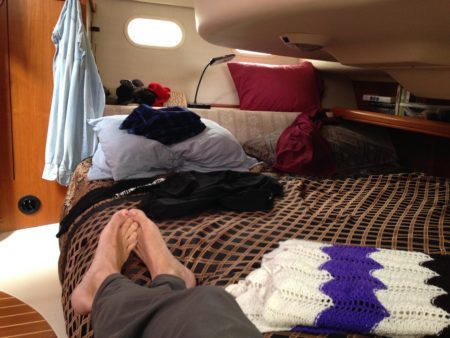
A little alone time.
Our condo is four floors including the basement and generally we often have no idea where anyone else is, or even if anyone is actually home. And this quickly results in all sorts of pre-programmed anti-social habits. Once we are back to work and busy with our own thoughts and concerns, it is going to be a struggle to avoid falling back into the trap of living together separately. But at least after our year of living small we are more aware and can actually make an effort to avoid the worst of it and just make time to “be” in the same space.
Four: the tyranny of choice
The phrase “tyranny of choice” is often tossed off as a trite witticism, but it takes a year of living with limited choice to really realize that the world does offer us too much choice. On board we had a reduced wardrobes, minimal crockery, just the food left in the lockers, limited choices for entertainment, and our “toys” were few and basic… But back on land we have access to pretty much anything we can imagine and therein lies the issue. I am starting to think that we as a culture spend too much time imagining and not enough time thinking. Simple choices are no longer simple if you can’t readily eliminate 90% of your imagined choices. This leads to a lot of wasted time, worry and brainpower. In a lot of ways, I miss the simplicity of boat life the most.
Five: too much room
 Hand-in-hand with too much choice is too much room. There are no piles on a boat. Discipline is enforced because there simply isn’t enough room. A day of maintenance that involves moving gear from its normal place will turn the boat into chaos for everyone — and everyone is always equally eager to get it all back to a semblance of order. Our condo has 1900 plus sq. ft; if you put something new down in an out-of-the-way corner, for us, it’s 60-40 that it will ever make its way to a permanent new home. And the next thing you know you’ve got a pile that grows to such proportion that simply dealing with it becomes something you actively avoid.
Six: indoor life
This one is purely psychological. On board I spent a minimum of a couple of hours outdoors every day. At home, not infrequently, days will pass before I step outdoors. I have no idea why coffee on deck on a cool morning is so appealing when on the water and so distasteful when in the city. But it is. I need to get over it.

Mornings
Seven: locked doors
We live in the city. We, prudently, lock our doors at every opportunity. I never realized how disheartening that is. And what an annoyance it is to take your keys with you every time you leave for 5 minutes. We locked the boat if we were going to be away for any extended period of time but rarely if someone was aboard. There is just something “wrong” with walking up to your own door and being locked out.
Eight: travelling in general
Say it’s eight in the morning and we have to go to Calgary; that’s a three hour drive away. Cue tension. The older I get, the more any long trip out of the city leaves me with a bad taste in my mouth. Traffic, boring scenery, the necessity of focussing your attention on all the other yahoos on the road — all of this makes travelling a big negative in my view. On the other hand, if we have a 5-hour motor or sail ahead of us, it’s just another adventure. You can switch off duties, enjoy the trip, eat, stretch and not feel tied down to a schedule, and, for me, finally make the journey just as interesting as the destination.

I have so many pictures like this 🙂
Nine: feeling the necessity to get out of the rain
Kids, at least when I was a kid, will play in the rain, sit in the mud and generally disdain common sense. But I haven’t spent more than 5 minutes out in the rain for years if I wasn’t camping or sailing. And for the life of me, I can’t figure out when “wet” became such a bad thing.
Ten: socks
 And for number Ten, I have saved the worst for last. I have come to the conclusion that socks are the devil’s creation. They are hot, uncomfortable and are always trying to strangle my feet. For the last year aboard I wore socks, if I was lucky, once a week. Now it seems I am expected to wear them a minimum of 10 hours a day. I am so tempted to go by a pair of Birkenstocks and embrace my inner hippy.
—Captain Why #Liveaboard